
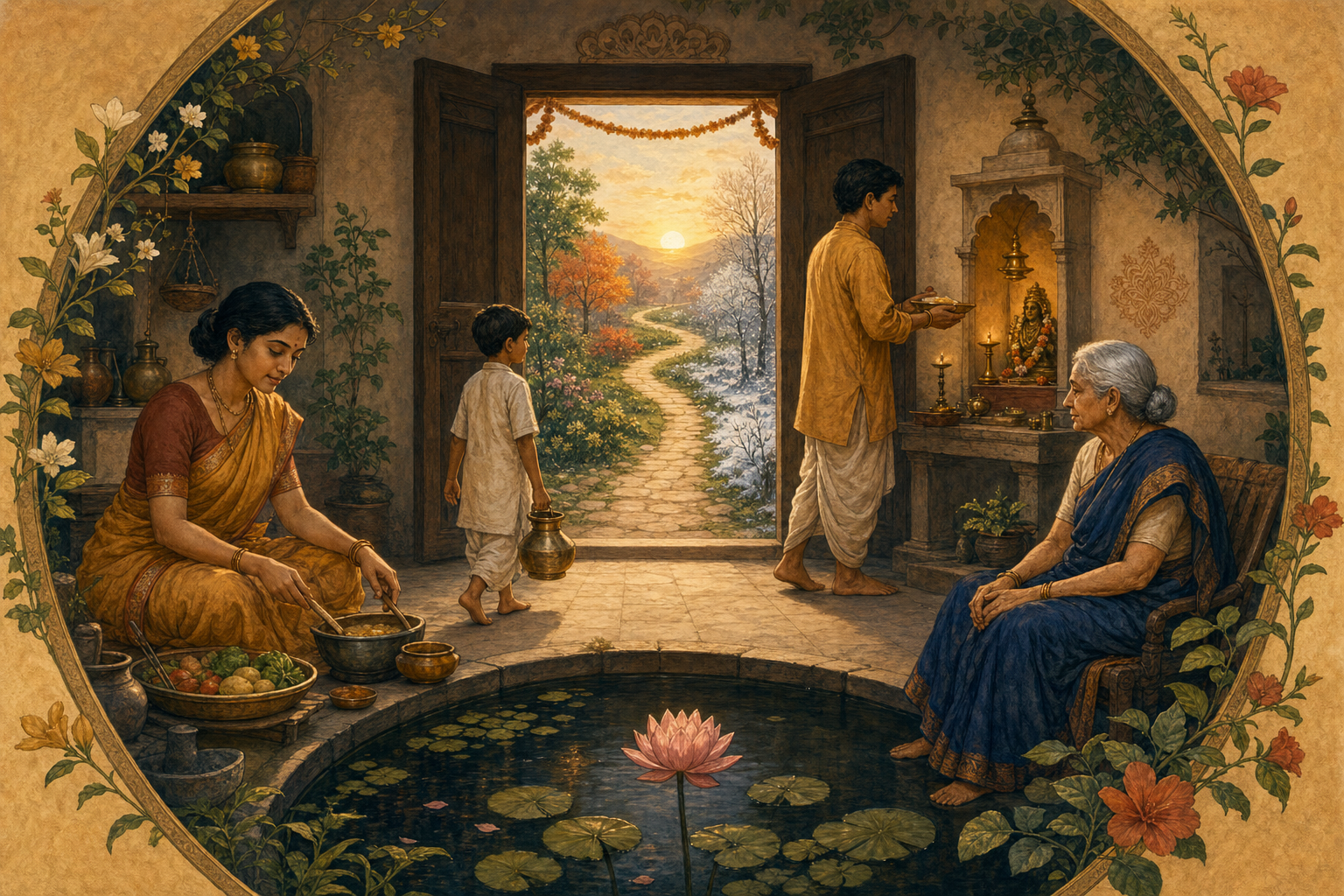
Three passages of the Śrīmad-Bhāgavatam approach spiritual bondage from sharply different directions: the obligations of a householder, the momentum of karma across repeated embodiment, and the body’s place within a larger cosmic order. Read together, they show how ordinary life becomes spiritually consequential through the way people earn, consume, care, desire, remember, and respond to mortality.
The resulting vision is neither world-denying nor complacent about attachment. The body is temporary but meaningful, the home is necessary but not an absolute possession, and action is unavoidable but need not remain self-binding. The central question is therefore not whether embodied household life is spiritual, but what orientation its repeated actions produce.
Key takeaways
- Karma is presented as a feedback loop in which desire shapes action, action creates consequences and tendencies, and those tendencies influence subsequent choices.
- Household dharma does not eliminate work, wealth, affection, or responsibility; it redirects them from private entitlement toward offering, service, restraint, and care.
- The body’s dependence on plants, water, vital functions, and ecological systems challenges the illusion that embodied life is autonomous.
- Detachment means freedom from possessiveness and compulsion, not indifference toward spouses, children, guests, dependents, animals, or the body itself.
Karma becomes bondage through repeated orientation
The source article on Śrīmad-Bhāgavatam 11.3.7 reports that the embodied being travels through conditions produced by previous action and remains subject to repeated creation and dissolution. Its discussion of the term karma-gatīḥ emphasizes not only visible consequences but also the destinations, dispositions, and future circumstances associated with intentional activity. Karma, in this account, is both moral continuity and psychological conditioning.
This helps explain why bondage can coexist with apparent choice. A person may initially choose an ambition, pleasure, possession, or identity, yet repetition can turn that choice into a governing habit. Desire prompts action; action leaves a consequence and an impression; the resulting conditioning generates further desire. The article’s treatment of avaśaḥ, or helplessness, does not erase responsibility. It describes the reduced freedom of someone increasingly governed by earlier choices and material identification.
The verse’s cosmic horizon places this process under time. According to the source’s reading, bodies, social arrangements, planets, and even the manifested cosmos are subject to change and dissolution. Impermanence is not offered as a reason to neglect temporary things. It is a warning against asking them to provide permanent identity or final security.
That distinction is essential for understanding freedom in the Bhāgavatam. Freedom is not simply a larger selection of impulses to follow, nor is it produced by action performed for egoic results. The Eleventh Canto article instead presents discernment, devotion, remembrance, hearing, chanting, service, and association with sādhus as ways to redirect consciousness. The aim is not merely to improve the next consequence within the karmic chain, but to change the orientation that keeps producing the chain.
The household makes the karmic mechanism visible
The article on Canto 7, Chapter 14 approaches the same problem through social life. It reports that Yudhiṣṭhira asks Nārada how someone living at home, amid livelihood, property, relatives, guests, ancestors, and ritual duties, can advance toward liberation. Nārada’s answer, as presented by the source, does not treat the household as a spiritual concession. It makes the home a demanding arena in which attachment and service are tested every day.
The decisive shift is from ownership to stewardship. The householder works and maintains dependents, but the fruits of work are offered to Kṛṣṇa, or Vāsudeva, instead of being regarded as an exclusively private entitlement. Food, wealth, land, knowledge, and time are consequently understood as entrusted resources. This changes the moral meaning of household activity without pretending that earning, feeding, planning, and caring can simply cease.
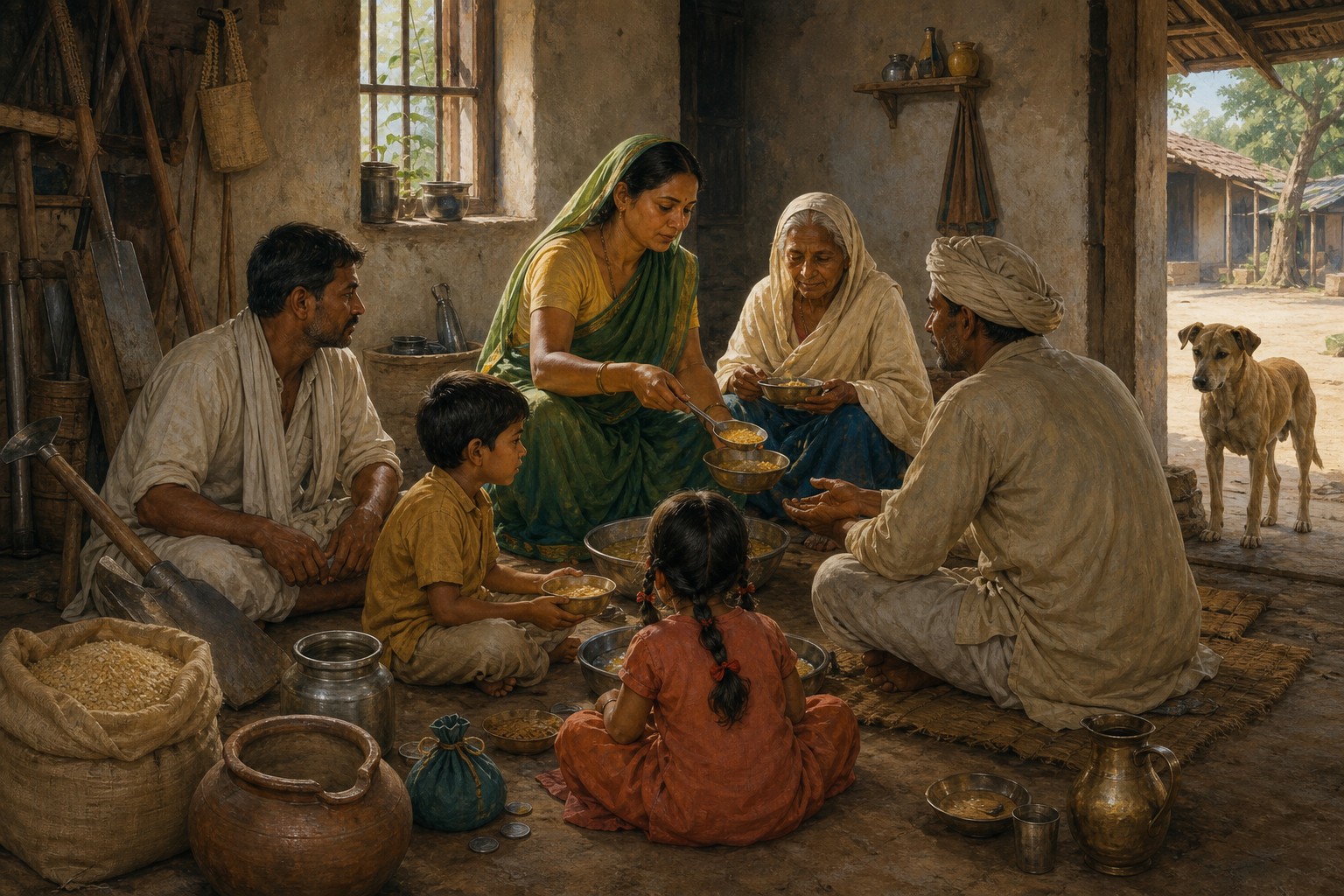
The source describes a concrete social expression of that orientation: sanctified food is shared, guests and vulnerable people are supported according to capacity, dependents are protected, and animals are not treated as disposable. It also discusses five daily forms of sacrifice directed toward the Supreme, sages, ancestors, living beings, and human society. These practices train the household to receive life with gratitude and then allow its resources to circulate beyond the narrowest definition of family interest.
Detachment in this setting cannot mean abandonment. The Canto 7 article presents the ideal householder as outwardly responsible and affectionate while inwardly refusing to make spouse, status, property, or consumption the final basis of identity. Its criticism of intense marital attachment is therefore best read as a criticism of possessive obsession. Marriage can support discipline, hospitality, and devotion when neither partner is reduced to an object of ownership.
The warning against ugra-karma sharpens this principle. Work becomes spiritually disproportionate when aggressive ambition, excessive strain, or the pursuit of prestige consumes the time and attention needed for worship, study, generosity, and self-knowledge. The issue is not whether householders should work, but whether work serves a measured life or builds a machinery of desire that its participants can no longer govern.
Embodiment joins sacred order to biological limitation
The article on Śrīmad-Bhāgavatam 3.26.56-57 supplies the cosmological dimension. In its account of Lord Kapila’s theological Sāṅkhya, the virāṭ-puruṣa connects bodily organs and functions with elements, natural life, presiding powers, generation, elimination, and death. The reported sequence moves through skin, hair, herbs and medicinal plants, generative power, water, the organ of evacuation, apāna, and mṛtyu. Sacred cosmology thus includes processes that spiritual discourse might otherwise sentimentalize or avoid.
This presentation makes the body relational rather than self-contained. Skin depends on a world of contact; health depends partly on plants; bodily continuity depends on water and generative processes; digestion requires elimination; vitality remains exposed to decline and death. The source interprets this arrangement through the relationship between the bodily microcosm and the cosmic macrocosm. Matter is not portrayed as an accidental collection of parts, but as an intelligible and ordered field connected to Supreme Consciousness.
The treatment of reproductive energy also complements the household teaching. The Third Canto article does not portray generation as intrinsically impure or family life as inherently hostile to spiritual practice. It presents generative power as inseparable from responsibility. Desire becomes binding when it grows compulsive and defines identity through bodily gratification; disciplined desire can instead coexist with service, learning, clarity, and care.
The ecological implications become clearer when the Third and Seventh Canto discussions are placed together. The embodiment article emphasizes dependence on herbs, medicinal plants, and water, while the household article describes natural resources as provisions intended for the maintenance of living beings rather than unlimited appropriation. Bodily dependence therefore supplies a basis for humility: the person who eats, heals, reproduces, and breathes does so through systems that cannot honestly be regarded as private creations.
Across all three source articles, impermanence is distinguished from contempt. The body returns to material conditions and remains subject to death, but it can serve dharma. The household can dissolve and its relationships cannot provide eternal identity, but it can sustain devotion and compassion. The world is unstable, but responsible action within it still shapes consciousness. Temporary existence matters precisely because it is the present field of moral and spiritual choice.
A fourfold test for action within ordinary life
Read as a unified teaching, the passages suggest four questions for distinguishing duty from entanglement: What motivates an action? What measure does it observe? Whom does it serve? What residue does it leave in consciousness? This is an interpretive framework drawn from the convergence of the sources rather than a separate formula stated in any one passage.
Motivation reveals whether an act arises mainly from responsibility and devotion or from the demand to possess and control. Measure asks whether earning, consumption, pleasure, and social obligation remain proportionate or have expanded into ugra-karma. The question of service widens the circle of concern from the individual consumer to family, guests, vulnerable people, animals, ancestors, teachers, and the sacred. Residue examines whether repetition produces gratitude and steadiness or anxiety, dependency, and further craving.
This test also prevents detachment from becoming an excuse for negligence. Feeding a dependent, caring for the body, earning a livelihood, conserving resources, and honoring a spouse can all be dharmic actions. The karmic danger lies less in their ordinary appearance than in the possessive consciousness, excess, or compulsion that may govern them. Conversely, an outwardly religious act can remain binding when it is performed principally for status, control, or reward.
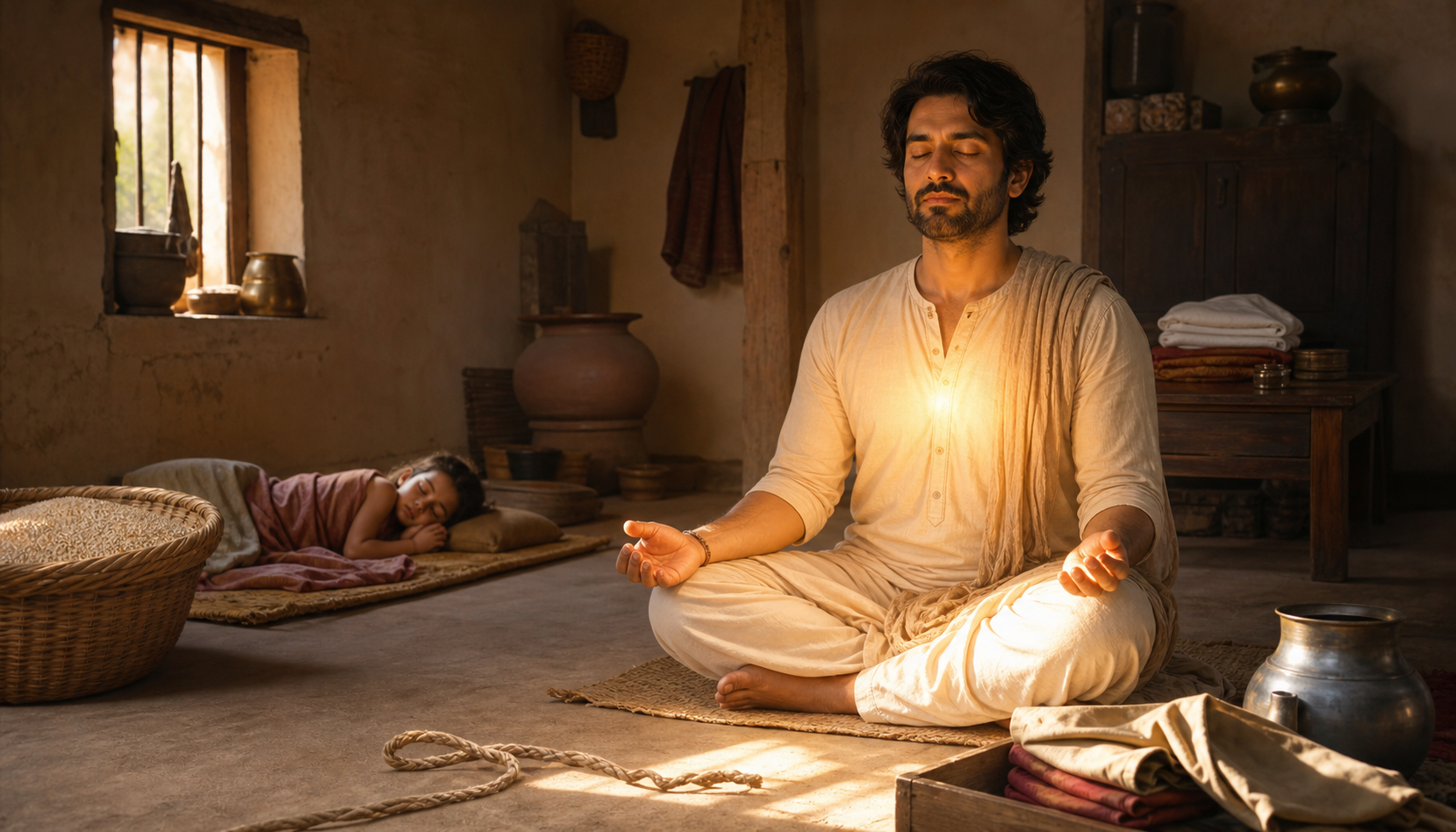
The practices emphasized in the sources address that inner orientation through repeated structure: hearing sacred accounts in good association, offering food before consumption, sharing according to capacity, simplifying unnecessary demands, restraining desire, and remembering mortality without despising the body. Their cumulative purpose is to interrupt unconscious repetition and make everyday action deliberate, grateful, and God-centered.
As work, consumption, and distraction acquire new forms, the Bhāgavatam’s challenge remains practical: the future of household spirituality will depend on whether homes can turn embodied necessity into conscious service before habit turns it into another form of helplessness.

References
- DharmaRenaissance Blog – Ideal Family Life in Srimad Bhagavatam: Powerful Dharma for the Modern Home
- DharmaRenaissance Blog – Powerful Lessons from Śrīmad-Bhāgavatam 11.3.7 on Karma, Time, and Freedom
- DharmaRenaissance Blog – Powerful Lessons from Śrīmad Bhāgavatam 3.26.56-57 on Body, Prāṇa and Death