
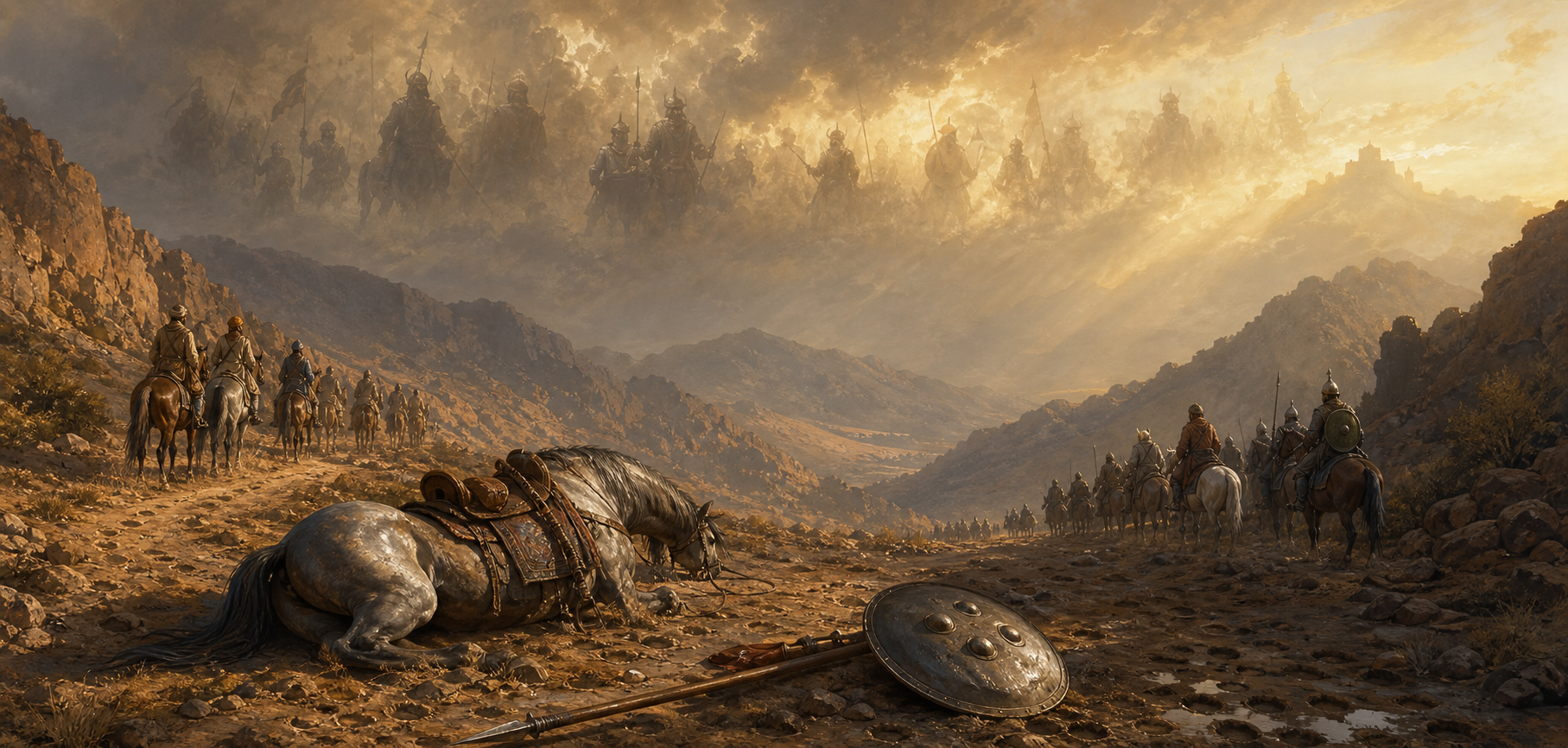
A battlefield produces an immediate result, but societies remember more than the disposition of armies. They also judge the purpose for which force was used, the obligations that shaped participation, and the meaning later generations attach to victory, resistance, and loss.
Two markedly different narratives illuminate this distinction. The first source examines the Battle of Haldighati as a historical contest between Mughal imperial power and Mewar’s defence of autonomy. The second turns to the Abhishahas, a briefly mentioned warrior group in the Kaurava host of the Mahabharata. Read together, they show how dharma complicates the military scoreboard and how historical memory preserves both exemplary individuals and nearly forgotten communities.
The four verdicts concealed within a battle
Military, political, ethical, and mnemonic judgments answer different questions. A military judgment asks who controlled the field. A political judgment considers whether that result produced durable authority. An ethical judgment examines the ends pursued and the conduct accepted. A mnemonic judgment asks whose actions a community later treats as worthy of remembrance. Confusion follows when success in the first category is assumed to settle the other three.
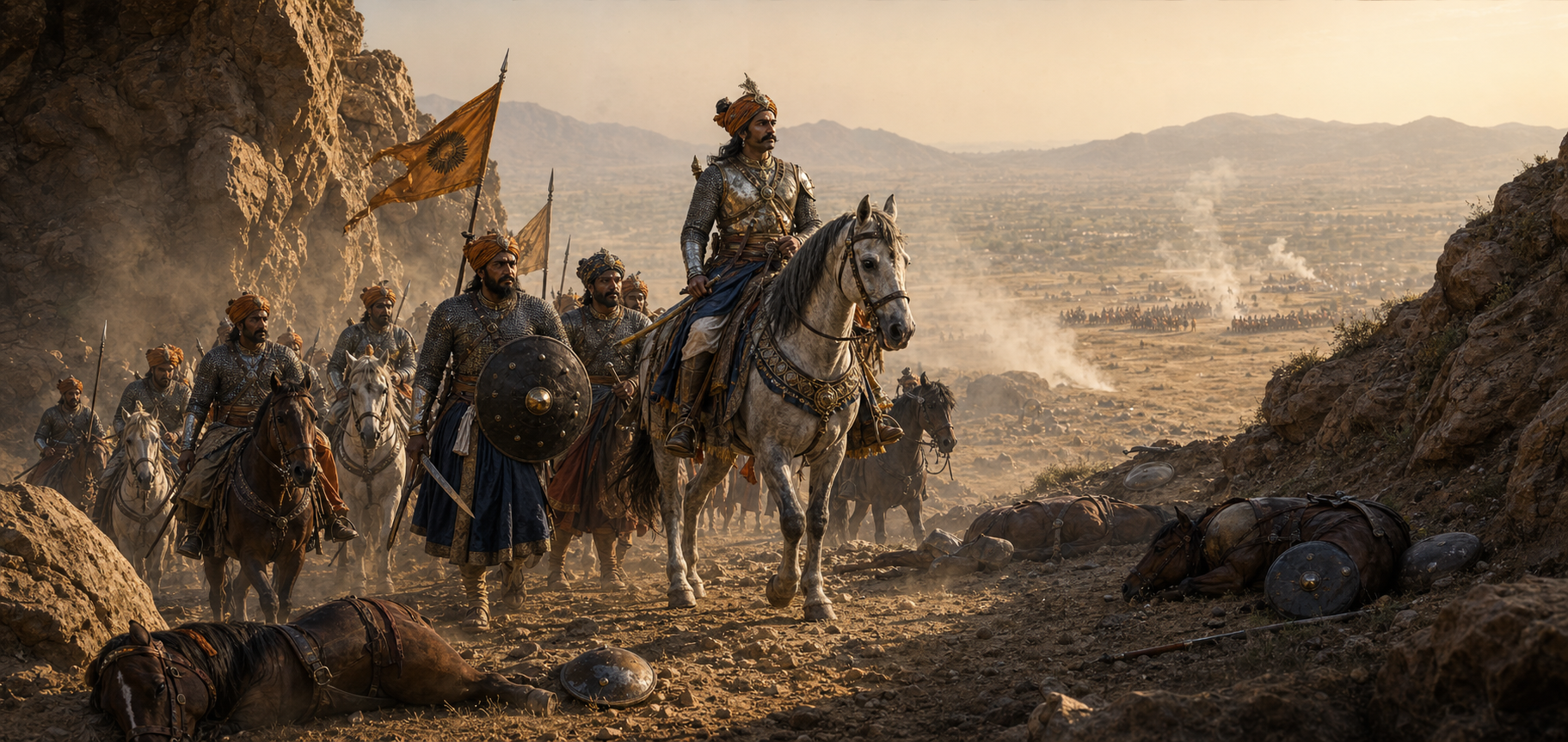
The Haldighati source reports that the Mughal army sent under Akbar’s authority held the field in the 1576 confrontation, while Maharana Pratap became the more enduring symbol of sovereignty and refusal to submit. Its argument is not that tactical facts should be reversed. Rather, battlefield possession and civilizational legitimacy can diverge. An imperial formation may be administratively capable, politically adaptive, and supported by local allies without thereby making resistance to its hierarchy meaningless.
The Abhishahas source approaches the same separation from another direction. It presents the Kaurava host as a large, organized confederation supported by clans, regional forces, command hierarchies, and battlefield formations. Yet military organization did not resolve the epic’s underlying moral crisis. The source places the Abhishahas within a political order it describes as shadowed by adharma, illustrating how competence and courage can serve an ethically compromised cause.
The two cases therefore resist opposite simplifications. Defeat does not automatically discredit a principled stand, but participation on the morally troubled side does not automatically prove that every warrior lacked virtue. Dharma requires judgment at more than one level: the cause, the decision-maker, the institution, and the individual obligation may not carry identical moral weight.
Dharma tests loyalty rather than abolishing it
Both sources treat loyalty as important but insufficient. The Haldighati article frames Maharana Pratap’s resistance through rajadharma and kshatra dharma, emphasizing strength joined to responsibility, restraint, and fidelity to an order higher than political convenience. In that account, accepting imperial suzerainty was not merely a practical adjustment; it implicated the meaning of sovereignty itself.
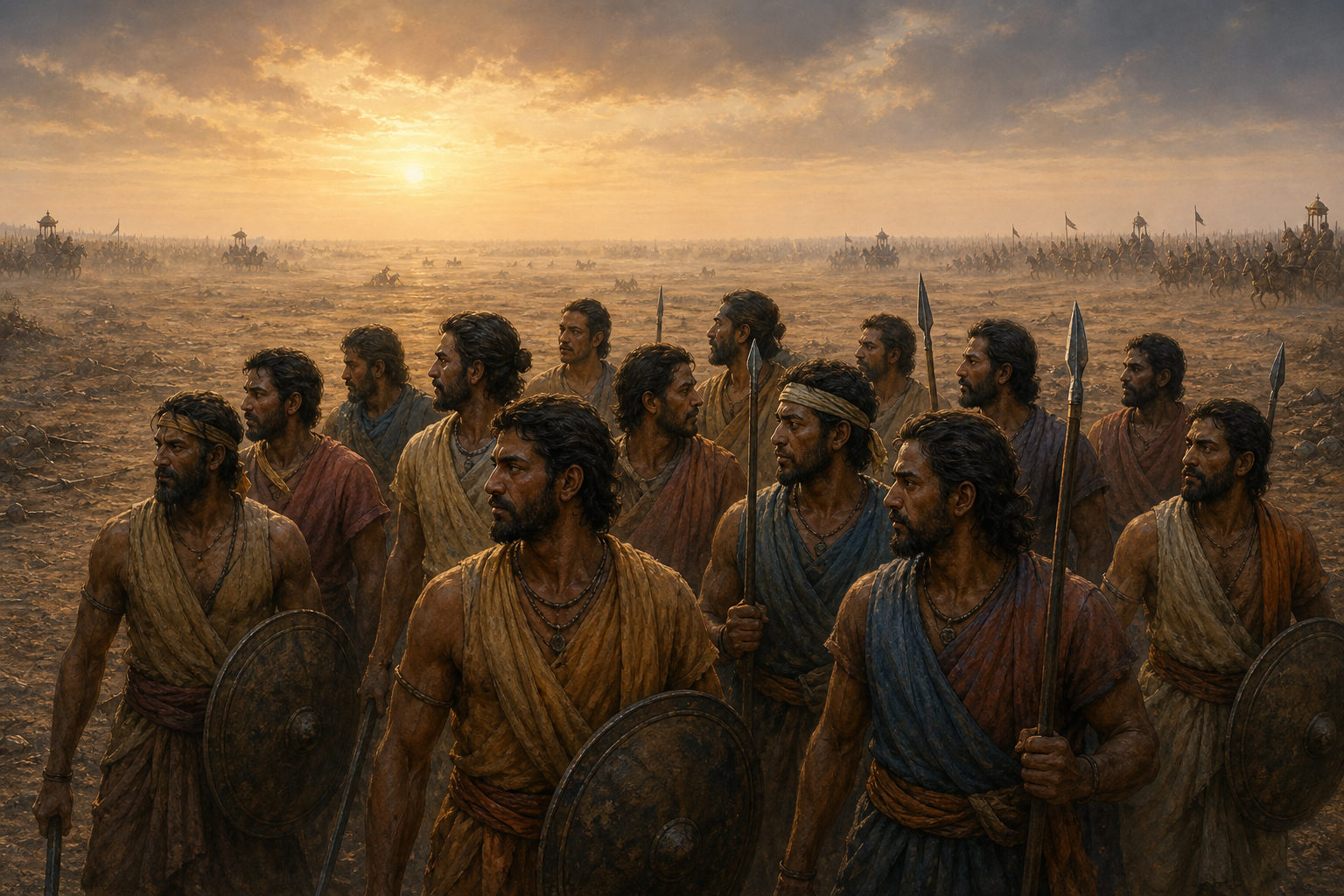
The Mahabharata article presents a more tragic landscape of allegiance. It notes that prominent Kaurava commanders were attached to the throne, their vows, royal service, friendship, gratitude, or personal honor. The lesser-known Abhishahas belonged to this wider network of political and military obligation. Their presence discourages the easy assumption that an army consists only of autonomous individuals who have each freely endorsed every action of its ruler.
Yet complexity is not the same as moral neutrality. The Abhishahas source argues that martial skill can be misdirected when political loyalty is detached from dharma. The Haldighati source likewise cautions that successful incorporation of elites does not, by itself, transform imperial expansion into consensual nation-building. In both treatments, a bond of service can explain conduct without fully vindicating it.
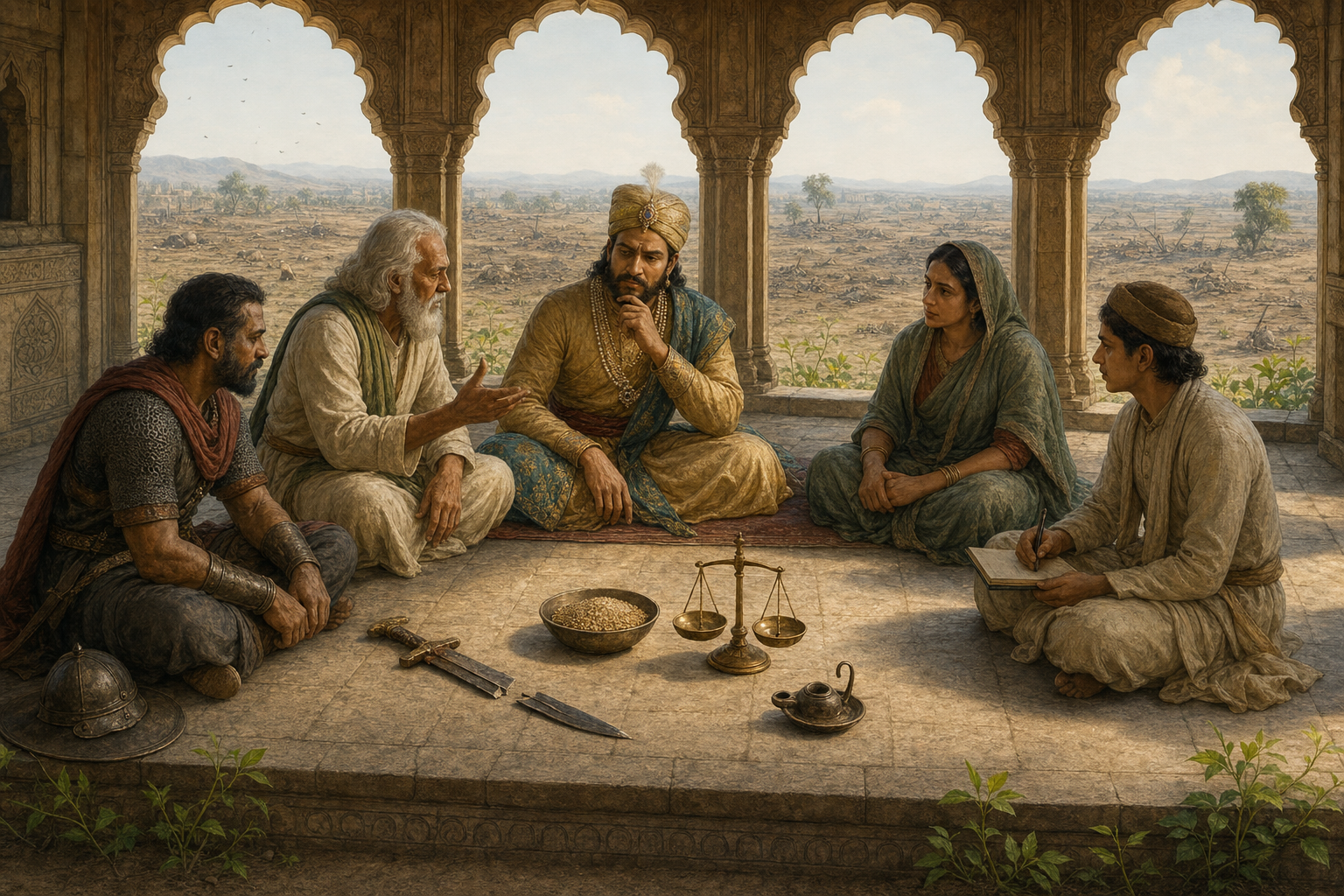
This produces a demanding ethical standard. Loyalty retains value because public life depends on trust, duty, and the honoring of commitments. But loyalty becomes dangerous when it prevents judgment of the order being served. Dharma, as used across these sources, is therefore neither a celebration of obedience nor a license for indiscriminate rebellion. It is a discipline for asking whether power, duty, means, and ends remain rightly aligned.
Why memory creates icons and leaves silhouettes
Maharana Pratap and the Abhishahas occupy opposite ends of historical visibility. According to the Haldighati article, Maharana Pratap’s refusal to surrender became part of a durable vocabulary of courage, sacrifice, and autonomy. His memory concentrates a broad political principle in a recognizable individual. The Abhishahas, by contrast, survive in the second source as a collective name with little securely recoverable biography.
This contrast reveals two functions of memory. Exemplary memory selects a person whose conduct can embody an ideal. Archival memory preserves fragments – a clan name, an alliance, a position in a host – that prevent large events from being reduced to their celebrated commanders. The first supplies moral orientation; the second restores social scale.
The Abhishahas source is especially careful about the limits of that restoration. It identifies them as a warrior group associated with the sons of Dhritarashtra but warns against inventing unsupported rulers, territories, genealogies, or episodes. Even its discussion of the name’s possible martial meaning is presented cautiously. Their obscurity is not an invitation to manufacture a fuller story; it is evidence of how unevenly epic tradition preserves the people drawn into war.
The comparison also requires attention to genre. Haldighati is discussed as a historical confrontation whose military and political interpretations remain contested. The Abhishahas appear within an epic narrative that carries literary, ethical, and possible social memories of clan-based warfare. Treating these sources as identical kinds of evidence would weaken the synthesis. Their value lies instead in the shared question they raise: what does a civilization choose to carry forward from conflict?
A history made only of commanding figures mistakes fame for function. A history made only of formations and outcomes misses why some choices retain moral force. Responsible memory needs both scales: the person who gives an ideal a visible form and the unnamed or lightly recorded participants who reveal the human breadth of political decisions.
Responsible remembrance separates legitimacy from resentment
The Haldighati source extends its argument to modern conflict, including pressure on Iran, to distinguish the destruction of capabilities from the creation of legitimacy. Its broader claim is that technological superiority, coercion, or tactical success may fail to produce a stable political settlement. Pressure can also deepen grievance and strengthen a community’s narrative of resistance. This is presented as an analogy rather than proof that medieval and modern conflicts are institutionally identical.
The analogy clarifies why historical memory matters to statecraft. Humiliation may outlive military defeat, while disciplined resistance may accumulate symbolic authority. Durable governance consequently depends on more than coercive capacity: it requires some combination of consent, cultural recognition, ethical restraint, and a credible shared future. These are political conditions, not sentimental additions to strategy.
Memory can nevertheless become distorted in two directions. One distortion treats victory as retrospective moral proof, allowing effective administration or elite alliances to erase questions of sovereignty. The other turns admiration for resistance into collective hostility against people living centuries later. The Haldighati article explicitly rejects that second use, arguing that remembrance should strengthen civilizational confidence without reopening communal wounds.
The Abhishahas article adds an evidentiary safeguard. It asks readers to acknowledge the many participants in conflict while remaining honest about what the text does not disclose. Together, the sources support a public history that is ethically serious without becoming accusatory, and culturally rooted without substituting legend for evidence.
Key takeaways
- A tactical result establishes control of a field, not an automatic verdict on legitimacy, justice, or historical significance.
- Dharma makes loyalty answerable to a higher standard while recognizing that vows, gratitude, service, and political dependence complicate individual choices.
- Iconic figures preserve moral ideals, whereas fragmentary groups such as the Abhishahas reveal the collective human structure of warfare.
- Admiration for resistance requires evidentiary restraint: uncertainty should be preserved rather than filled with invented detail.
- Historical memory serves the future best when it supports self-respect, ethical statecraft, and social responsibility rather than inherited resentment.
Future accounts of conflict will be most useful when they record military outcomes accurately while continuing to ask the harder questions of dharma: what power served, what obligations it imposed, and what kind of political inheritance it left behind.
References
- DharmaRenaissance Blog – Haldighati to Iran: Powerful Lessons on Why Battlefield Victories Still Fail
- DharmaRenaissance Blog – Abhishahas of Kurukshetra: Forgotten Kaurava Warriors and Epic Lessons