
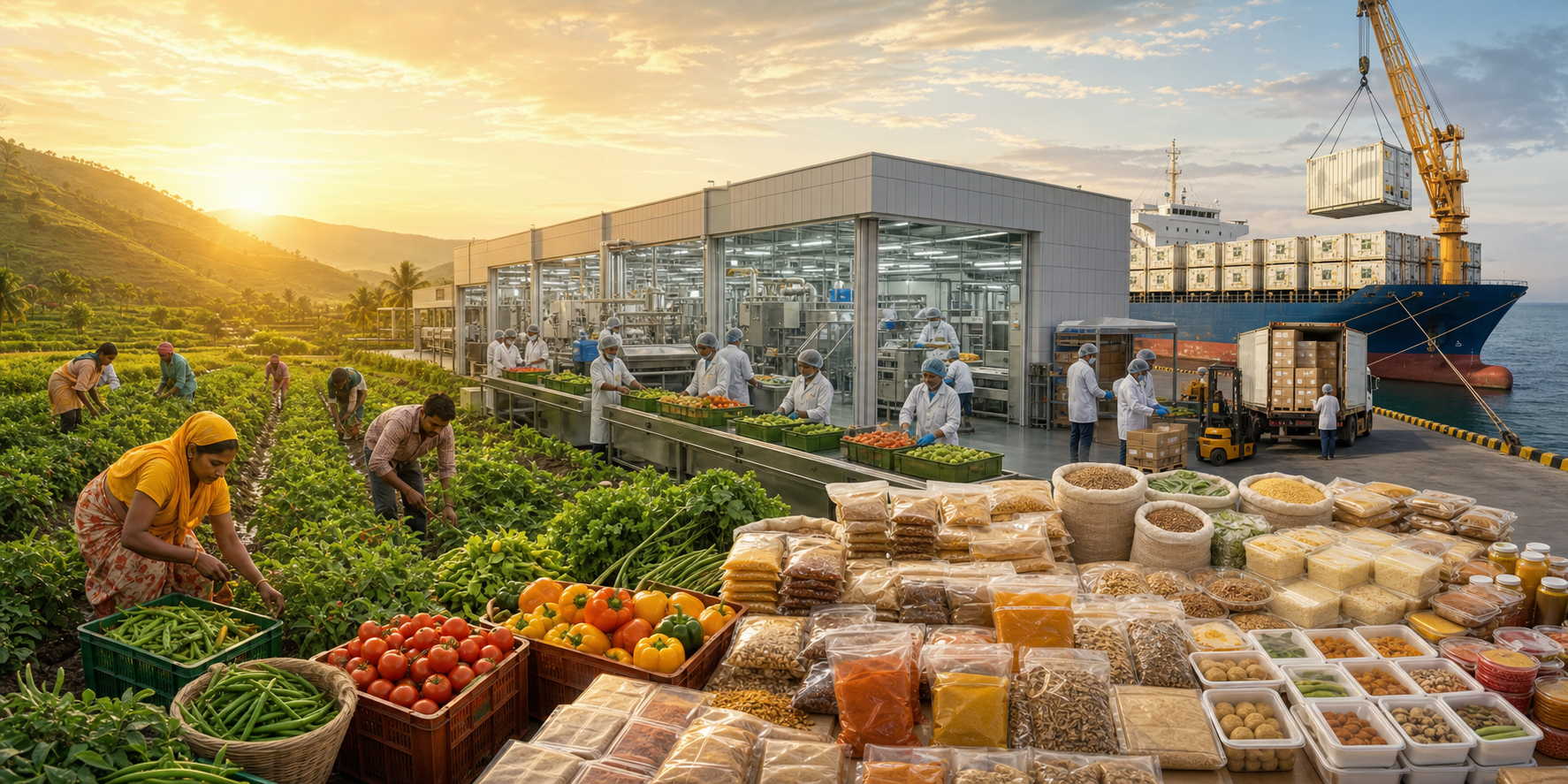
Bharat already exports food at scale. The strategic question is how much value can remain in the country as produce moves from the farm to an overseas consumer. Processing matters, but so do grading, testing, traceability, packaging, cold-chain reliability, branding and market access.
The available source connects these functions to rural incomes, export growth and geopolitical credibility. Read together, its figures and examples suggest that Bharat’s most consequential opportunity is not simply to ship more agricultural output. It is to build dependable value chains that can repeatedly deliver the form, quality and documentation that particular markets demand.
Key takeaways
- The source reports food exports of about USD 46 billion in 2024, alongside a food trade surplus of roughly USD 11 billion, but argues that this remains below Bharat’s productive potential.
- Value addition extends beyond factory processing: testing, grading, traceability, temperature control, packaging and branding all influence the value captured from an export sale.
- New product-market combinations reportedly contributed nearly USD 202 million in FY26, indicating that diversification can produce measurable gains even before it transforms the overall export total.
- State ambitions, including those described for Uttar Pradesh, will matter only if production targets are connected to post-harvest systems, processors and viable export corridors.
The export opportunity must be measured carefully
A useful strategy begins by distinguishing agricultural exports from food exports. Agricultural trade can include raw materials, live animals and products not intended for direct human consumption, while food exports form a narrower group that includes basic and processed items for consumers. The source reports that global agricultural trade exceeded an estimated USD 2 trillion in 2024 and separately places Bharat’s food exports at around USD 46 billion. Because those figures cover different categories, they should not be used to calculate a simple market share.
The comparisons are nevertheless instructive when kept within their stated context. The source places the United States and Brazil at approximately USD 181 billion and USD 144 billion in food exports respectively, and describes Bharat’s total as broadly comparable with Australia’s. Its argument is that leading exporters combine agricultural output with infrastructure, standards, commercial intelligence and coordinated policy. Production capacity is therefore a necessary foundation, not a sufficient export strategy.
That distinction is especially important for a country the source describes as a major producer of cereals, pulses, milk, fruits, vegetables, spices, fisheries products and plantation crops. Selling more raw output may increase volume, but value-added exports can retain income in activities such as cleaning, sorting, milling, preservation, formulation, packaging and distribution. They can also create a recognisable product rather than an interchangeable shipment.
Processing should not be treated as an automatic upgrade, however. Each additional stage adds costs, energy needs, quality risks and compliance obligations. It creates durable value when it improves shelf life, consistency, convenience, transport economics or consumer appeal enough to justify those costs. The practical objective is therefore the right degree of value addition for each product and destination, not processing for its own sake.
The wider export context raises the stakes. The source reports Bharat’s goods and services exports at about USD 0.86 trillion in 2025-26 and total international trade near USD 1.84 trillion, while noting a medium-term national aspiration of USD 2 trillion in exports. These are source-reported figures rather than independently verified numbers, but they frame the policy question clearly: agriculture and food can contribute more only if productive abundance is converted into consistently saleable international offerings.
Trust is the infrastructure behind value addition

An exportable food product is not completed at harvest. The source identifies storage losses, uneven grading, fragmented transport, limited cold-chain capacity and inconsistent phytosanitary compliance as constraints on value capture. It also points to residue levels, moisture control, packaging integrity, temperature management, documentation and traceability as factors that determine whether a shipment retains its quality and acceptance through delivery.
This changes the unit of strategy. The relevant output is not merely a tonne of grain, fruit, seafood or dairy product; it is a verified delivery that meets a buyer’s specification. A farm can produce excellent material and still fail to reach a premium market if aggregation mixes grades, storage alters quality, testing is delayed or records cannot identify the origin of a problem. Conversely, a reliable chain can make the same agricultural base more valuable without requiring every gain to come from a higher yield.
Standards should consequently be designed into production and procurement rather than inspected only at the port. Farmers need clear specifications before cultivation or harvest. Aggregators and farmer-producer organisations need systems that preserve identity and quality. Laboratories need credible procedures and useful turnaround times. Processors need dependable inputs, while logistics providers need handling protocols suited to the product. Export documentation must describe the same product that the physical chain actually delivers.
Branding sits at the end of this system, not in place of it. Attractive packaging may secure an initial trial, but repeat demand depends on uniformity, safety and predictable arrival. National reputation operates similarly: reliability across many firms and consignments can make Bharat a preferred sourcing partner, whereas repeated quality failures impose costs on compliant exporters as well as the responsible supplier.
Diversification should combine products, markets and risk

The source reports that new product-market combinations generated nearly USD 202 million in additional exports during FY26, with marine products, pulses and agri-processing among the contributors. It also says that the Agricultural and Processed Food Products Export Development Authority facilitated the first shipment of dried egg powder from Odisha to Austria. These examples are modest beside the reported national total, but they illustrate how export capacity can widen: a product is transformed into a more transportable form, matched with a destination and supported through market entry.
The phrase product-market combination is important. Diversification is not achieved merely by adding another crop to an export catalogue. A processor must know which formulation, pack size, certification, shelf life and price point a particular destination will accept. The same agricultural input may support several export propositions, but each proposition requires its own compliance and distribution logic.
A balanced portfolio can serve different functions. Bulk products provide scale but are often exposed to commodity pricing. Perishable produce may command higher prices but depends heavily on speed and temperature control. Shelf-stable processed foods can travel farther and support brands, although they require manufacturing consistency and market development. Marine, livestock and plant-based products also face different safety and traceability demands. Strategy should account for these differences instead of treating all food exports as one operational sector.
Diversification can also reduce concentration risk. The source notes exposure to price changes, policy restrictions, disease outbreaks, crop failures and shifts in consumer demand. Adding destinations without adding products may leave the export base vulnerable to a commodity shock; adding products without widening markets may leave it vulnerable to one country’s rules. Resilience comes from varying both dimensions while maintaining the ability to meet every contracted standard.
Regional ambitions need corridor-level execution
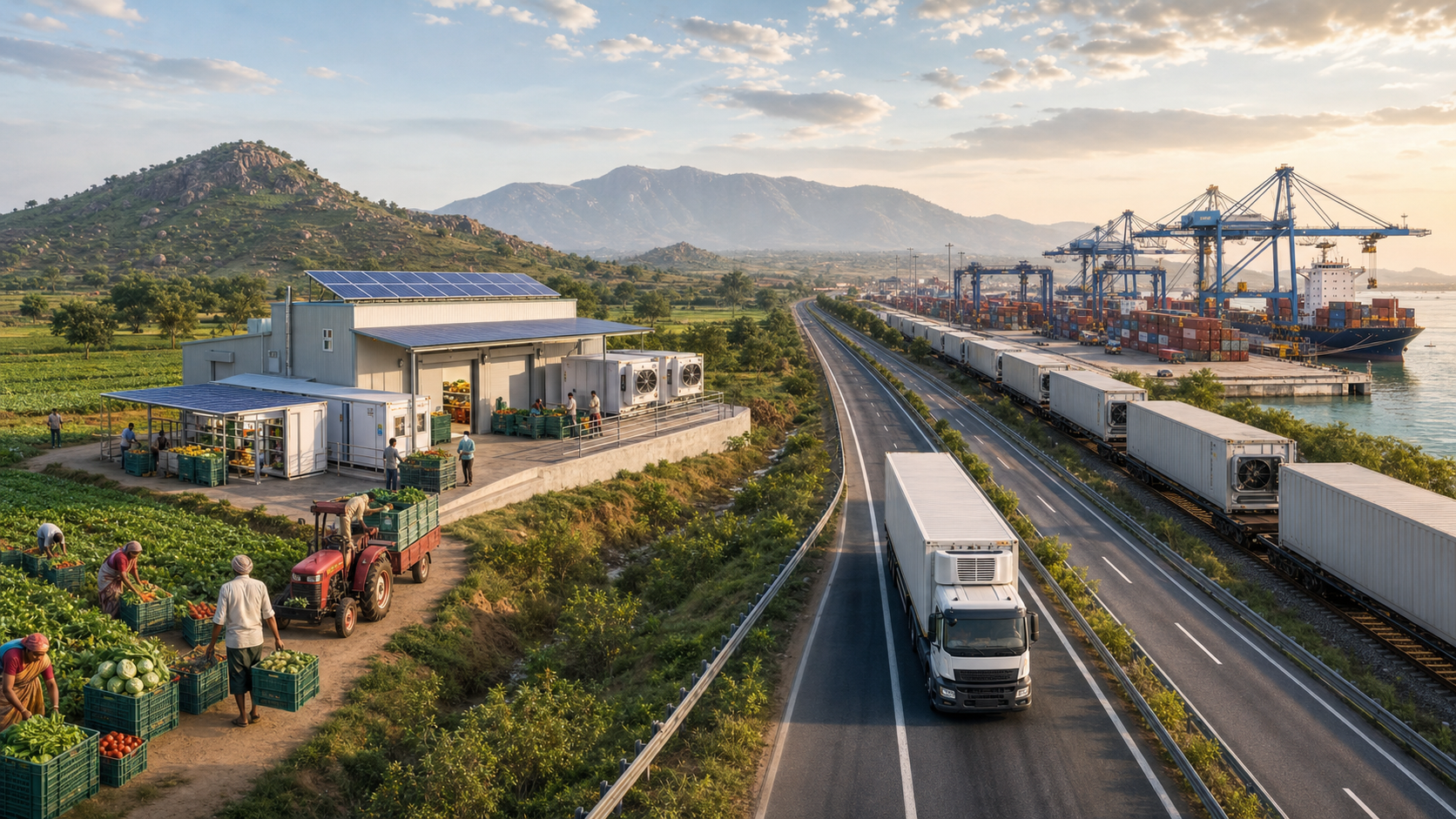
The source presents the Ganga River Valley as a region with large but incompletely realised agricultural potential and uses Uttar Pradesh to show the scale of possible state-level change. It reports that the state contains roughly 17 per cent of Bharat’s population and has announced goals involving smart farming, export-oriented agriculture, higher output of food grains, pulses and oilseeds, more organic farming, post-harvest losses below 4 per cent and cropping intensity above 250 per cent by 2047. It also reports an ambition to raise the state’s contribution to national agricultural exports beyond 15 per cent over the coming decades.
These targets are best understood as stated ambitions, not achieved outcomes. Their significance lies in the implementation questions they expose. Increased production will not necessarily create export income if processing capacity is too distant, testing is inaccessible, storage is unsuitable or transport schedules are unreliable. Likewise, a new processing facility will be underused if procurement cannot supply the required variety and grade in predictable quantities.
A corridor approach can connect these dependencies. Crop and livestock clusters can be mapped to aggregation points, laboratories, processors, cold stores, inland transport and ports or airports. Market intelligence can then work backwards from demand to farm practices and investment decisions. This makes public infrastructure, private processing and producer organisation parts of one commercial system rather than isolated schemes.
Performance should ultimately be judged by repeatable commercial outcomes: compliant consignments, lower avoidable losses, dependable delivery, sustained buyer relationships and a greater share of the final product’s value reaching Bharat’s producers and enterprises. If those outcomes become routine across regional corridors, production scale can support both branded consumer goods and trusted supply partnerships. That is the path by which food exports can become a durable source of rural prosperity and strategic credibility rather than a succession of exceptional shipments.