
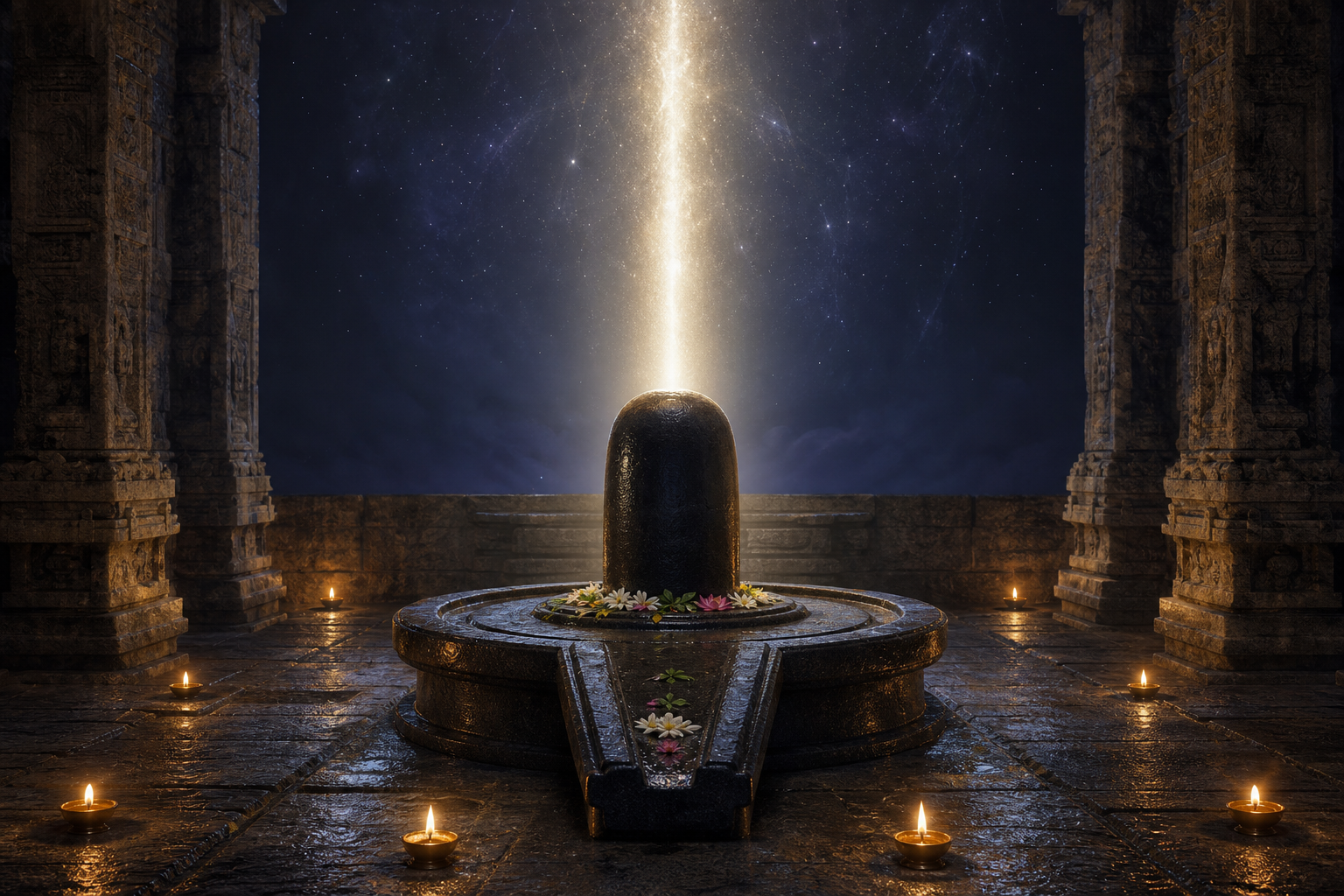
Arguments about the Shivalinga often begin with what its form appears to resemble. Shaiva philosophy asks a more demanding question: what range of meanings does the symbol hold together? An adequate interpretation must account not only for visual form, but also for language, sacred narrative, theology, ritual practice, and the inward experience of worship.
Read across those dimensions, the Shivalinga emerges as a sign of reality that exceeds representation. Generative power belongs within that meaning, but it does not exhaust it. The larger framework concerns infinity, consciousness, manifestation, disciplined desire, dissolution, and liberation.
From visible form to the immeasurable axis
A foundational clue lies in the word linga. DharmaRenaissance’s earlier treatment explains that the Sanskrit term can mean a mark, sign, token, characteristic, or indicator. The Shivalinga therefore functions as something that directs attention beyond itself. Its visible form makes contemplation possible while its simplicity resists the suggestion that the divine can be captured in a human portrait.
This is the significance of calling the Shivalinga an aniconic symbol. It represents Shiva without depicting a face, costume, weapon, posture, or episode from a biography. An iconic image identifies through recognizable attributes; the linga works differently, concentrating attention on presence without pretending that presence has been fully described.
The same source connects this logic of indication with the Lingodbhava narrative, in which Shiva appears as a pillar of light whose limits Brahma and Vishnu cannot discover. The story shifts interpretation away from anatomy and toward immeasurability. The vertical form becomes a cosmic axis between manifest and unmanifest reality, while the failure to locate its beginning or end expresses the inadequacy of finite categories before the Absolute.
The contrast between these readings is therefore methodological. A reductive interpretation asks what the object resembles in isolation. A Shaiva interpretation asks what the form indicates within the network of stories, concepts, and practices that gives it religious meaning. Visual resemblance may contribute an association, but it cannot by itself explain the symbol’s full theological role.
Shiva’s paradoxes widen the meaning of creation

Shiva’s identities make a single-function interpretation difficult to sustain. The source presents him as Mahayogi, the ascetic absorbed in stillness, but also as the husband of Parvati and the center of a divine family. He is associated with silence and dance, wilderness and temple worship, fierceness and compassion. These are not incidental additions to a fertility deity; together they depict a reality capable of embracing apparently opposed modes of existence.
The account of Shiva burning Kama when desire interrupts his meditation is especially revealing. Its philosophical force lies not in hostility to life, but in mastery over compulsion. Desire is not allowed to rule consciousness; it is redirected into awareness, austerity, and spiritual energy. Shiva’s household dimension then prevents ascetic mastery from becoming a rejection of relationship or embodied existence. Renunciation and participation are held in a creative tension.
This tension also clarifies Shiva’s association with dissolution. The earlier essay situates creation within a broader rhythm of manifestation, preservation, withdrawal, concealment, and grace. On that account, dissolution is not merely destruction. It is the removal or transformation of a form that has reached its limit, including the forms of ignorance and attachment that obstruct liberation.
The Shiva-Shakti relationship extends the argument from mythology into ontology. As the source explains, non-dual Shaiva traditions such as Kashmir Shaivism understand Shiva as pure consciousness and Shakti as the power through which consciousness manifests. Their unity describes the inseparability of awareness and its capacity for expression. Biological generation can belong within that field, but so can perception, thought, movement, knowledge, devotion, and spiritual awakening.
Fertility is thus neither treated as shameful nor installed as the master key to the symbol. It becomes one expression of a far more comprehensive creativity: consciousness revealing forms, sustaining experience, withdrawing appearances, and making liberation possible. The philosophical error in a fertility-only account is not that it notices generativity, but that it mistakes one consequence of manifestation for the principle encompassing the whole.
Abhishekam turns metaphysics into a lived discipline

Temple practice supplies another test of interpretation. The source describes the Shivalinga as an object installed, consecrated, bathed, adorned, and worshipped within Agamic ritual systems. Abhishekam may involve water, milk, curd, honey, or ghee, while bilva leaves, sandal paste, and sacred ash also appear in worship. These materials are presented as offerings associated with purification, cooling, surrender, and inner alignment rather than with one narrowly biological purpose.
The repeated flow of water gives philosophical teaching a bodily form. As the earlier essay interprets it, the offering can represent the mind being continuously surrendered to the divine. The devotee does not merely study the claim that ego and identity are impermanent; the ritual rehearses release through gesture, repetition, and attention.
The essay also describes the contemplative environment surrounding Shiva worship: the bell, mantra, stone, bilva leaves, and sacred water draw attention inward. A worshipper may approach with grief, confusion, exhaustion, ambition, or longing. The unadorned form does not mirror those passing identities back to the worshipper. It offers a stable center before which they can be acknowledged and relinquished.
Ritual and philosophy therefore interpret each other. The philosophical language of formless consciousness explains why the image avoids portraiture, while the ritual makes an abstract teaching available to the senses. The linga is concrete enough to receive an offering yet open enough to signify what cannot be confined to an object.
Key takeaways
- Linga means a sign or indicator, so the Shivalinga should be read by asking what it discloses rather than only what it resembles.
- The Lingodbhava pillar of light frames the symbol as an axis of infinity whose beginning and end cannot be measured.
- Shiva’s ascetic, familial, dissolving, and compassionate dimensions prevent his theology from being reduced to a single generative function.
- Shiva-Shakti philosophy and Abhishekam connect consciousness, manifestation, surrender, and inner transformation in doctrine and practice.
Four tests for a responsible interpretation

Any interpretation of the Shivalinga can be assessed through four forms of coherence. The semantic test asks whether it respects the meaning of linga as an indicator. The narrative test asks whether it can explain the immeasurable pillar of light and Shiva’s mastery of desire. The philosophical test asks whether it accommodates consciousness, Shakti, dissolution, and liberation. The ritual test asks whether it makes sense of consecration, Abhishekam, contemplation, and surrender.
A fertility-only reading has limited explanatory reach under these tests. It may recognize a possible visual or generative association, but it leaves most of the Shaiva system unexplained. A layered reading is more adequate because it can include sacred creativity without reducing cosmic manifestation, yogic discipline, or liberating knowledge to reproduction.
Responsible interpretation does not require erasing the body or denying the sanctity of life. It requires placing bodily symbolism within the wider world of meaning established by the tradition itself. Future discussion of the Shivalinga will become more illuminating when language, narrative, philosophy, and worship are allowed to converge around the symbol rather than being displaced by a single external analogy.