
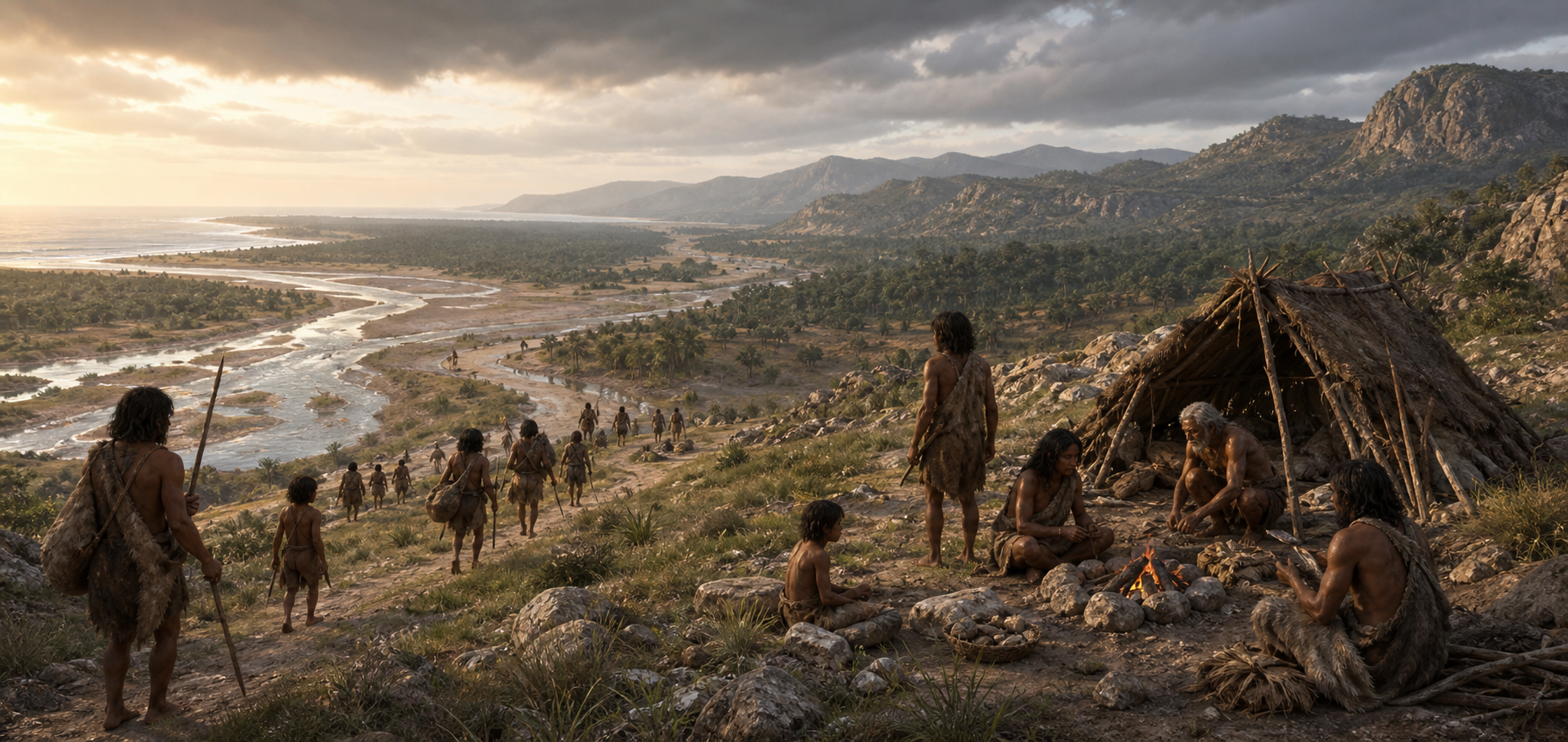
Bharat’s place in early human migrations cannot be understood by treating a single genetic lineage, language family or archaeological site as a complete history. The supplied DharmaRenaissance Blog article brings several kinds of evidence into the discussion: maternal and paternal lineages, genome-wide ancestry, ancient DNA from Rakhigarhi, archaeological continuity and the colonial construction of racial categories.
Read together, these strands present the subcontinent as an important corridor, settlement zone and region of diversification in the early history of non-African populations. They also support a necessary distinction: evidence of population movement and mixture is not, by itself, evidence of a conquering race that created Indian civilization.
A corridor became a long-term home
The source reports that South Asia contains substantial maternal diversity associated with macro-haplogroup M and its numerous branches. It presents this diversity as support for Bharat’s major role in early dispersals following the movement of humans out of Africa. In this account, the subcontinent was not simply a destination reached after the principal stages of migration had ended. It was one of the landscapes in which populations settled, adapted and diversified.
The article also discusses ancient paternal lineages, including markers within the C clade and the widely debated R1a lineage. These observations reinforce the importance of long population histories within the subcontinent, but they require disciplined interpretation. Genetic diversity in a region may reflect a lengthy presence, local branching, repeated contacts or some combination of these processes. It does not automatically identify the birthplace of a lineage, establish the direction of every migration or disclose the language and culture of its carriers.
This distinction changes the central question. Rather than asking whether Bharat was isolated or populated through one decisive arrival, the evidence invites study of how a geographically varied region became both a passage and a home across long periods. Deep continuity and later interaction can coexist within the same population history.
Different evidence answers different questions
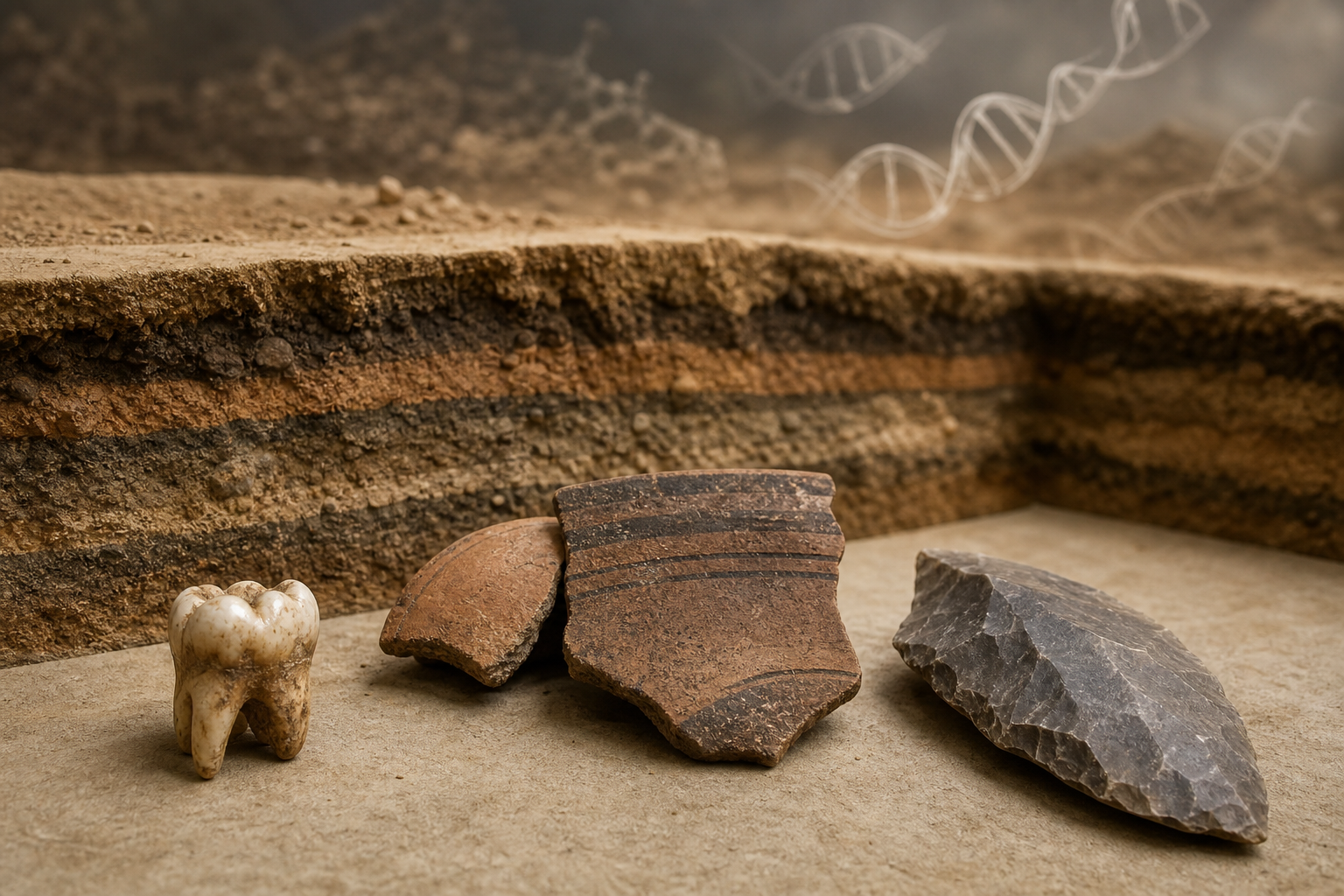
Mitochondrial DNA traces maternal lines, while Y-chromosome evidence follows paternal lines. Autosomal studies examine ancestry distributed across the wider genome and can reveal mixture that a single maternal or paternal branch cannot represent. The source treats these methods as complementary rather than interchangeable: each illuminates a different part of demographic history.
Ancient DNA adds a further layer because it associates genetic evidence with a particular ancient individual and archaeological setting. Yet one sampled person cannot stand for an entire city, cultural sphere or subcontinent. Ancient genomes are most informative when their geographic location, archaeological context and limits of representation remain visible.
Archaeology tests a different proposition. If a theory proposes abrupt civilizational replacement, researchers would look for corresponding changes such as widespread destruction, sharply altered settlement patterns, or sudden replacement of material and burial practices. According to the source, evidence around the Harappan and post-Harappan periods records substantial change and regional complexity but does not yield a simple picture of wholesale replacement by invaders.
Genetics can therefore reconstruct relationships and mixture, while archaeology can assess the material scale and character of cultural change. Neither field, on its own, can assign a genome a sacred tradition, turn a language into a biological population or reduce a civilization to one ancestral component.
Rakhigarhi and the model of layered ancestry
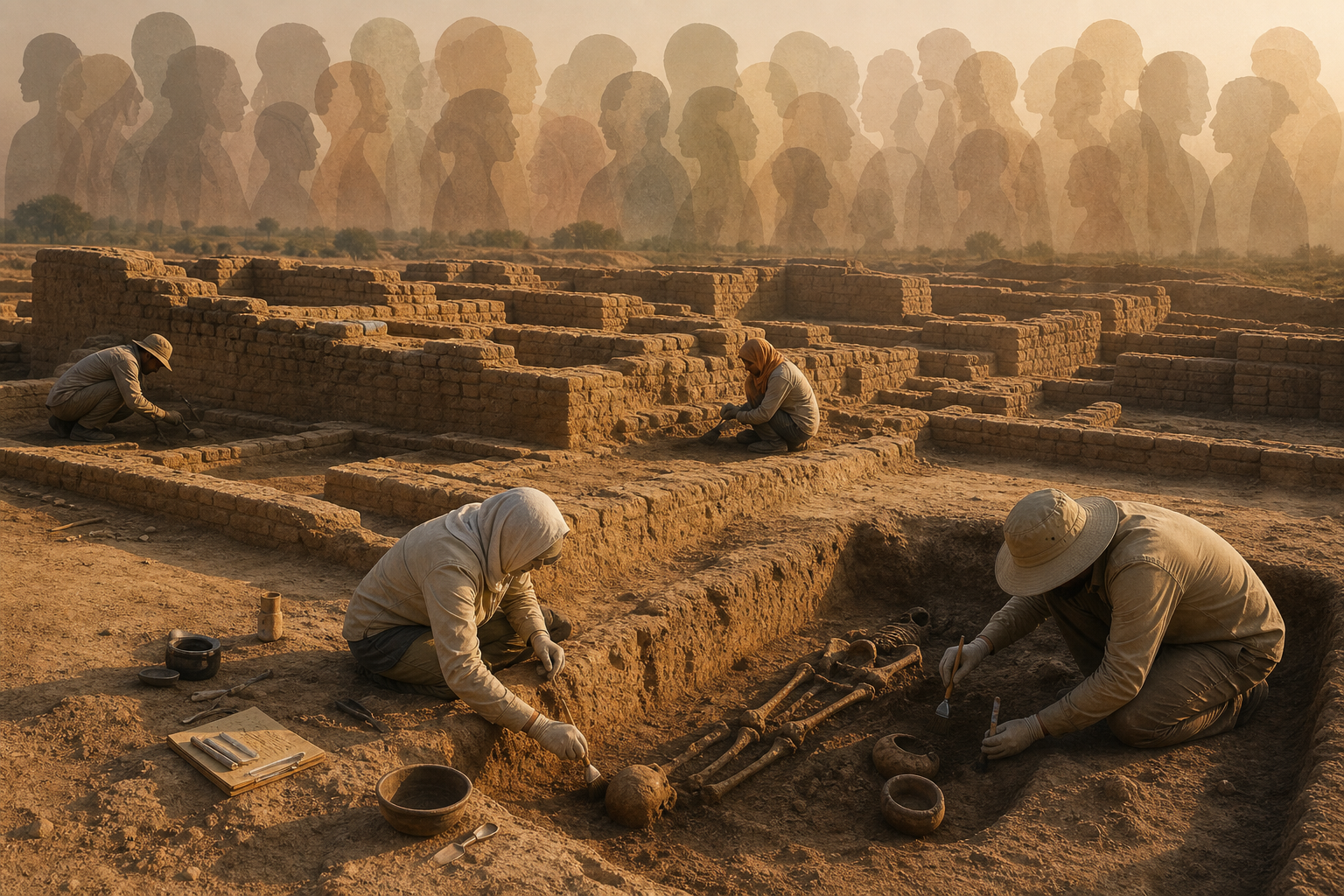
The article reports that a 2019 genome studied from Rakhigarhi lacked both steppe pastoralist ancestry and ancestry associated with Anatolian farmers. It describes the individual instead as carrying ancestry related to ancient Iranian-related groups together with deeply rooted South Asian hunter-gatherer-related ancestry. As presented by the source, this result complicates any claim that steppe-associated migrants founded the Harappan cultural sphere.
The same source also discusses a larger 2019 study of population formation in South and Central Asia. That study is reported to have identified several components among modern South Asians: deep South Asian ancestry, Iranian-related ancestry and, in proportions varying among groups, later steppe-related ancestry. The two reported findings address different historical layers rather than cancelling one another. The Rakhigarhi individual informs discussion of one ancient setting; the broader study addresses the formation of later populations across a much larger region.
R1a illustrates why timing and scale matter. The source notes that some older studies emphasized the diversity and antiquity of particular R1a branches in India, whereas several more recent ancient-DNA studies have argued for Bronze Age movements from the steppe into parts of South Asia. Even as the direction, date and demographic significance of those movements remain subjects of interpretation, neither position supports the old notion of a biologically superior race delivering civilization to a passive land.
The synthesis is a layered model: ancient South Asian populations had deep local roots and connections with neighboring regions; Harappan development cannot be reduced to steppe ancestry; and some later communities incorporated additional steppe-related ancestry. Migration, mixture, continuity and cultural transformation are distinct processes, although they can occur together.
Why migration is not the same as an Aryan invasion
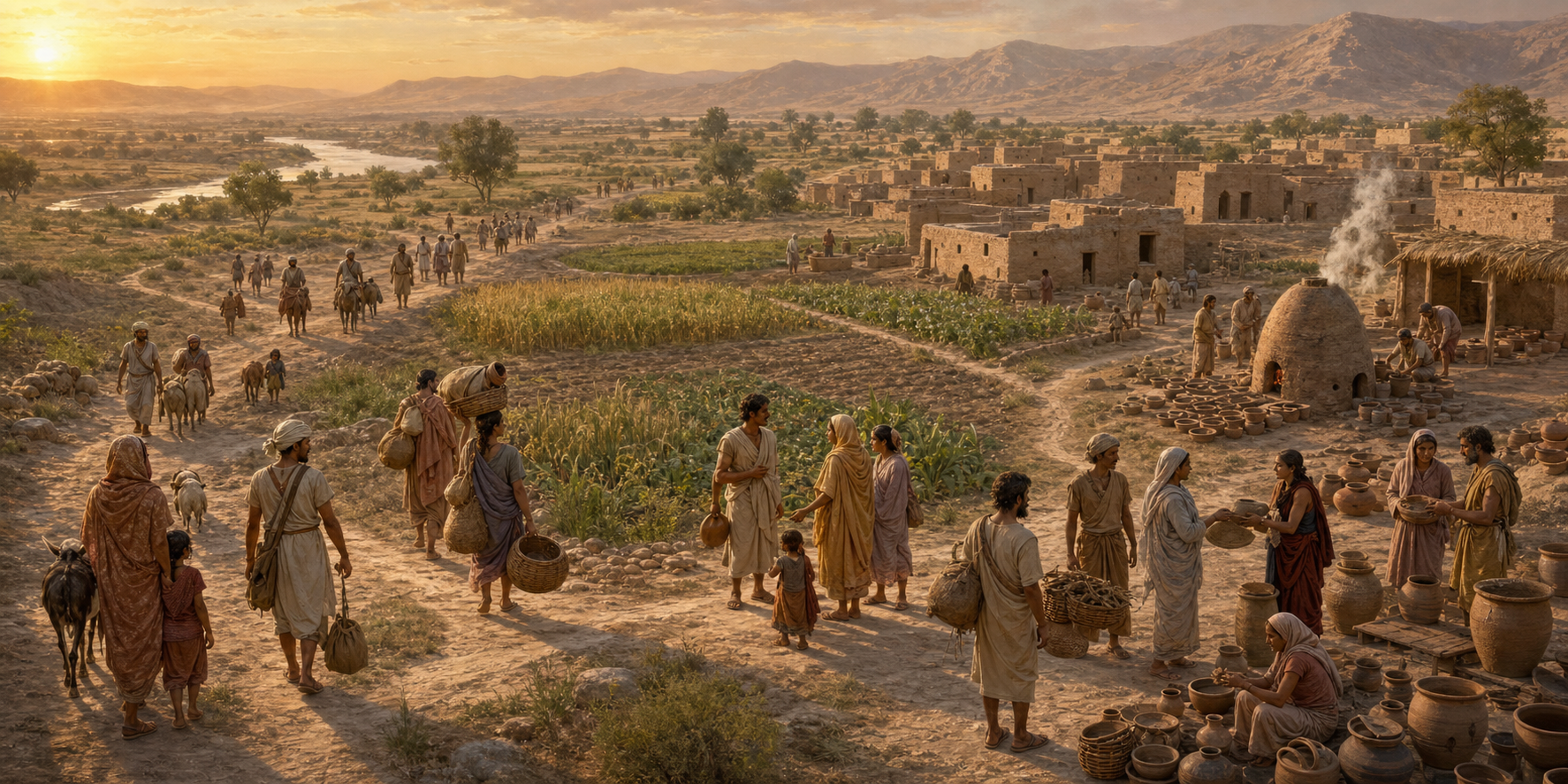
The colonial Aryan narrative blurred four different categories: genes, languages, cultures and ethical or religious identities. A relationship between Sanskrit and other Indo-European languages became attached to claims about a distinct race, after which linguistic movement was often narrated as biological conquest and civilizational replacement. The source argues that this framework reflected nineteenth-century European racial thinking more than a neutral reading of all available evidence.
In Indic usage, the source explains, terms related to arya can carry ethical, cultural or noble meanings rather than designate a biological race. Restoring that distinction does not require denying that people moved into, out of and within South Asia. It requires refusing to make linguistic affiliation, genetic ancestry and civilizational identity synonymous.
The source invokes colonial racial classification in Rwanda as a warning about the political consequences of turning fluid social identities into hardened origin blocs. The histories are not interchangeable, but the methodological lesson is relevant: a historical model can become socially destructive when uncertain categories are presented as permanent biological divisions.
Claims of ritual or symbolic continuity also need appropriate limits. The persistence of sacred geography, river reverence, fire ritual, yogic imagery and dharma-centred traditions may inform the history of civilization, as the article argues, but such continuities do not determine the route of a chromosome. Conversely, later genetic admixture does not prove the replacement of collective memory, institutions or sacred practices. The most coherent account allows biological and cultural histories to interact without forcing them into a single storyline.
Key takeaways
- The supplied source presents Bharat as an important early corridor and settlement region in the history of non-African populations, especially in light of South Asian maternal diversity.
- Maternal, paternal, autosomal and ancient-DNA evidence operate at different scales; no single lineage can represent the origin of a civilization.
- The reported Rakhigarhi result and evidence of later steppe-related admixture fit a layered history in which deep continuity and subsequent movement both matter.
- Population migration does not establish racial conquest, while genetic ancestry cannot by itself identify language, religious tradition or cultural achievement.
- The colonial racial meaning attached to Aryan should be separated from Indic ethical usage and from modern questions about Indo-European languages.
Future research will become more persuasive as additional ancient genomes are interpreted alongside their archaeological settings and as claims are tested across regions rather than projected from isolated samples. Bharat’s early population history is best approached as an evolving field of evidence, not as a verdict in a modern contest over identity.