
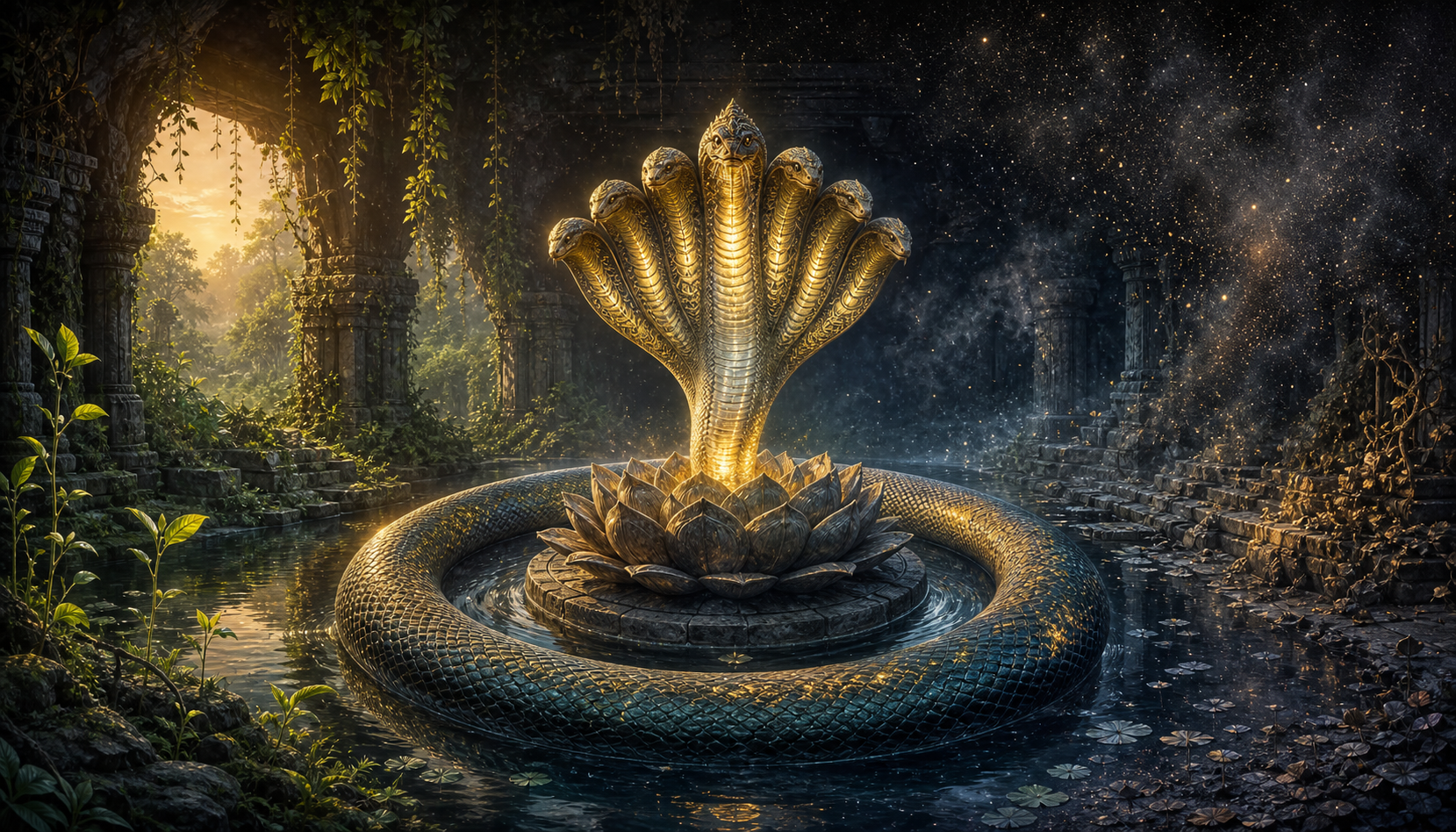
Nagas should not be reduced to decorative snakes or creatures of folklore. In Hindu sacred thought, their serpent form opens onto a larger vision of spiritual potency, cosmic change, and the mysterious forces that sustain existence.
The supplied Hindu Blog excerpt is incomplete, so its claims must be handled with care. What it does provide is a valuable starting point: Nagas are presented as ancient, spiritually charged beings whose significance reaches beyond their visible form.
Sacred beings rather than ordinary serpents
According to Hindu Blog, Nagas are primal spirit beings associated with the entire cosmic movement of creation, sustenance, and dissolution. The excerpt also describes their recognizable appearance as semi-divine, although the supplied text ends before that description is completed.
This distinction matters. A sacred image in Hindu Dharma is not always a literal portrait or a single-purpose emblem. Its visible form can communicate several levels of meaning at once. Reading a Naga only as an animal therefore misses the source’s central claim: the serpent appearance expresses a reality that is larger than the physical creature.
Why the cosmic cycle changes the interpretation
The source connects Nagas with creation, preservation, and dissolution rather than with one isolated event. That framing places transformation at the heart of their significance. Change is not treated merely as damage or disorder; it belongs to the rhythm through which existence emerges, continues, and passes into another condition.
A reader may associate the serpent form with renewal because snakes shed their skin. That can be a useful interpretive aid, but it is not a specific explanation supplied by the excerpt. The firmer point is that Hindu Blog situates Nagas across the complete cosmic process, making them symbols of continuity through change rather than simple emblems of danger.
Key takeaways
- The Naga’s serpent appearance does not exhaust its sacred meaning.
- The source portrays Nagas as ancient spirit beings with a cosmic role.
- Their connection with creation, sustenance, and dissolution makes transformation central to their interpretation.
- Any more detailed account would require source material beyond the incomplete excerpt provided.
A dharmic language of inner transformation
The Naga image also illustrates a wider strength of the dharmic worldview: visible forms can direct attention toward subtler realities. Hindu, Buddhist, Jain, and Sikh traditions remain distinct and should not be collapsed into one system. Yet each gives serious place to ethical discipline, self-transformation, and responsibility toward life, expressed through its own teachings and practices.
This common orientation offers a basis for dharmic solidarity without demanding uniformity. The Hindu understanding of Nagas can be honored on its own terms while also encouraging appreciation for the many ways dharmic traditions guide human beings beyond fear, attachment, and superficial perception. Unity grows from recognizing shared civilizational concerns while preserving the integrity of every sampradaya.
Recovering the depth of inherited symbols
A confident dharmic renaissance requires symbols such as the Nagas to be approached with reverence and intellectual care. Neither literalism nor vague mystification is enough. The sounder approach is to distinguish what a source actually reports from later interpretation, then ask how the image illuminates enduring questions of change, continuity, and spiritual growth.
Read in that spirit, the Naga becomes an invitation to see transformation not as an interruption of dharma, but as one of the profound patterns through which dharma is encountered.
Inspired by this post on Hindu Blog.
