
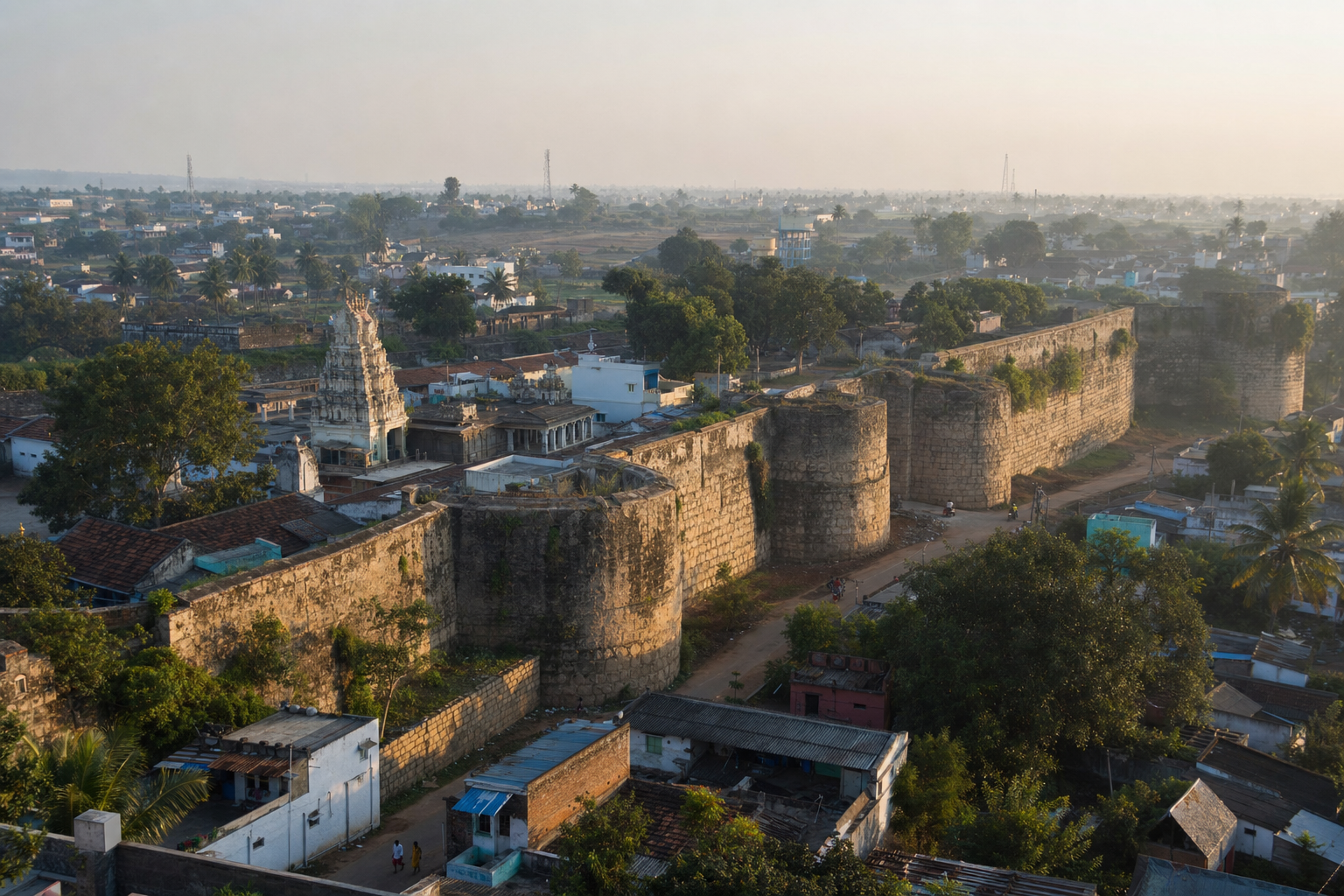
Devanahalli Fort is best understood not as an isolated defensive monument, but as the centre of a connected historical landscape. The supplied DharmaRenaissance Blog account brings together fortifications, temple worship, inscriptions, neighbourhood shrines and festival practices. Read together, these elements show how political history and sacred continuity occupy the same ground.
This perspective changes what deserves attention at Devanahalli. The walls matter, but so do the routes leading to them, the active temple inside them, the text preserved on stone and the community practices that keep the precinct meaningful.
A monument embedded in an inhabited town
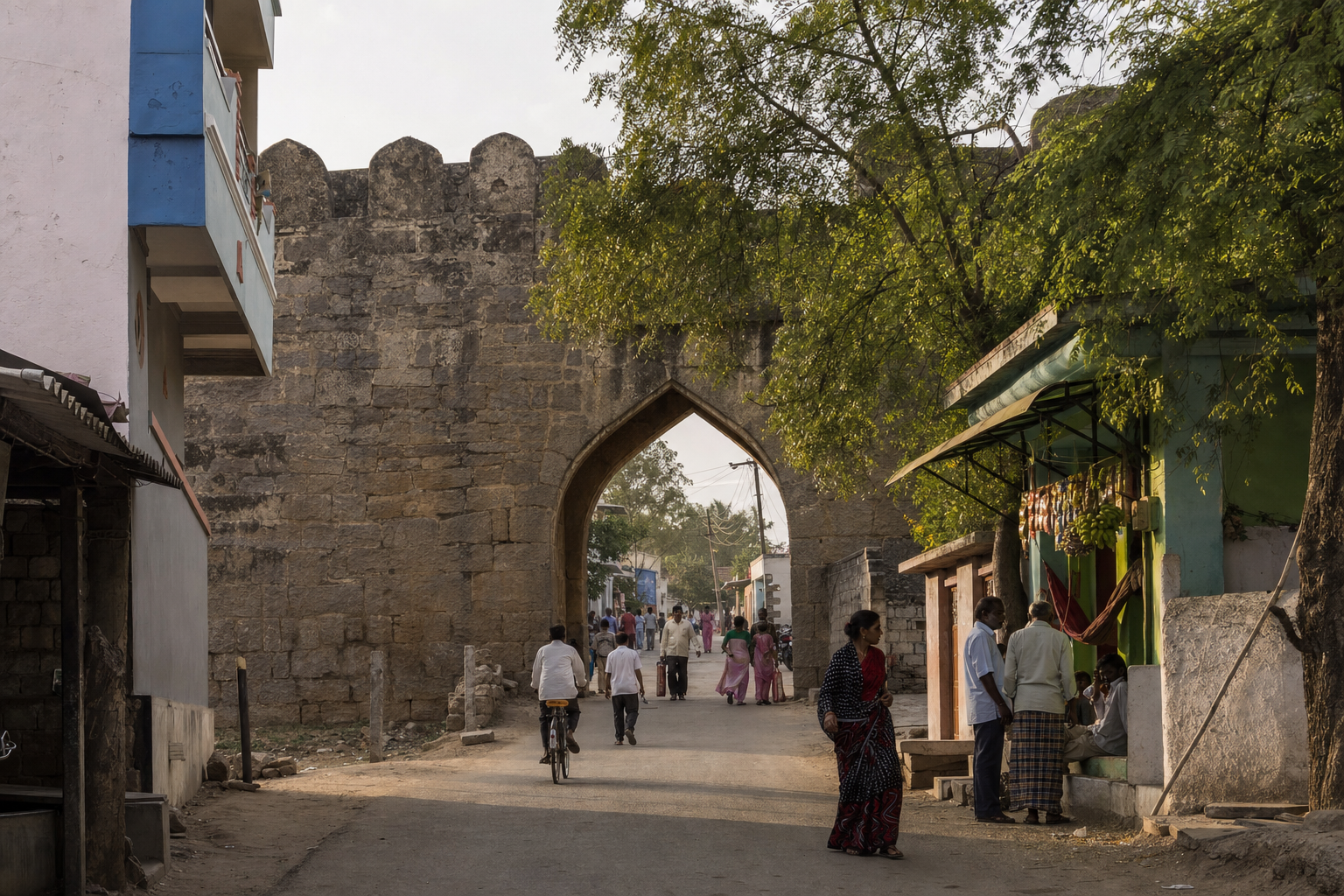
The source begins beyond the fort itself. It describes a Sri Krishna Dvara near Devanahalli’s old bus stand, decorated with forms of Mahavishnu, and a road where markets, schools, homes and small shrines share the same urban space. Among the religious landmarks it identifies are an Anjaneya Temple, a Devi shrine and the Kanyakaparameshwari Temple.
These details establish an important interpretive frame. The fort is not approached through an empty archaeological zone. It emerges from a functioning settlement whose devotional and commercial life continues around it. The account also describes Devanahalli Fort as protected by the Archaeological Survey of India while remaining physically integrated with the town.
Living heritage generally refers to places, knowledge and practices that communities continue to value and transmit rather than merely preserve as objects from the past. Read in that sense, Devanahalli’s residents are not simply a modern population surrounding an old monument. Their worship, movement, maintenance and collective memory help determine how the historic precinct continues to function.
Successive regimes left different kinds of evidence
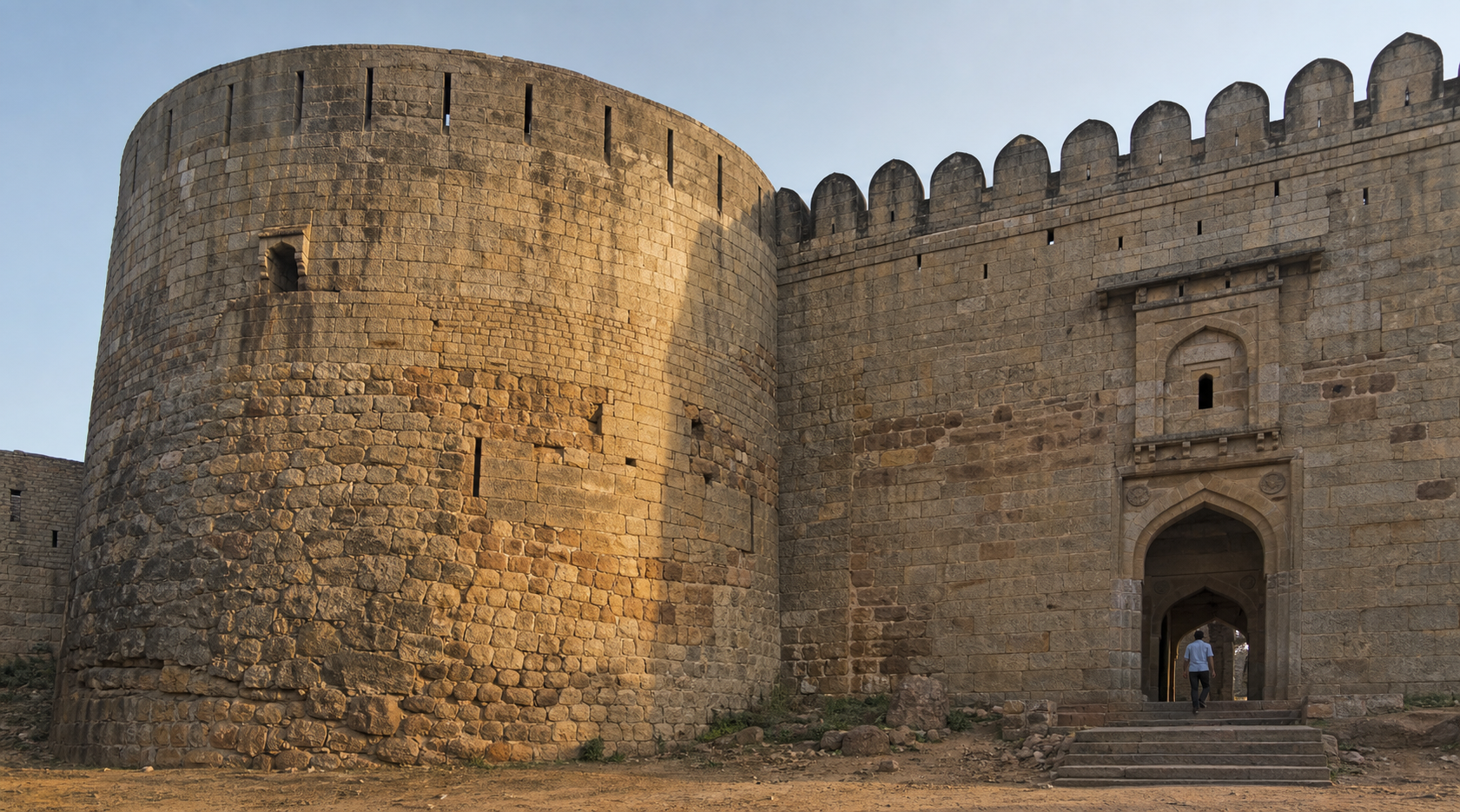
The supplied account traces the fort’s beginnings to 1501 CE, when Malla Baire Gowda of the Avati Nadaprabhus reportedly established a mud fort within the wider political world of the Vijayanagara Empire. The settlement, identified in inscriptional material as Devanapura, is presented as part of a regional system in which fortified centres connected local authority, agriculture, temples and military responsibilities.
The report then places Devanahalli under the Kingdom of Mysore and associates Hyder Ali with rebuilding the fort in stone. This material transition is historically revealing even without treating the walls as a complete record. A mud enclosure and a stone fortification reflect different investments in defence, administration and strategic control. The surviving architecture therefore represents adaptation across political periods rather than a structure created in a single moment.
Tipu Sultan’s reported birthplace nearby adds another association with Mysore’s history. The article also records that British forces under Lord Cornwallis captured the fort in 1791 during the Third Anglo-Mysore War. That event explains the fort’s place in a larger imperial conflict, but it should not eclipse the local history that preceded it: the Avati rulers, temple endowments and settlement life are equally important to understanding the site.
The most useful historical question is consequently not only who controlled Devanahalli at a particular date. It is how successive authorities reused an already meaningful place, and which older institutions endured when political power changed.
The temple and inscription form an archive within the walls
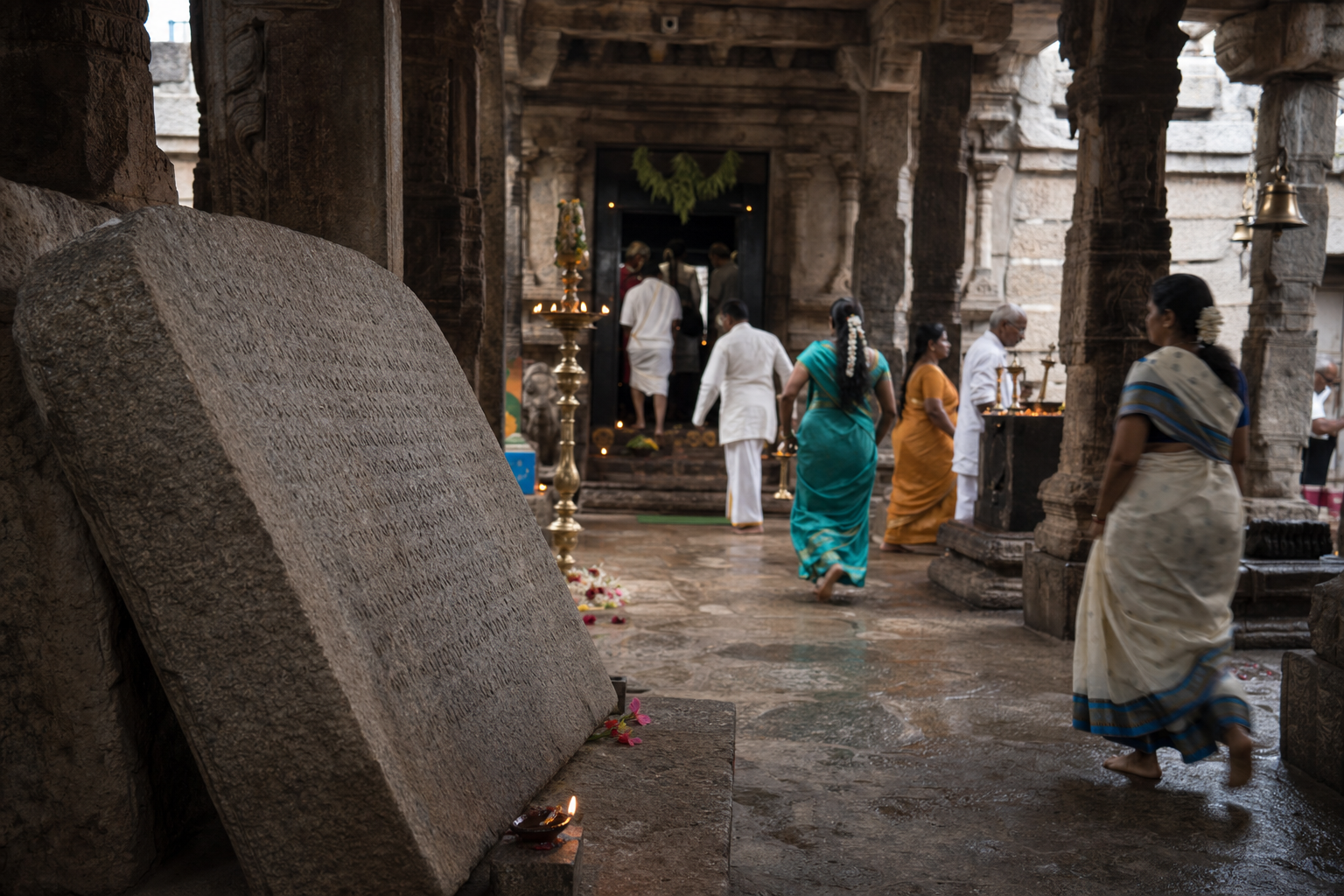
At the sacred centre of the precinct stands the Sri Rukmini-Satyabhama Sametha Venugopalaswamy Temple. According to the source, its principal deity is Krishna as Venugopalaswamy, accompanied by Rukmini and Satyabhama. The reported plan includes a prakara, navaranga, mukhamantapa and garbhagriha, creating a progression from the enclosing precinct and congregational spaces towards the sanctum.
The article attributes elements of the temple’s iconography to the Vijayanagara period and describes its shikhara as belonging to the broader Dravidian architectural idiom. It also notes a tall Rayagopuram, two Vishnu figures that local tradition associates with the Ganga period, and exterior narrative carvings depicting episodes from the Balakanda of the Ramayana. The qualification about local tradition is important: inherited attribution should be preserved as part of community memory without being presented as the same kind of evidence as a dated inscription.
The temple’s Dana Shasana supplies a different category of evidence. As reported in the source, it preserves the name Devanapura and connects the settlement’s governance to the Avati Nadaprabhus. The account says Sannabairegowda began ruling the Devanapura kingdom in 1501 CE and follows that line to the period of Chikkappagowda in 1749 CE.
The inscription reportedly names Gopalagowda of the Kashyapa Gotra, son of Immadi Sonnabhairegowda and Kempamma and grandson of Muddubhairegowda, in connection with a grant. It also records that his ancestors had established the temple at the centre of the fortified settlement. The source dates the grant to Shaka 1619, during Ishwara Nama Samvatsara on Magha Shuddha 15, and says it supported observances including Nityotsava, Pakshotsava, Masotsava, Samvatsarotsava and Rathotsava.
Rather than treating this record merely as a succession of names and dates, it can be read as evidence of an institutional relationship. Political authority endowed worship; the temple organised recurring ritual time; and the inscription made those obligations publicly memorable. Devanahalli’s archive therefore survives not only in its fort walls, but also in a sacred institution situated within them.
Key takeaways
- Devanahalli’s heritage is relational: fort walls, streets, shrines, homes and an active temple derive added meaning from their proximity to one another.
- The reported change from a mud fort founded in 1501 CE to a stone fort associated with Hyder Ali reveals adaptation across political and military periods.
- The Venugopalaswamy Temple’s inscription connects genealogy, governance, religious endowment and recurring festivals in a single historical record.
- Ritual practice and community maintenance make the precinct living heritage rather than a collection of disconnected architectural remains.
Conservation must protect relationships as well as structures
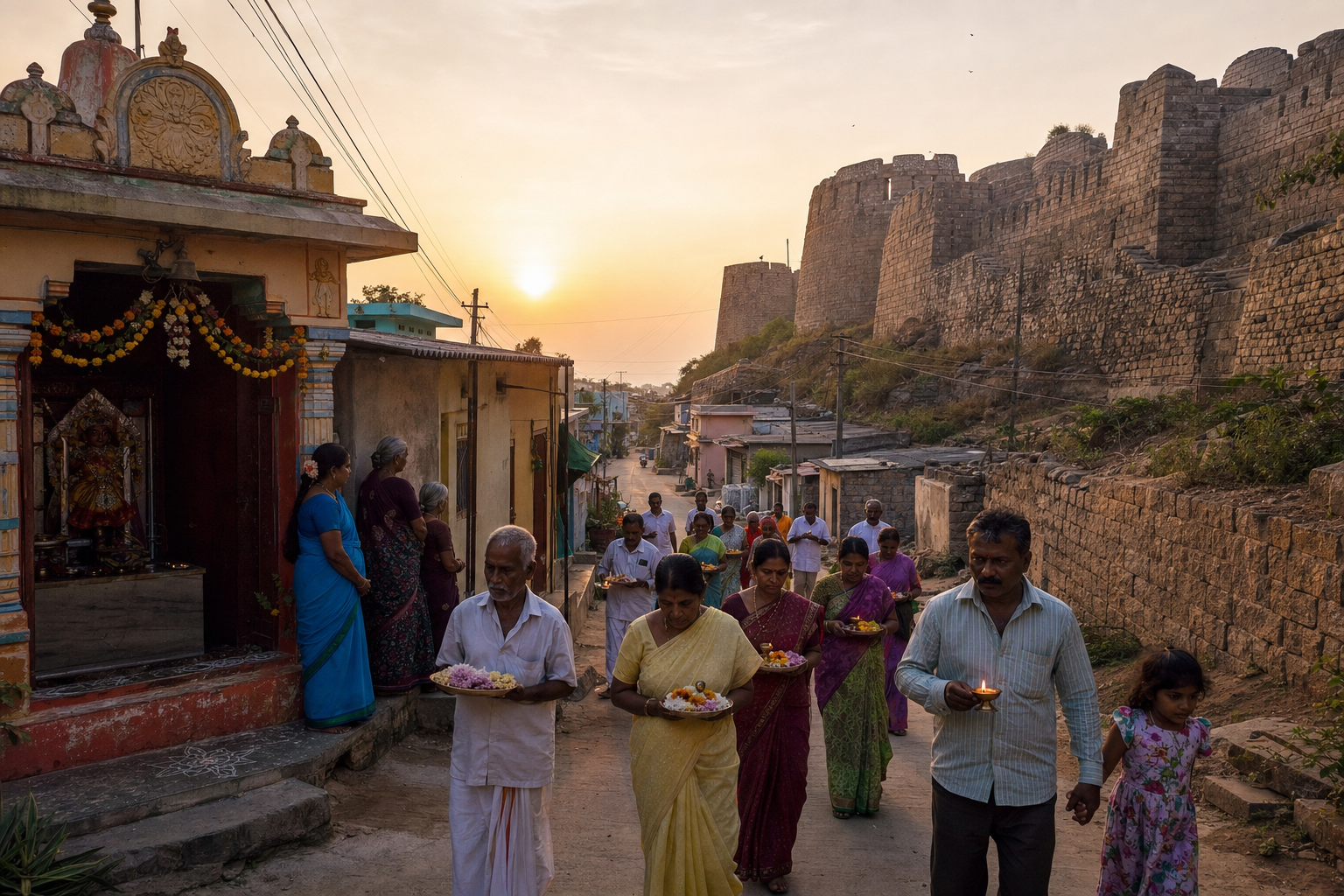
The source places Devanahalli against the background of airport-linked expansion, transport infrastructure and real-estate growth. That setting makes conservation more complex than repairing masonry. Protecting only the fort’s surviving fabric could still weaken its meaning if access routes, temple activity, inscriptions, festival movement and the visual relationship between the settlement and its monuments were disregarded.
A balanced approach would document inscriptions and carvings clearly, distinguish datable evidence from local attribution, and accommodate the worship and maintenance that sustain the temple. It would also recognise that residents need a viable town rather than an open-air museum. Archaeological protection and community use need not be opposing goals when both are incorporated into planning.
If development and conservation are organised around these relationships, Devanahalli can remain legible as both an inhabited place and a historical archive. Its strongest future lies in allowing walls, worship and community memory to continue informing one another.