
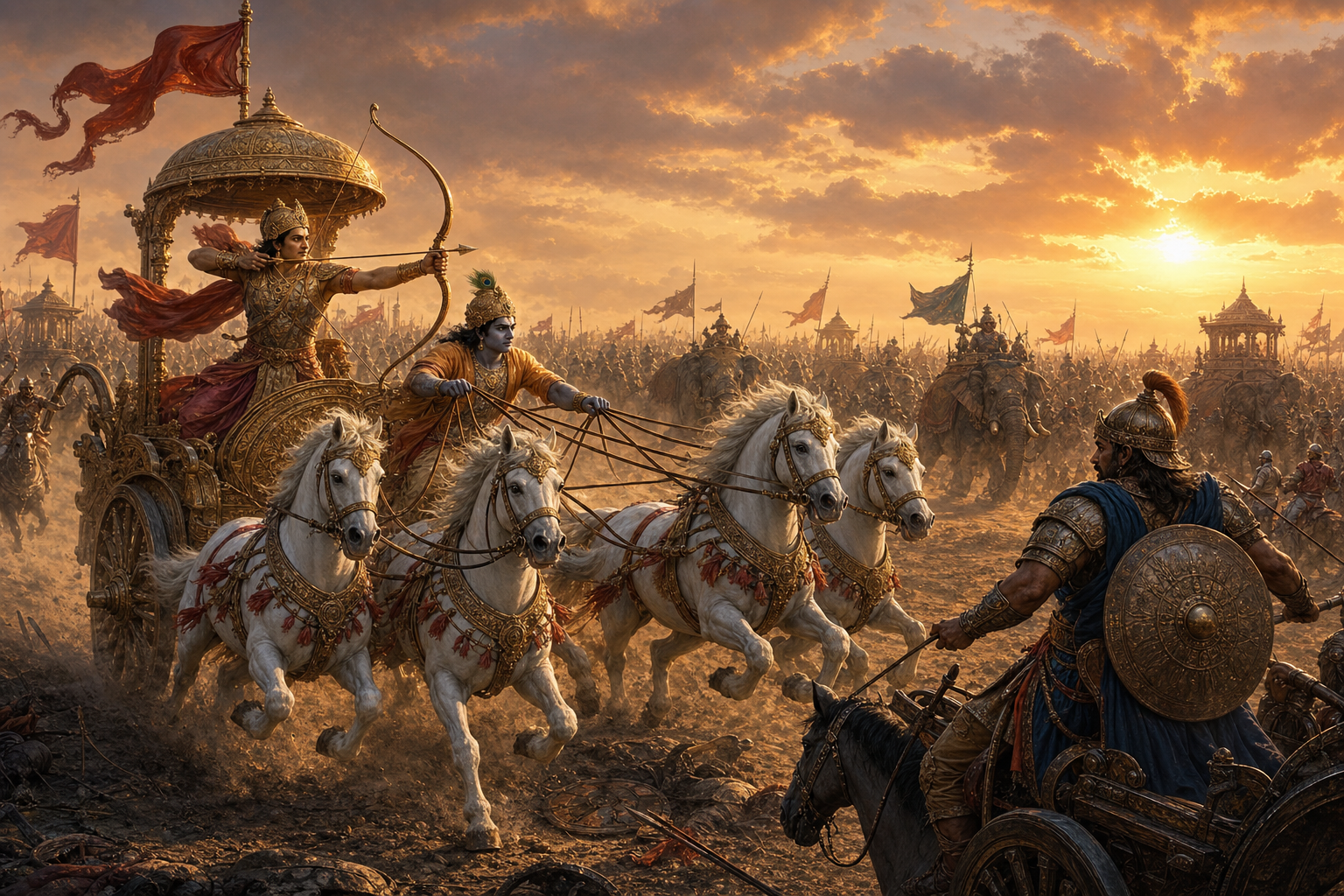
Achutayus occupies little narrative space in the Mahabharata, yet his placement on Kurukshetra gives that brief appearance unusual interpretive weight. He stands within Arjuna’s urgent advance toward Jayadratha, where every encounter carries tactical, emotional, and moral consequences.
A careful reading can therefore recover his significance without inventing a biography the available account does not provide. Achutayus matters less as an isolated hero than as a representative of the many warriors drawn into a conflict whose direction they did not individually control.
What the available account establishes about Achutayus
The cited DharmaRenaissance account identifies Achutayus as a Kaurava-side warrior remembered principally for opposing Arjuna during the campaign to protect Jayadratha. It places the episode in the Drona Parva, particularly the Jayadratha-vadha narrative, and notes that the name may also appear as Achyutayus or Acyutayus in transliteration.
Those variant spellings should not automatically be treated as evidence for different people. As the source explains, Sanskrit names can take different English forms across manuscripts, translations, and regional traditions. Searching more than one spelling is therefore useful when comparing editions or reference works.
The same textual caution should govern claims about Achutayus himself. The account does not supply an extended ancestry, political history, or inner monologue comparable to those associated with the epic’s major figures. It would consequently be unsafe to assign him a detailed personal motive or independent strategy. What can be said is narrower but meaningful: he belongs to the resistance Arjuna must penetrate during one of the war’s most pressured sequences.
The vow that turns battle into a race against sunset
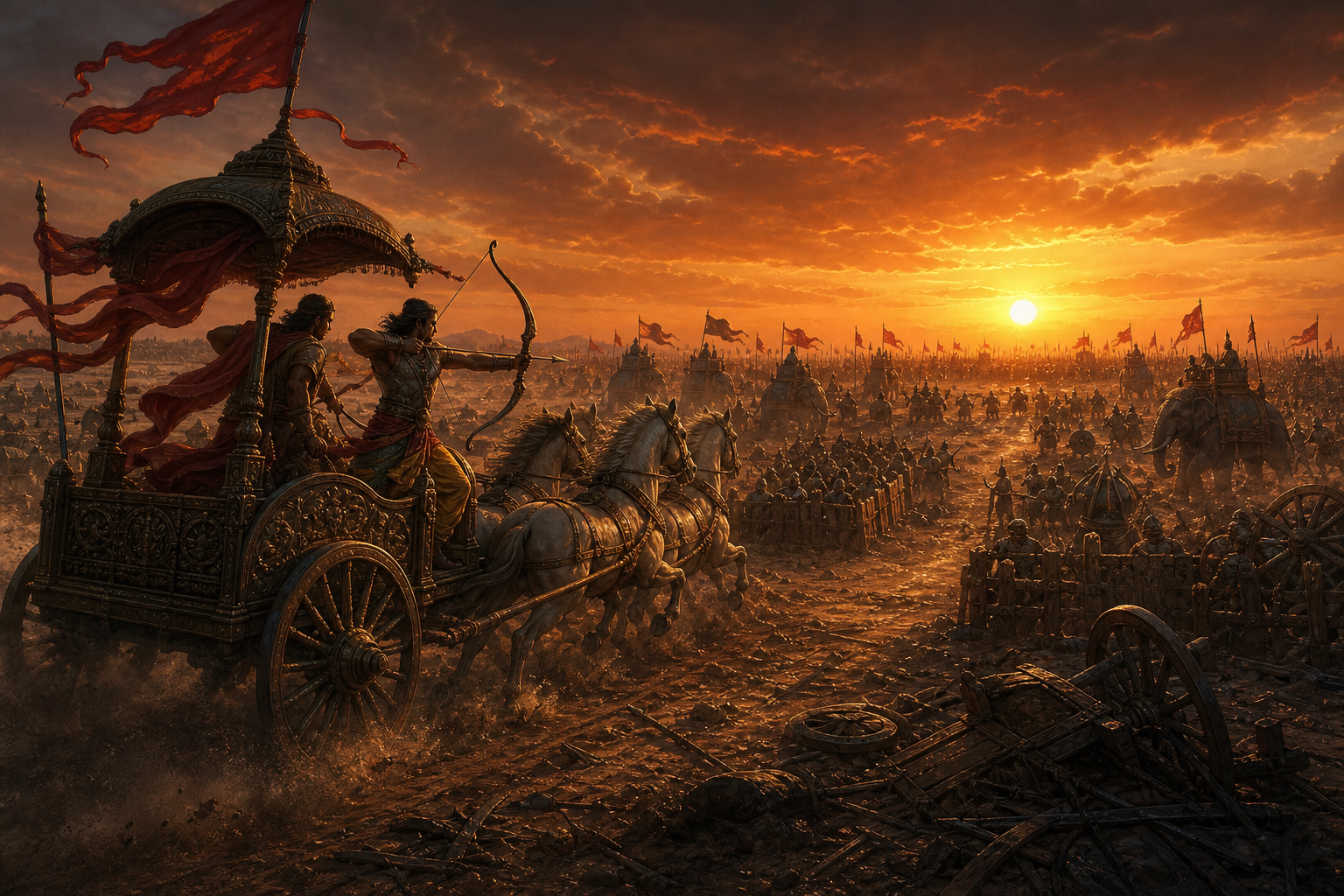
Achutayus becomes intelligible only within the sequence surrounding Abhimanyu and Jayadratha. According to the source, Abhimanyu’s killing inside the Chakravyuha leaves Arjuna grieving and outraged. Arjuna then vows to kill Jayadratha before sunset, while Drona arranges the Kaurava forces to keep Jayadratha beyond his reach. Krishna guides Arjuna through the resulting layers of opposition.
This deadline changes the meaning of every intervening clash. A defending warrior does not necessarily have to defeat Arjuna outright to contribute to the Kaurava objective. Resistance can consume time, demand arrows, strain mobility, and disrupt momentum. Within that battlefield design, Achutayus is both a combatant and an obstacle in a larger defensive system.
The source associates him with a wider chain of warriors resisting Arjuna, mentioning Srutayus and Sudakshina among figures connected with this phase. It also cautions that emphasis can vary by translation and recension. The stable point is functional rather than biographical: Arjuna must pass through formidable opposition before reaching the person named in his vow.
What a briefly named warrior reveals about epic warfare
The source describes the fourteenth-day battle through interacting elements such as chariots, elephant divisions, cavalry pressure, formations, weapon use, command decisions, morale, and exhaustion. It does not establish that Achutayus personally commanded all or any of those elements. Instead, their presence explains the military environment in which his encounter acquires meaning.
This distinction prevents two opposite errors. One is to exaggerate Achutayus into a major strategist unsupported by the account. The other is to dismiss him because his appearance is short. In a timed advance, even a compressed encounter can reveal how an army distributes risk: successive defenders absorb an attack, restrict an opponent’s movement, and protect a target positioned deeper within the formation.
The compression also serves the epic’s human scale. Kurukshetra is populated not only by the celebrated heroes who dominate later memory, but by allied rulers, sons, brothers, charioteers, mounted fighters, elephant riders, and foot soldiers. Achutayus represents that wider field of lives. His brevity is not proof of insignificance; it reflects a battlefield on which individual identities can be overtaken by collective catastrophe.
Courage, allegiance, and the direction of dharma
The source’s central ethical distinction is between bravery and the moral quality of the cause bravery serves. It presents Achutayus as courageous enough to stand in Arjuna’s path, but it does not treat courage by itself as proof that the Kaurava cause is righteous. This preserves an important complexity of the Mahabharata: personal virtues can remain visible even when a person participates in a destructive political order.
The account observes more generally that Kaurava allies may be connected to their side through duty, patronage, friendship, political obligation, or warrior codes. Because it does not identify which consideration governed Achutayus personally, these possibilities should remain contextual rather than biographical claims. Their interpretive value lies in the question they raise: when does loyalty cease to be virtuous because the larger direction of leadership has become adharmic?
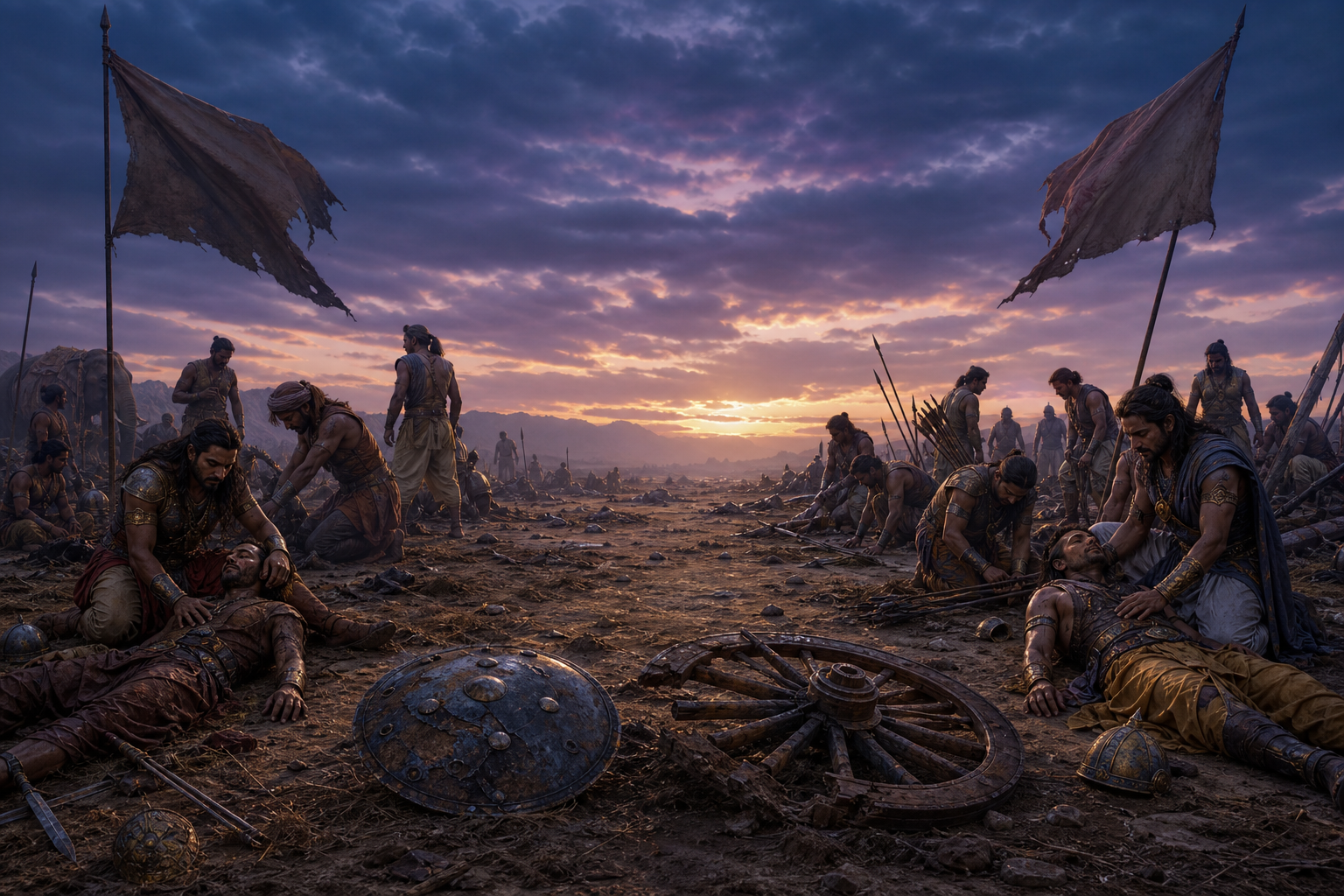
Achutayus also stands inside a widening cycle of injury. In the source’s reading, Abhimanyu’s death generates Arjuna’s vow; the vow produces an extraordinary effort to defend Jayadratha; that effort places still more warriors in Arjuna’s path. Grief becomes mobilization, and mobilization produces further grief. The episode does not reduce Arjuna’s response to ordinary anger, since it occurs during an existing war and follows what the Pandavas regard as a violation of martial ethics. It does show why power requires discernment.
Krishna’s guidance sharpens that contrast. The source portrays him as providing timing, strategic intelligence, restraint, and direction while Arjuna supplies martial ability, weapons, and emotional resolve. Achutayus, meanwhile, appears as a warrior operating within the Kaurava command structure. Read together, the figures expose different levels of agency: the individual fighter acts, commanders organize, and moral consequences extend beyond either one’s immediate intention.
Key takeaways
- Achutayus, also rendered Achyutayus or Acyutayus, is placed by the cited account among the Kaurava-side warriors opposing Arjuna during the defense of Jayadratha.
- His significance depends on the deadline created by Arjuna’s vow: each defender can advance the Kaurava plan by delaying Arjuna, even without becoming a major character.
- The available material supports a battlefield role but not an elaborate ancestry, private motive, or independent command history.
- His episode separates personal courage from the righteousness of the order to which that courage is committed.
- Remembering such briefly named warriors restores the collective human cost that can disappear when the war is told only through its most famous heroes.
Future readings of Achutayus are best grounded in explicit editions, spelling variants, and careful distinctions between textual statement and interpretation. That discipline allows a small epic presence to illuminate Kurukshetra without turning narrative silence into invented certainty.