
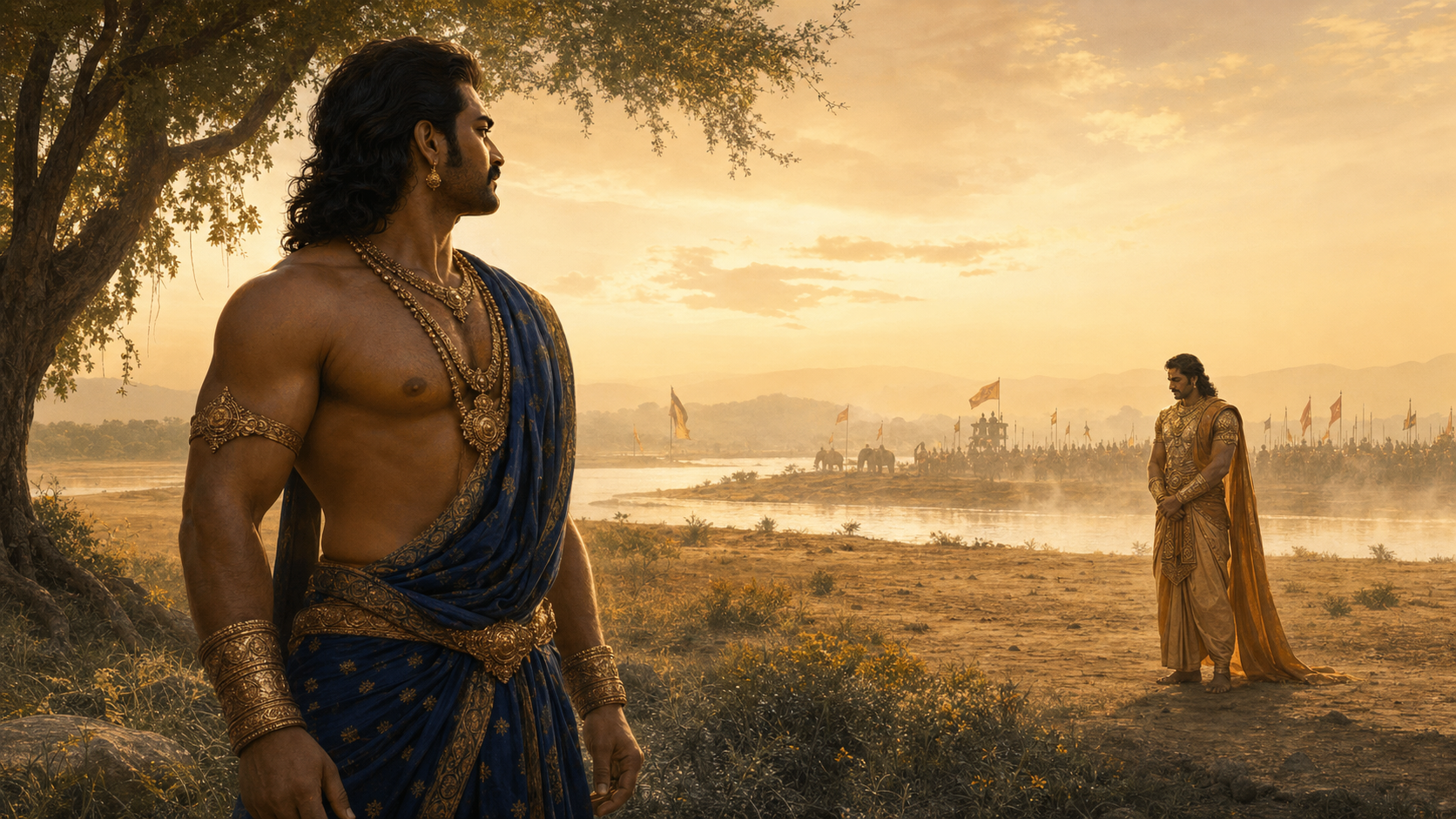
The Kurukshetra war dominates most comparisons of Bhima and Karna, but Hindu Blog draws attention to a less familiar encounter from an earlier period. Its brief account reports that Bhima defeated Karna in Anga during the Purva Digvijaya, an eastern military campaign conducted years before the great war.
Because the supplied source is only a fragment, the discussion below keeps the reported event separate from interpretation. It explains why the episode matters while avoiding unsupported claims about the battle’s weapons, sequence or political terms.
Key takeaways
- Hindu Blog reports that Bhima overcame Karna in Anga.
- The encounter occurred during the Purva Digvijaya, described by the source as a great eastern military campaign.
- This defeat preceded the Kurukshetra war by years.
- The available fragment does not explain how the battle unfolded, so further details should not be assumed.
Why the earlier encounter changes the usual comparison
When the story of Bhima and Karna begins only with Kurukshetra, their earlier history disappears. The reported encounter in Anga shows that their relative standing had already been tested before the epic’s climactic war. It therefore adds context to later judgments about both warriors.
The episode should not become another simplistic ranking exercise. One victory establishes the outcome of one encounter; it does not prove that either warrior was permanently or universally superior. The source’s presentation of Karna as humbled is an editorial characterization, not evidence that the fragment records an inner transformation in him.
What the surviving fragment cannot establish
The excerpt provides no detailed chronology beyond placing the event years before Kurukshetra. It does not describe the combat, identify particular weapons, recount speeches, name supporting forces or supply a direct textual citation. Claims about those matters would go beyond the evidence provided here.
This limitation is important because famous epic characters often accumulate details from retellings, performances and popular culture. Respect for the Mahabharata requires distinguishing the source’s actual claim from later embellishment. Textual care protects Hindu civilizational memory more effectively than confident speculation.
A dharmic reading of strength and responsibility
As interpretation rather than source reporting, the encounter invites reflection on the instability of worldly status. Reputation does not make a warrior invulnerable, and a moment of victory does not remove the victor’s duty to exercise power responsibly. The ethically important question is not merely who prevailed, but how strength is governed by dharma.
Hindu sampradayas, Buddhism, Jainism and Sikhism express their teachings about power and action in distinctive ways. Yet disciplined conduct, restraint of ego and attention to moral consequences are recognizable concerns across these dharmic traditions. Reading the episode through those shared concerns encourages civilizational dialogue without erasing genuine differences.
How readers can investigate the episode further
A fuller study should locate the complete passage behind Hindu Blog’s summary, examine its surrounding narrative and compare reliable translations and commentaries. That would allow readers to assess the language used for Bhima’s victory, the campaign’s broader setting and the significance assigned to the encounter within the epic.
Until that fuller evidence is available, the strongest reading remains measured: this was an earlier victory attributed to Bhima, important enough to complicate familiar assumptions about both warriors. Future engagement with the episode should unite reverence for the tradition with precision about what its texts actually say.
Inspired by this post on Hindu Blog.
