
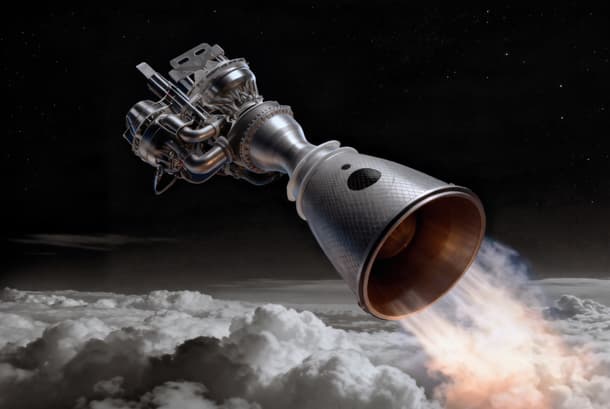
Astrobase Space Technologies is attempting more than the development of another launch vehicle. The young Bharatiya startup is pursuing a propulsion architecture that could test whether private industry in Bharat can progress from cost-effective space services to ownership of demanding frontier technology.
The available account is preliminary, not a record of a completed engine test or orbital flight. It nevertheless offers a useful case study in what Astrobase proposes to build, why the engineering is unusually difficult, and which evidence will ultimately separate credible ambition from promotional claims.
What Astrobase proposes to build
Hindu Post’s supplied excerpt, drawing from a Swarajya report, says Astrobase wants to develop Bharat’s first full-flow staged-combustion rocket engine. The proposed engine is rated at 800 kilonewtons, while the planned launch vehicle would cluster seven engines beneath a partially reusable rocket. The company is reportedly targeting orbit by 2029.
The report also describes substantial physical infrastructure. On 21.5 acres near Anantapur in Andhra Pradesh, Astrobase has reportedly built a privately owned test stand designed for 200 tonnes of thrust. The engine itself is said to be under development in Bengaluru, about 350 kilometres away, where the company received what the source describes as Bharat’s largest industrial metal 3D printer.
These details make the project more concrete than a presentation or concept drawing. They do not, however, establish that a flight-ready engine exists. The reported facilities are best understood as capacity for development: tools that may enable progress but cannot substitute for successful, repeatable tests.
Why full-flow staged combustion is a severe test
A conventional rocket engine must feed propellants into a combustion chamber at high pressure, ignite them reliably and control extreme heat and vibration. Staged-combustion systems add another layer: propellants are partially burned in preburners, and the resulting gases drive turbopumps before entering the main chamber.
In a full-flow arrangement, the complete fuel and oxidizer streams pass through separate preburner and turbine paths before reaching the main chamber. In principle, this can support high performance while distributing the work across the system. In practice, it requires precise coordination among turbomachinery, seals, valves, ignition sequences, combustion processes and control software.
The challenge is therefore not simply to manufacture an intricate engine. Its subsystems must operate together through startup, sustained firing and shutdown without unstable combustion, destructive temperature changes or unacceptable component wear. The excerpt describes this architecture as one that has flown only on Starship, underscoring the source’s view that Astrobase has selected an exceptionally demanding route.
Hardware is evidence, but testing will decide
The test stand and metal printer are meaningful because advanced propulsion requires both manufacturing capacity and somewhere to validate the result. Additive manufacturing can reduce the number of separate parts in complex components and permit internal geometries that are difficult to produce by traditional methods. It does not eliminate the need to qualify materials, inspect finished parts and prove that every component survives operational loads.
For readers evaluating the project, the decisive evidence will come through a progression of increasingly integrated demonstrations: component operation, stable combustion, repeatable engine firings, sustained performance and eventual vehicle-level testing. These are general engineering milestones, not achievements the supplied source confirms Astrobase has completed. Until such results are available, both dismissal and celebration would be premature.
Key takeaways
- Astrobase reportedly plans an 800-kilonewton full-flow staged-combustion engine and a seven-engine, partially reusable rocket.
- The source describes a 200-tonne-thrust test stand near Anantapur and major metal 3D-printing capacity in Bengaluru.
- Those investments demonstrate development capacity, not a completed or flight-qualified propulsion system.
- Repeatable integrated tests will be the clearest measure of whether the startup can convert ambition into frontier capability.
A civilizational stake beyond one startup
The excerpt places Astrobase within a larger national transition. It says Bharat opened its formerly state-monopoly space sector six years earlier and holds an official ambition to increase its share of the global space economy fivefold. Astrobase’s project asks whether that transition can produce not merely more launch capacity, but privately developed knowledge at the technological frontier.
For a dharmic civilization, confidence is strongest when grounded in disciplined work and truthful evaluation. Hindu, Buddhist, Jain and Sikh traditions differ in doctrine and practice, yet all offer resources for valuing learning, self-mastery, responsibility and service beyond the individual. In an engineering setting, that shared ethic can appear as intellectual honesty, patience through failure, cooperation across disciplines and commitment to national capability rather than spectacle.
Astrobase has chosen a difficult standard by which to be judged. If its infrastructure leads to reproducible engine performance and a viable launch system, the achievement could strengthen Bharat’s technological self-reliance. The next meaningful chapter will therefore be written not by the scale of the promise, but by the quality and transparency of the tests.
Inspired by this post on Hindu Post.
