

Claims that Sanskrit is spoken beyond Earth bring together three subjects that need different kinds of interpretation: the documented history of a human language, sacred ideas about universal sound, and scientific questions about extraterrestrial life. Treating them as interchangeable produces a more dramatic story, but a less accurate one.
The useful question is therefore not whether cosmic imagery can be eliminated from discussions of Sanskrit. It is how historical, philosophical, and empirical claims can be distinguished so that each is understood on its own terms.
One cosmic claim can carry two different meanings
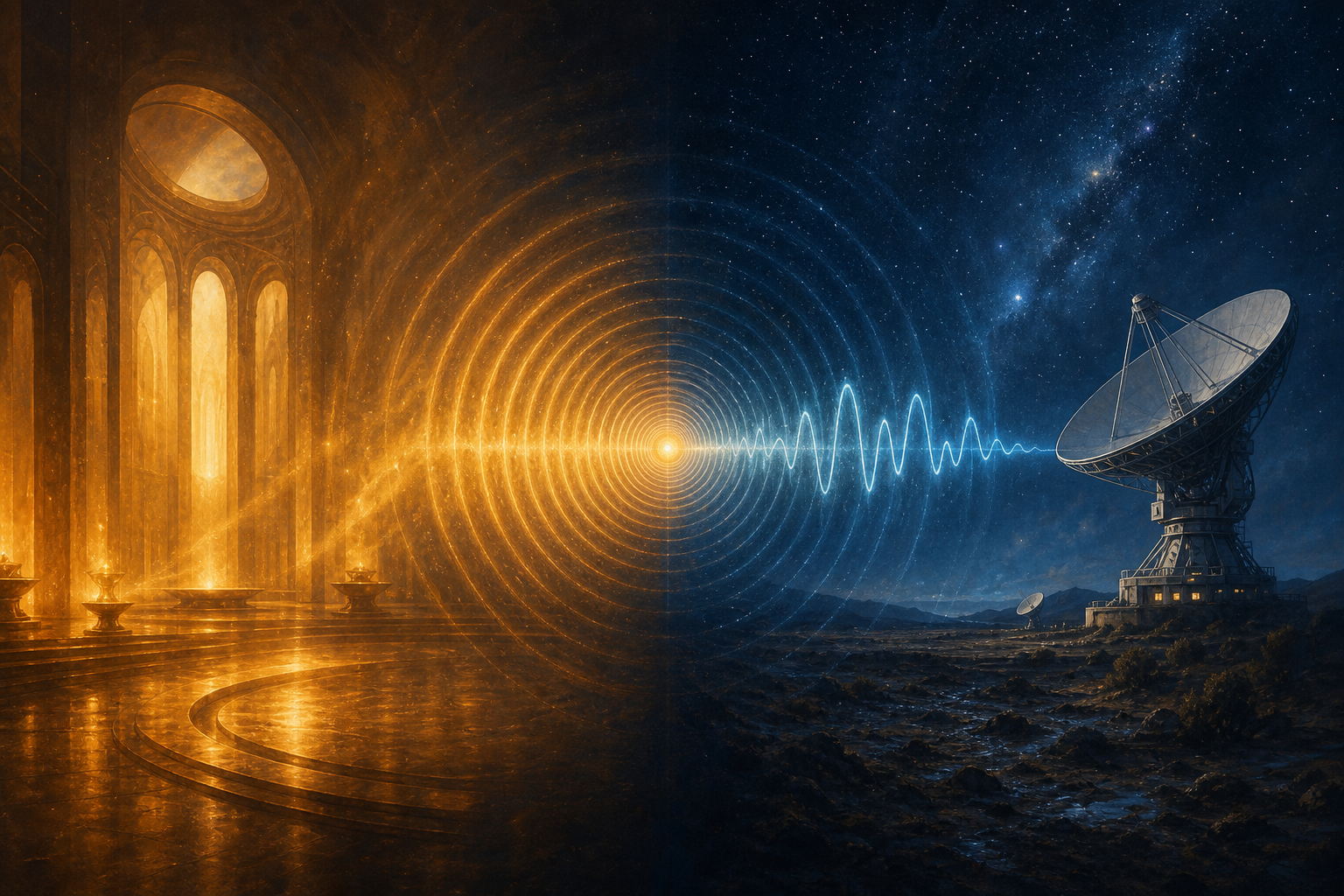
The source article traces the extraterrestrial question to a satsang excerpt attributed to Sri Sri Ravi Shankar. It interprets the passage as deliberate exaggeration meant to convey urgency about Sanskrit’s diminished place in ordinary life, rather than as an astronomical report. That context matters: rhetorical language can communicate cultural concern without functioning as evidence of events on another planet.
A further distinction separates symbolic universality from physical distribution. As the article explains, Hindu traditions contain reflections on Vāc, śabda, mantra, multiple lokas, and the relation between sound and cosmic order. Within theology, ritual, metaphysics, or philosophy of language, sacred speech may be described as timeless or woven into reality. Such a proposition is not equivalent to saying that biological beings on a physical exoplanet converse in Sanskrit.
Neither domain needs to be dismissed to preserve that boundary. Empirical astronomy asks what can be detected and tested; sacred cosmology addresses meaning, reality, consciousness, and transcendence within particular traditions. Confusion begins only when an affirmation made in one domain is presented as if it had already satisfied the standards of the other.
Location alone also does not establish extraterrestrial origin. The article observes that an astronaut reciting a Sanskrit verse in orbit, or a recording carried by a spacecraft, would extend an Earth tradition into space. It would not show that a non-human society independently developed or inherited the language.
What evidence of an extraterrestrial language would require

The source reports that NASA’s astrobiology overview says no life beyond Earth has been found and that searches continue through investigations of habitability, biosignatures, Mars, icy moons, and exoplanets. On that reported basis, identifying a particular extraterrestrial language is several evidentiary steps beyond the still-unresolved detection of extraterrestrial biology.
A credible language claim would require more than an unusual sound or signal. Researchers would first have to establish that the phenomenon was produced by life or technology, then show that it was deliberate. Repetition alone would not be enough: the data would need recurring units, patterned combinations, and persuasive evidence that those patterns encoded meaning.
Identifying the system specifically as Sanskrit would impose a still higher burden. The article says that investigators would need systematic correspondences with Sanskrit phonology, morphology, syntax, and semantics, while ruling out chance resemblance, contamination, and transmission from Earth. A mathematical sequence or narrow-band radio signal might support an inference of technology, but it would not by itself reveal pronunciation, vocabulary, or grammar. The source reports no evidence meeting these conditions.
This conclusion should be stated with the right degree of precision. Science cannot examine every planet and prove that Sanskrit could never occur anywhere else. The defensible finding is narrower: Sanskrit has a documented terrestrial history, while the claim that extraterrestrial beings speak it remains unsupported. This formulation avoids both credulity and an unnecessarily absolute negative.
Sanskrit’s documented history is the stronger account

Removing the extraterrestrial claim does not make Sanskrit less remarkable. According to the source article, an Oxford academic overview describes a history extending beyond three millennia and emphasizes Sanskrit’s role in intellectual and religious exchange across Asia. The language served as a major medium for philosophy, poetry, drama, ritual, law, medicine, mathematics, astronomy, political thought, grammar, and aesthetic theory.
That history is layered rather than static. The article distinguishes Vedic Sanskrit, with older features of accent, morphology, vocabulary, and syntax, from the later Classical norm associated especially with the grammatical tradition of Pāṇini. It also notes registers connected with epics, inscriptions, court poetry, scientific treatises, philosophical schools, and Buddhist and Jain literature. Sanskrit is therefore better understood as a long historical continuum shaped by periods, genres, regions, and communities than as a single unchanged code.
Pāṇini’s Aṣṭādhyāyī helps explain why Sanskrit is frequently drawn into modern technological narratives. The source describes a system of nearly four thousand concise rules employing definitions, operational rules, inherited conditions, ordering, metarules, and compact devices. These features make comparisons with formal grammar and computational procedures intellectually useful. They do not, however, turn Pāṇini into a modern programmer or Sanskrit into a programming language ready for direct machine execution.
The same caution applies to claims of perfect precision. Traditional Sanskrit phonology systematically arranges speech sounds by articulatory features, while inflection records grammatical information across nouns, adjectives, and verbs. Yet the article stresses that structural richness does not abolish interpretation. Polysemy, ellipsis, compound analysis, sandhi, discourse context, and competing word divisions can all create ambiguity. Human readers use grammatical training, subject knowledge, context, and commentarial traditions to resolve it; a computational system would also need ways to represent those resources.
Sanskrit should not be equated with Devanagari either. The source notes that it has been recorded in numerous regional scripts, including Grantha, Sharada, Bengali-Assamese, Telugu, Kannada, Malayalam, Odia, and Newar, while Roman transliteration is common in international scholarship. Its Vedic corpus was also maintained through disciplined oral transmission before the surviving written witnesses. A language is a system of meaningful speech and grammar; a script is one means of representing it visually.
Revival depends on measuring use accurately

The question of whether Sanskrit is spoken on Earth cannot be answered adequately with a simple living-or-dead label. The article reports its use in ritual, recitation, scholarship, teaching, public speaking, conversation courses, creative composition, broadcasting, and some households and educational institutions. It also notes Sanskrit’s recognition in the Eighth Schedule of India’s Constitution. These functions differ from those of a language used as the everyday mother tongue of a large population, but they are still forms of linguistic life.
The source identifies the Census of India 2011 C-16 data as the most widely cited official measure, reporting that 24,821 people returned Sanskrit as their mother tongue, or about 0.002 percent of India’s population at the time. It simultaneously warns against treating that number as a count of everyone who can read a text, understand a mantra, teach grammar, perform a ritual, compose verse, or participate in learned conversation. Mother-tongue identification measures one relationship to a language, not its entire cultural or educational reach.
This makes revival a question of functions as well as numbers. Labels such as classical, liturgical, heritage, scholarly, spoken, and revived describe different dimensions. A serious assessment would ask where Sanskrit is learned, how competently it is used, whether knowledge passes between generations, and which institutions support reading, conversation, teaching, composition, and textual preservation. Cosmic prestige cannot substitute for that work.
Key takeaways
- No evidence reported by the source identifies Sanskrit as the language of an extraterrestrial society.
- Sacred descriptions of universal speech belong to a different interpretive category from testable claims about physical planets.
- Sanskrit’s rule-based grammar and organized phonology justify serious study, but not claims that it is a flawless programming language or inherently free of ambiguity.
- Its present condition should be evaluated across mother-tongue use, education, ritual, scholarship, conversation, composition, and transmission.
The most durable path forward lies in strengthening access, competence, transmission, and thoughtful interpretation. Sanskrit needs neither extraterrestrial endorsement nor technological mythology for its history and intellectual resources to merit sustained attention.