
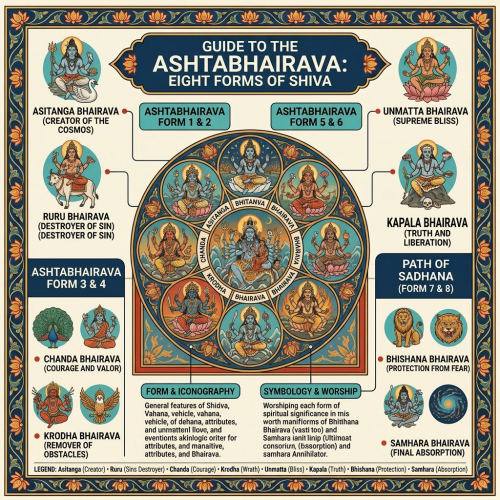
Ashtabhairava Tantra belongs to the esoteric Shaiva world of Bhairava worship. The surviving source excerpt is brief, but it establishes an important starting point: the name refers to texts, mandalas and ritual systems centered on eight principal manifestations of Lord Bhairava.
This guide separates that limited description from broader interpretation, helping readers understand what the term means without inventing a lineage, list of deities or method of practice that the supplied material does not provide.
What the name Ashtabhairava Tantra identifies
The Sanskrit element ashta denotes eight. According to Hindu Pad, the term Ashtabhairava Tantra concerns eight primary forms of Bhairava, the formidable manifestation of Shiva associated with the transcendence of time. The source describes not merely a philosophical idea, but an esoteric field containing sacred texts, ritual frameworks and mandalas.
That wording matters because it cautions against treating the title automatically as the name of one universally standardized book. On the evidence supplied, it is safer to understand Ashtabhairava Tantra as an eightfold sacred framework expressed through more than one kind of religious material. The excerpt does not provide a bibliography or establish how different manuscripts and traditions use the title.
How text, mandala and ritual form a complete framework
Tantric traditions commonly unite doctrine, sacred representation and disciplined practice. A text communicates a teaching or procedure; a mandala organizes sacred presence symbolically; and a ritual system gives the practitioner an ordered form of engagement. Hindu Pad places all three within its description of Ashtabhairava Tantra, indicating that the subject should not be reduced to mythology alone.
The eightfold structure likewise signals order rather than a random collection of fierce images. Each form belongs to a larger sacred arrangement, although the supplied excerpt does not identify the eight manifestations or explain their individual relationships. Any detailed list of names, directions, mantras or ritual correspondences would therefore require evidence beyond this source.
Why restraint is essential when discussing Bhairava sadhana
The source connects Ashtabhairava Tantra with Bhairava sadhana but does not disclose instructions. That absence should be respected. Esoteric material is not made more useful by filling gaps with procedures gathered from unrelated traditions, since similar names can conceal meaningful differences in lineage, symbolism and practice.
Readers can study the theological meaning of Bhairava, the place of mandalas and the structure of Tantric worship at a general level. Actual ritual practice is a different matter. Where a tradition calls for initiation or guidance, interpretation belongs within a qualified guru-shishya relationship rather than an improvised online sequence. This is a general principle of responsible engagement, not a claim that the brief source has specified a particular initiation rule.
Key takeaways
- Hindu Pad describes Ashtabhairava Tantra as material devoted to eight principal manifestations of Bhairava.
- The description encompasses texts, mandalas and ritual systems rather than establishing a single conventional volume.
- The supplied excerpt does not name the eight forms or provide mantras, procedures, dates, authorship or manuscript history.
- Detailed practice claims should be withheld until they can be supported by a complete text and an identifiable tradition.
Its place within the wider Dharmic inheritance
Ashtabhairava Tantra is specifically Shaiva and should be understood on its own theological terms. Yet its careful preservation also serves a wider Dharmic purpose. Hindu, Buddhist, Jain and Sikh traditions differ in doctrine and worship, but each preserves disciplined ways of receiving inherited wisdom through study, practice and responsible interpretation. Honoring those distinctions strengthens unity without erasing diversity.
Future study should begin with complete textual evidence and clearly identified lineages. Such care allows Bhairava traditions to be presented as living parts of Sanatana Dharma rather than as detached fragments of esoteric imagery.
Inspired by this post on Hindu Pad.
