
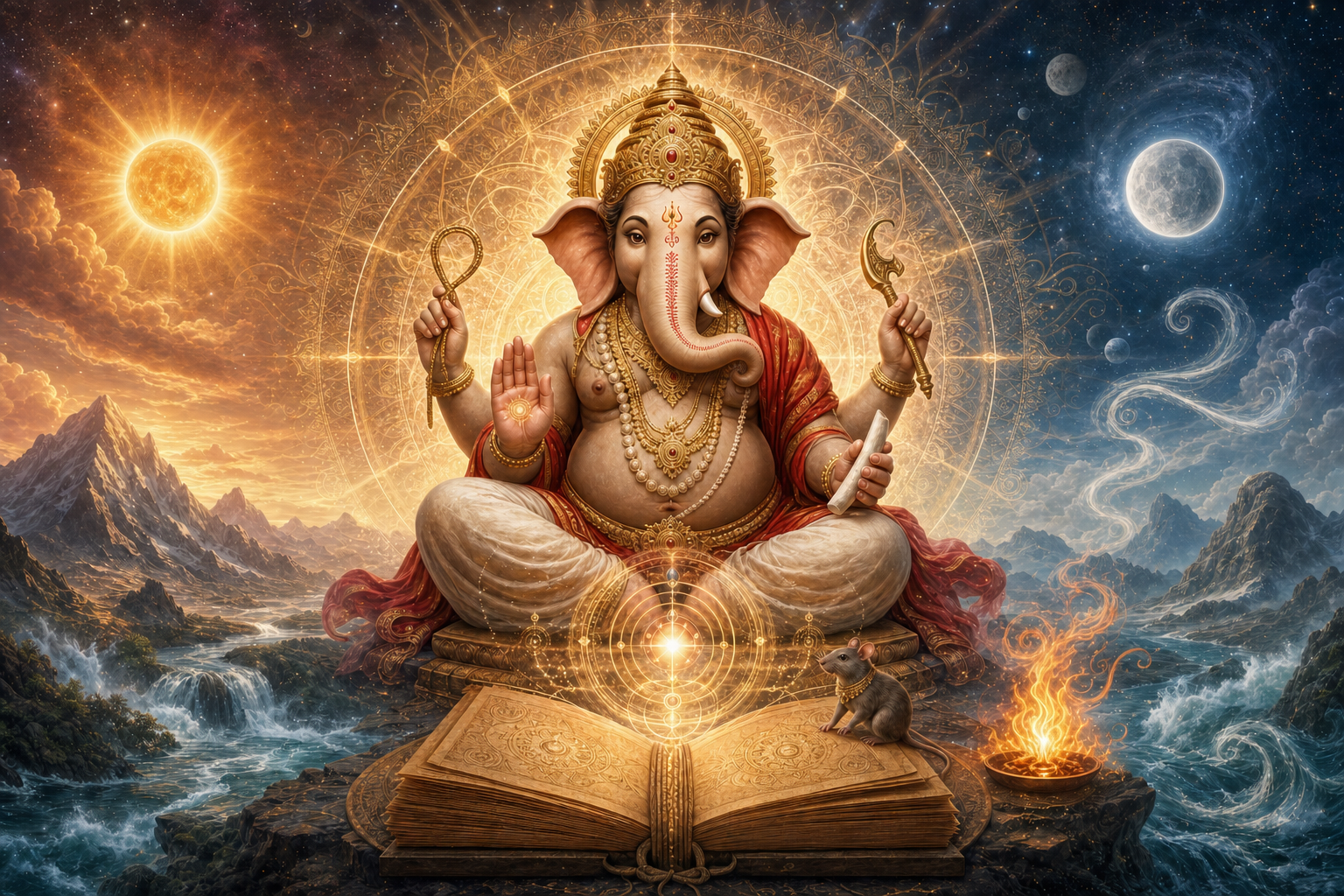
Ganesha stands at the threshold between the visible and the limitless. His familiar elephant-headed form supports devotion, while the Ganapati Atharvashirsha invites the worshipper to contemplate him as consciousness, cosmic order and Brahman itself.
Reading these teachings carefully requires both reverence and textual precision. The Atharvashirsha, the Ganapati Stava and a widely used white-clad invocation illuminate related themes, but they should not be collapsed into one composition or assigned to one author without evidence.
Key takeaways
- Ganesha’s icon is a support for approaching a reality that ultimately exceeds every image.
- The Ganapati Atharvashirsha identifies Ganapati with consciousness, sacred speech, the five elements and several divine powers.
- The Ganapati Stava and the familiar white-clad invocation have distinct textual and liturgical contexts.
- Removing obstacles includes correcting fear, pride, confusion and inadequate preparation.
- Devotion reaches maturity when prayer produces clearer judgment and ethical action.
Form is a doorway rather than a boundary
The Atharvashirsha moves deliberately between rupa, perceptible form, and tattva, the underlying principle. Its visual meditation presents the one-tusked, four-handed Ganesha with a large belly, broad ears, a noose, a goad, a blessing gesture and the mouse emblem. Red garments, fragrance and flowers give the mind concrete features on which to rest.
Yet this precision does not confine the deity to a portrait. The same text presents Ganapati as the reality from which the cosmos arises, in which it abides and to which it returns. Saguna contemplation uses qualities to steady attention; nirguna inquiry asks what remains beyond qualities, concepts and changing conditions. Hindu practice can honor both without treating either as spiritually inferior.
Three devotional sources require three careful readings
HinduPad presents the source material as an excerpt from a satsang by Sri Sri Ravi Shankar, prompted by a question about forms attributed to Shankaracharya. That chain of presentation is not proof that Adi Shankara composed every verse under discussion.
The principal Upanishadic text is the Ganapati Atharvashirsha, also called the Ganapati Upanishad. By contrast, the source locates the passage beginning Ajam nirvikalpam in the Ganapati Stava of the Ganesha Purana’s Upasana Khanda. Popular tradition may associate it with Adi Shankara, but the reported Puranic location makes firm authorship claims unwise.
The familiar invocation describing a white-clad, moon-bright, four-armed and serene figure presents another interpretive question because it does not explicitly name Ganesha. It appears in more than one ritual setting, including contexts associated with Vighneshvara and the Vishnu Sahasranama. Its meaning therefore depends partly on sampradaya and liturgical placement. Textual accuracy protects devotional plurality rather than weakening it.
The Atharvashirsha turns the cosmos into contemplation
The Upanishad identifies Ganapati with earth, water, fire, air and space. These are traditional contemplative categories, not a modern scientific account of matter. They train the devotee to encounter nature as spiritually meaningful and to join reverence with responsible stewardship.

It also relates Ganapati to Brahma, Vishnu, Rudra, Indra, Agni, Vayu, Surya and Chandramas. This inclusive theology does not erase the distinctive mantras, lineages or doctrines of Hindu sampradayas. From within Ganesha devotion, it recognizes diverse divine functions as expressions of a deeper unity.
The text further places Ganapati beyond the three gunas, the waking, dreaming and deep-sleep states, the gross, subtle and causal bodies, and past, present and future. Its theology of sacred speech analyzes the seed syllable through sound, nasal resonance, bindu and nada. Reciting Om Gam Ganapataye Namah can consequently become more than repetition: sound, attention and meaning are brought into one discipline. Traditional claims about mantra’s sacred efficacy should still be distinguished from experimentally established outcomes.
Obstacle removal begins with the traveller
Vighna does not refer only to an unfriendly circumstance. Confusion, impulsiveness, fear, pride, refusal to learn and poor preparation can obstruct a worthy undertaking from within. Ganesha devotion therefore asks for both a passable road and a person capable of walking it.
The icon reinforces this practical reading. The noose may suggest restraint or a drawing toward truth; the goad can signify guidance and correction; the broken tusk may evoke sacrifice or the transformation of loss into wisdom; and the mouse is often read as restless desire brought under intelligent direction. These meanings are interpretive traditions, not a universally fixed symbolic code.
A grounded practice can begin with steady posture, unforced breathing and attention to Ganesha’s serene face. Measured recitation may follow, ideally with pronunciation learned through a reliable text and knowledgeable tradition. Contemplation can then expand through the five elements and every direction before resting briefly in the formless meaning of Ajam nirvikalpam. The final step is concrete: study, plan, seek appropriate professional help or make the ethical correction the situation requires.
Dharmic unity grows through disciplined plurality
These teachings belong specifically to Hindu tradition, yet their emphasis on disciplined attention, wisdom, compassion, self-mastery and ethical conduct offers ground for respectful conversation with Buddhist, Jain and Sikh communities. Genuine dharmic solidarity does not require declaring distinct scriptures or doctrines identical. It grows through mutual protection, intellectual honesty and recognition of shared resistance to destructive impulses.
Approached in this spirit, Ganesha remains both the beloved presence at a new beginning and an invitation to see beyond every limiting division. The next threshold is crossed through devotion joined to discernment, preparation and responsible action.
