,

The Mahabharata’s Rakshasa Vengeance Chain: Bhima’s Fierce Triumph of Dharma

22 min read
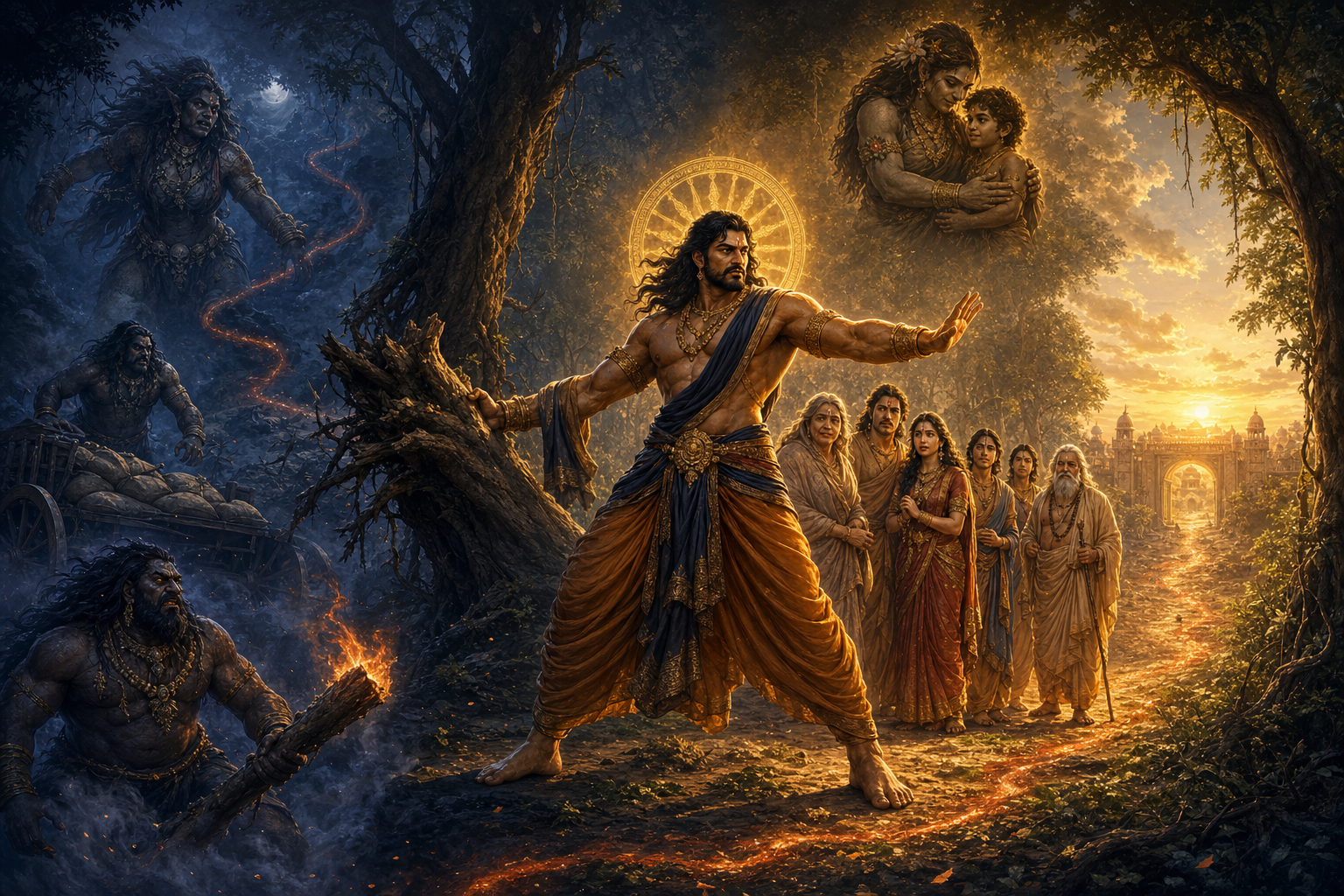
Bhima shields the Pandavas and their family at a forest threshold as three Rakshasas emerge from moonlit shadows beside a path leading to dawn.

Beyond the dynastic war

The Mahabharata is far more than the record of a struggle for the Kuru throne. It is an epic inquiry into dharma: the difficult effort to preserve justice, responsibility, and moral order when ordinary institutions fail. That inquiry is already active long before the armies assemble at Kurukshetra. In forests, villages, and places of exile, the Pandavas repeatedly encounter forms of power that feed upon fear. Among the most graphic of these encounters are Bhima’s battles with the man-eating Rakshasas Hidimba, Baka, and Kirmira.

Read together, the three episodes create a compact drama of predation, protection, kinship, and revenge. Hidimba attacks the Pandavas after their escape from the house of lac. Baka holds the people of Ekachakra under a system of compulsory tribute that includes a human victim. Kirmira later confronts the exiled Pandavas because Bhima killed Baka, his brother, and Hidimba, his friend. The sequence explains why a seemingly isolated forest battle becomes part of a longer Rakshasa vengeance chain.

A necessary correction: network, not a single bloodline

The popular phrase cannibal clan is vivid, but it is not genealogically precise. The Mahabharata identifies Kirmira as Baka’s brother and Hidimba’s friend; it does not state that all three are members of one biological lineage. The more accurate description is a network joined by kinship, friendship, a shared predatory way of life, and Kirmira’s demand for retribution. This distinction matters because the epic carefully separates inherited identity from chosen conduct.

The word Rakshasa must also be handled with care. In Sanskrit epic literature, it names a complex class of beings associated with extraordinary strength, shape-changing, night combat, and other superhuman capacities. It is not simply a synonym for cannibal, nor does every Rakshasa occupy the same moral position. These passages explicitly portray Hidimba, Baka, and Kirmira as consumers or would-be consumers of human flesh. Yet Hidimbi rejects her brother’s command, protects the Pandavas, and becomes Bhima’s partner, while their son Ghatotkacha becomes a devoted Pandava ally. The epic therefore makes conduct, not category alone, morally decisive.

Textual names, spellings, and sequence

English editions vary in spelling. Hidimba may appear as Hidimva; Baka may appear as Vaka or Bakasura; and Kirmira may appear as Kirmeera. Older translations can also use the same form, Hidimva, for the male Rakshasa and his sister, whom modern retellings commonly distinguish as Hidimbi. Section numbers differ between the vulgate, regional recensions, critical editions, and translations. The stable guide is the narrative location: the Hidimva-vadha and Vaka-vadha episodes occur in the Adi Parva, while Kirmira’s vengeance appears near the beginning of the Vana Parva.

1. Hidimba: danger in the forest after the house of lac

The first confrontation begins when the Pandavas are exceptionally vulnerable. They have escaped the combustible house at Varanavata, where a political plot was meant to kill them, and they are moving through the wilderness with Kunti. Exhaustion overcomes the family, but Bhima remains awake as their guard. This setting establishes his characteristic role. He is not seeking conquest, sport, or fame; he is standing between sleeping dependants and an approaching threat.

From a tree, Hidimba detects the presence of human beings and sends his sister Hidimbi to bring them as food. The command is unambiguous, and the threat is immediate. Yet the expected attack does not occur. On seeing Bhima, Hidimbi rejects her brother’s intention, assumes an attractive human form, warns Bhima, and offers to carry the entire family away. Her response is one of the episode’s most important ethical turns: a person living within a violent household refuses to reproduce its violence.

Bhima will not abandon Kunti or his brothers, and he will not wake them merely because an enemy is approaching. His confidence can sound boastful, but its narrative function is protective. Hidimba then arrives, discovers his sister’s refusal, and turns his rage toward her as well as toward the Pandavas. Bhima intervenes before Hidimba can attack Hidimbi. The battle is therefore fought in defence of both his own family and the woman whom her brother now threatens.

The combat is described as close, physical, and destructive. Bhima seizes Hidimba, drags him away so that the noise will not disturb the sleepers, and wrestles with him among breaking trees and creepers. When the family awakens, Arjuna offers assistance. Bhima refuses, intensifies his effort, whirls the Rakshasa, throws him down, bends his body, and kills him. The violence is graphic, but the narrative gives it a defined cause: Hidimba has announced an intention to kill and eat the travellers and has attempted to kill his own sister.

The episode does not end with indiscriminate retaliation. Bhima, still suspicious, initially wants Hidimbi to leave and fears Rakshasa deception. Yudhishthira stops any possibility of violence against her, insisting that anger does not justify killing a woman and that adherence to virtue is more important than fear. This intervention places a boundary around legitimate force. Hidimba’s aggression is answered; Hidimbi’s different choice is recognized.

Kunti then listens to Hidimbi rather than reducing her to her brother’s identity. Hidimbi explains her attachment to Bhima, her separation from the customs of her people, and her willingness to help the family in dangerous terrain. Yudhishthira accepts a regulated union: Bhima may spend the day with her but must return to his family at night, and Bhima agrees to remain until a son is born. The arrangement combines personal desire, family responsibility, and the emergency conditions of exile.

The son is Ghatotkacha, who matures with supernatural speed, honours both parents, and promises to come whenever the Pandavas need him. The supposed enemy household has now produced a defender of the Pandavas. This is not a minor sentimental afterpiece. It overturns any interpretation in which Rakshasa birth automatically determines adharma. Hidimbi’s moral agency creates kinship across a former line of conflict, and Ghatotkacha converts that kinship into service.

Ghatotkacha later assists the family during the forest exile, including by carrying the exhausted Draupadi through difficult country. During the Kurukshetra War, his power in nocturnal combat places the Kaurava army under extreme pressure. Karna ultimately uses the single-use divine missile he had preserved for Arjuna to kill him. Krishna interprets the expenditure of that weapon as strategically decisive for Arjuna’s survival. Thus, the compassion shown to Hidimbi near the beginning of the epic eventually alters the military balance of the great war, though at a devastating cost to Bhima and the Pandavas.

This long consequence gives the Hidimba episode unusual structural importance. An immediate act of protection is followed by restraint; restraint permits relationship; relationship produces Ghatotkacha; and Ghatotkacha’s death in battle protects the Pandava cause. The Mahabharata does not present compassion as passive softness. Properly directed, it becomes a force that changes history within the epic’s own narrative world.

2. Baka of Ekachakra: predation turned into a political system

After the Hidimba encounter, the Pandavas reach Ekachakra and live anonymously in the house of a Brahmin family. Their disguise is essential because the Kauravas believe them dead. They survive by collecting alms and sharing what they receive, with Bhima taking a large portion because of his extraordinary appetite. The domestic quiet of this period makes the discovery of Baka’s regime especially disturbing. Terror has not merely entered the town; it has been normalized through procedure.

Baka controls the surrounding territory through a brutal compact. The population receives protection from other dangers, but each household must, when its turn arrives, send a cartload of rice, two buffaloes, and the human being who delivers them. Refusal brings destruction upon the entire family. This is more than random predation. Baka has transformed appetite into taxation, protection into extortion, and fear into a rotating civic obligation.

The account also criticizes failed kingship. The distressed householder describes the regional ruler as incapable of effective governance. Because lawful authority cannot provide security, an unlawful power fills the vacuum and then claims payment for the order it imposes. In political terms, Baka behaves like a predatory sovereign: he monopolizes violence, extracts resources, and makes the victims administer their own victimization. The arrangement persists because each family faces the crisis separately and only at long intervals.

When the host family’s turn arrives, every member offers to die so that the others may live. Husband, wife, daughter, and even the young son reason through duty, affection, vulnerability, and survival. The scene is emotionally severe because no available choice is morally clean. A system of terror has forced love itself into the language of sacrifice. Readers need no supernatural experience to recognize the underlying anguish: families under coercion often debate how to distribute a danger that none of them created.

Kunti hears their grief and refuses to remain a passive guest. She remembers the shelter the family has provided and treats gratitude as an obligation, not a feeling. She offers one of her five sons in place of the household’s victim, while privately knowing that Bhima has the strength to survive. The host objects because sacrificing a guest to save oneself would violate hospitality. Kunti answers that she is not surrendering a helpless dependent; she is sending a capable protector against an aggressor.

Yudhishthira initially condemns the decision as dangerously rash. Bhima is the family’s principal physical defence and a central hope for recovering the kingdom. If he dies, the moral rescue of one household could expose many others to disaster. Kunti responds with evidence rather than emotion alone: Bhima carried the family away from Varanavata, survived extreme dangers, and killed Hidimba. She also argues that their duty as Kshatriyas includes protecting those who seek refuge, regardless of social rank.

The exchange is a technical exercise in dharmic judgment. Kunti weighs gratitude, protective duty, Bhima’s demonstrated capacity, the scale of public benefit, and the risk to the Pandavas. Yudhishthira weighs parental obligation, collective survival, political strategy, and the danger of overconfidence. Neither position is trivial. The final decision is persuasive because Kunti’s compassion is joined to a realistic assessment of means. Dharma here is not a rule applied without context; it is disciplined reasoning under pressure.

Bhima carries the tribute into the forest but then calmly eats the food himself while calling for Baka. This famous act is comic, provocative, and symbolically exact. Baka’s power depends upon controlling who eats and who is eaten. By consuming the tribute, Bhima rejects both parts of that order. He refuses to behave as victim, courier, or taxpayer, and he makes the tyrant watch his claimed entitlement disappear.

Baka strikes Bhima from behind, yet Bhima finishes the meal, washes, and only then turns to fight. Trees become weapons before the struggle closes into wrestling. As Baka tires, Bhima pins him, places a knee against his back, grips his neck and waist, and bends him until his body breaks. The repeated emphasis on fatigue and leverage is significant. Bhima does not win merely because the poem calls him strong; the combat has a sequence of endurance, positional control, and decisive force.

What follows is as important as the killing. Baka’s relatives and attendants emerge in terror, but Bhima does not exterminate them. He requires a promise that they will stop killing human beings and warns that renewed predation will bring the same consequence. They agree, and the text reports peaceful relations thereafter. The resolution combines deterrence with behavioural reform. The target is not an entire species or family; it is the practice of consuming and terrorizing people.

Bhima drags Baka’s body to the town gate and leaves without revealing himself. The body becomes public proof that the seemingly permanent regime has ended. The grateful host protects the Pandavas’ disguise by attributing the deed to an unnamed, mantra-skilled Brahmin. Ekachakra celebrates liberation without knowing its liberator. Bhima receives no throne, payment, or public ceremony. This anonymity distinguishes protection from self-promotion and keeps the act aligned with the family’s larger need for survival.

The Baka episode consequently joins household ethics to political theory. A guest repays hospitality; a warrior assumes risk; a mother makes a strategic moral decision; a town discovers that institutionalized terror can end; and the relatives of the aggressor receive a path back to peaceful life. Valor is present, but the victory of dharma lies in the restoration of ordinary human security.

3. Kirmira: vengeance enters the Kamyaka forest

Kirmira’s appearance comes much later in the story, after the dice game, Draupadi’s humiliation in the Kuru assembly, and the beginning of the Pandavas’ long forest exile. The narrative deliberately reconnects this new crisis to Bhima’s earlier victories. What seemed finished at Ekachakra returns as a grievance carried by a surviving brother. Kirmira turns memory into a claim upon Bhima’s life.

The account is framed through several narrators. Dhritarashtra asks Vidura how Kirmira was killed, and Vidura recounts what he learned from the Pandavas and accompanying Brahmins. This framing changes the political meaning of the event. Bhima’s forest victory is not confined to the forest; news of it reaches Hastinapura, where it deepens awareness of Pandava strength. A personal defence of the exiles becomes strategic information at court.

The confrontation occurs after midnight as the Pandavas enter the Kamyaka forest. Kirmira blocks the path with a burning brand, violent sound, dust, darkness, and Rakshasa illusion. Animals scatter, and Draupadi closes her eyes in fear while the brothers support her. The detail carries emotional weight because she has only recently endured public assault and forced exile. The forest threat arrives before the wounds of the court have had time to close.

Dhaumya first neutralizes the illusion with protective mantras. Only after the manufactured terror has been dispersed does Yudhishthira ask the stranger to identify himself and state his purpose. The order is instructive: perception must be cleared before judgment can begin. Spiritual discipline, rational inquiry, and physical courage function together rather than competing for authority.

Kirmira identifies himself as Baka’s brother and declares that he survives by defeating and eating human beings. Once Yudhishthira names the Pandavas, Kirmira recognizes the opportunity he has sought. He says that Bhima killed his brother Baka and his dear friend Hidimba, and he intends to satisfy the debt of vengeance by killing and consuming Bhima. This declaration supplies the only explicit link among the three male Rakshasas.

His speech also demonstrates how vengeance rewrites memory. Kirmira depicts Bhima as cowardly, minimizes Baka’s coercive rule, and alleges that Bhima took Hidimbi by force after killing her brother. The earlier Adi Parva narrative shows the opposite: Hidimbi chose Bhima, warned the Pandavas, requested the relationship, and received Kunti’s and Yudhishthira’s consent. Kirmira’s grievance contains real bereavement, but grief has been organized into a distorted moral account that erases the agency of victims and survivors.

This distinction separates revenge from justice. Kirmira does not seek an impartial hearing, protection for others, or an end to future harm. He announces beforehand that he eats travellers, and he plans to devour Bhima in front of Bhima’s family. His family loyalty therefore cannot legitimize his purpose. Affection is morally serious in the Mahabharata, but affection detached from truth and restraint can become an engine of adharma.

Yudhishthira rejects the threat. Arjuna strings the Gandiva, but Bhima asks him to stand aside and meets Kirmira himself. The choice is more than pride. Kirmira’s challenge is directed at Bhima, and Bhima is the family member best suited to a wrestling contest against a massive opponent at close range. The brothers nevertheless remain present, showing that individual heroism operates inside collective protection.

The battle escalates through distinct stages. Bhima strikes with an uprooted tree; Kirmira answers with a burning brand and trees of his own. A rock fails to move Bhima. The opponents then grapple like powerful animals. Bhima throws Kirmira down, grips his waist, whirls him until exhaustion and disorientation set in, restrains him with his arms, presses a knee into his body, and crushes his neck. As in the Baka fight, the poem emphasizes endurance, balance, exhaustion, and control rather than an unexplained miraculous blow.

With Kirmira’s death, the immediate vengeance chain ends. The Pandavas enter a forest now freed from a predator, and Draupadi is comforted by the family’s survival. The account does not portray Bhima hunting Kirmira’s wider associates or seeking payment for previous injuries. He responds to an armed obstruction and an announced intention to kill. The limit of the action remains protection.

Bhima’s recurring role: strength placed under moral direction

Across all three encounters, Bhima functions as the Pandavas’ embodied shield. He remains awake when others sleep, accepts the tribute mission that would kill an ordinary courier, and confronts Kirmira when the family is newly exiled and emotionally shattered. His physical power is immense, but the epic does not leave it morally self-justifying. Kunti, Yudhishthira, Arjuna, Draupadi, and Dhaumya provide context, restraint, counsel, witness, and purpose.

This distributed agency is crucial. Kunti recognizes the obligation to the host family. Yudhishthira tests the risk and prevents violence against Hidimbi. Dhaumya breaks Kirmira’s illusion. Arjuna stands ready to intervene. Draupadi’s vulnerability makes the cost of failure visible. Bhima supplies the force that the situation finally requires. Dharma emerges through coordinated faculties: compassion identifies the suffering, reason examines the duty, knowledge clears deception, and courage acts.

Bhima’s anger is likewise neither denied nor romanticized. In the Kirmira fight, memories of the humiliation inflicted by Duryodhana intensify his strength. That emotional energy is dangerous, but it is directed against an assailant who has openly threatened the family. The broader epic repeatedly asks whether wrath serves justice or consumes judgment. Here, anger remains bounded by a protective task; elsewhere in the Mahabharata, the same emotion can drive catastrophe.

Dharma is not passivity, and force is not automatically dharmic

These episodes resist two simplistic conclusions. First, dharma does not require helpless submission to violence. Hidimba, Baka, and Kirmira each present an imminent or continuing lethal threat, and Bhima stops them by force. Second, victory in combat is not enough to prove righteousness. The surrounding decisions establish the difference between defence and domination: Hidimbi is spared, Baka’s relatives are offered peace, the people of Ekachakra are liberated, and Kirmira is fought only after his purpose is stated.

The Sanskrit concept of dharma carries meanings that no single English term can exhaust, including duty, right conduct, sustaining order, and justice appropriate to role and circumstance. In these narratives, its practical marks are recognizable. Power protects the vulnerable, gratitude becomes service, evidence disciplines confidence, punishment ends predation, and restraint prevents collective blame. Adharma reverses those relations by converting strength into appetite and dependence into tribute.

Food, appetite, and the moral economy of the episodes

Food is not decorative imagery in this sequence. Hidimba smells sleeping humans as prey. Baka makes an entire town organize food and a human life into scheduled tribute. Kirmira identifies travellers as food before he knows their names. In each case, another person is reduced from a moral subject to an object of appetite. Cannibalism therefore represents more than physical horror; it is the extreme form of a social relation in which power recognizes no reciprocal obligation.

Bhima’s own famous appetite creates an intentional contrast. He eats a large share of the family’s alms, and he consumes Baka’s tribute in full view of its supposed owner. Yet his appetite remains inside human relationships of sharing, gratitude, and protection. The distinction is not between hunger and purity. It is between receiving nourishment within a moral community and consuming the community itself.

Forests, gates, and contested boundaries

Each confrontation occurs at a boundary. Hidimba approaches a displaced family between political centres. Baka lives outside Ekachakra but governs life inside it through fear. Kirmira blocks the entrance to Kamyaka. These spaces are neither fully domestic nor securely royal. The failures of court and kingship expose travellers and townspeople to alternative powers. Bhima repeatedly restores passage: the family can continue, the town gate no longer marks a road to sacrifice, and the exiles can enter the forest.

The public placement of Baka’s body at the gate is especially precise. A gate usually controls admission and exclusion; under Baka’s system, it also marks the movement of tribute from town to predator. Bhima reverses that movement by bringing the defeated predator back to the civic boundary. Fear that once travelled outward as payment returns as evidence that coercion has ended.

Vengeance, memory, and the ethics of narration

Kirmira’s accusation reveals that every violent event can generate competing narratives. From the Pandava perspective, Bhima stopped three predators. From Kirmira’s perspective, a brother and friend were killed, and revenge became a sacred debt. The epic allows the grievance to be spoken but does not treat all accounts as equally accurate. It invites comparison with previously narrated events, particularly Hidimbi’s explicit choice and Baka’s exploitation of Ekachakra.

This is an enduring lesson in historical and ethical reading. Emotional sincerity does not guarantee factual completeness. A narrative can arise from genuine grief and still erase context, agency, and prior harm. Justice requires memory that is broad enough to include the people whom vengeance would prefer to forget.

Women are decision-makers, not merely reasons for male combat

Hidimbi and Kunti substantially determine the course of these events. Hidimbi refuses an order to kill, warns the family, chooses Bhima, and offers material help. Kunti converts hospitality into a public rescue, evaluates Bhima’s capacity, and persuades Yudhishthira. Draupadi’s fear at Kamyaka is not a sign of moral weakness; it registers the cumulative cost of violence after the assembly outrage. Their experiences supply the ethical stakes that physical descriptions of combat alone cannot provide.

Kirmira’s false claim that Hidimbi was taken by force is therefore revealing. Revenge simplifies a woman with demonstrated agency into property transferred between men. A close reading corrects that erasure. The alliance between Hidimbi and the Pandavas begins with her refusal, her warning, and her petition; it continues through a negotiated arrangement and the acknowledged kinship of Ghatotkacha.

Birth does not settle moral worth

The contrast between Hidimba and Hidimbi is immediate, while the contrast between Kirmira and Ghatotkacha unfolds across generations. Individuals who share Rakshasa identity make radically different choices. Some hunt human beings; others protect them, form loyal relationships, and accept mortal risk in battle. The moral field of the Mahabharata is consequently plural and dynamic. No community is reduced without remainder to its worst representative.

This point supports a constructive reading across Dharmic traditions without pretending that Hinduism, Buddhism, Jainism, and Sikhism possess identical doctrines. Each tradition has its own scriptures, histories, disciplines, and understandings of liberation. Yet the refusal of collective blame, the effort to restrain hatred, the protection of life, moral courage, and accountability for conduct offer a respectful basis for dialogue. Unity is strongest when difference is acknowledged rather than erased.

A contemporary ethical reading

The Rakshasa battles should not be flattened into direct allegories for modern ethnic, religious, or political groups. Their value lies in the questions they stage. What happens when formal government cannot protect a town? When does gratitude require personal risk? How can a community end predation without condemning every relative of the aggressor? How does grief become propaganda? What disciplines must guide strength before it becomes another form of domination?

The Baka narrative is particularly relevant to systems of normalized coercion. People can become trapped when danger is distributed in isolated turns, when a weak authority outsources security, and when compliance seems safer than collective resistance. The story’s answer is not a universal policy prescription; it is an ethical model in which unusual capacity creates unusual responsibility. Bhima’s strength becomes meaningful because it is used to remove a burden that ordinary families cannot bear.

Kirmira’s story offers a complementary warning. Cycles of vengeance survive by narrowing memory to one’s own dead and one’s own pain. The antidote is not indifference to loss but a fuller account of causes, choices, and victims. The Mahabharata grants Kirmira a voice, then places that voice beside the events readers already know. Such narrative comparison is itself a discipline of justice.

What triumph actually means

The triumph of dharma in these episodes is real but limited. Three threats are ended, a town is liberated, a forest becomes passable, and the Pandavas survive. Yet exile continues, Ghatotkacha will eventually die, and the greater Kuru conflict remains unresolved. The epic rarely offers permanent moral comfort. A right action can secure the next necessary space for life without abolishing suffering from the world.

That limitation makes Bhima’s valor more compelling. He does not solve every injustice, nor does physical strength answer every question. He performs the task immediately before him: guarding sleepers, repaying a host, breaking an extortion system, and stopping a revenge attack. Dharma advances through such concrete acts, judged by motive, means, context, and consequence.

Conclusion: the vengeance chain ends where moral discrimination begins

The linked stories of Hidimba, Baka, and Kirmira are not a simple catalogue of monsters defeated by a stronger hero. They form a study of how predatory power operates: through sudden attack, institutional tribute, and inherited revenge. Bhima defeats each form physically, but the Pandavas’ deeper success depends upon moral discrimination. They distinguish Hidimbi from Hidimba, Baka’s relatives who accept peace from Baka’s continued predation, grief from justice, and protective force from indiscriminate violence.

The most durable outcome is therefore not the death of a so-called cannibal clan. It is the survival of a different lineage of action. Hidimbi’s refusal produces Ghatotkacha’s loyalty. Kunti’s gratitude liberates Ekachakra. Yudhishthira’s restraint prevents fear from becoming collective punishment. Dhaumya’s discipline clears illusion. Bhima’s strength gives all of these choices practical force. Vengeance ends when courage is governed by truth, compassion, and dharma.

Textual basis for further reading

The narrative details above follow Kisari Mohan Ganguli’s public-domain English translation, especially the Hidimva-vadha Parva, the Vaka-vadha Parva, and Vana Parva, section XI on Kirmira. Ghatotkacha’s final battle and Karna’s use of the divine dart appear in the Ghatotkacha-vadha portion of the Drona Parva. Readers comparing editions should expect differences in transliteration, chapter numbering, and occasional interpretive wording.


Inspired by this post on Hindu Blog.


Graphic with an orange DONATE button and heart icons on a dark mandala background. Overlay text asks to support dharma-renaissance.org in reviving and sharing dharmic wisdom. Cultural Insights, Personal Reflections.

FAQs

Are Hidimba, Baka, and Kirmira members of one Rakshasa bloodline?

The article says no common biological lineage is established. Kirmira is identified as Baka’s brother and Hidimba’s friend, so “vengeance network” is more accurate than “cannibal clan.”

Why does the article say conduct, not Rakshasa birth, determines moral standing?

Hidimba, Baka, and Kirmira threaten or consume human beings, but Hidimbi rejects her brother’s command, protects the Pandavas, and chooses a relationship with Bhima. Their son Ghatotkacha later becomes a devoted Pandava ally, showing that inherited category does not determine conduct.

Why does Kunti send Bhima to confront Baka at Ekachakra?

Kunti treats the host family’s hospitality as creating a duty of gratitude and believes Kshatriyas must protect those who seek refuge. She chooses Bhima because his previous feats demonstrate that he is a capable protector, not a helpless substitute victim.

What does Baka’s tribute system reveal about failed kingship?

Each household must provide a cartload of rice, two buffaloes, and a human victim in exchange for protection, while the lawful ruler cannot secure the region. The article reads this as predatory sovereignty: violence becomes extortion, and the victims are forced to administer their own victimization.

How does Bhima respond to Baka’s relatives after killing Baka?

Bhima does not kill them. He requires them to stop killing human beings and warns that renewed predation will bring the same consequence, directing force at the harmful practice rather than an entire family or class.

Why is Kirmira’s revenge presented as different from justice?

Kirmira distorts the earlier events, erases Hidimbi’s agency, and seeks to kill and consume Bhima rather than protect anyone or seek an impartial judgment. His genuine grief therefore becomes a moral claim detached from truth and restraint.

What unites Bhima’s battles with Hidimba, Baka, and Kirmira?

In each episode, Bhima uses strength to answer an immediate threat: he guards vulnerable family members, frees Ekachakra from coercion, or clears the Pandavas’ path through Kamyaka. The article presents his force as protective and bounded, not as conquest or an effort to perpetuate a blood feud.

Leave a Reply