
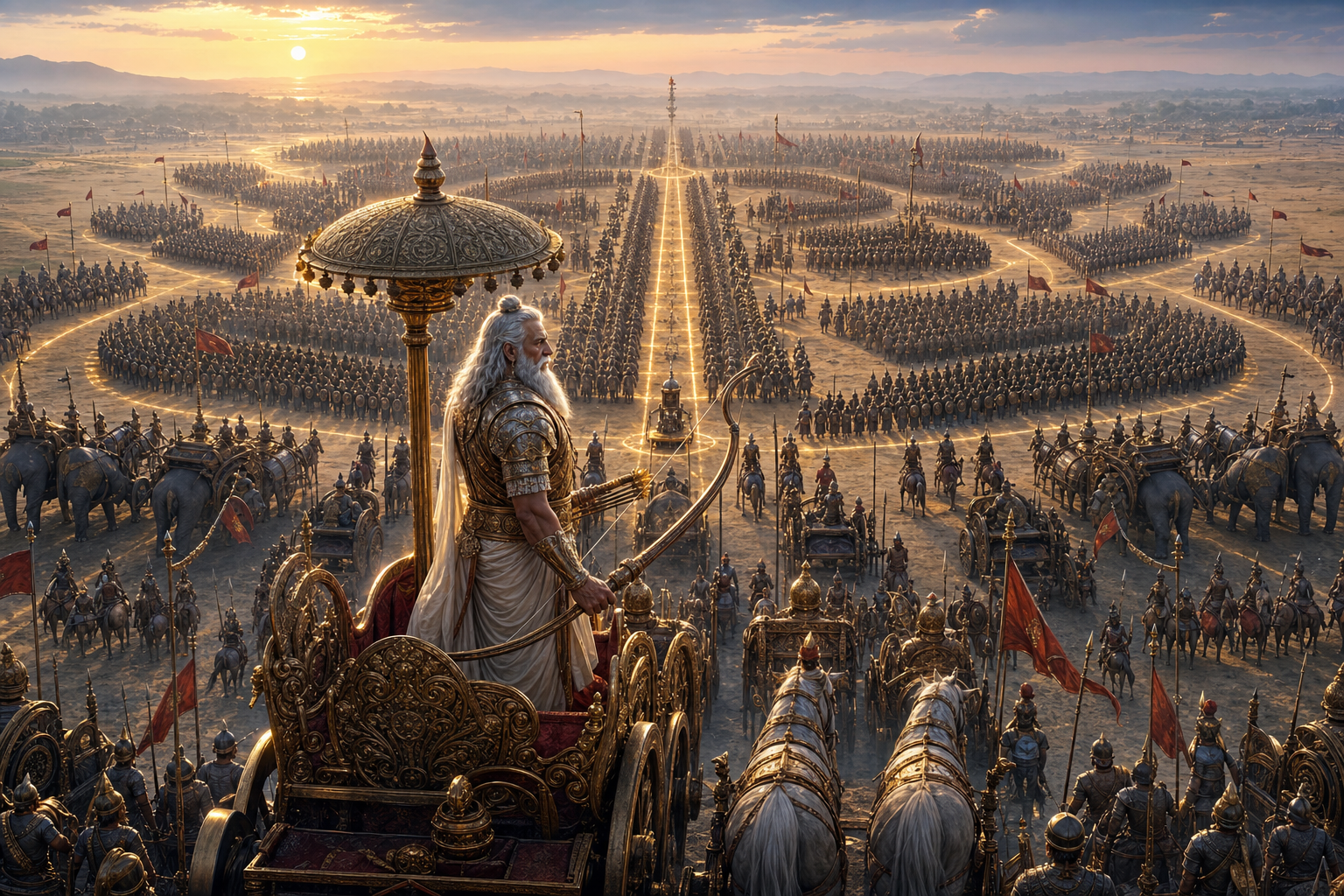
The first day of the Kurukshetra war is often remembered for its emotional weight: elders stood against pupils, cousins against cousins, and warriors bound by affection entered a battlefield governed by duty. Yet beneath that emotional drama lay a disciplined military science. The armies did not simply rush at one another. They entered battle through carefully arranged formations known as vyuha, and Bhishma, commander of the Kaurava army, opened the war with a formation traditionally remembered as the Sarvatomukhi Dand Vyuha.
The term Sarvatomukhi suggests an arrangement that faces in all directions. Dand means rod, staff, or disciplined line of force. Taken together, Sarvatomukhi Dand Vyuha may be understood as an all-facing rod formation: a compact, alert, and multi-directional battle array intended to resist attack from any side while preserving the army’s forward striking capacity. In the context of the Mahabharata, this was not merely a geometric shape. It was a statement of command philosophy.
Bhishma’s position on the first day must be understood carefully. He was not a reckless general seeking a quick victory through uncontrolled aggression. He was an elder statesman of war, a master of weapons, and a guardian of royal order, even while standing on the morally troubled side of Duryodhana. His opening formation therefore needed to perform several functions at once: protect a vast army, preserve discipline among many kings and divisions, respond to the Pandava challenge, and create psychological confidence in the Kaurava ranks.
The Kurukshetra war, spanning eighteen days, was governed by the science of vyuha rachana, or battle array formation. Each day’s combat began with a deliberate arrangement suited to the commanders, terrain, troop strength, objectives, and expected enemy response. The Mahabharata describes several such formations, including Chakra Vyuha, Makara Vyuha, Garuda Vyuha, Krauncha Vyuha, Vajra Vyuha, and Padma Vyuha. These names were not ornamental labels alone. They indicated patterns of movement, concentration, protection, penetration, and counter-attack.
The Sarvatomukhi Dand Vyuha is especially significant because it reflects the tension of the first day. A commander opening an eighteen-day war could not afford immediate disarray. Bhishma had to ensure that his forces did not expose a vulnerable flank to Arjuna, Bhima, Satyaki, Dhrishtadyumna, or the other powerful Pandava warriors. An all-facing structure was therefore appropriate for a battlefield in which danger could emerge from any direction.
In military terms, the formation may be read as a controlled defensive-offensive system. The dand element suggests a strong central axis, a disciplined line capable of pushing forward. The Sarvatomukhi element suggests vigilance on all sides, with the outer components arranged to answer attacks from the front, rear, and flanks. Such a formation would be valuable when an army had numerical strength but also needed cohesion across a broad field.
The Kaurava army was vast, but size alone does not guarantee battlefield effectiveness. Large armies can become slow, confused, and vulnerable if command signals fail or if individual divisions act without coordination. Bhishma’s formation addressed this problem by creating a structure in which multiple faces of the army could remain battle-ready. It was a shield, but not a passive shield. It allowed defensive stability while retaining the ability to strike through selected points.
The first day also carried psychological importance. The Pandavas were fewer in number, yet they possessed extraordinary warriors and moral confidence. The Kauravas had a larger army, but their unity depended heavily on Bhishma’s authority. By deploying a formation that appeared secure from all sides, Bhishma communicated order, control, and preparedness. The soldiers could see that their commander had not entered battle impulsively. He had created a system.
For readers of the Mahabharata, this is one of the most striking lessons of Kurukshetra: emotion and strategy are never separated. The battlefield is filled with grief, vows, anger, loyalty, and moral confusion, yet the actual conduct of war remains disciplined. Bhishma’s Sarvatomukhi Dand Vyuha stands at that intersection. It is both a military arrangement and a reflection of an old warrior’s effort to impose order upon a tragic conflict.
The technical logic of the formation can be approached through four major principles: all-directional readiness, central strength, controlled movement, and layered protection. All-directional readiness prevented surprise. Central strength preserved the army’s command and offensive power. Controlled movement reduced disorder in a large force. Layered protection ensured that important commanders and divisions were not immediately isolated by enemy attacks.
All-directional readiness was essential because the Pandavas were not dependent on a single point of attack. Arjuna could penetrate formations with speed and precision. Bhima could break through dense infantry and elephant divisions by force. Dhrishtadyumna, commander of the Pandava army, had both strategic responsibility and personal motivation. Satyaki brought mobility and skill. A rigid formation facing only one direction would have been dangerously exposed.
The central axis of the Dand Vyuha gave Bhishma the ability to maintain command focus. In ancient Indian military thought, the center of a formation was not merely a physical middle. It was the place where authority, communication, and morale were concentrated. If the center collapsed, the rest of the army could fragment. By holding the center strongly, Bhishma protected the organizational heart of the Kaurava army.
The layered nature of such a formation also matters. Ancient armies consisted of chariots, elephants, cavalry, and infantry, each with different strengths and vulnerabilities. Chariots provided mobility and archery power. Elephants could break enemy ranks but required control. Cavalry could move rapidly across the field. Infantry provided mass and endurance. A sophisticated vyuha arranged these elements so that one arm supported another rather than obstructing it.
In this sense, Sarvatomukhi Dand Vyuha was not a flat diagram. It was a living battlefield organism. Its value depended on timing, discipline, command clarity, and the skill of warriors placed at crucial points. The Mahabharata repeatedly shows that a formation is only as effective as the people who hold it. A weak commander can ruin a strong array, while a powerful warrior can disrupt even a carefully built structure.
Bhishma’s personal presence gave the formation credibility. He was among the greatest warriors in the epic, revered by both armies. His banner, weapons, and reputation carried immense symbolic force. When such a commander stood within a carefully arranged formation, the formation became more than tactical design. It became a moral and psychological anchor for the soldiers who depended on him.
At the same time, the formation reveals the limitations of strategy when dharma is unsettled. Bhishma could create order on the battlefield, but he could not resolve the deeper injustice that had led to war. This is one reason the Mahabharata remains a profound text rather than a simple war chronicle. It shows that technical excellence, military discipline, and personal greatness do not automatically remove moral complexity.
The phrase Sarvatomukhi also carries a wider philosophical resonance. An all-facing formation suggests awareness in every direction. In dharmic traditions, vigilance is not only military. It is ethical and spiritual. A person, family, institution, or society must learn to face challenges from many sides: desire, anger, pride, fear, confusion, and attachment. The battlefield of Kurukshetra therefore becomes a mirror for inner discipline as much as outer war.
This broader reading should not erase the historical-military meaning of the formation. Rather, it deepens it. The Mahabharata often works on several levels at once. It can be read as history, epic literature, political instruction, ethical inquiry, and spiritual teaching. The Sarvatomukhi Dand Vyuha belongs to the military layer, but it also invites reflection on preparedness, responsibility, and the cost of conflict.
From a strategic perspective, Bhishma’s choice was conservative but powerful. On the first day, he did not need to gamble. He needed to establish dominance, test the Pandava response, and preserve the Kaurava army’s massive structure. A formation open to all directions allowed him to manage uncertainty. In modern language, it created resilience, redundancy, and situational awareness.
The comparison with modern military thinking is useful if handled cautiously. Ancient vyuha systems were shaped by chariots, elephants, bows, maces, swords, conches, drums, and visual command signals. Modern armies use mechanized units, aircraft, satellites, and electronic communication. Yet the underlying principles remain recognizable: protect the center, secure the flanks, maintain reserves, coordinate movement, and prevent the enemy from dictating the terms of engagement.
Bhishma’s formation also demonstrates how Indian epics preserved technical knowledge through narrative memory. The Mahabharata is not a modern military manual, and its descriptions are often poetic, symbolic, and embedded within dramatic storytelling. Nevertheless, its repeated attention to formations shows that warfare was understood as an organized science. Courage mattered, but courage without arrangement could become wasteful.
The first day of Kurukshetra therefore begins with a lesson in discipline. Before the arrows fly, before individual duels dominate the narrative, the armies stand arranged according to thought. This moment is easy to overlook because later episodes, such as Arjuna’s crisis, Bhishma’s fall, Abhimanyu’s entry into Chakra Vyuha, and Karna’s battles, often receive more attention. Yet the opening formation sets the tone for the entire war.
In the Sarvatomukhi Dand Vyuha, Bhishma appears as a commander who understood both danger and duty. He knew the Pandavas were formidable. He knew Arjuna’s skill. He knew Krishna’s presence changed the moral and strategic atmosphere of the battlefield. His response was not panic but structure. The formation became his first answer to uncertainty.
The emotional dimension of this cannot be ignored. Bhishma loved the Pandavas, yet he fought for the throne of Hastinapura. His life was defined by vows, and those vows bound him to a painful role. The all-facing formation can be read as an image of his own condition: guarded on every side, disciplined, powerful, but surrounded by moral pressure that no battlefield geometry could fully contain.
For students of Mahabharata interpretation, this point is crucial. Bhishma should not be reduced either to a flawless hero or to a simple supporter of adharma. The epic presents him as a towering but tragic figure. His military genius is real. His personal sacrifice is real. His failure to prevent injustice is also real. The Sarvatomukhi Dand Vyuha belongs to this complexity.
The formation also highlights the importance of leadership under pressure. A leader’s first decision in a crisis often shapes the confidence of everyone who follows. Bhishma’s arrangement told the Kaurava army that the war would begin with discipline, not disorder. Even those who disagreed among themselves could temporarily function within the framework he established.
There is a valuable civilizational lesson here for all dharmic traditions. Hindu, Buddhist, Jain, and Sikh thought each places great importance on discipline, awareness, restraint, and responsibility, though expressed through different vocabularies and practices. The study of Kurukshetra need not glorify violence. It can instead illuminate the heavy responsibility that accompanies power and the need to align strength with dharma.
The Mahabharata’s treatment of war is not simplistic celebration. It repeatedly shows that victory comes at a cost and that even righteous struggle leaves wounds. The study of formations such as Sarvatomukhi Dand Vyuha should therefore be approached with seriousness. The technical brilliance of ancient Indian military strategy must be acknowledged, but so must the epic’s deeper warning: when dialogue fails and adharma hardens, even the most disciplined societies may be drawn into devastating conflict.
As a battlefield design, Sarvatomukhi Dand Vyuha reveals Bhishma’s tactical mind. As a narrative moment, it reveals the gravity of the war’s beginning. As a cultural memory, it preserves the sophistication of vyuha rachana in the Indian epic tradition. As an ethical symbol, it reminds readers that true preparedness requires more than strength. It requires awareness in every direction, including inward.
The enduring relevance of Bhishma’s opening strategy lies in this layered meaning. A society, like an army, must know how to organize its energies. It must protect what is central, remain alert to threats, avoid needless aggression, and maintain discipline when emotions are high. The Sarvatomukhi Dand Vyuha becomes a powerful metaphor for civilizational steadiness: firm at the center, watchful at the edges, and guided by a higher sense of responsibility.
On the first day of Kurukshetra, Bhishma did not merely place soldiers on a field. He arranged memory, authority, fear, loyalty, and strategy into visible form. The Sarvatomukhi Dand Vyuha was his opening declaration that the war would be fought through intellect as well as force. Its study continues to reward careful attention because it shows the Mahabharata at its best: technically rich, emotionally intense, ethically demanding, and deeply rooted in the search for dharma.
Inspired by this post on Hindu Blog.
