
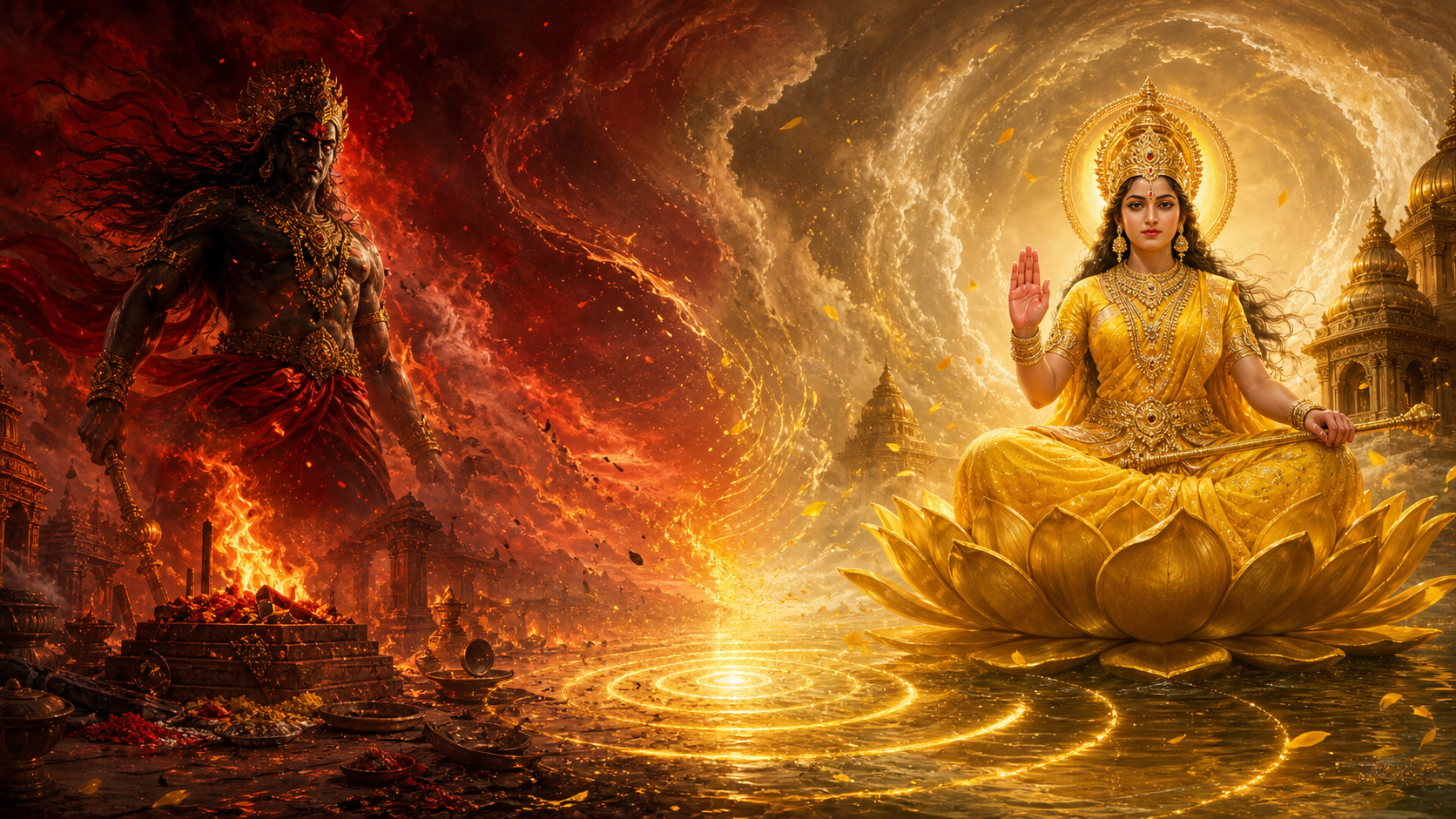
What does divine power look like when order has already failed? Two Hindu sacred narratives answer through sharply different images: the fury released after Sati’s death at Daksha’s sacrifice and the stilling power through which Goddess Bagalamukhi arrests a cosmic storm.
Read together, the accounts present more than a contrast between violence and calm. They distinguish destructive force from corrective power, show how apparently sacred structures can harbor disorder, and place restraint alongside confrontation as a mode of cosmic repair.
Disorder can arise inside ritual or through uncontrolled motion
The two narratives locate crisis in different settings. In DharmaRenaissance’s account of Sati and Shiva’s ganas, Daksha’s yajna should align human conduct, divine presence, and cosmic order. Instead, pride and deliberate exclusion turn the sacrifice into a setting for contempt. In the article about Bagalamukhi, a violent universal storm threatens the fabric within which life, ritual, speech, and consciousness remain ordered.
This difference matters. Daksha’s crisis is disorder disguised as order: the rites continue, but their moral center has failed. The cosmic storm is disorder as runaway movement: energy has become destabilizing because it no longer operates within rhythm or restraint. In neither case is the fundamental problem simply a shortage of power. It is power, authority, or activity severed from a dharmic relationship.
The synthesis therefore complicates any simple opposition between order and chaos. Formal order can conceal adharma, while intense force is not automatically corrupt. The decisive question is whether authority, ritual, emotion, speech, and movement remain answerable to a sacred center.
Sacred fury reveals the failure of Daksha’s sacrifice
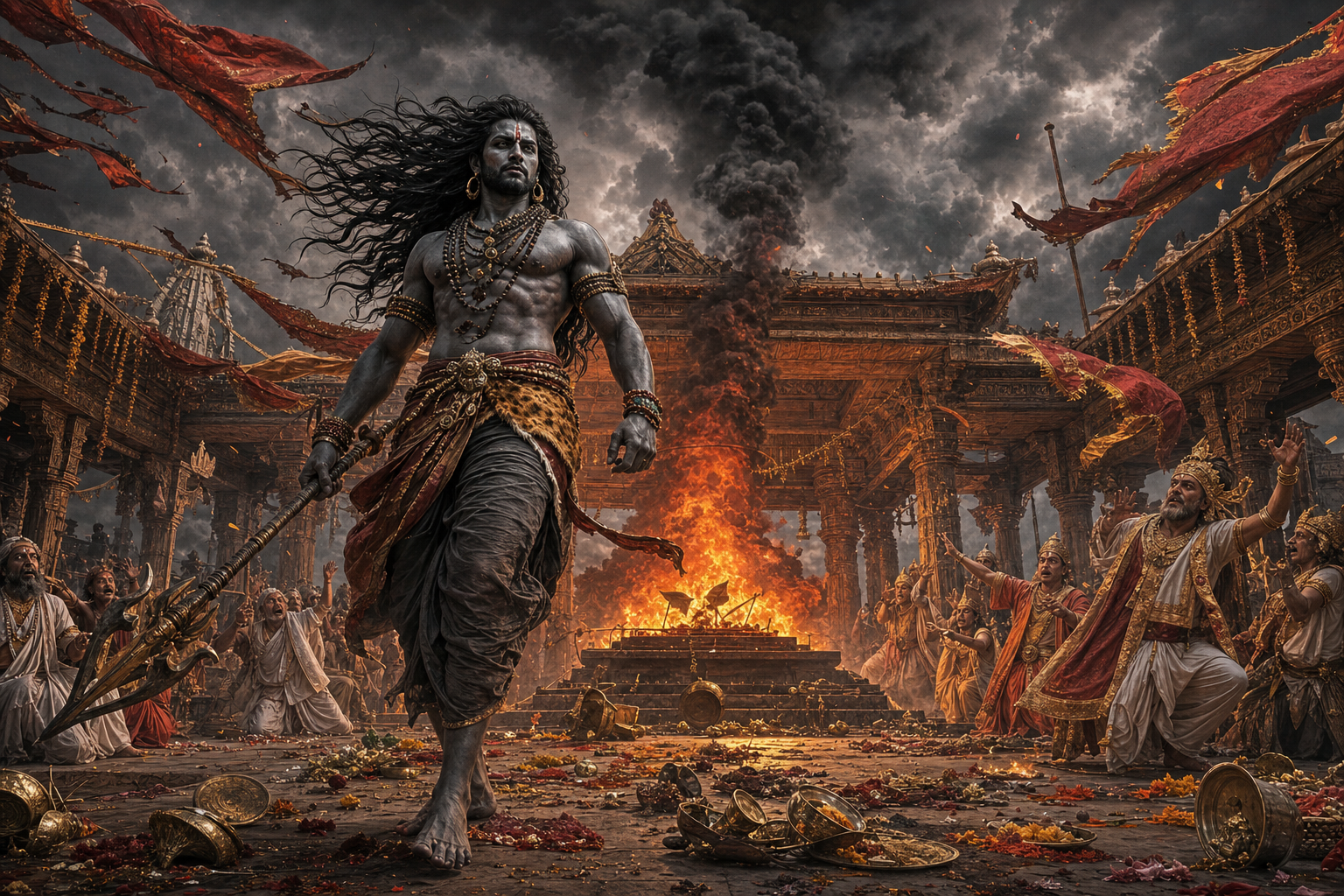
The article on Sati associates its account with the Skanda Purana’s Kedara Khanda sequence, particularly Chapter 3, verses 24 to 30. It presents Sati’s death not merely as a family tragedy but as a theological rupture. Because Sati embodies Shakti, her humiliation and withdrawal expose the sacrifice’s deeper defect: a ritual cannot remain whole while divine presence is treated with contempt.
Sati is consequently more than the passive object of Daksha’s hostility. In the source’s interpretation, she protests, judges the assembly, and refuses to sustain a bodily connection to a lineage that dishonors Shiva. Her withdrawal makes visible what ceremonial prestige had concealed. Priests, offerings, mantras, and fire cannot by themselves convert arrogance into sacred order.
The ganas respond from their own liminal position. The source describes them as Shiva’s fierce and unconventional attendants, associated with thresholds, wildness, cremation grounds, and beings rejected by respectable society. Their grief follows from total belonging to Shiva’s world. When the bond of Shiva and Shakti appears ruptured, they experience the event as a collapse of meaning rather than as a distant loss.
The source calls their response sacred fury to distinguish its literary purpose from anger rooted in wounded ego. Their extremity reveals and confronts a disorder that polite ritual behavior has failed to restrain. The larger narrative movement, as the article explains it, proceeds toward the correction of Daksha’s arrogance and the restoration of order, with Virabhadra emerging in many versions of the yajna story. Destruction is therefore not presented as the final good; it belongs to a movement from concealed corruption toward exposure, humility, and repair.
The article also supplies an essential ethical boundary: Sati’s death and the ganas’ self-sacrifice belong to mythic and symbolic language and should not be treated as instructions for literal self-harm. Their actions communicate the extremity of cosmic grief, devotional identity, and refusal of complicity. Removing that distinction would turn theological symbolism into a dangerous behavioral prescription.
Bagalamukhi stops disorder before it completes its course

The Bagalamukhi article presents an almost opposite form of intervention. It identifies the goddess as one of the ten Mahavidyas and locates her manifestation, in the traditional account it recounts, amid a universal storm in Satya Yuga. The crisis is imagined as turbulent motion capable of overturning cosmic stability. Bagalamukhi does not wait for that motion to exhaust itself; she arrests it.
Her characteristic power is stambhana, which the source explains as the capacity to stop, immobilize, suspend, or still a dangerous force. This is not power as unlimited acceleration. It is mastery demonstrated through interruption. When movement has become destructive, restraint preserves the conditions in which ordered life can resume.
The source reports that Vishnu undertakes austerity and worship to invoke the Divine Mother in devotional versions of the story. It reads this detail as an affirmation of complementary divine functions: preservation turns toward Shakti because preservation requires effective power. Bagalamukhi’s manifestation is also associated with Haridra Sarovar and the yellow or golden symbolism of turmeric, auspiciousness, protection, purification, and concentrated spiritual force.
Her familiar iconography brings the same principle into the domain of speech. According to the article, Bagalamukhi is often depicted holding the tongue of a hostile being while preparing to subdue it. The image is interpreted as restraint applied at the origin of harmful expression and intention. Because speech can bless, teach, reveal, deceive, accuse, or inflame, controlling the tongue symbolizes intervention before words mature into wider disorder.
Correction requires both exposure and interruption

The narratives should not be flattened into a claim that one divine form destroys while another merely pacifies. Their interventions address different stages and kinds of crisis. Sacred fury exposes a corrupted system whose outward forms have preserved the appearance of legitimacy. Sacred stillness interrupts a dangerous momentum before it can finish its work.
In the Daksha narrative, restraint alone would risk leaving ritual arrogance unmasked. The assembly’s moral disorder has to become undeniable. In the Bagalamukhi narrative, further motion would intensify the crisis; the compassionate act is to stop the process itself. One response breaks the authority of a false order, while the other suspends force so that genuine order again becomes possible.
Both sources consequently portray divine power as discriminating rather than merely overwhelming. It responds to the structure of the disorder. Power may appear fierce when corruption is protected by status, or still when danger is being amplified by speed. Its theological measure is not spectacle but its capacity to restore a truthful relationship among energy, consciousness, speech, ritual, and responsibility.
An ethical grammar for grief, authority, and speech

These myths become ethically useful when their extraordinary actions are translated into principles without being reduced to literal templates. Sacred fury is not permission to identify personal resentment with divine justice. Stambhana is not a warrant to silence criticism or inconvenient speech. In both cases, the narratives demand discernment about motive, proportion, and the order being defended.
The Bagalamukhi article explicitly extends the storm image to social agitation, misinformation, verbal aggression, panic, and emotional reactivity. Its central practical insight is the value of a pause before harmful speech becomes action. The Sati article offers a complementary warning: civility and ceremonial correctness cannot excuse contempt, exclusion, or spiritual arrogance. Sometimes the first task is to stop escalation; at other times, it is to name the corruption hidden beneath respectable form.
Key takeaways
- Cosmic disorder can appear as a respected institution emptied of reverence or as energy accelerating without restraint.
- Sati’s withdrawal reveals that sacred form cannot remain intact when Shakti is dishonored.
- The ganas’ fury symbolizes cosmic grief and total devotion; it is not an ethical model for self-harm.
- Bagalamukhi’s stambhana presents stopping as an active, protective form of power.
- Corrective action must fit the disorder: expose concealed adharma, interrupt harmful momentum, and preserve the possibility of repair.
The continuing value of these narratives lies in the discipline they place upon power. Future reflection on conflict, institutional failure, or uncontrolled communication can begin with a precise question: does the moment require truth that disrupts a false peace, or stillness that prevents further harm?
References
- DharmaRenaissance Blog – Sacred Fury After Sati: The Ganas’ Sacrifice and Shiva’s Terrible Grace
- DharmaRenaissance Blog – How Goddess Bagalamukhi Stilled the Cosmic Storm: A Powerful Shakta Insight