
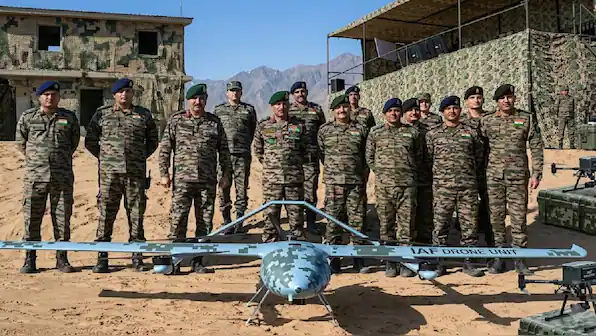
Bharat’s Drone-Age Army: Self-Reliance, Technology, and the Changing Character of War
The Indian Army’s current transformation marks one of the most consequential shifts in Bharat’s modern defence history. It is not merely a matter of buying new equipment or adding drones to existing formations. It reflects a deeper institutional recognition that future warfare will be faster, more transparent, more data-driven, and more unforgiving than the wars for which many twentieth-century armies were originally designed.
The June 2026 discussion around General Upendra Dwivedi’s tenure as Chief of Army Staff is therefore significant because it places military reform within a wider civilisational and national-security framework. The question is no longer whether Bharat should modernise its army. The real question is whether the country can build a self-reliant, technologically agile, and ethically grounded force capable of defending national sovereignty in an era shaped by drones, artificial intelligence, electronic warfare, cyber operations, precision weapons, and information dominance.
This transformation also carries an emotional weight for ordinary citizens. For families living near border regions, for veterans who have seen older forms of combat, and for young Indians entering a world of contested technology, the idea of a future-ready Indian Army is not abstract. It is tied to safety, national confidence, and the belief that Bharat must never again depend helplessly on foreign supply chains during moments of crisis.
The Drone Revolution and the New Battlefield
The most visible symbol of this transformation is the rapid rise of drones in Indian Army planning. Contemporary conflicts in Ukraine, Gaza, West Asia, and the Caucasus have shown that unmanned systems are no longer peripheral tools. They now shape reconnaissance, artillery correction, logistics, surveillance, target acquisition, deception, and precision strikes. Small drones costing a fraction of traditional platforms can alter the tempo of a battle, expose troop movement, and impose psychological pressure on adversaries.
Reports on the Indian Army’s drone expansion indicate a movement from limited experimental use to large-scale operational integration. The reported growth from only a few hundred drones to tens of thousands reflects a shift in mindset. Drones are not being treated as exotic assets reserved for specialised units; they are becoming battlefield necessities across formations, especially in high-altitude areas, counter-terrorism operations, forward surveillance, and infantry support.
Equally important is the rise of counter-drone infrastructure. A drone-age army cannot only possess unmanned systems; it must also deny hostile drones the ability to observe, harass, or strike. Counter-unmanned aerial systems require layered detection, jamming, spoofing, directed-energy possibilities, kinetic interception, and real-time command networks. This is where drone and counter-drone hubs across military stations become strategically meaningful. They create a training and experimentation ecosystem rather than a one-time procurement pipeline.
Why Drones Change Military Logic
Drones change warfare because they compress the distance between detection and action. In earlier battlefields, identifying a target, confirming its location, passing information through command channels, and striking it could take substantial time. Modern unmanned systems reduce that cycle dramatically. A platoon, company, or battalion commander equipped with drones can see beyond immediate line of sight, adjust fire, avoid ambush, and create local tactical advantage.
This does not mean technology replaces the soldier. General Dwivedi’s own public emphasis on the continuing centrality of the soldier is important. Technology improves reach, awareness, speed, and survivability, but the moral courage, discipline, terrain knowledge, and judgment of soldiers remain decisive. In a dharmic understanding of duty, instruments are never substitutes for character. A powerful weapon without restraint, training, and ethical clarity becomes a liability rather than a source of security.
The experience of Ukraine has been especially instructive. Commercial drones, first-person-view systems, loitering munitions, electronic warfare, and rapid battlefield innovation have created a cycle in which tactics evolve within weeks. A system that works today may be neutralised tomorrow. This means the Indian Army must build not only inventory but adaptability. The decisive capability is the ability to learn faster than the adversary.
Self-Reliance as Strategic Necessity
Self-reliance in defence is often discussed as an economic or political slogan, but in the drone age it becomes an operational requirement. Drones are consumed, lost, upgraded, repaired, and replaced at high speed. A country that depends heavily on foreign suppliers for sensors, batteries, motors, secure communication links, flight controllers, and munitions can face dangerous bottlenecks during conflict.
Bharat’s push for indigenous defence production must therefore be understood as a matter of battlefield endurance. Atmanirbharta is not isolationism. It is the capacity to design, manufacture, integrate, maintain, and improve critical systems domestically while still learning from global technology trends. In practical terms, this means stronger collaboration between the Indian Army, defence public-sector institutions, private industry, start-ups, research laboratories, academia, and field formations.
Indian industry has already begun contributing to unmanned systems, loitering munitions, surveillance platforms, and counter-drone solutions. The strategic challenge is scale. A few successful prototypes do not create military advantage unless they can be produced reliably, tested under realistic conditions, hardened against electronic attack, and supplied across varied terrain from deserts to mountains to forests.
The Himalayas and the Logistics Dimension
The drone revolution is not limited to combat strikes. Logistics drones may become especially valuable for the Indian Army along the Himalayan frontier, where terrain, altitude, weather, and distance make conventional supply difficult. Forward posts often depend on helicopters, animal transport, porters, or long human effort. Each method has limitations. Helicopters are expensive and weather-sensitive; manual carriage is slow and physically demanding.
Logistics drones can carry ammunition, medical supplies, communication equipment, food, batteries, and critical spares to locations where speed matters. They may not replace helicopters or ground logistics, but they can reduce risk, conserve aviation assets, and improve resilience. In high-altitude warfare, a small improvement in last-mile supply can have outsized operational value.
This is also where the Indian Army’s unique experience matters. Bharat’s military does not train on a generic battlefield. It operates across the Line of Actual Control, the Line of Control, counter-insurgency zones, riverine regions, deserts, dense settlements, and extreme mountain environments. Drone doctrine must therefore be Indian in design, not merely imported from foreign conflicts.
Artificial Intelligence and Data-Centric Operations
Artificial intelligence will increasingly influence how armies classify threats, analyse imagery, detect patterns, prioritise targets, and manage swarms of unmanned systems. In an environment flooded with sensor data, human commanders need decision-support tools that reduce confusion rather than add noise. The challenge is not collecting information; it is converting information into timely and reliable judgment.
For the Indian Army, AI must be integrated carefully. Systems need explainability, secure data pipelines, resistance to spoofing, and human oversight. A battlefield algorithm that cannot be trusted under electronic attack or adversarial deception can create false confidence. Therefore, AI in military operations should support commanders, accelerate analysis, and improve situational awareness while preserving accountable human decision-making.
Data-centric operations also require secure communications. Drones, sensors, artillery, infantry units, air defence systems, and command posts must exchange information quickly. Yet the same networks become targets for cyber intrusion and electronic warfare. The army of tomorrow must therefore combine connectivity with redundancy. It must be networked enough to act fast and resilient enough to continue fighting when networks are degraded.
Electronic Warfare: The Silent Contest
Electronic warfare is one of the most decisive aspects of the drone age. A drone depends on navigation, communication, sensors, and control links. If these are jammed, spoofed, intercepted, or deceived, the platform may become ineffective. This means every drone strategy must be paired with an electronic warfare strategy.
The modern battlefield is becoming an invisible contest over spectrum control. Forces that dominate the electromagnetic environment can blind enemy drones, protect friendly communications, and disrupt precision weapons. Forces that fail to do so may find themselves visible, targeted, and paralysed. For Bharat, this makes indigenous electronic warfare systems as important as airframes and munitions.
Training also becomes critical. Soldiers must learn not only how to fly drones but how to operate when drones fail, when GPS is unreliable, when enemy jamming begins, and when deception is suspected. Future readiness depends on disciplined adaptation under pressure, not technological dependence.
Institutional Reform and New Formations

The Indian Army’s broader transformation includes organisational changes intended to create more agile, integrated, and specialised formations. Public discussions around formations such as Bhairav Battalions, Rudra Brigades, Shaktibaan artillery units, and Divyastra capabilities point toward a force seeking greater speed, precision, and combined-arms effectiveness.
The logic behind such reform is clear. Traditional mass remains important in a country with complex borders, but mass without mobility, sensors, precision, and coordination can become vulnerable. Modernisation aims to preserve the courage and depth of the Indian Army while adding technology-enabled lethality and survivability.
At the infantry level, drone platoons and tactical unmanned systems can transform local awareness. At the artillery level, precision fires and loitering munitions can shorten the kill chain. At the air-defence level, counter-drone systems can protect forward units and critical infrastructure. At the command level, integrated data systems can enable faster decisions across domains.
Lessons from Contemporary Conflicts
Recent conflicts have provided several hard lessons. First, visibility has increased. Troop concentrations, armour movement, artillery positions, and logistics routes are more likely to be detected. Concealment, deception, dispersion, and rapid movement are therefore essential. Second, cheap systems can threaten expensive platforms. This alters cost calculations and forces armies to rethink protection.
Third, innovation cycles have shortened. Units in active conflict often modify drones, software, jammers, and tactics rapidly. A rigid procurement culture cannot keep pace with this reality. Bharat’s defence ecosystem must allow faster testing, feedback, and iteration while maintaining safety and accountability.
Fourth, information warfare accompanies kinetic warfare. Videos from drones, claims of precision strikes, psychological messaging, and battlefield narratives influence public perception. The Indian Army must therefore prepare for a battlespace where truth, morale, and narrative discipline are also contested.
The Dharmic Dimension of National Defence
Defence modernisation should not be viewed only through machines and budgets. Bharat’s civilisational traditions, including Hindu, Buddhist, Jain, and Sikh streams of dharmic thought, have long reflected on duty, restraint, courage, justice, and protection of society. The idea of national security is strongest when technological capability is guided by ethical responsibility.
A dharmic approach to security does not glorify war. It recognises that peace requires preparedness, deterrence, and the willingness to defend the innocent. In this sense, the Indian Army’s modernisation can be seen as an expression of Rajadharma: the responsibility of the state to protect its people, preserve social order, and prevent aggression.
This perspective also supports unity among dharmic traditions. Hindu, Buddhist, Jain, and Sikh communities may differ in practices and philosophies, but they share a deep concern for discipline, self-mastery, compassion, and righteous conduct. A technologically strong Bharat must also remain morally anchored, because power without dharma can become destructive, while dharma without the capacity for protection can become vulnerable.
Challenges That Cannot Be Ignored
The Indian Army’s transformation faces real challenges. Procurement speed must improve without compromising quality. Indigenous systems must meet battlefield standards rather than merely satisfy symbolic goals. Training pipelines must expand rapidly. Maintenance, spare parts, battery supply, software updates, and secure communications must be planned from the beginning.
There is also a human-resource challenge. Drone operators, electronic warfare specialists, AI analysts, cyber defenders, and maintenance technicians require different training models from traditional combat roles. The army must create technical depth while preserving field toughness. A soldier may need to understand terrain, weapon handling, radio discipline, drone feeds, and cyber hygiene within the same operational environment.
Another challenge is avoiding technological overconfidence. Drones are powerful, but they are not magic. Weather, terrain, jamming, air defence, battery limits, supply constraints, and enemy adaptation can reduce their effectiveness. A mature military doctrine treats drones as part of a combined system, not as a universal solution.
Why General Dwivedi’s Tenure Matters
General Upendra Dwivedi’s tenure is likely to be assessed in the context of this transition from a manpower-intensive force toward a technology-enabled and future-ready army. The significance lies not in one platform or one announcement, but in the acceleration of a broader institutional shift. He presided over a period when the Indian Army had to absorb lessons from global wars while preparing for Bharat’s specific security environment.
That environment is unusually complex. Bharat faces nuclear-armed adversaries, disputed borders, terrorism, proxy warfare, cyber threats, information operations, and grey-zone coercion. It must prepare for short, sharp crises as well as prolonged tensions. It must defend high mountains and dense urban areas. It must be ready for conventional combat, counter-terrorism, and hybrid warfare simultaneously.
In such a setting, self-reliance is not merely a procurement preference. It becomes the foundation of strategic autonomy. A country that can produce, repair, upgrade, and adapt its own battlefield technologies has greater freedom of action. It can sustain pressure, avoid diplomatic vulnerability, and respond to threats with confidence.
The Road Ahead for Bharat’s Army
The next phase of Indian Army modernisation should focus on integration. Drones must communicate with artillery, infantry, air defence, logistics units, and command systems. Counter-drone systems must be layered and widely available. AI tools must be trained on relevant data and tested under realistic conditions. Indigenous manufacturers must receive clear requirements and honest field feedback.
Bharat also needs a stronger culture of defence innovation. Start-ups and private firms can move quickly, but they need predictable procurement pathways. Military users need systems that are rugged, repairable, secure, and affordable at scale. Academia can contribute to autonomy, materials, sensors, encryption, robotics, and human-machine teaming. The state must coordinate these efforts without suffocating them under excessive procedure.
The most important requirement, however, is intellectual honesty. Future warfare will not wait for comfortable assumptions. If drones are reshaping combat, doctrine must change. If electronic warfare is decisive, training must change. If supply chains are vulnerable, manufacturing priorities must change. If soldiers remain central, technology must be designed around their needs rather than imposed as a burden.
Conclusion: Preparedness as a National Duty
Bharat’s preparation for drone-age warfare is ultimately about national resilience. It is about ensuring that the Indian Army can see farther, move faster, strike more precisely, defend more effectively, and sustain operations under pressure. It is also about ensuring that technological power remains rooted in duty, restraint, and the protection of society.
The transformation underway is not complete, and it should not be romanticised. There will be delays, failures, technical gaps, and doctrinal debates. Yet the direction is unmistakable. The Indian Army is preparing for a battlefield where drones, artificial intelligence, electronic warfare, cyber operations, and precision fires will shape outcomes. In that battlefield, self-reliance will be as important as bravery, and innovation will be as necessary as tradition.
For Bharat, the lesson is clear: a civilisation that values peace must also cultivate strength. A nation that honours dharma must be capable of defending it. The drone age has arrived, and the Indian Army’s response will shape not only military readiness but the confidence of a society determined to remain sovereign, secure, and self-reliant.
Inspired by this post on Hindu Post.
