
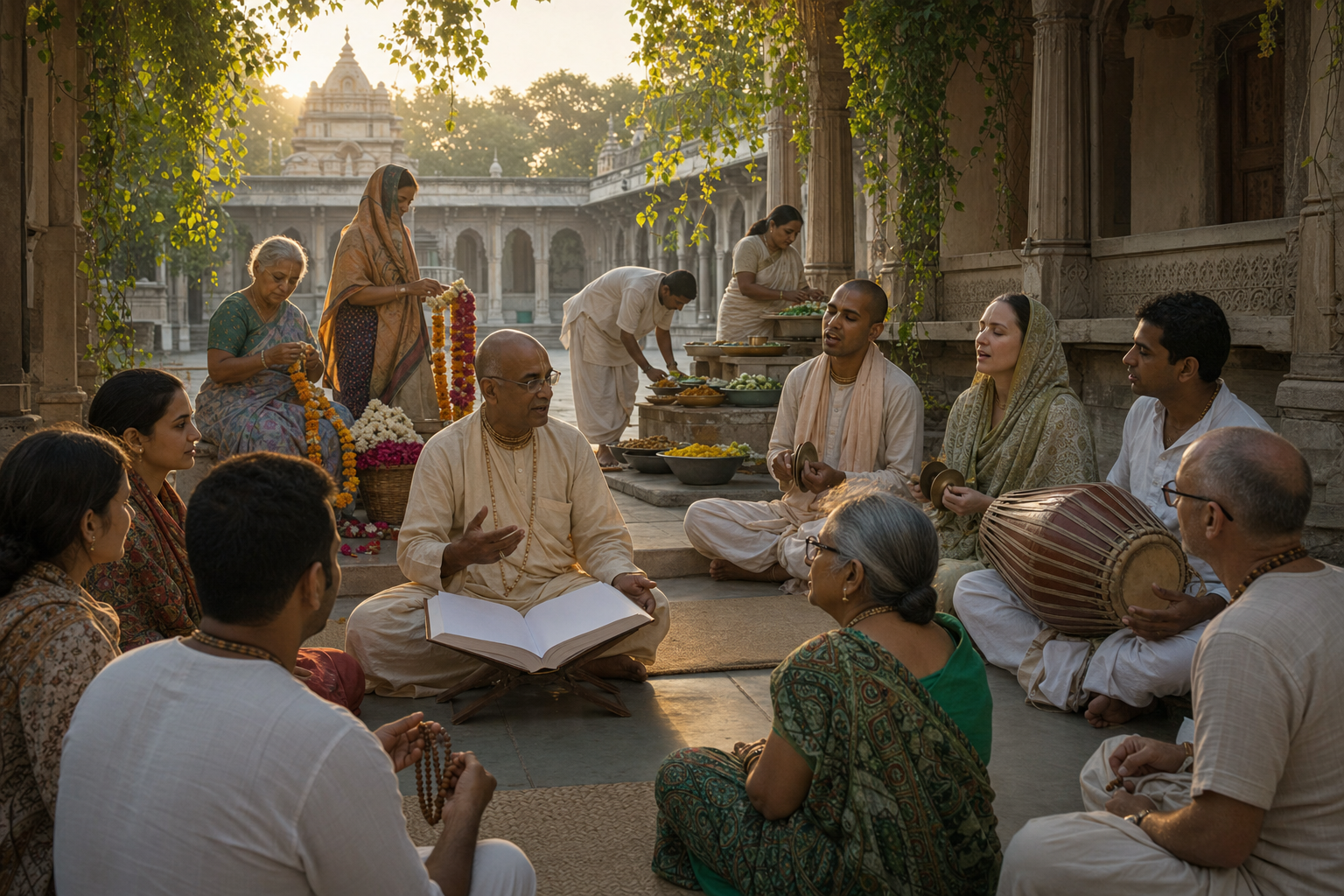
Gaudiya Vaishnavism becomes easier to understand when its philosophy, disciplines, and institutions are viewed as parts of one formative system. Across accounts of scriptural instruction, japa, extended kirtan, temple classes, and festival volunteering, teaching gives practice its direction, practice tests whether teaching has been absorbed, and community makes both sustainable.
This synthesis traces that relationship from theological discernment to public service. It also offers a practical standard for evaluating lived bhakti: whether sacred knowledge is producing attentive practice, responsible relationships, humility, and useful service.
Key takeaways
- Gaudiya theology holds unity and meaningful difference together, preventing spiritual connectedness from becoming careless equivalence.
- Guru, scripture, family instruction, and communal hearing turn religious information into accountable formation.
- Japa and kirtan operate at different scales but share a discipline of returning attention to sacred sound.
- Temple life and festival seva convert inward devotion into education, hospitality, organization, and intergenerational continuity.
Discernment connects metaphysics to daily conduct
The domestic exchange examined in the article on Caitanya-caritamrita Adi-lila 14.33 provides a compact model of Gaudiya reasoning. Child Nimai argues from the shared material origin of earth, food, the body, and a clay vessel. Sacimata answers by distinguishing origin from suitability: grain nourishes, raw dirt harms, and a formed pot can carry water while an unformed lump of clay cannot. The article interprets this as embodied philosophy rather than an abstract dispute.
That lesson illuminates acintya-bhedabheda, the Gaudiya doctrine of inconceivable simultaneous oneness and difference. Reality depends upon the Supreme, yet its beings, energies, forms, and functions are not interchangeable. Unity therefore does not abolish relationship; it makes relationship intelligible. Devotion presupposes a devotee, the Lord who is served, an offering, and an act of service, even though all exist within a divine order.
The Bhagavad-gita essay on unity develops a compatible argument at a larger scale. It presents the living being as an eternal self related to Krishna and describes creation as dependent upon divine energies. At the same time, it insists that unity does not erase distinctions between spirit and matter, duty and negligence, or devotion and selfishness. Both articles consequently treat discernment as a condition of spiritual unity, not as its opponent.
Read together, these sources suggest a three-part test for applying theology. A practitioner must ask how something is related to the divine source, whether its present form and use are spiritually suitable, and what kind of consciousness its use cultivates. Food, speech, knowledge, music, and organization are not sanctified merely by being declared spiritual; their effects and devotional orientation matter.
This approach also shapes inter-dharmic respect. The sources repeatedly argue that harmony among Hindu, Buddhist, Jain, and Sikh traditions need not depend on pretending that their metaphysics and practices are identical. Shared ethical seriousness can be recognized while doctrinal integrity is preserved. The same logic that distinguishes a pot from a lump of clay permits solidarity without flattening difference.
Transmission turns information into formation
Knowledge in these accounts is received through relationships rather than assembled from isolated spiritual fragments. In the discussion of Srimad-Bhagavatam 4.8.53, the young Dhruva meets Narada while driven by rejection and ambition. Narada does not merely soothe him or provide an impressive formula. He redirects Dhruva’s pain through mantra, meditation, discipline, and a devotional object of attention. The source presents guru-guided practice as the architecture by which an intense motive can be purified.
The Bhagavad-gita article places this process within parampara. On its account, disciplic succession preserves more than propositions: it transmits a way of interpreting scripture and embodying it through conduct. Memorization or quotation is therefore insufficient when it does not produce humility, ethical refinement, and service. Authority functions here as responsibility for meaning and practice, not simply as institutional rank.
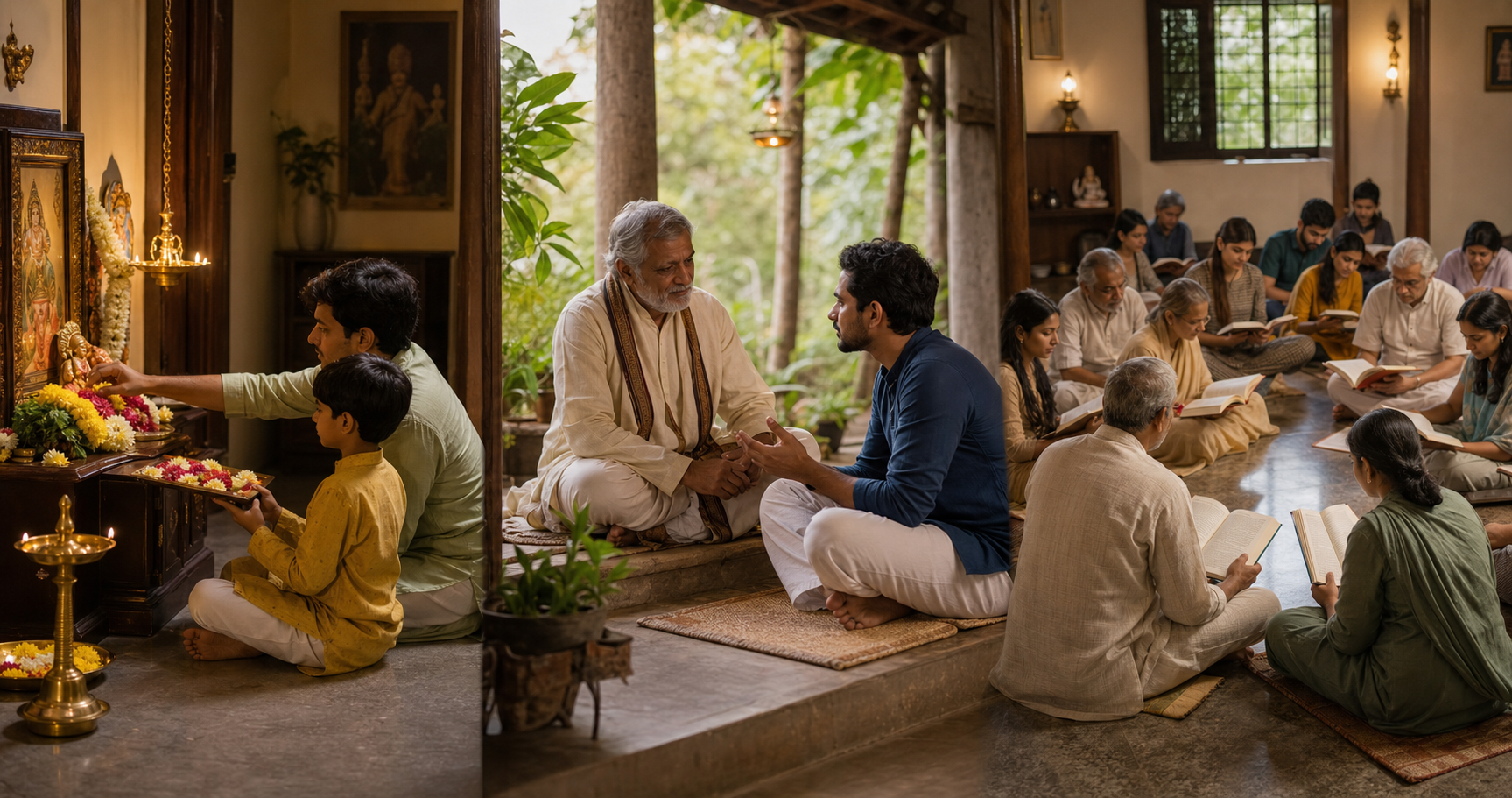
The child Nimai episode adds a complementary dimension. The Lord, while concealing his identity within the intimacy of childhood play, accepts practical correction from his mother. As interpreted by the source, the scene honors spiritual instruction in the home and shows that philosophical clarity can be carried through care, household experience, and moral responsibility. Formation begins before a person enters a formal classroom.
The Bhaktivedanta Manor article then situates instruction in the communal practice of sravana, attentive hearing. An important limitation is explicit in that source: no transcript of the particular class was available, only a thumbnail image. Its account is therefore contextual rather than evidence of what an individual speaker said. Even with that limitation, it usefully explains how a temple class can connect scripture, questions, ethical self-examination, and the circumstances of families and younger generations in a diaspora setting.
Together, the sources offer a practical standard for devotional education. Reliable teaching should disclose its scriptural and lineage context, explain how a principle changes conduct, permit sincere questions, and direct attention beyond the teacher’s personality. Its success is visible not only in what listeners can repeat but also in how they speak, manage desire, use time, and treat other people.
Sacred sound joins personal discipline to shared devotion
Sacred sound is the point at which received teaching becomes repeatable daily practice. The Dhruva article describes japa as focused mantra recitation integrating speech, hearing, memory, and intention. It emphasizes listening to the mantra, returning after distraction, and orienting the mind toward the Lord rather than pursuing blankness. It also places unusual yogic attainments below the Bhagavatam’s deeper concern: the purification of desire.
The report on the June 2026 six-hour kirtan broadcast from ISKCON Alachua examines the same principle at a congregational scale. Call and response, voices, mridanga, and kartals organize collective attention around the maha-mantra. According to that account, extended duration allows the chant to move through contemplative, joyful, and intense devotional moods while challenging habits shaped by fragmented attention.
Japa and kirtan are therefore different without being rivals. Japa exposes the individual practitioner’s wandering mind and requires repeated acts of return. Kirtan distributes attention across a congregation through listening and response, allowing people with different levels of experience to participate in a common rhythm. One cultivates personal steadiness; the other makes sacred remembrance social and embodied.
Neither source reduces chanting to a psychological relaxation technique, musical entertainment, or a means of acquiring extraordinary powers. Both connect sound with meaning, relationship, discipline, and transformation. Musical ability and emotional intensity can support that process, but they are not its final measure. A more demanding measure is whether chanting weakens pride, improves attention, and increases readiness to serve.
The Alachua account also identifies a contemporary opportunity and a boundary. Digital broadcasting can extend access to devotees, families, and interested observers who are geographically distant, but the article does not present a screen as a complete replacement for physical association or temple participation. Digital kirtan is most coherent when it serves as an entry into attentive practice rather than becoming devotional background noise.
Community gives bhakti public and durable form
The Alachua and Bhaktivedanta Manor articles show why Gaudiya community cannot be reduced to attendance at occasional programs. The Alachua source describes a rural devotional ecosystem involving temple worship, scripture classes, kirtan, prasadam, education, gardens, cow protection, family life, and festivals. The Manor article emphasizes a related ecology in Britain, where classes help translate inherited ritual and Sanskrit vocabulary into intelligible commitments for people living in a plural society.
Their emphases are different but complementary. The Alachua report foregrounds concentration through a long congregational chant and places it within a daily temple rhythm. The Manor piece foregrounds interpretation through the class and the role of a temple in intergenerational diaspora education. One shows how a community gathers attention; the other shows how it gives that attention conceptual and ethical direction.
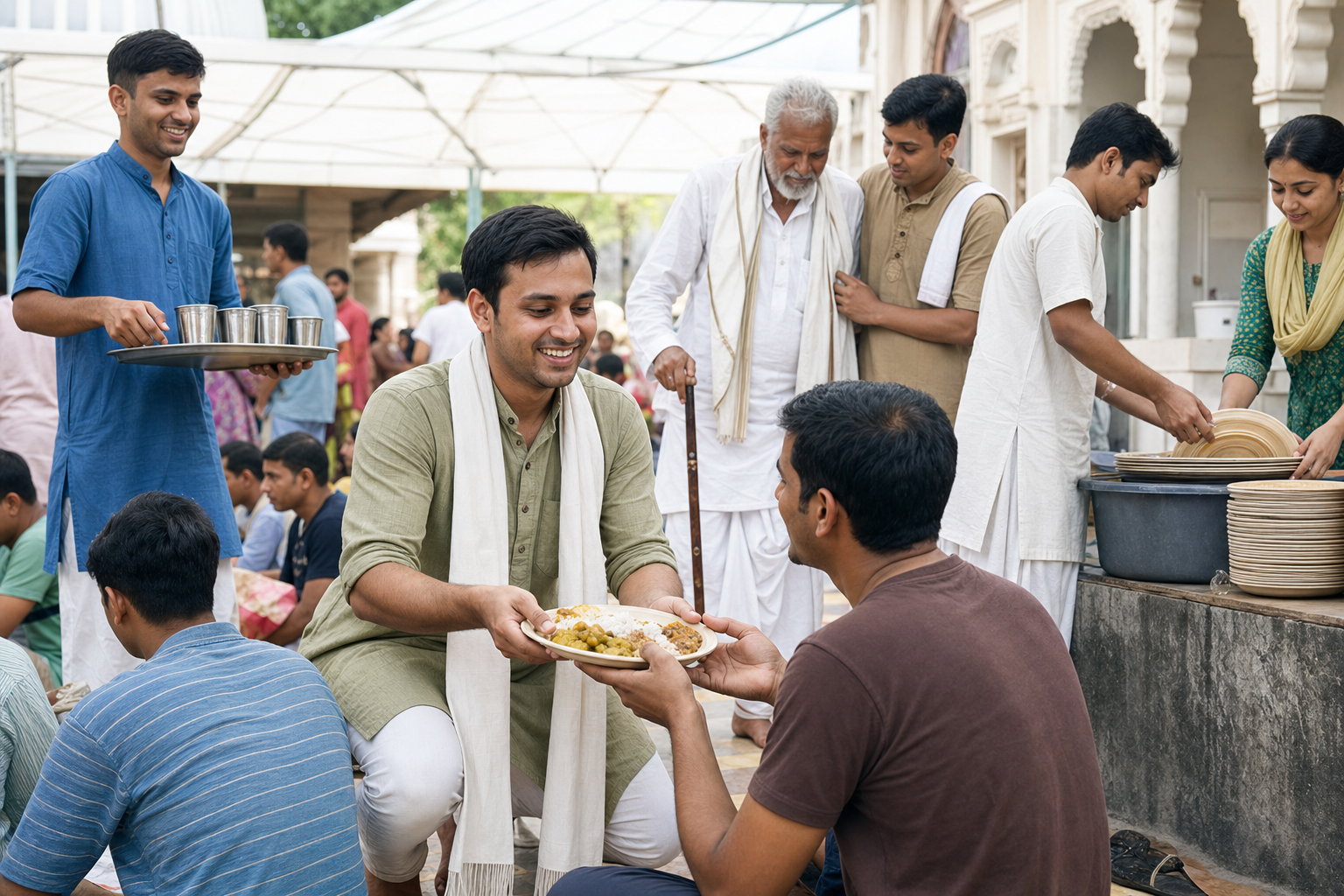
The article honoring volunteers associated with the 2026 New York City Ratha Yatra adds the often-invisible infrastructure of public devotion. It reports a broad field of service behind the procession, including planning, supplies, offerings, crowd assistance, prasadam distribution, equipment, accessibility, cleanup, and communication. Its central contribution is to show that competence is not external to seva. Careful organization protects participants and creates the conditions in which worship, hospitality, and learning can occur.
Public festival service also tests the transition from theology to conduct. A volunteer answering questions, serving food, assisting an elder, or restoring a public space communicates the tradition through behavior. In this setting, humility is operational rather than merely emotional: it appears as reliability, courtesy, cleanliness, gratitude, and willingness to perform work that attracts little attention.
These three community settings reveal a recurring formation cycle. Scriptural teaching clarifies the purpose of practice; chanting trains attention and remembrance; temple rhythms embed those disciplines in time; and seva directs their fruits toward other people. Experience then returns to the classroom and the home as material for further reflection. When one element is isolated, knowledge can become display, kirtan can become performance, and organization can become bureaucracy. Their integration keeps bhakti relational.
The future strength of Gaudiya Vaishnava communities will depend on maintaining that integration while adapting responsibly to new generations and media. Communities that preserve philosophical precision, disciplined sacred sound, transparent education, and appreciative service can make continuity more than the repetition of inherited forms; they can make it a living transmission of devotional purpose.


References
- DharmaRenaissance Blog — Caitanya Caritamrita Adi 14.33: Powerful Wisdom for Deep Spiritual Clarity
- DharmaRenaissance Blog — SB 4.8.53 Revealed: The Transformative Power of Sacred Japa and Guru-Guided Bhakti
- DharmaRenaissance Blog — Six-Hour Kirtan at ISKCON Alachua: A Powerful Window Into Living Bhakti
- DharmaRenaissance Blog — Bhaktivedanta Manor Classes: Powerful Lessons in Bhakti, Dharma, and Community
- DharmaRenaissance Blog — Awakening Unity Through the Bhagavad Gita: Divine Love, Bhakti, and Truth
- DharmaRenaissance Blog — The Hidden Power of Seva: Honoring 2026 NYC Ratha Yatra Volunteers