
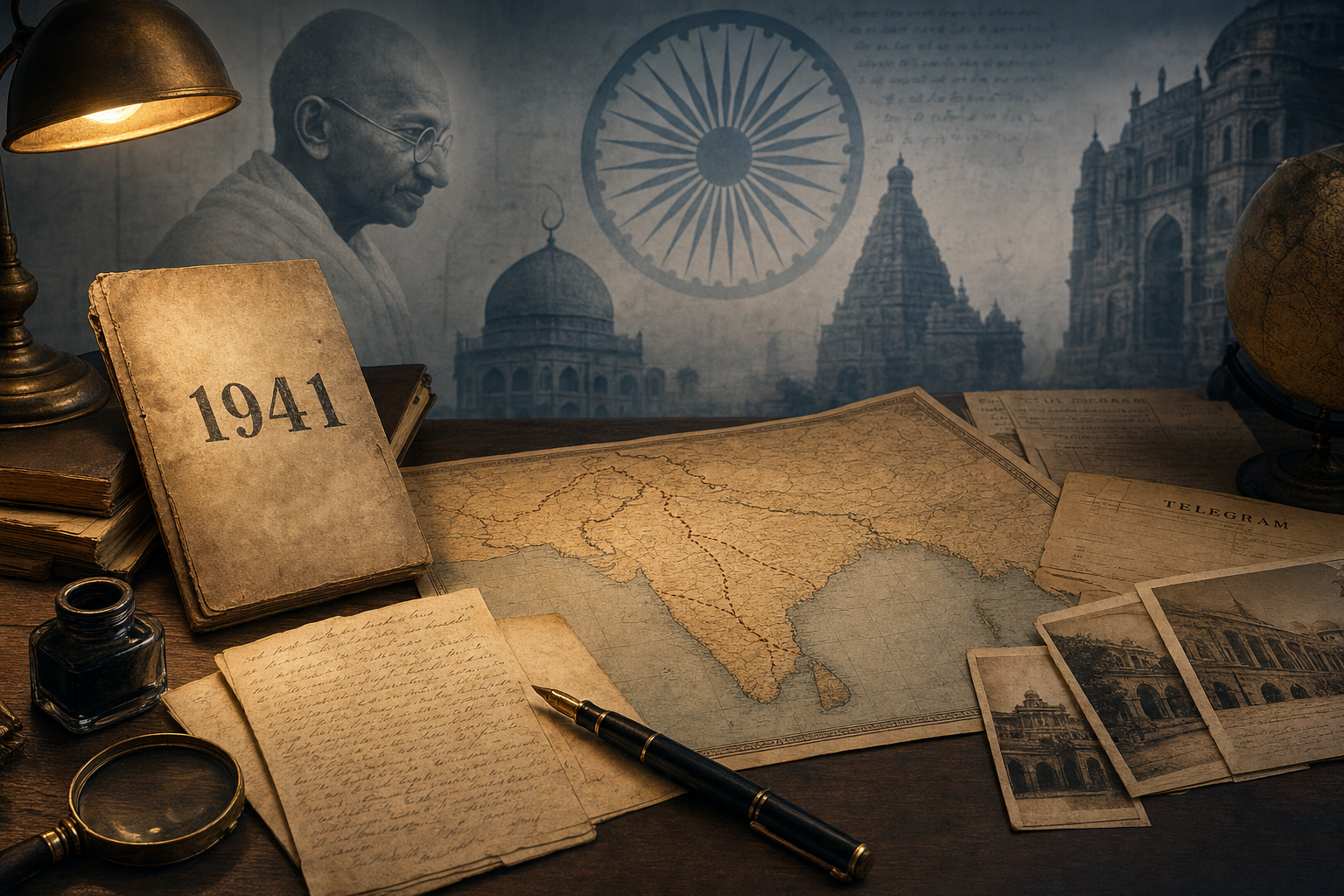
In February 1941, while the Second World War was reshaping empires and exposing the fragility of British rule in India, a small Poona publication entered the political debate with unusual force. The book was titled Gandhi-Muslim Conspiracy, published by R.D. Ghanekar and attributed to the pseudonymous “A Hindu Nationalist.” Its central claim was severe: that the Khilafat-era alliance between Mohandas Karamchand Gandhi and the Ali Brothers had not merely been a tactical anti-colonial partnership, but had carried within it a dangerous willingness to invite external Islamic power into India’s political struggle.
The controversy around the book must be understood within its moment. By 1941, British imperial power was strained by war, Indian soldiers were being deployed in a global conflict, the Muslim League had become a decisive political force, and the demand that would culminate in Pakistan had moved from ideological assertion toward practical politics. In this climate, any text alleging a hidden political bargain between Gandhi, Khilafat leadership, and trans-frontier Muslim power was bound to provoke both admiration and hostility.
The 2026 Dharma Dispatch essay revisits this forgotten work as a piece of historical polemic and as a window into a wider anxiety that haunted many nationalist minds in the early twentieth century: whether Gandhi’s commitment to Hindu-Muslim unity, when combined with his doctrine of non-violence, weakened the political self-protection of Hindu society and the future Indian nation-state. The article’s argument is not merely biographical. It concerns political realism, national defence, religious mobilisation, and the costs of confusing moral aspiration with statecraft.
At the centre of the debate stands the Khilafat Movement, a mass agitation launched after the First World War to defend the Ottoman Caliphate. Gandhi’s support for Khilafat was one of the most consequential decisions of the Indian freedom struggle. He saw in it an opportunity to unite Hindus and Muslims against British rule through Non-cooperation. Critics, however, argued that the movement imported pan-Islamic concerns into Indian nationalism and gave religiously charged politics a mass legitimacy that later became difficult to contain.
The 1941 tract claimed that during 1920-21 there existed a plan to invite the Amir of Afghanistan to invade India, and that Gandhi and the Ali Brothers were implicated in the mentality that made such a scheme politically thinkable. This is a grave historical allegation and must be treated as an allegation rather than as settled fact. Yet its importance lies in the fact that it reflected a real fear among some Indian nationalists: that anti-British passion could be exploited by forces whose long-term objectives were not necessarily aligned with a free, culturally rooted, and civilisationally secure Bharat.
The article also discusses the contested authorship of Gandhi-Muslim Conspiracy. A common attribution points to Jamnadas M. Mehta, a barrister, public figure, Finance Minister of the Bombay Presidency, and later a critic of Gandhi’s Khilafat policy. Whether every aspect of that attribution can be conclusively established is a matter for historians, but the larger point remains clear: the book emerged from a political current that believed Gandhi’s moral authority had silenced necessary criticism of his strategic choices.
One of the strongest themes in the Dharma Dispatch essay is the charge that Gandhi’s non-violence became, in practice, a form of state-blind politics. The criticism is not aimed at personal ethics alone. It asks whether a nation can survive if its leaders deny the need for coercive power, defence preparedness, and constitutional firmness in the face of external aggression or internal separatism. This remains a technical question of political theory: moral authority can inspire mass mobilisation, but sovereignty requires the ability to protect borders, citizens, institutions, and civilisational continuity.
The Bardoli-Chauri Chaura sequence is used in the article to illustrate this tension. The Chauri Chaura incident occurred on 4 February 1922, when a violent mob killed policemen, after which Gandhi suspended the Non-cooperation Movement. The 1941 argument linked Gandhi’s decision not only to his horror at violence but also to the changing geopolitical context, including the Indo-Afghan treaty process. Whether that causal link can be proven demands archival caution, but the episode does reveal Gandhi’s recurring dilemma: how to control a mass movement once religious passion, anti-colonial anger, and revolutionary expectation had been awakened together.
The essay further cites political statements attributed to Khilafat-era and Muslim League-linked figures to argue that some leaders imagined post-British India not as a neutral constitutional democracy but as a theatre of religious power. Terms such as Dar-ul-Islam and Dar-ul-Harb appear in this discussion because they were part of the ideological vocabulary through which certain political actors framed sovereignty, loyalty, and conflict. A responsible reading must distinguish between those ideological actors and ordinary Muslims, many of whom lived, worked, suffered, and struggled within the same colonial conditions as their Hindu, Sikh, Jain, and Buddhist neighbours.
This distinction is essential for any dharmic reading of history. Historical criticism should not become collective hatred. The objective is not to turn memory into resentment, but to recover political clarity. Hindu, Buddhist, Jain, and Sikh traditions all preserve strong resources for ethical restraint, social harmony, and spiritual discipline; they also recognise, in different idioms, the duty to resist adharma. A mature civilisational history must hold both truths together: compassion is a virtue, but self-erasure is not dharma.
The Dharma Dispatch article also places Gandhi’s politics against the rise of the Muslim League and the eventual Partition of India. From the vantage point of 1941, the fear of political separatism was no longer theoretical. The Lahore Resolution had already been passed in 1940, and the constitutional future of India was being negotiated under the shadow of communal claims, British divide-and-rule strategies, and the collapse of older assumptions about composite nationalism. In that sense, Gandhi-Muslim Conspiracy belongs to a wider archive of warnings about appeasement, strategic naivety, and ideological asymmetry.
Yet the book’s polemical tone also requires careful handling. It used harsh language, sweeping generalisations, and a style typical of wartime political pamphleteering. Modern historical analysis benefits from separating evidence from rhetoric. The evidence worth examining includes Gandhi’s writings, Congress resolutions, Khilafat speeches, Muslim League publications, Afghan diplomatic developments, Lala Lajpat Rai’s concerns, and later debates over national defence. The rhetoric, by contrast, must be filtered through ethical judgment so that the study of history strengthens society rather than inflaming it.
One important figure in this debate is Lala Lajpat Rai, who worried about foreign intervention and the vulnerability of India if British power weakened before Indians had achieved national unity and defensive preparedness. His concern was not simply communal; it was geopolitical. A colonised country surrounded by imperial, tribal, religious, and military pressures had to ask what sovereignty would actually mean. Would freedom be only the departure of the British, or would it also require the formation of a disciplined national will?
The article’s discussion of national defence is therefore especially significant. Gandhi’s reluctance toward armies and coercive institutions is often celebrated as ethical radicalism. Critics saw it as a fatal misunderstanding of political order. No state can outsource its survival to goodwill alone. Even a deeply spiritual civilisation needs institutions that protect pilgrimage routes, temples, monasteries, gurudwaras, libraries, families, borders, and vulnerable communities. In dharmic political thought, kshatra is not aggression; it is disciplined protection.
This is where the debate acquires contemporary relevance. Modern Bharat cannot afford either amnesia or bitterness. It needs an honest history of the freedom struggle that includes Gandhi’s achievements, Gandhi’s limitations, the role of revolutionaries, the tragedy of Partition, the vulnerability of minorities in regions shaped by separatist politics, and the civilisational resilience of Hindu society alongside Buddhist, Jain, and Sikh traditions. Such a history should be neither colonial nor sentimental. It should be evidence-based, morally serious, and nationally rooted.
The emotional force of this subject comes from the fact that these were not abstract debates. They touched families, villages, temples, schools, and entire communities that later experienced displacement, violence, and civilisational loss. For many readers, the history of Khilafat, Non-cooperation, Muslim League politics, and Partition is not distant. It survives in inherited memories, silences at home, ancestral migration stories, and the uneasy awareness that political misjudgments can alter the destiny of generations.
At the same time, dharmic unity requires discipline in how such memories are expressed. The lesson is not that communities must live in suspicion. The lesson is that unity must be built on truth, reciprocity, constitutional equality, and cultural self-respect. A society that forgets hard lessons becomes vulnerable; a society that weaponises every wound becomes unstable. The dharmic middle path is neither denial nor hatred, but awakened responsibility.
The forgotten 1941 text, therefore, should be read as a historical document of warning rather than as a final verdict. It reveals the anxieties of those who believed Gandhi’s pursuit of Hindu-Muslim unity came at an excessive price. It also forces a larger question: how should a civilisation negotiate with political forces that do not share its assumptions about pluralism, sacred geography, and cultural continuity? That question remains central to Indian political history.
A factual reconstruction of this debate does not require diminishing Gandhi’s sincerity. It is possible to accept that Gandhi was deeply committed to truth and non-violence while also examining whether his political methods produced unintended consequences. Historical maturity depends on precisely this capacity: reverence must not prevent scrutiny, and criticism must not become caricature. Gandhi was neither beyond criticism nor reducible to failure.
The enduring value of revisiting Gandhi-Muslim Conspiracy lies in the questions it raises about leadership. Can spiritual vocabulary substitute for strategic clarity? Can national unity survive if one side treats compromise as moral duty while another treats it as tactical opportunity? Can a freedom movement remain coherent when religious mobilisation is used for anti-colonial ends? These questions are uncomfortable, but they are necessary for anyone studying Indian history, Hindu-Muslim relations, and the formation of modern Bharat.
In the final analysis, this episode belongs to the broader history of Bharat’s struggle to define freedom. Political independence was not only a transfer of power from British hands to Indian hands. It was also a test of civilisational confidence, social cohesion, and the ability to protect dharma without abandoning justice. The 1941 warning may be disputed in parts, but the challenge it presents remains powerful: national life cannot be built on sentiment alone. It must rest on memory, realism, unity, and the disciplined protection of a shared civilisational inheritance.
Inspired by this post on Hindu Post.
