
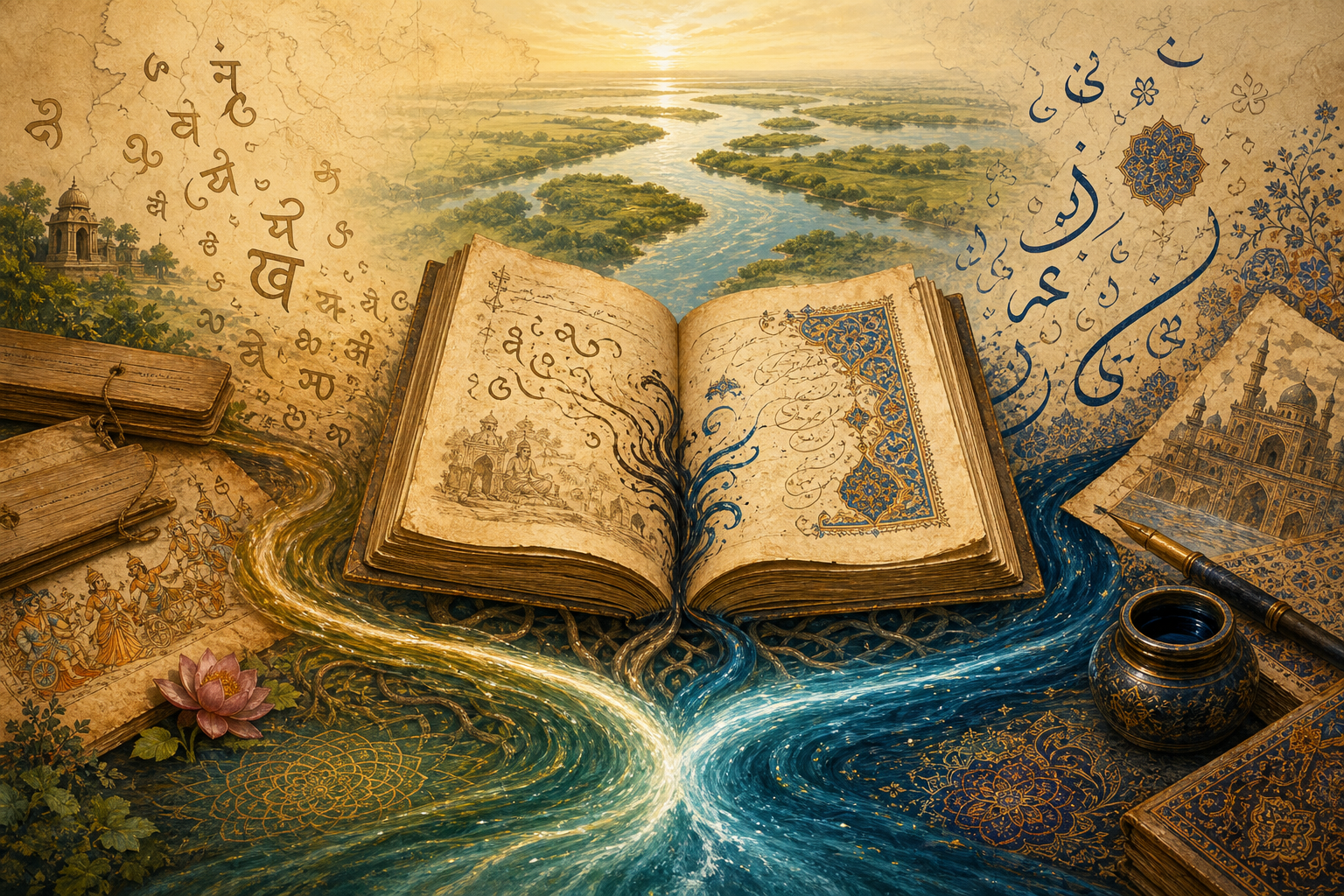
The history of the Bengali language is often described through the image of two streams: one associated with Sanskritic, Hindu, and wider Indic inheritance, and another associated with Islamic literary expression shaped by Persian and Arabic vocabulary. That image is useful, but only if it is handled with care. Bengali did not begin as two hostile linguistic worlds. Its literary history shows long continuities, shared habits of expression, regional creativity, and later moments of deliberate differentiation. A sober reading of the evidence suggests that Bengali’s strongest story is not one of permanent rupture, but of a civilizational language negotiating multiple inheritances while remaining recognizably rooted in the broader Indic language family.
The wider domain of Indic languages stretches from Sindh and Punjab in the west to Assam and Bengal in the east. In classical and early medieval intellectual life, Sanskrit served as a vehicle of Hindu scripture, philosophy, poetry, law, ritual, and knowledge systems. Pali and Sanskrit also carried major streams of Buddhist literature, making the linguistic ecology of the subcontinent deeply connected to dharmic traditions across Hinduism, Buddhism, Jainism, and later regional devotional cultures. This shared background matters because Bengali did not emerge in isolation. It belongs to a family of languages shaped by Sanskrit, Prakrit, Apabhramsha, local speech forms, and centuries of literary experimentation.
Sanskrit may be compared, imperfectly but usefully, to Latin and Greek in Europe. It is a classical language with a vast prestige literature, yet for many Indic vernaculars it is also an ancestral source through the intermediate stages of Prakrit and Apabhramsha. Bengali, Assamese, Odia, Hindi, Marathi, Gujarati, Punjabi, Sindhi, Kashmiri, and related languages carry this inheritance in varying degrees. In Bengali, that inheritance is visible not only in learned vocabulary, but also in literary forms, religious idiom, poetic convention, and the memory of epics such as the Rāmāyaṇa and Mahābhārata.
The late medieval and early modern periods added another major layer. Islamic literary cultures developed in several Indic languages, especially in regions where large Muslim communities emerged over time. Sindhi, Punjabi, Bengali, and Kashmiri all came to include major bodies of Muslim-authored literature. Such writers often drew on Persian and Arabic, not only as religious languages but also as languages of court culture, law, theology, and refined expression. The best-known linguistic parallel is Hindi-Urdu, where a shared spoken base came to be associated with distinct literary registers and scripts. Bengali presents a subtler case: its Islamic literary current appears to have grown within a shared Bengali matrix, acquired certain features of its own, and later interacted again with the wider literary mainstream.
Several claims have gathered around this history, and some of them have hardened into polemical assumptions. One recurring claim is that vernacular literary activity in India began only after the arrival of Muslim rule, because Sanskritic learning allegedly prevented regional languages from becoming literary vehicles. The argument is sometimes framed as if Muslim political power alone broke a supposed monopoly of Sanskrit and allowed languages such as Bengali to flourish. This claim is too sweeping. It underestimates the vitality of regional dharmic literary cultures before and outside Islamic courts, and it reduces a complex process of language formation to a single political cause.
The evidence from other Indian languages makes the point clear. In Assam, Harivara Vipra, associated with the court of King Durlabhanārāyaṇa of Kamatā, composed Babrubāhanar Yuddha, based on the Aśvamedhaparva of the Mahābhārata, as early as the thirteenth century. Mādhava Kandalī, patronized by King Mahāmaṇikya in the fourteenth century, translated the Rāmāyaṇa into Assamese verse, predating the known Bengali Rāmāyaṇa tradition by more than a century. In Kannada, the Vikramarjuna Vijaya, a version of the Mahābhārata, was composed in the tenth century. In Telugu, Nannaya began rendering the Mahābhārata in the eleventh century, and Tikkanna carried the project forward in the thirteenth century. These examples show that regional literary expression was not waiting for Islamic rule to become possible.
This does not mean that Muslim courts and patrons made no contribution to Bengali literature. They did. The point is narrower and more historically responsible: vernacular literary activity in India had multiple sources, and dharmic literary culture was one of the strongest among them. The translation of epics into regional languages was not inherently anti-Sanskritic. Rather, it often reflected the desire to make sacred, ethical, and heroic narratives available to communities beyond narrow circles of formal learning. For readers familiar with oral recitation, temple storytelling, village performance, and household memory, this is not surprising. Indian civilization has long moved between the learned and the popular, the scriptural and the performative, the Sanskritic and the regional.
T. W. Clark’s discussion of a “blank period” in Bengali literature after the conquest of Bengal around 1200 CE is also important. The absence of preserved texts does not necessarily prove the absence of literary activity. Clark observed that the Bengali compositions appearing in the fourteenth century seem to reflect a longer development. The record may be thin because manuscripts were lost, patronage networks were disrupted, or conditions after conquest made preservation difficult. The comparison with Persia’s “two centuries of silence (دو قرن سکوت)” after the Arab conquest is suggestive: major cultural change can interrupt archives without erasing cultural life itself.
Patronage under the Bengal Sultanate also requires careful distinction. Later references to “Muslim patronage” can blur the difference between central sultans, regional courts, military elites, local magnates, and converts whose social practices still reflected older cultural patterns. Shāh Muḥammad Ṣaghīr, often identified as the first Bengali Muslim poet and known for Yūsuf Julaykhā, commented on Kavindra’s Mahābhārata translation in a revealing way: “Kavindra composed the Mahābhārata at the order of Lashkar Parāgal Khan. Both Hindus and Muslims read that book in their respective houses, and none remembers the name of Khodā and Rasūl (God and His Prophet).” The observation implies a readership that was not divided neatly into sealed religious compartments. It also suggests that epic literature continued to circulate across social boundaries.
The linguistic evidence from early Muslim Bengali poets further complicates any rigid communal division. Clark concluded that a Muslim poet could generally be distinguished from a Hindu poet by subject matter, but not by the language in which he wrote. This is a crucial point. Early Muslim poets in Bengali often used the standard literary Bengali of their time. Persian and Arabic terms entered Bengali through contact with Islamic culture, but Muslim writers did not necessarily use them more heavily than Hindu writers. Clark even reported that passages with above-average Perso-Arabic vocabulary in early Bengali literature were found in works of Hindu poets. The literary language, therefore, was shared to a greater degree than later communal readings sometimes assume.
A second major claim concerns the standardization of Bengali in Calcutta after the founding of Fort William College in 1800. A highly formal, Sanskritized prose style known as sādhu bhāṣā became influential. Critics have argued that Hindu pundits employed by the College deliberately removed Arabic and Persian words from Bengali and replaced them with Sanskritic vocabulary, thereby creating a literary language that reflected Hindu culture rather than Muslim culture. This accusation captures a real anxiety about linguistic ownership, but it also oversimplifies the history of Bengali and the deep Sanskritic character already present in Muslim-authored Bengali literature before the nineteenth century.
The case of Saiyad Sultān, a sixteenth-century Muslim Bengali poet, is especially instructive. He defended his use of Bengali in words that remain moving because they reveal the emotional dignity of one’s mother tongue: “Whatever language God created for a man that language is his greatest treasure …… The people who cannot understand their own language criticize me and say that I have composed pāñcālī, i. e. what I have written is like the poetry of the Hindus. When they read my book they call me a traitor because I have Hinduised the language of Ketabs.” The original verse is preserved as: Yāre yei bhāṣe prabhu karila srjan / Sei bhāṣ tāhār amulya rattan //…. Ye sabe āpnā bol na pāre bujhite / Pāñcālī racilun kari āchae doṣite/ Monāfek bale more kitabeta paḍi/ Kitāber kathā dilum hiduyānī kari //”
This passage is historically valuable because it shows that the debate over Bengali, Sanskritic vocabulary, and Islamic subject matter was already alive before colonial standardization. Saiyad Sultān was criticized not because Fort William College had Sanskritized Bengali, but because Bengali literary expression itself already carried forms associated with older Hindu and Indic poetic traditions. Words such as bhāṣe, prabhu, srjan, amulya, rattan, Pāñcālī, and katha point to Sanskritic inheritance within Muslim Bengali writing. This does not make the poet less Muslim; it shows that Bengali literary culture was a shared civilizational medium.
Clark’s more nuanced criticism of nineteenth-century standardization deserves attention. He argued that the emerging literary dialect was purified not only of colloquial forms but also of Perso-Arabic vocabulary that had become naturalized over centuries. He also noted that literary merit came to be assessed by the density of Sanskrit words, tatsamas, new Sanskritic borrowings, and the use of compounds known as samās. Longer verbal and pronominal forms were preferred over spoken forms. In its extreme version, Sādhu bhāṣā could become a scholarly register, distant from ordinary speech and difficult even for many educated readers.
This criticism is plausible without requiring the conclusion that Bengali was artificially detached from its true nature. Standard languages often emerge through selection, exclusion, prestige, and pedagogy. English, French, Persian, Tamil, Hindi, Urdu, and Bengali all have histories in which one form becomes “proper” while others are treated as rustic, mixed, vulgar, or provincial. The problem with sādhu bhāṣā was not that it recognized Sanskritic roots, but that its most pedantic form could move too far from living speech. After the 1850s, Bengali writers increasingly negotiated a middle path, preserving literary dignity while becoming more accessible.
Some Muslim writers, however, viewed the reduction of Perso-Arabic vocabulary as cultural loss or exclusion. In response, certain circles increased the use of Arabic and Persian words in their own writing. By the 1840s, the Bat[a]tala Press in Calcutta had issued books in a mixed register distinct from colloquial Bengali. In 1854, James Long referred to this register as Musalman Bengali. Later discussions also use the term Dobhashi Bangla. Yet its relationship to standard Bengali was not one of total separation. It was better understood as a marked register, shaped by religious vocabulary, community identity, and literary preference.
Clark believed that medieval Bengali may have seen either rapprochement between Hindu and Muslim linguistic currents or, more likely, that those currents had never truly fallen apart. He acknowledged that Bengali consists overwhelmingly of words of Sanskrit and Prakrit origin, but also argued that by the eighteenth century it had acquired a mixed character. One piece of evidence was Bhāratchandra Rāy’s reference to writing in “yabanī miśal bhāṣā”, understood as a mixed language associated with ordinary use and with Muslim social presence. The word yabanī in that context pointed toward Muslim-associated vocabulary or usage.
Even here, caution is necessary. Bhāratchandra Rāy was trained in both Sanskrit and Persian, and such a figure would naturally be comfortable with Perso-Arabic vocabulary. His usage cannot automatically be projected onto the entire population of Bengal. The Muslim masses of nineteenth-century Bengal were, in many regions, culturally close to the Hindu communities from which many had historically emerged. Their social practices, household customs, local rituals, and speech habits did not necessarily align with the elite Perso-Islamic culture of urban or courtly circles. The linguistic distinction between ordinary Hindus and ordinary Muslims was therefore likely much smaller than elite polemics suggest.
The demographic history strengthens this point. The 1872 census revealed that Muslims formed majorities in districts such as Rajshahi, Dacca, and Chittagong, and that they made up 48 per cent of Bengal’s population. This surprised not only Hindu elites but also sections of the Muslim elite. Earlier colonial officials had badly underestimated the Muslim population; some even assumed that Muhammadans formed only a tiny fraction of Bengal. William Adam, studying indigenous education in 1835, noticed that Rajshahi was two-thirds Muslim while officials still treated it as a Hindu district. Such confusion reveals how deeply local Bengali Muslim life was embedded in regional society rather than visibly separated by language or elite culture.
Rafiuddin Ahmed’s work on Bengal Muslims shows that upper-class Muslim observers often hesitated to recognize the rural indigenous Muslim masses as fully Muslim in the elite sense. One sharif observer treated the atrap as socially marginal, while another wrote in the Moslem Chronicle in 1895: “In the last census report it has been stated that more than fifty per cent of the inhabitants of the Nuddea district are Mussalmans; but are our readers aware what form of Islamism the bulk of the Nuddea people profess? Nearly all of them have Hindu names; their manners and customs are those of the Hindus; they celebrate the pujahs; they have a caste distinction too.” The passage is socially charged, but it illustrates how porous identity, custom, and language could be in Bengal.
For the study of Bengali language and Bengali literature, the implication is significant. If large sections of the Muslim population shared the cultural environment of their Hindu neighbors, it is unlikely that they maintained a sharply distinct everyday language. Elite registers could diverge, religious vocabulary could differ, and literary choices could signal identity, but the spoken and inherited Bengali base remained widely shared. That shared base is precisely what makes Bengali’s history valuable for cultural reflection today. It shows how language can carry difference without surrendering continuity.
Dr. Md. Enamul Haq’s conclusion remains one of the most balanced summaries of the matter. He argued that the predominance of Sanskrit words in Bengali should not be treated simply as a Hindu trait. Medieval Hindu and Muslim writers both used a Sanskritised Bengali literary language that later became known as standard Bengali. “Muslim Bengali” or Dobhashi Bangla was basically the same language as standard Bengali, though marked by different vocabulary preferences. The eighteenth- and nineteenth-century effort to eject Sanskrit words from Bengali and bring it closer to Urdu did not produce substantial results. Bengali remained Bengali.
This conclusion should not be read as a denial of Islamic contributions to Bengali literature. Bengali Muslim poets enriched the language through narrative, devotional, ethical, romantic, and theological works. They expanded the emotional and thematic range of Bengali. Their presence shows that Bengali was capacious enough to accommodate Yūsuf Julaykhā, epic retellings, local piety, Sanskritic vocabulary, Perso-Arabic religious terms, and the everyday speech of Bengal’s villages. A mature cultural history does not need to erase one inheritance to honor another.
At the same time, the Sanskritic and Prakritic foundations of Bengali cannot be dismissed as a late fabrication. They are visible in grammar, vocabulary, literary convention, and the testimony of early texts. Claims that Bengali’s Sanskritic character was merely imposed by colonial institutions or Hindu pundits ignore centuries of earlier usage, including usage by Muslim poets themselves. Fort William College may have shaped modern prose standardization, but it did not invent Bengali’s Indic ancestry.
The wider lesson reaches beyond Bengal. Indic civilization has repeatedly held together unity and diversity: Sanskrit and regional languages, śāstra and लोक practice, temple and household, classical discipline and popular creativity. Buddhism, Jainism, Sikhism, and Hindu traditions all demonstrate, in different ways, how sacred and ethical ideas travel through language. Bengali’s evolution belongs to this larger pattern. Its two streams should therefore be studied not as proof of permanent communal antagonism, but as evidence of a language negotiating history, power, devotion, memory, and identity.
Modern readers may feel the emotional force of this history because language is never only a technical system. It is the sound of home, the medium of prayer, the rhythm of songs, the vocabulary of family memory, and the archive of civilizational experience. When a language becomes a battlefield, communities often begin to read their own past defensively. Bengali’s history invites a better approach: careful chronology, respect for evidence, and the humility to admit that shared cultural life was often richer than later ideological categories.
The debate over Bengali, Sanskrit, Perso-Arabic vocabulary, sādhu bhāṣā, and Dobhashi Bangla is therefore not merely a linguistic dispute. It is a study in how communities remember themselves. The facts point toward continuity beneath difference. Bengali literature did develop recognizable Hindu and Muslim thematic currents, but both drew deeply from a common linguistic ground. The most enduring conclusion is that Bengali’s greatness lies not in the victory of one stream over another, but in its ability to absorb, refine, and transmit a shared Indic inheritance while giving voice to multiple communities across Bengal.
References: [1] Muhammad Mohar Ali, History of the Muslims of Bengal, Survey of Administration Society and Culture, vol 1b, Riyadh: Imam Muhammad Ibn Sa‘ud Islamic University publication, 1985, p. 855. [2] Ibid., pp. 856-858. [3] Birinchi Kumar Barua, History of Assamese Literature, East-West Center Press, Honolulu, 1965, p. 10. [4] Ibid., p. 11. [5] T. W. Clark, “Encounter and Growth in Bengali Literature: A Survey of Medieval Bengali Literature,” in Edward C. Dimock, Jr. ed., Bengal: Literature and History, Michigan State University, East Lansing, 1967, p. 11. [6] دو قرن سکوت (Two Centuries of Silence), Abdolhossein Zarrinkoub. [7] Abdul Karim, Social History of the Muslims in Bengal (Down to AD 1538), Dacca, 1959, pp. 81-82. [8] Clark, op. cit., p. 16.
References continued: [9] Syed Ali Ashraf, “The Impact of Islam on Modern Bengali Poetry,” in John C. Hawley ed., The Postcolonial Crescent: Islam’s Impact on Contemporary Literature, Peter Lang Publishing, New York, 1998, p. 218. [10] Quoted by M. E. Haq in “Kabi Saiyad Sultān,” Sāhitya Pariṣat Patrikā, Calcutta, 1941, Vol. 41, No. 2. [11] T. W. Clark, “Encounter and Growth in Bengali Literature: A Survey of Modern Bengali Literature,” in Edward C. Dimock, Jr. ed., Bengal: Literature and History, Michigan State University, East Lansing, 1967, p. 84. [12] Clark, op. cit., p. 85. [13] Rafiuddin Ahmed, The Bengal Muslims 1871-1906: A Quest for Identity, Delhi: Oxford University Press, 1981, p. 1. [14] Sufia Ahmed, Muslim Community in Bengal: 1884-1912, Dacca: Oxford University Press, 1974, pp. 2-3. [15] Rafiuddin Ahmed, op. cit., p. 7. [16] Md. Enamul Haq, Muslim Bengali Literature, Pakistan Publications, Karachi, 1957, p. 192.
Inspired by this post on Pragyata.
