
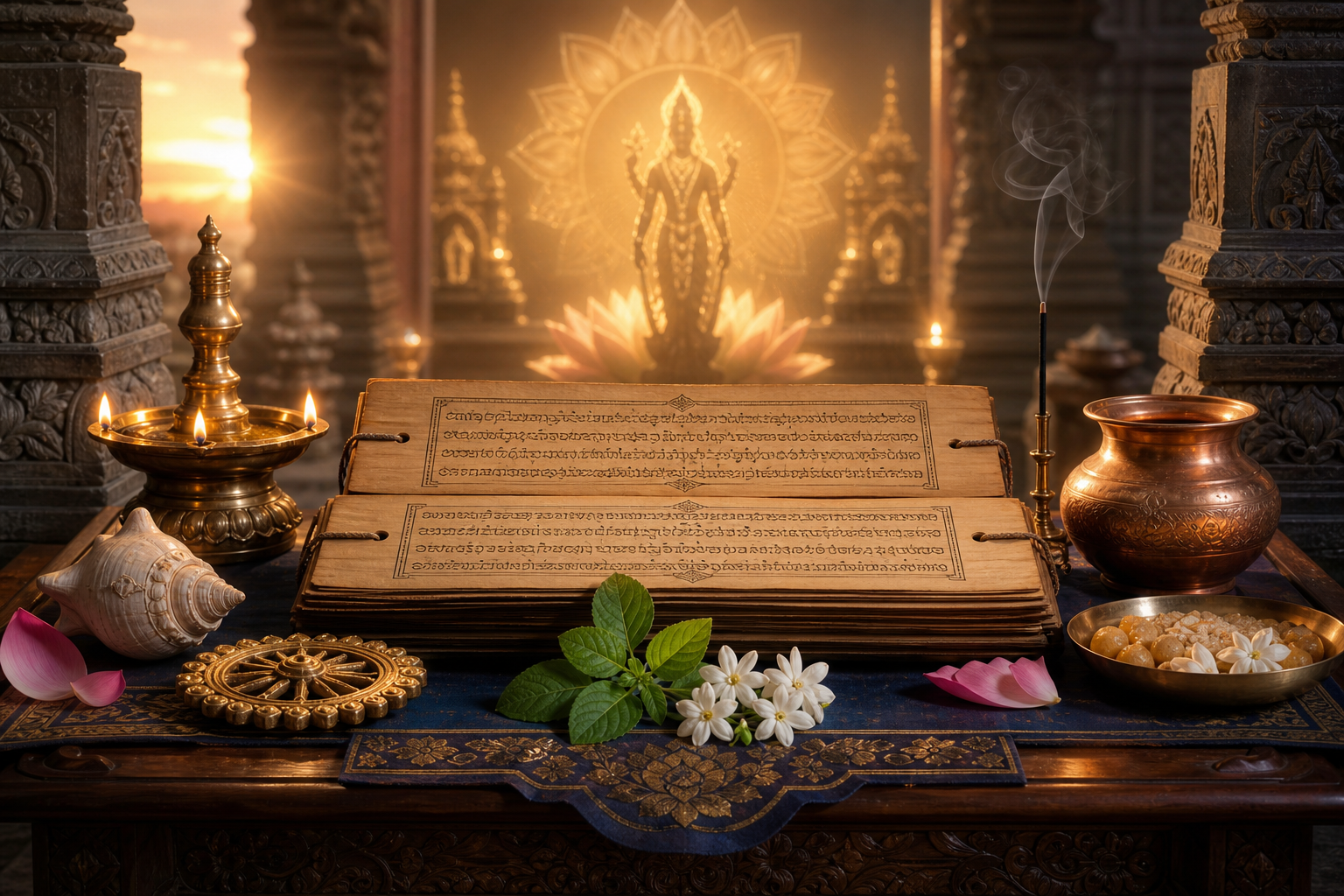
Ishvara Samhita occupies an important place within the Pancharatra tradition of Vaishnava Agama literature. It is remembered not merely as a ritual handbook, but as a sacred framework through which worship, temple discipline, initiation, meditation, mantra, and devotion are organized around the presence of Vishnu-Narayana. The surviving description of the text presents it as a work of 24 chapters, and that structure itself suggests a carefully ordered manual rather than a loose collection of devotional reflections.
In the broader history of Hindu scriptures, the Pancharatra tradition represents one of the most influential Vaishnava systems for understanding divine manifestation and practical worship. Its samhitas guide the devotee from external ritual to inner realization, from the consecrated image to the indwelling divine, and from disciplined practice to spiritual intimacy. Ishvara Samhita belongs to this world of temple-centered spirituality, where theology is not separated from practice and devotion is not reduced to emotion alone.
The significance of Ishvara Samhita becomes clearer when it is placed beside other Pancharatra texts such as Sattvata Samhita, Jayakhya Samhita, Paushkara Samhita, Ahirbudhnya Samhita, Padma Samhita, and related Vaishnava Agamas. These works are concerned with the nature of Narayana, the forms of divine manifestation, the rules of worship, the discipline of the priest, the sanctity of the temple, and the gradual refinement of human consciousness. Ishvara Samhita participates in this same intellectual and devotional heritage.
At the heart of the Pancharatra worldview is the conviction that the Supreme is both transcendent and accessible. Vishnu-Narayana is not confined to an abstract philosophical category, nor is the deity treated as a mere symbol. The divine is approached through mantra, image, consecration, meditation, ritual service, and ethical preparation. This layered vision gives Ishvara Samhita its enduring relevance, because it speaks to the human need for form, rhythm, discipline, and inward meaning.
The text is especially important for understanding Vaishnava worship as a complete way of life. Ritual in this tradition is not mechanical performance. It is a trained language of reverence. Every offering, gesture, mantra, purification, and act of service is meant to transform the worshipper as much as it honors the deity. In that sense, Ishvara Samhita preserves a vision in which worship is both sacred art and spiritual technology.
One of the most striking features of the Pancharatra tradition is its ability to connect temple ritual with inner practice. The devotee may begin with visible forms: water, flowers, lamps, incense, food offerings, and sacred space. Yet these outer elements are not ends in themselves. They train attention, purify intention, and cultivate devotion. Ishvara Samhita can therefore be read as a bridge between ritual precision and spiritual realization.
The Vaishnava Agamas often explain worship through a disciplined sequence. The devotee prepares the body, purifies the mind, invokes the divine presence, offers service, meditates upon the deity, and receives prasadam as grace. This rhythm reflects a deep understanding of human psychology. A distracted mind requires structure. A restless heart requires devotion. A fragmented life requires sacred repetition. Ishvara Samhita responds to these needs through an integrated system of worship.
In the temple context, texts like Ishvara Samhita help define the relationship between deity, priest, devotee, and sacred space. The temple is not merely a building where worship happens. It is a consecrated field of presence, memory, learning, service, and community. The rules of worship protect that sanctity. They ensure that devotion is expressed with care, continuity, and humility rather than personal improvisation alone.
The Pancharatra tradition is also known for its theology of divine manifestation, especially the understanding that the Supreme can be approached through multiple modes. These include the transcendent form, emanational forms, avataric forms, the indwelling presence, and the consecrated image. This theology is central to Vaishnava spirituality because it explains how the infinite becomes approachable without ceasing to be infinite.
Ishvara Samhita should therefore not be understood as a narrow ritual manual. Its ritual instructions rest upon a larger philosophy: the divine accepts the devotee through accessible forms, and the devotee ascends through sincere, disciplined engagement with those forms. This is one of the great strengths of Hindu spiritual traditions. They allow metaphysics, devotion, aesthetics, discipline, and community life to work together.
The text also reflects the importance of initiation in Vaishnava practice. Initiation is not simply a formal entry into a religious group. It is a transmission of responsibility, discipline, mantra, and sacred orientation. A person who receives initiation is expected to live with greater awareness, moral steadiness, and devotional commitment. Ishvara Samhita belongs to the world in which spiritual knowledge is received with reverence and practiced with accountability.
Mantra occupies a central place in this sacred discipline. In Vaishnava practice, mantra is not treated as ordinary speech. It is sound charged with presence, memory, lineage, and meditation. Repetition of mantra refines attention and binds the heart to the deity. The ritual world of Ishvara Samhita therefore depends not only on correct action but also on sacred sound, inward focus, and devotional intention.
Another important aspect of Ishvara Samhita is its contribution to the culture of temple worship. Hindu temples, especially Vaishnava temples, have historically functioned as centers of worship, music, learning, charity, calendar observance, pilgrimage, and social cohesion. Agamic texts preserve the standards by which these institutions remain spiritually coherent across generations. Without such textual foundations, tradition can easily become vague, ornamental, or dependent on personal preference.
The discipline described in such texts also reveals a refined understanding of purity. Purity is often misunderstood in modern discussion as external rigidity alone. In the Agamic setting, purity includes bodily preparation, mental steadiness, ethical conduct, proper intention, and respect for the sanctity of sacred objects. It is a way of aligning the human being with the act of worship so that the offering is made with dignity and clarity.
For many practitioners, the emotional power of Vaishnava worship lies in its tenderness. The deity is awakened, bathed, adorned, fed, praised, and placed at the center of communal life. These actions may appear symbolic from outside, but within the tradition they cultivate a relationship of service and affection. Ishvara Samhita belongs to this devotional world where reverence is expressed through care, and care becomes a form of knowledge.
This devotional tenderness does not weaken the intellectual seriousness of the text. On the contrary, Pancharatra literature is deeply theological. It addresses the nature of the Supreme, the relation between form and formlessness, the function of consecration, the role of mantra, and the movement from ritual action to spiritual insight. Ishvara Samhita shows that bhakti and philosophy are not opposing paths. They are mutually sustaining dimensions of Sanatana Dharma.
The text also deserves attention for its role in preserving continuity. Traditions survive not only through belief but through repeatable forms of practice. A lamp lit every evening, a mantra recited daily, a deity served according to inherited procedure, and a festival observed by a community all become carriers of civilizational memory. Ishvara Samhita helps safeguard that continuity by giving worship a disciplined grammar.
In the context of Dharmic unity, Ishvara Samhita can be appreciated without sectarian narrowness. It is a Vaishnava text, but its underlying values resonate across Hindu, Buddhist, Jain, and Sikh traditions: reverence, discipline, ethical refinement, sacred sound, inner transformation, and respect for a path received through lineage. Each Dharmic tradition has its own vocabulary and theology, yet all recognize that spiritual life requires practice, humility, and self-transformation.
This wider Dharmic perspective is important because sacred texts are sometimes read only through the lens of difference. Ishvara Samhita should instead be read as part of the larger Indian effort to preserve spiritual knowledge through disciplined forms. Whether one stands in a Vaishnava temple, listens to kirtan, studies Vedanta, practices meditation, observes ahimsa, or receives wisdom through the guru-shishya tradition, the deeper aim is refinement of consciousness and alignment with dharma.
Modern readers may also find in Ishvara Samhita a response to the disorder of contemporary life. The text assumes that sacred living does not happen casually. It must be cultivated through time, place, sound, gesture, study, and devotion. In an age of distraction, such a vision feels especially relevant. It teaches that spiritual depth is built through repeated acts of attention.
The technical nature of the text should not discourage readers. Agamic literature can appear complex because it deals with precise procedures, classifications, mantras, and ritual sequences. Yet this precision is part of its beauty. It demonstrates that worship is worthy of careful thought. Just as music requires scale, rhythm, and discipline before it becomes moving, sacred worship requires form before it becomes inwardly transformative.
Ishvara Samhita also challenges the modern assumption that ritual and spirituality are separate. In many contemporary conversations, ritual is dismissed as external and spirituality is praised as internal. The Pancharatra tradition does not accept this division. It teaches that outer acts can educate inner life when they are performed with knowledge, devotion, and humility. The body participates, the senses participate, the voice participates, and gradually the mind becomes steady.
The text can therefore be understood as a sacred pedagogy. It trains the devotee to see the world differently. Water is no longer only water; it becomes an offering. Food is no longer only consumption; it becomes prasadam. Sound is no longer only speech; it becomes mantra. Space is no longer only architecture; it becomes temple. Time is no longer only routine; it becomes worship.
Its continuing relevance also lies in the dignity it gives to service. In Vaishnava spirituality, service to the deity is not servility. It is a deliberate turning away from ego-centered life. The devotee learns to arrange, clean, offer, chant, bow, remember, and receive. These actions discipline the senses and soften the heart. They create a devotional culture in which humility is not weakness but spiritual intelligence.
From an academic perspective, Ishvara Samhita is valuable because it helps scholars understand how theology becomes embodied practice. Abstract ideas about Vishnu, Narayana, avatar, mantra, consecration, and liberation are not left in philosophical language alone. They are translated into daily worship and temple life. This makes the text an important witness to the lived reality of Vaishnava Hinduism.
From a devotional perspective, the text is valuable because it preserves a path of nearness. It teaches that the divine can be approached with order, beauty, reverence, and love. The devotee is not asked to abandon the world in order to find sacredness. Instead, ordinary materials and daily acts are elevated into worship. This is one of the most enduring gifts of the Agamic imagination.
Ishvara Samhita ultimately stands as a reminder that Hindu scriptures are not only books to be read but traditions to be lived. Its teachings belong to the temple, the home shrine, the voice that chants, the hands that offer, the mind that meditates, and the community that gathers around sacred presence. It is a guide to Vaishnava worship, but it is also a guide to disciplined spiritual attention.
Its message remains powerful because it unites accuracy of practice with warmth of devotion. It protects the sanctity of ritual while pointing beyond ritual toward realization. It honors Vishnu-Narayana through form, mantra, and service while reminding the devotee that every sacred act must lead toward inner purification. For this reason, Ishvara Samhita continues to deserve careful study within Hindu scriptures, Pancharatra tradition, Vaishnava worship, and the wider heritage of Sanatana Dharma.
Inspired by this post on Hindu Blog.
