
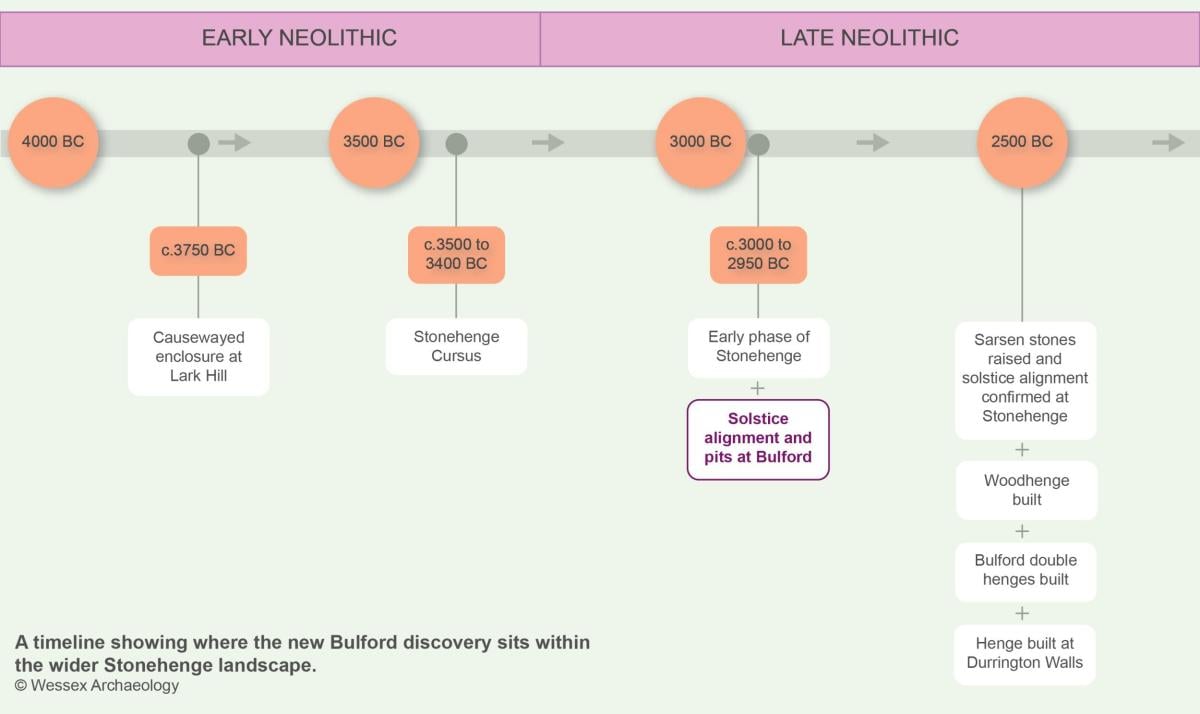
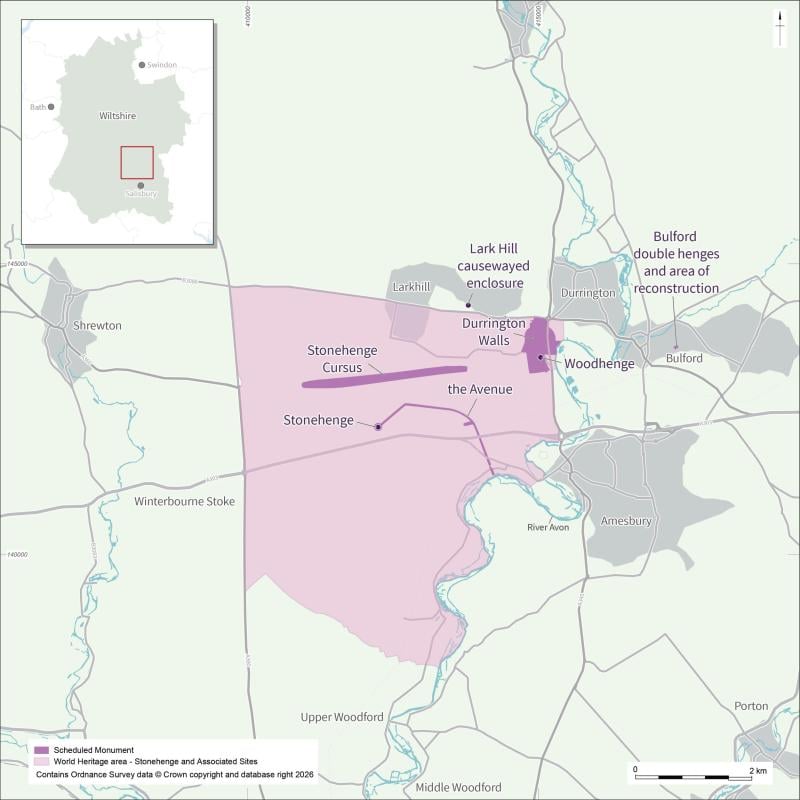
The newly reported discovery at Bulford, Wiltshire, deserves careful attention because it places the sacred landscape around Stonehenge into a longer and more complex history than is often imagined. Announced by Wessex Archaeology on June 18, 2026, the find concerns a 5,000-year-old timber alignment located about 5 kilometres from Stonehenge, close to the Salisbury Plain Training Area. Radiocarbon dating places associated activity around 2950 BC, making the site broadly contemporary with the earliest earthwork phase of Stonehenge but earlier than the famous sarsen stone alignment by roughly five centuries.
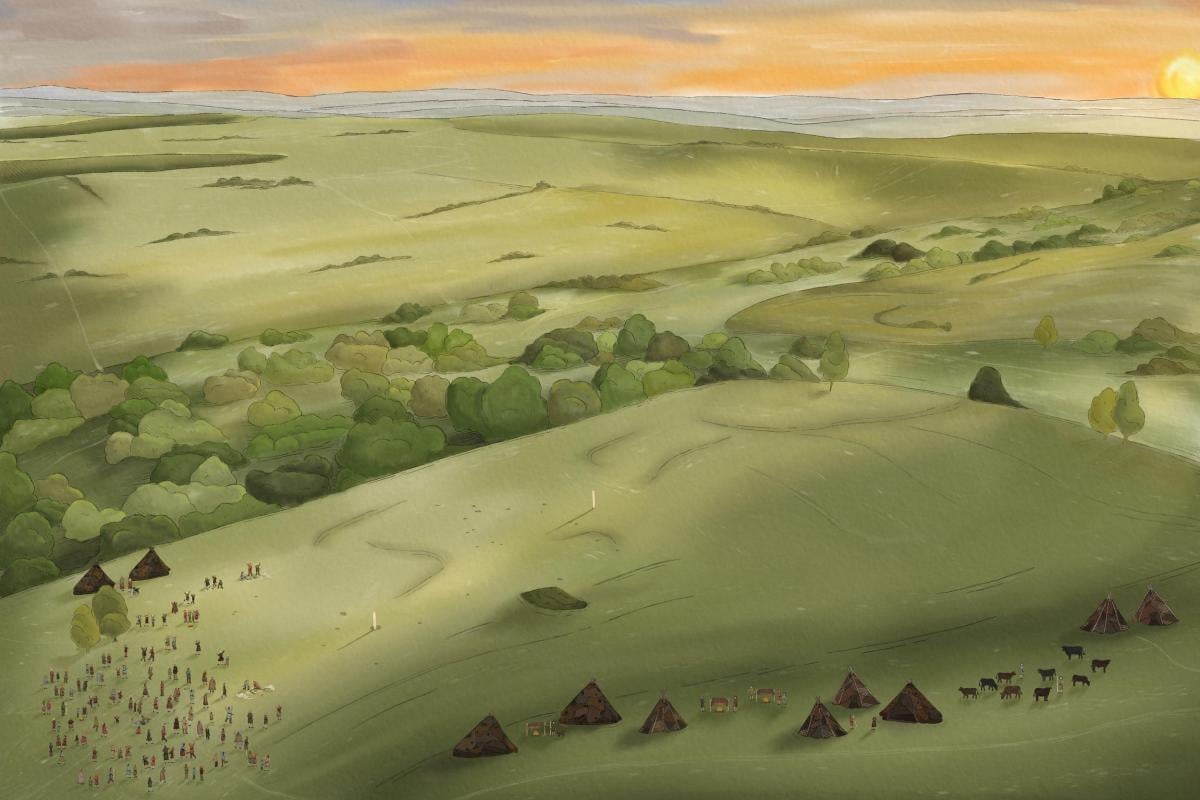
The importance of the Bulford discovery lies not in monumental stone, but in the disciplined reading of small archaeological traces: post pits, worked flints, pottery, animal bone, charcoal, and the spatial logic of a vanished structure. Nothing like a standing monument survives above ground. Instead, the evidence comes from the pits where two wooden poles once stood, set about 120 metres apart. When examined against reconstructions of the ancient sky, local horizon, and prehistoric landscape, the alignment appears to have pointed toward the rising sun at the summer solstice and the setting sun at the winter solstice.
That technical detail is profound. A solstice alignment is not merely a line on a map. It is a deliberate relationship between earth, horizon, time, and observation. For communities without written calendars, the recurring movement of the sun offered a reliable structure for memory, ritual, seasonality, agricultural expectation, and religious meaning. The Bulford alignment suggests that Neolithic communities in the Stonehenge landscape were not only watching the heavens; they were building places where the sky could be observed, marked, remembered, and ritually celebrated.
According to Wessex Archaeology, the alignment analysis was carried out by skyscape archaeologist Dr Fabio Silva, using reconstructions of the sky and horizon as they would have appeared around five millennia ago. The reported accuracy, within about one degree, is striking because it indicates more than accidental orientation. It points to repeated observation, practical astronomical knowledge, and a community capable of translating celestial movement into built form. In that sense, the Bulford site is not a crude predecessor of Stonehenge, but an early expression of the same broad intellectual and sacred concern: how human beings locate themselves within cosmic order.
This is why the word “prototype” must be used with care. It does not necessarily mean that Bulford was a direct architectural blueprint for Stonehenge in a modern engineering sense. Rather, it suggests that ideas later expressed more permanently at Stonehenge may already have been active in the surrounding landscape. Wooden poles could be erected, replaced, removed, or allowed to decay. Stone, by contrast, creates permanence. The shift from timber to stone may therefore represent not the invention of solstice religion, but the monumentalization of older practices.
The discovery also helps correct the common habit of treating Stonehenge as an isolated marvel. Archaeology has long shown that Stonehenge belongs to a wider ceremonial landscape that includes earthworks, avenues, burial areas, timber structures, settlements, and other ritual sites. Bulford adds another layer to this landscape. It suggests that sacred activity, seasonal gathering, and astronomical orientation were already part of the region’s religious culture before the iconic stones became the dominant symbol in public imagination.
The excavations at Bulford were originally undertaken between 2015 and 2017 as part of the Ministry of Defence’s Army Basing Programme, ahead of accommodation development for service personnel. This context is significant because many major archaeological discoveries emerge not from romantic quests for lost temples, but from careful rescue archaeology before modern construction. In this case, what first appeared to be ordinary pits became, through deeper study, evidence for one of the earliest known solstice-aligned structures in the Stonehenge landscape.
The site contained 48 pits dated to around 2950 BC. The associated finds included pottery, animal bone, charcoal, and worked flints. Such material is important because it points to gathering, feasting, tool use, and repeated activity rather than a single accidental deposit. Feasting evidence is especially relevant in prehistoric ritual studies. Shared food and seasonal gathering often mark the transition from individual observation to communal ceremony. The solstice was not only seen; it was socially enacted.
One particularly intriguing find was a rare disc-shaped flint knife recovered from a pit that may have served as part of a viewing station. Wessex Archaeology has suggested that the object may have had symbolic association with the sun disc. This interpretation should remain cautious, as prehistoric symbolism cannot be read with the certainty of a written text. Yet the combination of a solar alignment, ceremonial deposits, and a disc-shaped object makes the interpretation reasonable within the broader archaeological pattern.
From a technical perspective, the Bulford alignment demonstrates the importance of archaeoastronomy and skyscape archaeology. These fields study how ancient people related built environments to celestial events, horizon features, light, shadow, and seasonal cycles. The work is not a matter of projecting modern astronomy backward in a simplistic way. It requires modelling ancient skies, accounting for changes in celestial positions over time, examining local topography, and testing whether alignments are statistically and contextually meaningful. At Bulford, the solstitial orientation gains force because it is supported by dating, archaeology, landscape context, and ritual evidence.
The summer solstice, falling around June 21 in the modern calendar, marks the longest day of the year in the northern hemisphere. The winter solstice marks the shortest day and the gradual return of light. For prehistoric communities, these were not abstract astronomical facts. They were thresholds in the lived year, tied to warmth, darkness, food, animal cycles, death, renewal, and continuity. A community gathering at midsummer sunrise or midwinter sunset was participating in a visible rhythm that linked survival with sacred order.
This aspect of the discovery offers a meaningful point of reflection for Dharmic traditions, including Hinduism, Buddhism, Jainism, and Sikhism, without forcing false equivalence between distinct cultures. Many Dharmic practices preserve a deep sensitivity to time, season, direction, light, dawn, ritual calendars, and cosmic order. The reverence for sunrise, the use of sacred calendars, and the alignment of festivals with lunar and solar cycles show how spiritual life can be structured through disciplined observation of nature. Bulford belongs to ancient Britain, not ancient India, yet it reminds readers that reverence for cosmic rhythm is a widespread human inheritance.
Such comparisons should be made with scholarly humility. The Bulford builders were not Hindus, Buddhists, Jains, or Sikhs, and their beliefs cannot be reconstructed through later religious categories. However, the discovery does encourage a respectful comparative insight: human communities across the world have often responded to the sky not merely with curiosity, but with devotion, responsibility, and ceremony. This shared human impulse can deepen inter-traditional respect rather than encourage claims of ownership over the past.
The discovery also carries emotional power because it makes the distant past feel unexpectedly intimate. Five thousand years ago, people stood on a Wiltshire hillside and watched the same sun that modern visitors still greet at Stonehenge. Their tools, languages, songs, and deities may be lost, but the gesture of gathering at a turning point of light remains understandable. It is one of archaeology’s great gifts that a pattern of pits in chalk can restore a scene of human attention: people waiting together for sunrise, sharing food, marking time, and seeking assurance that the world remained ordered.
For modern observers, this is also a reminder that ancient religion should not be dismissed as primitive superstition. The Bulford alignment required observation, memory, geometry, social coordination, and skilled construction. Ritual and technical intelligence were not separate domains. The sacred and the scientific, in this prehistoric context, met in the act of placing posts so that the horizon and the sun could speak through the built environment. This is a valuable corrective to modern assumptions that spirituality and empirical observation must always stand apart.
The relation to Stonehenge is especially significant. Stonehenge’s later stone architecture famously aligns with the midsummer sunrise and midwinter sunset, and the monument has become a global symbol of prehistoric astronomy. Bulford suggests that the principles behind such alignments may have been tested, practised, or ritually developed in simpler forms before being expressed in stone. If similar timber alignments once existed in the earliest phases of Stonehenge, later construction may have erased them. This possibility makes the absence of surviving evidence as important as the evidence that remains.

The find also illustrates the layered nature of heritage. The modern landscape includes military land, development projects, heritage management, archaeological rescue work, scientific dating, public solstice celebrations, and global interest in ancient spirituality. Bulford sits at the intersection of all these realities. Its discovery was made possible by contemporary infrastructure work, but its meaning reaches back to a time before written history in Britain. This is precisely why heritage preservation matters: ordinary ground can contain extraordinary memory.
There is also a broader cultural lesson in the way this discovery should be received. Ancient pagan, indigenous, and Dharmic traditions each deserve to be studied without contempt, caricature, or sectarian hostility. The goal of serious cultural reflection is not to replace one exclusivism with another, but to recognise how different communities have sought meaning through ritual, landscape, ancestors, ethics, and cosmic order. The Bulford discovery is therefore best approached as an opportunity for respect: respect for ancient Britain, respect for living spiritual traditions, and respect for the human search for harmony between earth and sky.
Academically, the next important stage will be publication of the fuller findings from the Army Basing Programme and related discussion through archaeological channels such as The Prehistoric Society and Wessex Archaeology’s Open Library. Until then, interpretations should remain evidence-based and appropriately cautious. The current evidence strongly supports a solstitial alignment and ceremonial activity, but the exact theology, mythology, and social structure of the Bulford community remain beyond direct recovery.
Even with that caution, the discovery is remarkable. It shows that the Stonehenge landscape was already a place of solar attention, seasonal gathering, and sacred architecture around 5,000 years ago. It strengthens the view that Stonehenge emerged from deep local traditions rather than appearing as a sudden isolated achievement. Most importantly, it reminds modern readers that the human relationship with the sun has always been both practical and spiritual: a matter of warmth and harvest, but also of wonder, gratitude, and the desire to live within a meaningful cosmos.
Primary source: Wessex Archaeology, “Discovery led by Phil Harding reveals 5,000-year-old ‘prototype’ for Stonehenge solar alignment”.
Inspired by this post on Hindu Human Rights Blog.
