
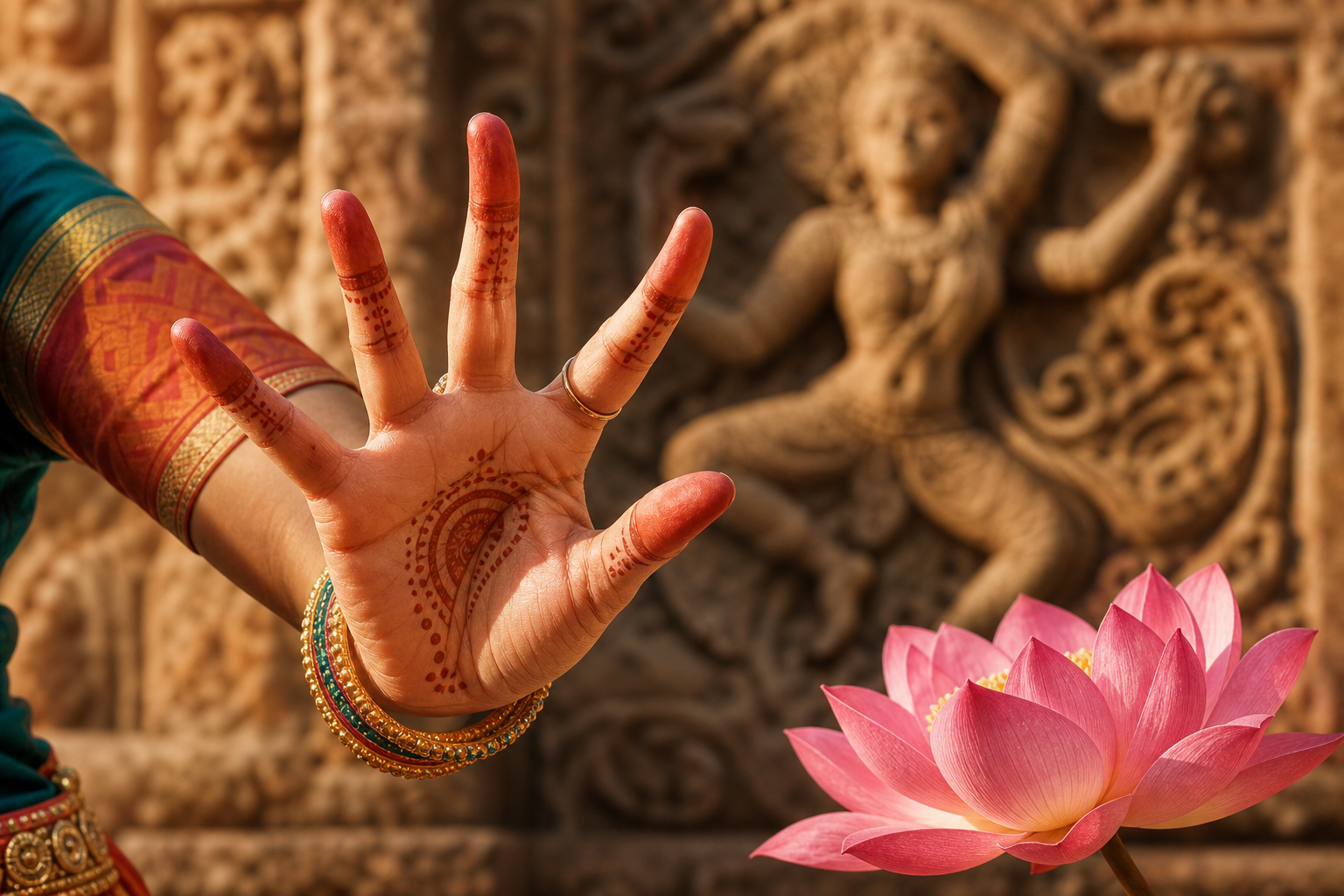
Alapadma Mudra — The Blossoming Lotus of Sacred Hand Language in Hindu Sculpture
In the visual language of Hindu sacred art, the hand is never a minor anatomical detail. It is a disciplined instrument of meaning, theology, aesthetics, ritual memory, and embodied devotion. A sculpted palm may bless, protect, grant, teach, summon, or reveal. A dancer’s hand may become a flower, a river, a face, a moon, an offering, or a state of longing. Within this refined vocabulary, Alapadma Mudra occupies a distinctive place as the open lotus hand: a gesture of blossoming, radiance, beauty, sacred expansion, and refined emotional expression.
The Sanskrit term Alapadma is commonly understood as the fully opened lotus. In performance traditions such as Bharatanatyam, Odissi, Kuchipudi, Mohiniyattam, and related classical arts, it belongs to the family of codified hand gestures known as hasta or mudra. In sculptural traditions, its exact naming may not always be inscribed beside the image, yet its visual form and symbolic force are recognizable across temple panels, divine figures, celestial attendants, and iconographic compositions where the open hand evokes fertility, grace, awakening, and sacred beauty.
Technically, Alapadma is formed by opening the palm and spreading the fingers outward in a circular, petal-like arrangement. The fingers are not stiffly extended like mechanical rods; they curve with controlled softness, suggesting the organic unfolding of a flower. The wrist may rotate, soften, or lift depending on the expressive context. The hand appears expansive, yet disciplined. It is open, yet intentional. This balance between freedom and structure is central to the aesthetic power of Hindu art and Indian classical dance.
The lotus is one of the most enduring symbols in Hindu culture, dharmic philosophy, and Indian artistic imagination. It grows from mud yet opens unstained above the water; it is rooted in the world while pointing beyond it. This quality gives the lotus a profound spiritual vocabulary. It can signify purity, birth, beauty, detachment, cosmic unfolding, divine presence, and the awakening of consciousness. Alapadma Mudra carries this symbolic inheritance into the human hand, turning the body itself into a medium of sacred suggestion.
In Hindu iconography, the lotus is closely associated with deities such as Lakshmi, Saraswati, Brahma, Vishnu, and many forms of Devi. Lakshmi often stands or sits upon the lotus, embodying auspiciousness, abundance, and royal grace. Saraswati’s association with refined knowledge and artistic wisdom also resonates with the lotus as a symbol of cultivated clarity. Vishnu’s iconography includes the lotus as one of his attributes, while Brahma is traditionally linked with the lotus emerging from the navel of Vishnu in cosmological imagery. Alapadma Mudra does not simply imitate a flower; it participates in this wider sacred grammar.
Classical treatises on performance, especially the traditions associated with the Natya Shastra and later works such as the Abhinaya Darpana, preserve a sophisticated theory of gesture. These texts do not treat movement as decoration. Gesture is a vehicle of rasa, bhava, narrative clarity, and spiritual communication. A single hand gesture may carry multiple meanings depending on context, direction, facial expression, rhythm, and dramatic intent. Alapadma therefore cannot be reduced to one fixed translation. It is a living sign whose meaning unfolds through use.
In dance, Alapadma may represent a fully blossomed lotus, beauty, charm, the face, the moon, a mirror, circular movement, delicate ornamentation, emotional separation, or the radiance of a feminine presence. Its interpretive range reveals the genius of Indian aesthetics: meaning is layered rather than flat. The same hand that becomes a flower in one passage can become the face of a beloved in another, the luminous fullness of the moon in another, and the ache of separation in a devotional composition. Such versatility is not ambiguity; it is cultivated semantic richness.
In Hindu sculpture, the open lotus hand often appears where the artist seeks to communicate refinement, auspiciousness, and divine elegance. Sculptors working in stone, bronze, wood, and terracotta were attentive to the expressive value of the palm. Even when a deity holds a lotus as an object, the surrounding hands and attendant figures may echo the flower through gesture. Temple art frequently uses such visual correspondences: the deity, the ornament, the body, the posture, and the architectural setting speak to one another through repeated symbolic forms.
The sculptural hand is especially important because Hindu temple imagery is not merely representational. It is devotional, ritual, and pedagogical. The devotee approaching a murti is not looking at an isolated artwork in the modern museum sense. The image participates in darshan, temple ritual, sacred geography, and inherited memory. A hand gesture in this setting becomes part of a larger encounter between the human and the divine. Alapadma-like openness can quietly suggest that the deity is not closed, remote, or inert, but radiant, present, and unfolding toward the devotee.
The open lotus also has a subtle psychological force. A closed fist suggests holding, defense, or concentration of power. An open palm suggests offering, revelation, generosity, and beauty. Alapadma refines this openness into a floral form. The viewer does not merely see a hand; the viewer senses blossoming. This is why the mudra feels emotionally accessible even to those who have not formally studied iconography. Its beauty communicates before its technical meaning is explained.
At the same time, accurate interpretation requires discipline. Not every open hand in Hindu sculpture should automatically be identified as Alapadma Mudra. Iconographic study must consider the figure, period, regional style, textual tradition, posture, attribute, and narrative context. A hand may be in Abhaya Mudra, Varada Mudra, Kataka Mudra, or another codified position. Some sculptural gestures resemble performance mudras without being exact dance transcriptions. The strongest readings arise when visual analysis is joined with textual knowledge and awareness of living practice.
This relationship between sculpture and dance is one of the most fascinating features of Hindu art. Indian classical dance did not develop in isolation from temple culture, nor did temple sculpture exist apart from performative imagination. Many temple panels preserve dancing figures, musicians, divine attendants, ganas, apsaras, yoginis, and forms of Shiva Nataraja whose bodies record principles of movement. The sculptor freezes rhythm into stone; the dancer releases stone back into rhythm. Alapadma Mudra belongs to this shared world of embodied knowledge.
In Bharatanatyam, Alapadma is often encountered as part of abhinaya, the expressive dimension of performance. When used near the face, it may heighten beauty, tenderness, longing, or wonder. When rotated outward, it may suggest blossoming or expansion. When placed in relation to the heart, it may convey emotional opening. In devotional repertoire, this gesture can help describe the beauty of Krishna, the compassion of Devi, the tenderness of Rama, the grace of Shiva, or the inner state of the devotee yearning for darshan.
Odissi, with its sculptural tribhanga and deep relationship to temple imagery, offers another powerful context for understanding Alapadma. The curved body, the ornamented hand, and the face turned in controlled suggestion create a visual continuity with carved figures from Odisha’s temple heritage. In such performance, the mudra is not an isolated sign but part of an entire grammar of curve, rhythm, glance, and devotional mood. The open lotus hand becomes one element in a larger architecture of grace.
Kuchipudi and Mohiniyattam also reveal the mudra’s dramatic and lyrical range. Kuchipudi may use the open lotus hand in narrative passages, devotional description, and rhythmic movement. Mohiniyattam, with its soft circularity and lasya quality, gives Alapadma a particularly fluid presence. In each tradition, the core gesture remains recognizable, yet its emotional temperature changes. This is characteristic of dharmic artistic systems: unity is preserved without erasing regional personality.
Alapadma Mudra also invites comparison with the broader dharmic reverence for the lotus across Hinduism, Buddhism, Jainism, and Sikh cultural memory. The lotus appears in Buddhist art as a sign of awakening and transcendence. Jain imagery uses lotus symbolism in connection with purity, auspiciousness, and the spiritual dignity of the Tirthankaras. Sikh scripture and devotional vocabulary also employ the lotus as a metaphor for spiritual awareness amid worldly life. These shared resonances do not collapse distinct traditions into one another; rather, they show how dharmic civilizations often develop through dialogue, continuity, and mutual symbolic recognition.
This inclusive understanding is especially important when discussing sacred art. The goal is not to use iconography as a boundary marker for division, but to understand how inherited symbols cultivate refinement, discipline, and reverence. The open lotus hand can be read as an image of cultural generosity. It opens outward without losing its center. It honors specificity while allowing a wider spiritual imagination to breathe.
From a technical art-historical perspective, Alapadma-like gestures also demonstrate the sophistication of Indian sculptural anatomy. The artist must suggest softness through hard material. A stone hand must appear alive, flexible, and fragrant with movement. This requires mastery of proportion, spacing, contour, and implied tension. The spread fingers must not look broken or accidental; they must read as petals. The palm must hold energy without becoming rigid. Such details show why Hindu sculpture deserves close looking rather than hurried categorization.
The mudra’s association with beauty should not be dismissed as merely ornamental. In Hindu aesthetics, beauty is often a pathway to recognition. Saundarya, or beauty, can direct attention toward order, harmony, luminosity, and the presence of the sacred. A beautifully rendered hand is not superficial; it is theological in form. It teaches that the body, when disciplined and sanctified, can become an instrument of higher meaning.
Alapadma also reveals the philosophical subtlety of embodiment in Hindu traditions. The body is neither treated as meaningless matter nor worshipped as an isolated object. It is trained, refined, and placed in relation to dharma, devotion, knowledge, and liberation. The hand becomes a bridge between inner feeling and outer expression. A dancer may inwardly hold bhakti, karuna, viraha, or wonder; the mudra gives that inner state a visible form. Sculpture performs a similar act across time, preserving inner states in enduring material.
For many devotees and students of Indian art, the first encounter with such a mudra may be intuitive rather than academic. A hand carved on a temple wall, a bronze figure in a sanctum, or a dancer’s palm opening under stage light can produce a moment of recognition before analysis begins. Later study deepens that recognition. The viewer learns that what seemed simply graceful belongs to a precise system of knowledge. This transition from admiration to understanding is one of the great rewards of studying Hindu art and culture.
The open lotus hand also has pedagogical value. It teaches viewers to slow down. Modern habits often train the eye to consume images quickly, but temple sculpture and classical dance demand patient attention. A gesture may contain a flower, a cosmology, a mood, a theological association, and a performance memory. Alapadma Mudra reminds the observer that sacred art is not exhausted by surface beauty. Its meaning grows through repeated seeing, much like a lotus opening gradually with light.
In temple architecture, the placement of such gestures matters. A figure on an outer wall may participate in a larger program of auspicious imagery, while a figure near a sanctum may carry a more concentrated devotional charge. Celestial dancers and attendant figures often frame the divine presence, creating a rhythmic environment around the central deity. Their hands, including lotus-like gestures, contribute to the atmosphere of abundance, celebration, and sacred order. The temple becomes not only a house of the deity but a complete visual cosmos.
The mudra’s symbolic relationship with the lotus also connects it to ideas of spiritual unfolding. In yogic and tantric vocabularies, the lotus often appears as a metaphor for subtle centers, awakened consciousness, and the flowering of inner awareness. While performance mudras and yogic symbolism should not be carelessly conflated, the shared imagery indicates a broader Indian habit of thinking through organic forms. The flower is not merely botanical; it is metaphysical, aesthetic, and experiential.
Alapadma’s presence in dance education further shows how tradition is transmitted through the body. Students do not learn the mudra only by reading definitions. They repeat it, correct it, feel the spacing of the fingers, observe the wrist, coordinate it with the eyes, and integrate it with rhythm and expression. Knowledge passes from teacher to student through disciplined practice. This guru-shishya mode of transmission preserves nuance that a diagram alone cannot capture.
In the modern study of Hindu Sculptures and Hindu Art and Culture, Alapadma Mudra offers a valuable case study because it sits at the intersection of iconography, performance, Sanskrit textuality, temple architecture, and devotional experience. It encourages a method that is neither purely textual nor purely visual. The gesture must be studied in manuals of abhinaya, in living dance traditions, in sculptural examples, and in the symbolic universe of the lotus. Only then does its full cultural depth become visible.
There is also a contemporary relevance to this study. In an age when sacred symbols are often flattened into decorative motifs, understanding Alapadma restores dignity to detail. It shows that a hand gesture can carry centuries of reflection, artistic training, and spiritual aspiration. It also helps younger audiences recognize that Hindu iconography is not random or primitive symbolism, but a refined intellectual and artistic system with precise internal logic.
Alapadma Mudra may appear delicate, but its cultural strength is considerable. It links the dancer’s moving body to the sculptor’s enduring stone. It links the lotus of mythology to the lotus of inner awakening. It links beauty with discipline, devotion with technique, and regional art forms with a shared dharmic vocabulary. Its open form suggests that sacred knowledge is not closed within abstraction; it can bloom through gesture, rhythm, worship, and attentive seeing.
To study this mudra is to enter a larger conversation about how Hindu traditions understand the body as a bearer of meaning. The hand becomes scripture in motion and sculpture in miniature. It can speak without sound, teach without argument, and evoke devotion without demand. In Alapadma, the human palm becomes a lotus: rooted in discipline, opened by beauty, and directed toward the sacred.
The enduring appeal of Alapadma Mudra lies in this union of clarity and mystery. Its form is simple enough to recognize, yet its meanings continue to unfold across sculpture, dance, ritual, and philosophy. It is a reminder that Hindu sacred art often communicates through layered elegance rather than blunt statement. The open lotus hand does not merely show a flower; it reveals a civilization’s confidence that beauty, when disciplined by dharma, can become a path of knowledge.
Inspired by this post on Hindu Blog.
