
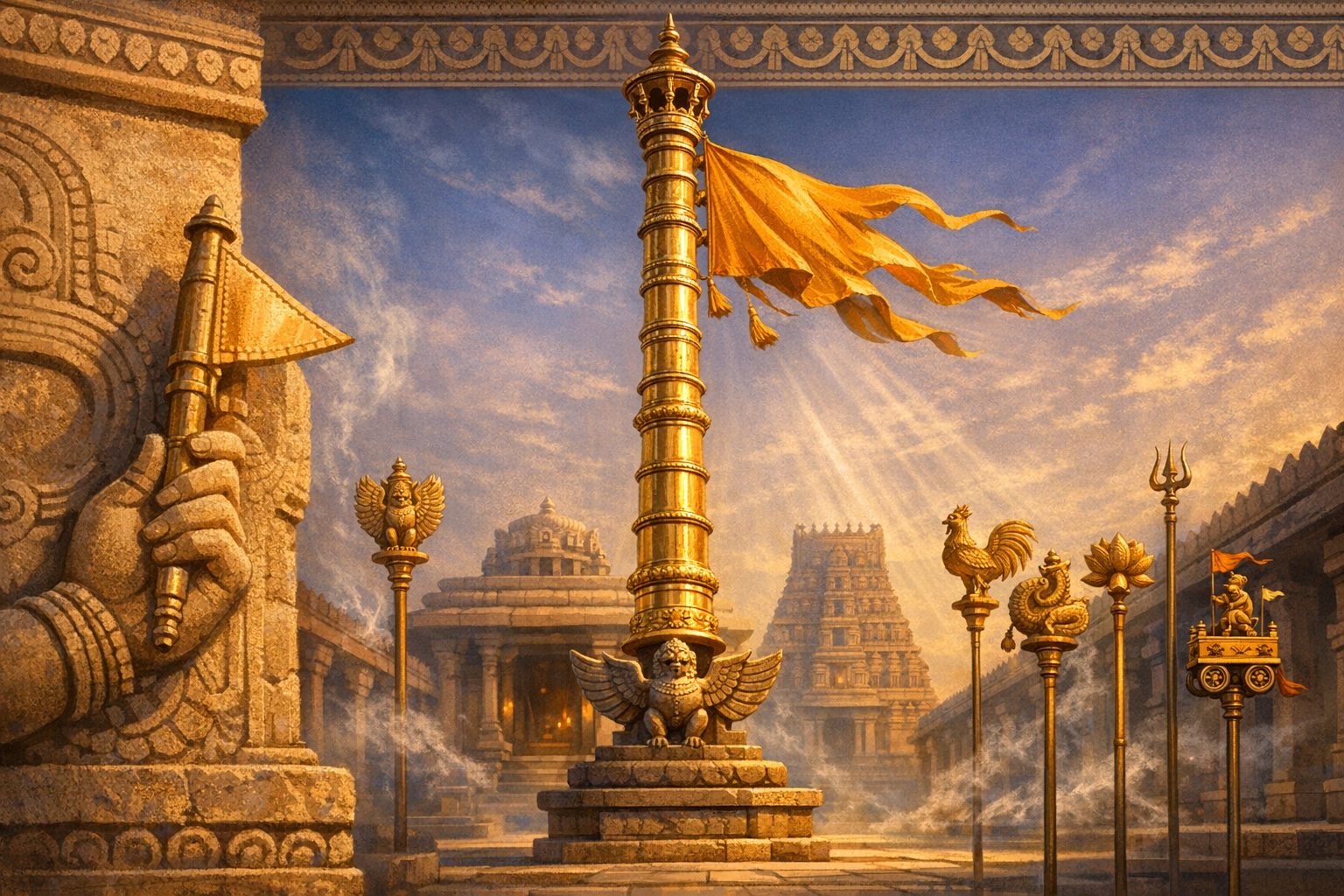
The patakaoften rendered as the dhvaja or sacred flagoccupies a distinctive place in Hindu iconography and temple culture. Unlike the sword, trident, or mace, which telegraph martial protection and kinetic force, the pataka belongs to a quieter, emblematic register: it signals presence, sovereignty, auspicious commencement, and communal identity. In sculpture and ritual alike, the flag functions not as a weapon but as an insignia (chihna), a visible pledge of dharma that gathers worshippers under a shared banner of meaning. This subtle yet potent symbol helps decode how Hindu sculptures communicate theological ideas through nonviolent attributes.
Philologically, pataka denotes a “flag” or “pennon,” while dhvaja conveys “standard,” “ensign,” or “banner.” Related Sanskrit termsketu (standard, sign), lanchana (emblem), and chihna (mark)recur across Purana literature, the Agamas, and the Śilpaśāstras, where they organize the attributes of deities into typologies of weapons (āyudha), gestures (mudrā), ornaments (ābharaṇa), and insignia. Within that matrix, the pataka is classified as an emblem rather than an offensive implement. Its theological register aligns with sovereignty, auspicious beginning, and victory-by-righteousness (jaya through dharma), rather than victory-by-force.
In sculptural programs from early historic to medieval India, standards and flags mark thrones, chariots, and processional scenes as well as divine attendants. Coins and inscriptions reinforce the emblematic role of banners in statecraft and temple culture. The continuity between royal insignia and sacred standards clarifies why the pataka communicates ordained authority: the flag is an oath made visible, announcing not just the presence of power but its rightful orientation toward protection and order.
Materially, the pataka appears in three broad sculptural forms. First, as a compact, hand-held emblem topped with a small triangular or forked pennon; second, as a tall staff borne by an attendant or fixed near a deity’s chariot or vahana; and third, as an architectural companion to the dhvaja-stambha, the great temple flagstaff. Even when carved in stone or cast in bronze, artists render the banner as if in motioncloth curling, tassels liftedto emphasize its relationship to breath and wind (vāyu), the vital subtlety that animates sacred space.
The pataka’s semiotics can be read in four overlapping layers. Sovereignty: as a royal standard that asserts legitimate rule through dharma. Presence: as a sign that a deity or sanctum is “in session,” inviting devotion and ritual attention. Auspicious commencement: raised to inaugurate festivals (dvajarohana), it turns the flow of time itself into liturgical time. Communal identity: as an emblem that gathers devotees into one fellowship under a shared symbol, cultivating cohesion without coercion.
Texts and practice converge on the temple dhvaja-stambha, the monumental flagstaff aligned along the eastern axis between the bali-pitha, the vahana, and the sanctum. Agamic prescriptions describe its consecration, metallurgical sheathing, and ritual maintenance. When the festival flag ascends, the entire complex acquires the acoustic, visual, and emotional cadence of utsava; for many visitors, the moment a banner catches the first breeze of dawn feels like the temple itself taking a deep, collective breath.
Iconographically, the pataka often bears device-emblems that identify sectarian lineage or a deity’s sphere of protection. Vaishnava traditions privilege the Garuḍa-dhvaja; Gupta coins immortalize it as a dynastic standard, while temple precincts celebrate Garuḍa on pillars and pedestals facing Vishnu’s sanctum. Shaiva spaces emphasize the Rishabha or Nandi-lanchana; a trident-finial above a standard can also proclaim Shaiva affiliation. Shakta contexts deploy leonine or lotus motifs, and in the mythology of Kāma (Kāmadeva), the iconic makara-dhvaja (crocodile-emblazoned flag) becomes a metaphor for alluring yet disciplined desire.
In the Tamil country, Subrahmaṇya/Skanda is linked with the seval kodi (rooster banner), a vivid emblem of vigilance and martial intelligence that complements the vel (spear). Sculptures of Murugan sometimes imply the banner’s presence through attendant standards, while processional imagery renders the rooster pennon in bright textile to dramatize the deity’s mobilizing charisma. For museum-goers encountering a Chola bronze of Skanda or a Pallava relief, the small pennon or its absent-yet-signified staff silently teaches how sectarian identity and protective grace are communicated without aggression.
The Mahābhārata offers one of the most resonant banner-images in the kapidhvajathe monkey-emblazoned standard on Arjuna’s chariot, sanctified by Hanuman’s presence. Here the flag fuses protection, memory, and vow: a warrior’s sankalpa anchored in devotion. Sculptures that allude to this narrativewhether by showing a chariot with a small simian device or by placing Hanuman near martial figurestap an ethical grammar in which strength is governed by service and restraint.
On processional days, standards lead, mediate, and protect. The pataka’s forward position is neither ornamental nor incidental: it declares the moral jurisdiction of the deity through the avenues of town or village, extending the temple’s protective perimeter into civic life. Field observations across South Indian temples show that residents intuit this perimeter; shopkeepers lower their voices as the standard passes, and children fall in step, discovering community through the choreography of sacred banners.
Comparative dharmic perspectives deepen the pataka’s meaning. In Buddhist iconography, the victory banner (dhvaja) stands among the aṣṭamaṅgala as a sign of the Buddha’s triumph over inner afflictionsvictory translated from battlefield to mind-field. Jain temples fly dhvajas to proclaim the tīrtha’s sanctity and the vow of ahiṁsā as public ethic. The Sikh Nishan Sahib, rising beside every gurdwara, synthesizes presence, service, and sanctuary. These cognate traditions affirm a shared civilizational thesis: a sacred flag is not expansionist propaganda but a protective canopy under which diverse seekers gather.
Because the pataka belongs to the emblematic register of attributes, its presence in a deity’s hand recalibrates how a sculpture is read. A flag-bearing murti typically emphasizes oversight, proclamation, and vow-keeping rather than wrathful subjugation. This does not negate kṣatra (protective courage); it frames it within rajadharma and lokasaṁgrahathe guardianship of the social and cosmic order envisioned in the Gītā.
Shilpa canons guide the proportions of staff, pennon, and finials. The Agamas and Śilpaśāstras coordinate the banner’s height with the vahana pedestal and sightlines from the dvajasthambha to the sanctum. Even in compact icons, sculptors maintain these harmonies by balancing the flag’s diagonal thrust with counterposed limbs or garments, keeping the deity’s stillness intact while implying the airy motion of cloth.
Motif-lexicons attached to banners are regionally inflected. Lotus and conch speak a Vaishnava vernacular of abundance and refuge; bull and trident signal Shaiva ferocity domesticated by grace; the rooster announces Murugan’s keen strategic alertness; the makara of Kāma encodes desire’s ambivalence, disciplined toward auspiciousness. Where multiple emblems appear in narrative reliefs, the composition stages dialogue rather than rivalryan artistic prefiguration of unity in diversity among Hindu sects and sister dharmic paths.
The flag’s choreography in ritual time is equally instructive. Dwajarohanathe hoisting that inaugurates Brahmotsavam or other major utsavasretunes a community’s daily rhythms. The descent of the flag concludes the cycle, returning power to latency, just as the folded banner returns to quietness without losing its authority. Many communities describe a soft emotional hush at these thresholds, an experiential theology in which sound, wind, and color conspire to convey the invisible.
Conservation and heritage management must attend to banners as semiotic infrastructure. Replacing metal sheathing on dhvaja-stambhas, maintaining finials that bear sectarian emblems, and documenting sculpted pennons in situ preserves more than ornamentation; it safeguards the legibility of temple space. Digital inventories that tag pataka motifs alongside mudrā and āyudha attributes can strengthen iconographic research and visitor interpretation alike.
The pataka’s pedagogical value extends to galleries and textbooks. Curators who foreground banners in object labelsnaming a Garuḍa-dhvaja on a Gupta coin or a seval kodi beside a Chola bronzeequip viewers to “read” images ethically and theologically, not merely stylistically. Educators can use the pataka to introduce broader ideas: sovereignty tempered by dharma, communal identity without exclusion, and the dharmic ideal of strength disciplined by compassion.
For urban audiences encountering temple architecture anew, the dhvaja-stambha offers an intuitive entry point. Positioned on the longitudinal axis and often clad in gleaming metal, it mediates earth and sky, sight and vow. Its relationship to the bali-pitha, vahana, and gopuram can be grasped in a single glance, translating complex Agamic geometry into a lived, navigable map of sacred space.
In a comparative civilizational register, the pataka exemplifies how Hinduism, Buddhism, Jainism, and Sikhism converge on a grammar of visible sanctity: flags announce, protect, and gather, but do not compel. This shared banner-ethicpublic, peaceful, and protectiveoffers a template for contemporary pluralism. Rather than erasing difference, a sacred standard frames difference within a field of mutual regard.
Contemporary design and community arts have begun re-engaging the pataka’s semiotics: festival installations that echo dhvaja proportions, school projects that study motifs ethically, and neighborhood processions that adapt the aesthetics of sacred standards to affirm nonviolence and solidarity. When undertaken with sensitivity to temple canons and local customs, such efforts extend heritage from structure to street, renewing cultural memory without trivialization.
For researchers, the pataka is a nexus of disciplinesphilology, art history, ritual studies, and heritage conservation. Key questions include how emblem motifs travel across regions; how dynastic standards migrate into sacred iconography; and how processional practices recalibrate urban acoustics and social bonds. Interdisciplinary documentationinscriptions, coins, bronzes, stone reliefs, and living ritualcan illuminate the pataka’s longue durée across the subcontinent.
Ultimately, the flag in a deity’s hand invites a particular mode of seeing. It asks viewers to recognize authority without aggression, motion without restlessness, and unity without uniformity. In that invitation lies the pataka’s enduring power: a sacred banner that teaches, gathers, and protects, turning movement into meaning and presence into promise.
Understanding the pataka within Hindu sculptures, temple architecture, and allied dharmic traditions enriches both scholarship and devotion. It is a reminder that symbols can be strong without being sharp, public without being partisan, and ancient without being inertliving insignia of dharma’s protective grace in a plural world.
Inspired by this post on Hindu Blog.
