
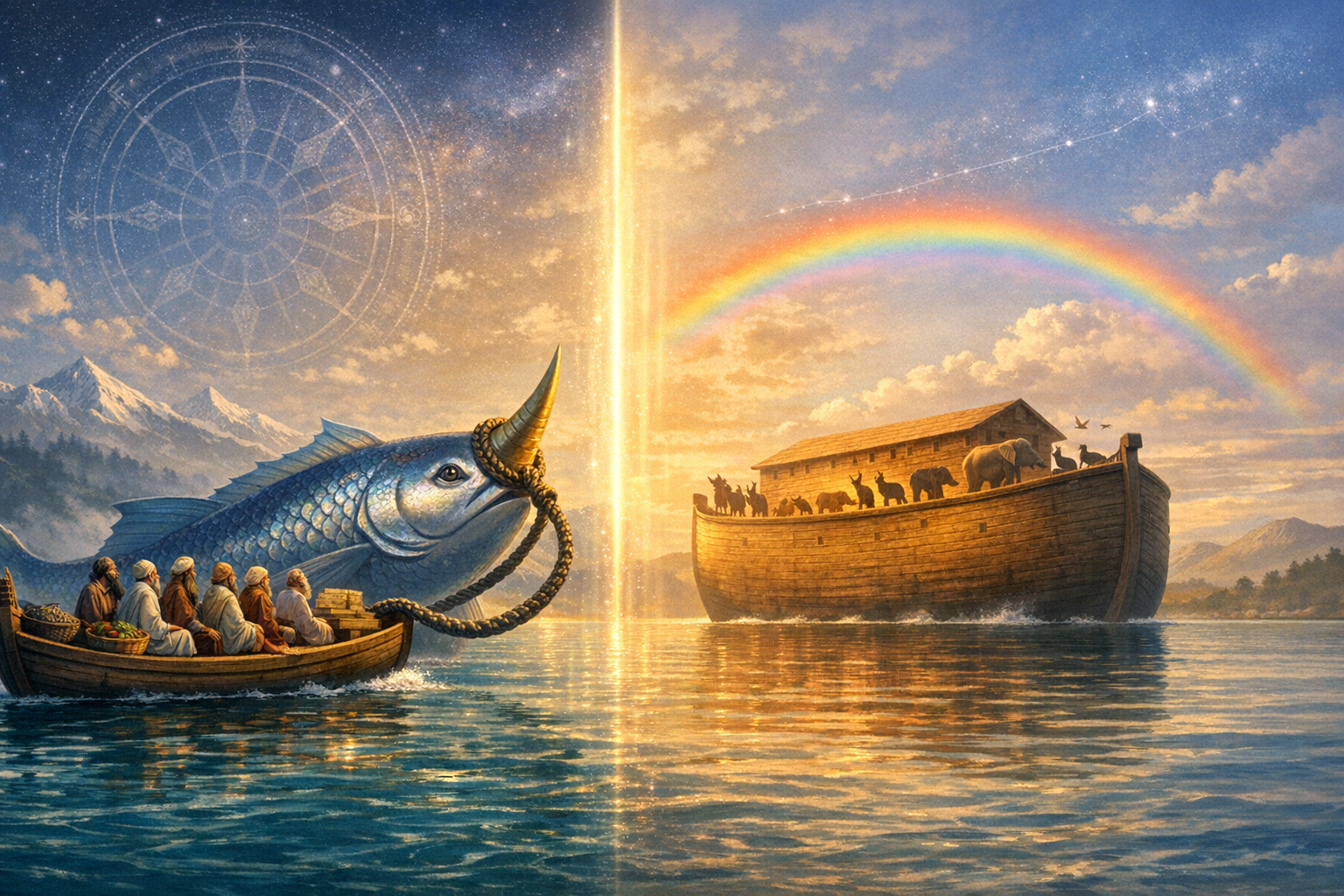
Across classrooms, temples, and family gatherings, people often notice a recurring comparison: the Hindu account of the Matsya avatar guiding Vaivasvata Manu through a great deluge and the Biblical story of Noah’s Ark. At first glance the similarities appear strikingan impending flood, a divinely warned human, and the preservation of life. Yet a closer reading of the sources and their cosmologies shows that the two narratives operate in fundamentally different theological, cosmological, and ethical registers. Reducing the Matsya–Manu narrative to a variant of Noah’s Ark obscures the distinctive structure of Puranic cosmology, the doctrine of avatar, and the broader Dharmic vision of cyclical time.
In Hindu sources, the Matsya narrative is embedded in multiple layers of tradition. Early versions appear in the Shatapatha Brahmana, and rich, fully developed retellings occur in the Bhagavata Purana, the Matsya Purana, and the Mahabharata. While details vary by recension, salient elements persist: Vaivasvata Manu (also known as Satyavrata in some tellings) receives a warning from a mysterious fish, who later reveals itself as Vishnu’s Matsya avatar. Manu safeguards seeds, sages (Saptarishi), and the continuity of sacred knowledgethe Vedasby boarding a boat that is fastened to the horn of Matsya, sometimes with the serpent Vasuki serving as the tether. The boat ultimately reaches the highlandsoften associated in popular memory with Himalayan localessignaling the reconstitution of order after pralaya (dissolution).
By contrast, the Noah narrative in Genesis 6–9 is framed within a linear historical arc. The deity’s judgment responds to pervasive human wickedness; Noah, considered righteous, is commanded to construct an ark with specified dimensions and to preserve pairs of animals (with additional pairs for clean species). After the waters subside, a covenant is instituted, signified by the rainbow, and sacred history proceeds toward a teleological moral horizon. This moral-prophetic patterning is central to the Abrahamic scriptural worldview.
The first major divergence lies in cosmology. Puranic cosmology articulates cyclical time: srishti (creation), sthiti (sustenance), and laya or pralaya (dissolution) recur across unimaginably vast scales. A kalpa (a day of Brahma) spans 4.32 billion years, within which unfold 14 manvantaras; each manvantara contains 71 mahayugas, and each mahayuga cycles through the four yugas. The current age is governed by Vaivasvata Manu, the seventh Manu in the present kalpa. Within this architecture, floods function as periodic, lawful transitions rather than singular, absolute ruptures. Genesis, by contrast, advances a linear, once-and-for-all historical judgment and covenantal reset.
The second divergence concerns divine agency. In the Matsya–Manu story, Vishnu is immanentappearing as Matsya to guide, protect, and restore. Avatar is therefore not only salvific but also epistemic and cosmological: the deity enters time to uphold dharma and preserve sacred knowledge. In Genesis, the deity remains transcendent and issues commands to a prophet-like figure (Noah), whose obedience exemplifies faithfulness. The difference is not trivial; it conditions how each tradition understands revelation, ritual, and the continuity of wisdom across ages.
A third divergence pertains to purpose and payload. In the Puranic frame, what must be preserved is not merely biological life but the seed-stock of order: bija (seeds), the Saptarishi, and the Vedastemplates of knowledge necessary to re-establish dharma. The emphasis is civilizational and cosmological. In Genesis, the preservation program centers on animal pairs and Noah’s household; its moral horizon is communal and genealogical, culminating in covenant. Conflating these distinct aims erases the Hindu scriptural concern with transmitting cosmic law and sacred learning through cycles.
Hermeneutically, the traditions also differ. Hindu sacred history often tolerates multiple tellings (itihasa–purana) within a shared metaphysical grammar. Variation does not signal contradiction but depth; allegorical, ritual, and philosophical readings co-exist. In many Puranic accounts, Matsya also recovers the Vedas from forces of disorder, underscoring that knowledge itself is part of what is safeguarded through dissolution. Biblical canon, while multivocal in its own ways, is nevertheless constrained within a unified linear salvation history; the flood occupies a single, unrepeatable place in that line.
Methodologically, comparative religion benefits from acknowledging widespread flood motifs without rushing to deduce borrowing or equivalence. Flood narratives appear globallyfrom Mesopotamia to Mesoamericalikely reflecting collective human memories of catastrophic inundations, riverine floods, coastal surges, or even deep-time sea-level rise events. The presence of a flood story in two cultures, therefore, is insufficient evidence for derivation; what matters are the cosmological functions those stories serve within their home traditions.
Geoclimatic context supports this caution. South Asia’s monsoon-fed river systems, Himalayan glacial dynamics, and coastal topographies make floods both memorable and meaningful. Across millennia, societies encoded such experiences not only as warnings but as wisdom literature, mapping environmental rhythms onto metaphysical cycles. In this sense, the Matsya–Manu account resonates with ecology: seeds and sages endure so that knowledge and cultivation may resume with the turning of the cosmic wheel.
This cosmological imagination also has Dharmic breadth. Buddhism discusses cyclical cosmology in terms of saṃvaṭṭa (contraction) and vivaṭṭa (expansion) of world-systems; Jainism details ascending and descending cycles (utsarpinī and avasarpinī) within an immense temporal architecture; Sikh Gurbani, while not constructing a technical cosmology of cycles, repeatedly emphasizes the primacy of the One, the moral law pervading all beings, and the futility of ego in the face of the divine order. Read together, these perspectives underline a shared Dharmic intuition: time is vast, law-like, and ethically textured, and preservation is ultimately about right order, not only survival. Affirming this unity strengthens inter-Dharmic understanding without collapsing doctrinal distinctions.
Readers frequently recall childhood encounters with these storiestemple murals of a fish towing a boat, school textbooks on Noah’s Ark, or family retellings during festivals. Such memories are not merely sentimental; they hint at how societies transmit ethics: care for nature’s seeds, humility before vast cycles, and trust that knowledge survives upheaval. In the Hindu narrative, Manu’s boat symbolizes continuity of dharma through crisis; in Genesis, the ark embodies obedience and moral renewal. Both teach responsibility, but they do so within distinct metaphysical frames.
Several technical motifs in the Matsya–Manu narrative reward close reading. The horn of Matsya functions as a stabilizing axis, an image of cosmic guidance to which the human vessel can be fastened. Vasuki as the tether evokes energies that tie terrestrial life to divine order, much as Vasuki appears in other myths (e.g., Samudra Manthan) mediating between cosmic forces. The presence of the Saptarishi underscores transmissionof ritual, lore, and ethical memoryacross manvantaras. These are not incidental details; they communicate that preservation is simultaneously material and intellectual.
From a philological and doctrinal perspective, Manu is not a one-off ancestor but a title for progenitors of different epochs; Vaivasvata Manu is the Manu of the present manvantara. Some Puranic accounts identify Satyavrata’s elevation to Vaivasvata Manu after the deluge, while others simply treat Vaivasvata Manu as the current lawgiver. This plurality is characteristic of Puranic literature: layered redaction and regional retellings coexist within a coherent cosmological logic. Treating such texts as if they aimed at a single, fixed historical chronicle risks category mistakes.
Ethically, the Hindu flood narrative carries a conservationist subtext. The safeguarding of bija highlights biodiversity and agriculture, while the guardianship of Vedic knowledge emphasizes education, memory, and practice. Concepts such as lokasangraha (the welfare of the world) and Vasudhaiva Kutumbakam (the world as one family) align with this ethos; preservation is not insular survival but the re-establishment of a shared order in which all beings participate.
Comparatively, therefore, the question is not whether Matsya–Manu is “really” Noah’s Ark by another name; the question is what each narrative accomplishes within its own metaphysics. The Matsya–Manu story models avataric guidance through cyclical dissolution, the transmission of dharma via sages and scriptures, and the rebooting of civilizational memory. The Noah account codifies moral purification, covenant, and a linear rededication to divine law. Recognizing these differences enables deeper respect for both traditions.
For interfaith dialogueand especially for harmony among Dharmic traditionsthis clarity matters. When narratives are flattened into assumed equivalence, unique insights are lost, and communities speak past one another. When narratives are honored on their own terms, meaningful bridges emerge: shared concern for moral order, reverence for life, and the conviction that knowledge and goodness must be carried through dark waters, whether cyclical or singular.
In sum, equating the Matsya–Manu narrative with Noah’s Ark obscures critical distinctions in cosmology, theology, hermeneutics, and ethics. The Hindu account inhabits the vast canvas of Puranic cosmologykalpas, manvantaras, and yugasin which avatar preserves the principles and templates of life and learning. The Biblical account anchors a unique historical covenant within a linear timeline. Appreciating both, without reduction, enriches comparative studies and supports unity-in-diversity across Hinduism, Buddhism, Jainism, and Sikhisman approach that aligns with the living ideal of dharma as a shared commitment to truth, compassion, and the flourishing of all beings.
Inspired by this post on Hindu Blog.
