

If you are trying to decide whether West Bengal’s scrutiny of unrecognised madrasas is necessary, discriminatory, or merely political theatre, the phrase under scanner won’t answer you. Ask what officials can prove about each institution, what happens to its students, and whether the same procedure would be defensible for any school serving children.
On 7 June 2026, state authorities directed law enforcement and district administrations to intensify monitoring of unrecognised madrasas. That creates a legitimate opportunity to protect children and restore educational accountability. It is not a blank cheque for collective suspicion, indiscriminate closure, or opaque police action.
Key takeaways
- The declared target is an institution’s lack of statutory recognition, not madrasa education as such. Recognised and board-affiliated madrasas must remain outside this particular exercise.
- Unrecognised is an administrative status, not proof of abuse, radicalisation, financial crime, or any other offence. Each additional allegation requires its own evidence and lawful process.
- A credible inspection must cover recognition, child protection, learning, teachers, premises, and finances. It must also state what remedy is required and when officials will return.
- Immediate dangers call for immediate protection. Remediable deficiencies call for a written compliance path. Neither situation justifies making a child lose an academic year.
- The public should judge the drive by documented improvements, recognised institutions, safe student transitions, and learning outcomes – not by the number of raids, visits, or headlines.
First separate unrecognised madrasas from recognised ones

The word Khariji is used locally for madrasas operating outside a formal recognition framework. It should not be treated as a synonym for every Islamic educational institution. Recognised madrasas, including board-affiliated Aliya streams, generally follow an approved curriculum and operate within a state audit structure. The present monitoring initiative is specifically directed at institutions outside such recognition arrangements.
This distinction matters because public debate easily collapses three separate questions into one. The first is whether an institution is legally recognised. The second is whether it gives children safe, age-appropriate education with a usable route to examinations and higher study. The third is whether there is evidence of a separate legal or security violation. A finding on the first question does not automatically answer the other two.
Officials therefore need an institution-by-institution record, not a communal label. A defensible initial process would do five things in order:
- Map the premises, assign a unique institution ID, identify its management, and record whether it is a day school, a residential facility, or both.
- Verify any claimed recognition or affiliation directly with the relevant authority rather than relying only on a displayed certificate or verbal assurance.
- Record the number and age range of students while keeping children’s names and other identifying details out of public databases.
- Issue a dated inspection note that separates urgent risks from deficiencies that can be corrected through training, repairs, documentation, or curriculum bridging.
- Give the management a written route to recognition where regularisation is legally and practically possible; where it is not, prepare recognised placements for the students before operations cease.
This sequence prevents two opposite errors. The state must not ignore an institution merely because it performs a religious function. It must also not presume criminality merely because the institution lacks educational recognition. Recognition is the starting fact to verify, not the final verdict on everyone connected with the premises.
Equal regulation is both the constitutional and Dharmic standard

Sections 18-19 of the Right of Children to Free and Compulsory Education Act, 2009 establish recognition requirements for schools, while the West Bengal Right of Children to Free and Compulsory Education Rules put those requirements into operation within the state. The West Bengal Board of Madrasah Education Act, 1994 supplies a formal recognition and curriculum route for madrasas seeking board affiliation.
Educational recognition is only one layer. The Protection of Children from Sexual Offences Act, the Juvenile Justice framework, and applicable building, fire, sanitation, health, and residential-facility requirements address risks that can exist wherever minors study or live. A religious description does not remove those duties. At the same time, the exact legal route can depend on an institution’s form, age range, and residential arrangements. Every notice should therefore identify the provision being applied, the evidence of non-compliance, the remedy sought, and the available grievance or review channel.
Articles 25-30 of the Constitution protect religious freedom and the ability of minorities to establish and administer educational institutions. Those protections do not turn a school into a regulatory no-go zone. Reasonable requirements concerning safety, academic standards, and teacher suitability can coexist with religious autonomy, provided officials do not use regulation as a pretext to take over core religious or administrative matters.
The practical boundary is clear. The state may ask whether mathematics, science, languages, and social science give students age-grade parity and a route into recognised examinations. It need not replace permissible religious instruction or decide theological questions. It may verify whether a teacher is qualified and suitable to work with minors. It should not convert a routine credentials check into ideological profiling.
For a Dharmic public, this is rajadharma in a recognisable civic form: protect the vulnerable, apply known rules consistently, give reasons for state action, and restrain power through review. Leniency toward unsafe schooling fails children. Collective suspicion fails justice. Firm, neutral, evidence-led regulation avoids both failures.
A real inspection must produce evidence in six areas
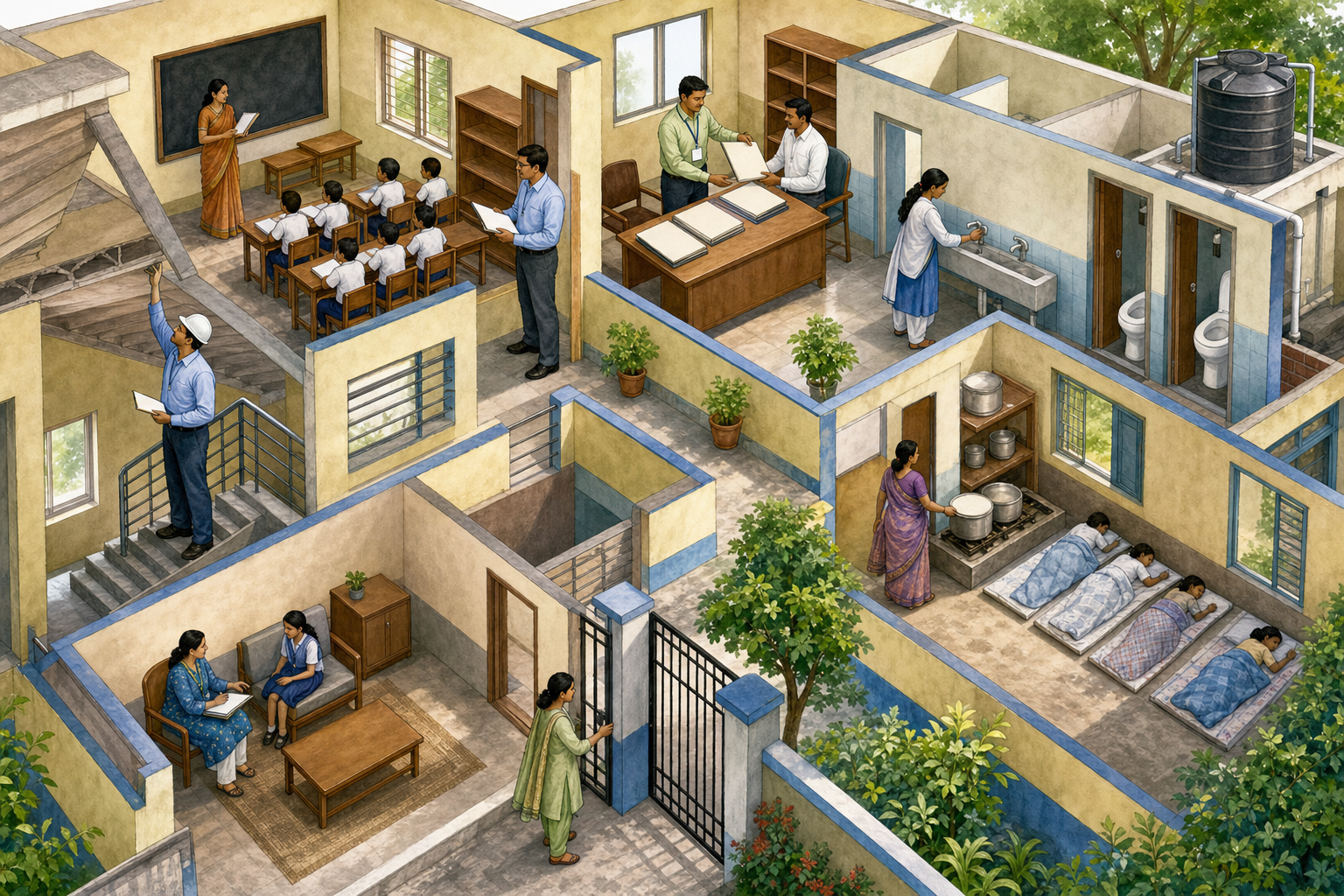
An audit that ends after asking for a recognition certificate is incomplete. Recognition status tells you whether an institution sits inside the formal system; it does not by itself tell you whether a residential dormitory is safe, teachers have been verified, students can enter public examinations, or financial records are intelligible. A workable oversight structure has six connected pillars.
| Area | What inspectors should verify | What a useful response looks like |
|---|---|---|
| Recognition and identity | Board status, recognition documents, management details, geotagged location, day or residential operation, and any pending application. | Assign a unique ID, confirm status with the competent authority, and give a dated recognition or regularisation calendar. |
| Child safeguarding | A designated Child Protection Officer, displayed helpline information, a POCSO-compliant reporting process, staff awareness, and registration of any residential facility under applicable norms. | Correct urgent risks immediately, train staff, establish a documented reporting route, and conduct follow-up or surprise checks where legally permitted. |
| Curriculum and progression | Teaching time for language, mathematics, science, and social science; age-grade placement; student work; and the route to recognised examinations or further study. | Use bridge courses, recognition of prior learning, and alignment of core subjects while preserving permissible religious or values instruction. |
| Teachers | Identity, credentials, suitability to teach minors, background verification, assigned subjects, and professional-development needs. | Verify records and create an upskilling route through appropriate certification, District Institutes of Education and Training, or open-university options rather than treating displacement as the only remedy. |
| Premises and health | Structural safety, fire equipment, evacuation practice, potable water, light, ventilation, gender-segregated sanitation, hygiene, nutrition, and residential conditions where relevant. | Remove immediate hazards at once. Use phased repairs only when interim safeguards can genuinely control the risk. |
| Financial transparency | Fee schedules, scholarships, donations, basic accounts, and compliance with FCRA requirements where foreign funding is involved. | Apply proportionate audits that can identify misuse without imposing the same administrative burden on every institution regardless of size or risk. |
The value of this checklist is not only that it disciplines institutions. It also disciplines the government. A standard inspection form forces an official to replace a vague label with verifiable findings. It lets a management committee see what must change, lets a parent understand the consequence, and lets a reviewing authority compare similar cases.
Those findings should lead to three different kinds of response:
- Immediate danger: A credible threat to a child’s safety, a dangerous building condition, or another urgent welfare concern cannot wait for the end of a long recognition process. Authorities should control the risk, use the applicable child-protection channel, and move children to a safe setting if necessary.
- Remediable non-compliance: Missing documents, teacher-training gaps, repairable infrastructure deficiencies, and correctable curriculum gaps should produce a written improvement plan, practical assistance, a deadline, and reinspection.
- Non-viable or persistently non-compliant operation: If recognition is legally impossible, serious deficiencies cannot be made safe, or management refuses lawful correction, authorities should issue a reasoned order and activate the student-transition plan. The children should not discover the decision at a locked gate.
Phased compliance must never become an excuse for leaving children in immediate danger. The safe alternative to an abrupt closure is not continued exposure to a serious risk; it is temporary relocation or transfer with educational continuity while the institution’s legal process continues.
Regularisation must not cost a child an academic year

The hardest part of enforcement comes after inspectors find that an institution cannot continue as it is. A closure order may resolve an administrative file while creating a larger problem for the child: no recognised grade placement, no transport to another school, no record of completed learning, or no clear route to the next examination.
The monitoring direction should therefore be converted into a public calendar. One practical implementation model is a 90-day mapping window followed by a 180-day regularisation path. These periods are useful benchmarks for organising the work, not a claim that every institution must receive recognition automatically. The first phase identifies every site and its status. The second gives eligible institutions inspections, remedial steps, training, and a final decision.
The governing promise should be no closure without safe transition. Where regularisation is not feasible, the district administration should arrange admission to a nearby recognised school, assess prior learning, provide a bridge course where needed, and address transport or lawful residential alternatives. The transfer must preserve the student’s next educational step rather than merely remove the student from the old premises.
A proper transition file should show:
- the written finding explaining why the existing institution cannot continue or cannot yet serve the student safely;
- the recognised school that has accepted the student and the grade in which the student will enter;
- how prior learning will be assessed and which bridge instruction will be provided;
- whether the student remains eligible for the intended board or public examination pathway;
- how transport, hostel, disability-access, health, or other practical needs will be handled where applicable; and
- when and in which language the family was informed, with clear communication available in Bengali and Urdu where needed.
If your child attends an institution affected by the exercise, don’t settle for a verbal assurance that recognition is in process. Ask for the recognition or affiliation number, the authority handling the application, the written inspection findings, the intended examination pathway, and the transition plan if recognition is refused. Also ask who serves as the Child Protection Officer and how a safeguarding concern can be reported. These questions are not hostile to the institution. They establish whether its promises can travel with your child into higher education and employment.
Teacher policy needs the same distinction between risk and remedy. Identity and background verification are necessary when adults work with minors. A teacher who lacks a recognised credential, however, is not automatically unsuitable or dangerous. Where the gap can be corrected, certification and professional development protect students without discarding useful teaching experience or suddenly stripping a community of staff.
Judge the government by outcomes, not the size of the scanner
A statewide census can become either an accountability system or an unchecked dossier. The difference lies in data minimisation and access control. The management system needs an institution ID, location, recognition status, non-compliance categories, deadlines, follow-up results, and aggregate enrolment information. It does not need to expose children’s names, family details, or sensitive personal records on a public dashboard.
Access to non-public information should be limited by role, and every query should be logged. District and state dashboards can publish aggregated numbers: institutions mapped, recognition status verified, applications pending, notices issued, deficiencies corrected, institutions regularised, students transferred, and follow-up inspections completed. This gives citizens enough information to evaluate implementation without turning minors into searchable records.
Police support may be necessary for lawful access, immediate safety, or a credible security concern. It should not replace education and child-welfare officials in routine academic oversight. Lack of recognition is not, by itself, evidence of a security offence. Any further investigation should be intelligence-led, legally warranted, and proportionate to specific information rather than inferred from the religious identity of an institution.
Public redress is equally important. Inspection orders and outcomes should be published with children’s personal details removed. A toll-free helpline and district grievance cells should let parents, teachers, and management committees correct records or challenge procedural failures. An independent body containing education and child-rights expertise can review a sample of decisions every quarter. That sample review is especially valuable because unequal treatment often appears in the pattern across cases, not in the wording of a single order.
The most meaningful scorecard comes after implementation. Recognition rates, sanitation and fire-safety improvements, verified teacher qualifications, enrolment and retention, and student learning results reveal whether the policy improved children’s lives. An independent evaluation after 12-18 months can test those outcomes and identify districts where the process produced closure or disruption without equivalent educational gains.
When the next headline tells you that more madrasas are under scrutiny, use a five-question test. Was recognition status actually verified? Were findings and remedies issued in writing? Were immediate risks separated from correctable deficiencies? Did every displaced child receive a recognised placement? Were aggregate outcomes published without exposing minors? If officials cannot answer those questions, strict monitoring remains a slogan rather than a system.
West Bengal should be firm where children’s safety, education, or lawful financial accountability is at stake. It should be equally firm about evidence, constitutional limits, privacy, and educational continuity. Ask for the institution ID, the checklist, the deadline, the transition record, and the measured result. That is how you distinguish child-first rajadharma from administrative spectacle.
References
