
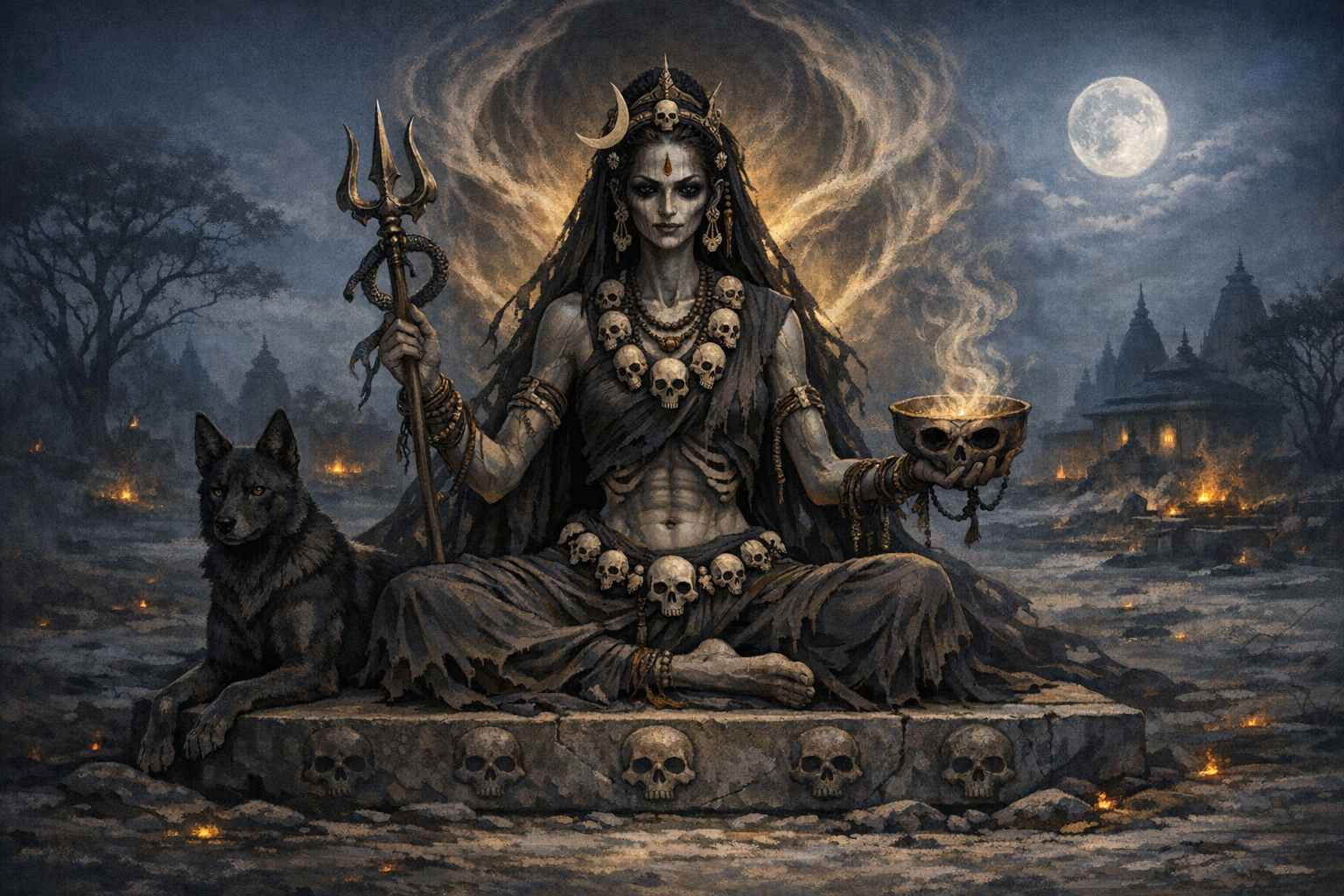
The Hunger That Cannot Be Filled, a phrase often evoked in Shakta discourse, captures the enigma of Goddess Chamunda’s gaunt and skeletal iconography. Within the Devi Mahatmya of the Markandeya Purana (a seventh-century text foundational to Shaktism), Chamunda erupts into the sacred narrative not as a distant celestial descent but as a force arising from the battlefield of consciousness itself. Far from grotesque, her emaciated form is a deliberate, sophisticated visual theologyan encoded language of Tantrism and Shakta iconography that teaches the devotee to confront impermanence, fear, insatiable desire, and, ultimately, the devouring nature of time (Kala).
Textually, the Devi Mahatmya narrates that the Great Goddess summons a terrifying energy to conquer the asura generals Chanda and Munda. In many recensions, the goddess who severs their heads is the fearsome Kali, whereupon the epithet “Chamunda” is conferred in honor of that victory. Closely allied yet subject to regional and sectarian distinctions, Chamunda emerges across medieval and later traditions as a cremation-ground (shmashana) goddess, one of the Matrikas in many lists, and a paradigmatic ugra devata (fierce deity). Whether treated as a distinct form or a specialized aspect of Kali, the shared semiotics are unmistakable: sunken belly, visible ribs, skull garlands, a lolling tongue, and a setting that centers ash, bone, and the thresholds between life and death.
Iconographically, Chamunda is instantly recognizable. The body appears desiccated, with prominent ribcage and hollowed abdomen; the ornaments are often serpents, bones, or flayed skins; the garland is a mundamala (string of severed heads) signifying the cessation of ignorance and egoic multiplicity; the hands commonly hold a kapala (skull cup), trishula (trident), damaru (drum), and sometimes a khatvanga (skull-topped staff). Her seat (asana) may be a corpse (pretasana), and her vahana (vehicle) is frequently a jackalan animal of the liminal cremation ground. Each element is an interpretive key in the broader Shakta semiotic system.
The skeletal appearance serves a core doctrinal function: it signifies the total withdrawal of rasa (vital sap, aesthetic nourishment) from material life. Where other Hindu goddess forms overflow with fertility and abundance, Chamunda embodies dispassion (vairagya) in its most radical, uncompromising register. In Tantric symbolism, the emaciated body is not a lack but an achievementthe conquest of appetite. It illustrates that the insatiable hunger of samsara may never be satisfied by acquisition; only by recognition of impermanence and the facing of death does a fearless compassion emerge.
Philosophically, Chamunda’s gauntness is the visage of Kala-Shakti, the devouring power of time that dissolves all forms. Bones, skulls, and ash are not performative macabre details; they are the ledger of time written on matter. In Shakta metaphysics, this “emptying out” is a preparation for fullness. The lolling tongue and blood imagery found in related Kali-Chamunda cycles dramatize how the Divine intercepts and consumes the proliferations of ego and violence before they replicate. What looks like destruction, therefore, is a fierce mode of protection.
Ritually and soteriologically, Chamunda’s form operates as shock pedagogy. Tantric sadhana in cremation grounds (shmashana sadhana) uses the liminal environment to dissolve aversion to death and attachment to form. The kapala (skull cup) is a vessel of emptying and insight; the corpse seat (pretasana) locates realization precisely where ordinary consciousness recoils. This is not theater but pedagogy: by confronting the abject, the practitioner discovers a nondual clarity in which fear, disgust, and longing are transmuted into steadfastness, wisdom, and compassion under competent guidance and within ethical boundaries established by tradition.
A signature feature in Chamunda-centered practice is the Panchamundi Asana symbolism. The “seat of five skulls” is variously enumerated across traditions, yet its consistent thrust is mastery over the five limiting matricesconceived as elements, aggregates, or deep-seated proclivities. Sitting upon the “five” communicates sovereignty over the finite frameworks that bind ordinary experience. In this way, Chamunda’s skeletal body and skull-seat combine to declare an uncompromising thesis: the finite cannot be the ground of freedom.
Equally telling is the jackal, often cited in Goddess Chamunda jackals symbolism. As a scavenger and a guide of the thresholds, the jackal is a precise vahana for a cremation-ground goddess. It signals the courage to traverse taboo, to metabolize what life discards, and to find unshakable clarity where others perceive only dread. Chamunda’s jackal, in this reading, becomes a companion to radical discernmentone that moves fluidly between worlds without becoming trapped by any.
Thematically, Chamunda stands within the continuum of Shakta iconography that spans saumya (benign) to ugra (fierce). Where Lakshmi conveys auspicious abundance and Saraswati articulates refined knowledge, Chamunda teaches a knowledge beyond refinementthe intelligence that faces suffering without sentimentality. Her skeletal form therefore complements, rather than contradicts, the maternal, protective ethos of the Devi. In practice, devotees often experience Chamunda’s fierceness as supreme tenderness, precisely because she devours what harms themfear, pride, and the compulsions that keep suffering in motion.
An inter-dharmic perspective shows this teaching cohering with the wider Indic imagination. Vajrayana Buddhism’s charnel-ground dakinis, for example, similarly deploy frightening imagery to short-circuit clinging; Jain traditions, while eschewing such iconography, enshrine radical vairagya and ahimsa as paths beyond craving; Sikh teachings on dissolving haumai (ego) through remembrance (simran) harmonize with the inner conquest celebrated by Chamunda’s form. In each case, the aim is unity beyond fear and desire. Read in this light, Chamunda’s skeletal iconography contributes to a shared dharmic pedagogy of fearlessness and compassion.
Historically, Chamunda’s cult and iconography flourished from at least the early medieval period. Reliefs and sculptures across regionssuch as in Rajasthan (including Osian), the Deccan, Odisha, and Karnatakaattest to the goddess’s presence in temple programs that often include the Matrikas. Regional ateliers emphasized different attributes: some render the body more skeletal, others prioritize the skull garland or the cremation-ground attendants. Despite variation, the grammar remains constant: gauntness as metaphysics, bones as pedagogy, and the battlefield of life as the stage for liberation.
Within the Devi Mahatmya’s narrative arc, Chamunda/Kali functions alongside Durga as the kinetic edge of Shakti. She is victory not just over external foes but over the proliferating inner adversariesanger, greed, delusionthat animate the mythic asuras. Her skeletal thinness is a visual assertion that these adversaries cannot be appeased by feeding them; they must be seen through and disempowered. The ugra devata thus becomes the consummate teacher of restraint, courage, and clarity in dharmic life.
From a psychological point of view, the “hunger that cannot be filled” names a universal human predicament. Tantric hermeneutics translate this predicament into an image that cannot be ignored. Many contemporary practitioners report that meditation on Chamunda stabilizes attention when facing grief, loss, or anxiety, because her form normalizes reality as it isimpermanent, unpredictable, and yet navigable with wisdom. In daily worship cycles and during Navratri observances, invoking fierce forms within the wider Devi framework can support a balanced spiritual practice that pairs inner strength with compassionate service.
It is also important to resist colonial-era misreadings that reduced such imagery to morbidity. Indigenous interpretive traditions consistently understand Chamunda as protective, auspicious in her own right, and integrally related to the broader moral and ritual order. When assessed through the internal logic of Hinduism and its Shakta and Tantric lineages, the skeletal body is not a cult of death but a science of fearlessnessa way of seeing that washes the mind free of clinging and aversion, allowing dharma to flourish.
Taken together, Chamunda’s emaciated form, skull ornaments, cremation-ground setting, Panchamundi Asana symbolism, and jackal vahana compose a coherent theological statement. She reveals that what is terrifying in appearance can be liberative in function. By consuming the residues of ignorance and the compulsions of desire, she makes room for an unconditioned compassion. In this way, the skeletal goddess becomes a mirror held up to the human conditionand an invitation to the courage found across the united dharmic traditions of Hinduism, Buddhism, Jainism, and Sikhism: to live lucidly, love fearlessly, and let go wisely.
Inspired by this post on Hindu Blog.
