
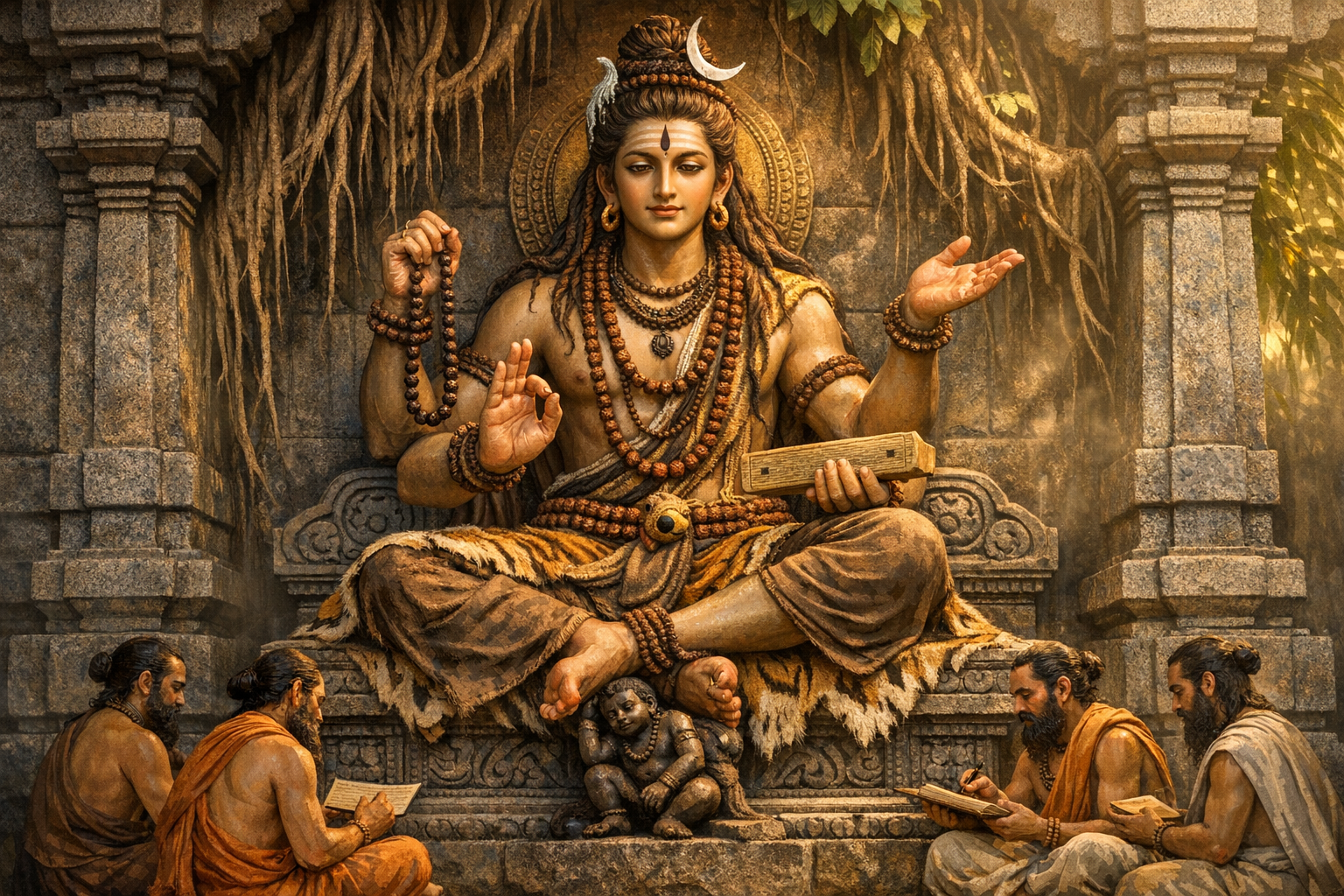
Medha DakshinamurtiShiva as the sovereign of intellect, discernment, and sacred knowledgeembodies the archetype of the silent preceptor. Venerated across the Shaiva Agamas and South Indian temple traditions, this form distills the transformative power of jñāna (wisdom) into a visual theology: serenity as instruction, stillness as discourse, and compassionate presence as the highest pedagogy.
Etymologically, “Dakshinamurti” denotes the south-facing form (dakṣiṇa = south; mūrti = manifestation), while “Medha” signals retentive intelligence, penetrating insight, and the refined capacity to integrate learning. Together, Medha Dakshinamurti communicates a precise promise within iconography: knowledge that is not only acquired but assimilatedclarified into memory, judgment, and right action.
Classical sources describe this icon through complementary strands: the Śaiva Āgamas outline theological intent and ritual usage; Śilpa-śāstras such as Mānasāra and Mayamata codify sculptural canons; temple śāla practice transmits living variations. Across these, Dakshinamurti persists as guru of all gurus, communicating through a “wordless language of stillness”the consummate symbol of wisdom beyond argument.
In standard iconography, Dakshinamurti is seated beneath the vāṭa-vṛkṣa (banyan), the cosmic tree of longevity and proliferating knowledge. The right leg rests upon Apasmara, the dwarf of forgetfulness, spiritual inertia, and distracted mind; the left leg is folded in contemplative stability. The gaze is tranquil; the countenance is youthful yet timeless; the teaching is silent and unbroken.
Orientation is integral. Medha Dakshinamurti faces south, the quarter of Yama and finitude, to affirm that wisdom disarms fear. In South Indian Drāviḍa temples, Dakshinamurti occupies the south koṣṭha (niche) of the garbhagṛha’s outer walla canonical placement that encodes a spatial catechism: to the south, the Teacher who resolves doubt; to the west, the revelation of Liṅgodbhava; to the north, complementary deities completing the circumambulatory syllabus of darśan.
Attributes vary by subtype, yet a four-armed Jñāna/Medha Dakshinamurti predominates. The lower right hand often displays the jñāna/chin mudrā (or the vyākhyāna mudrā, the gesture of exposition); the upper right may hold an akṣamālā (rosary), signifying unbroken contemplation. The lower left commonly holds a pustaka (palm-leaf manuscript), emblematic of śruti-smṛti continuity; the upper left bestows varada (boon-giving) or shelters with abhaya (fearlessness). In Medha emphasis, akṣamālā and pustaka become central, aligning form with function: the conferral of refined intellect.
The jñāna/chin mudrā itself is a condensed metaphysics. The touching thumb and index finger depict the unity of Paramātman and jīvātman; the remaining three fingers recall the triad of guṇas or the temporal triptych (past–present–future) held in equipoise. The gesture is simultaneously epistemic (how truth is known) and soteriological (how bondage is dissolved). In meditative practice, this semiotics of the hand mirrors the pedagogy of the heart.
Apasmara, often glossed as a demon, is a technical symbol. In Ayurvedic parlance, apasmāra denotes convulsive disorder; in iconography, it abstracts as the restless, untrained mindfickle memory, scattered attention, and persistent misapprehension (avidyā). Dakshinamurti’s right foot rests upon it, not to annihilate embodiment, but to stabilize cognition. Medhaclear, retentive, and discriminatingarises when forgetfulness is relieved of sovereignty.
The banyan canopy amplifies the teaching. Its aerial roots multiply like lineages of knowledge; its longevity suggests the perennial philosophy. As the Bodhi tree sacralizes awakening in Buddhism and the samavasaraṇa pavilion frames Tīrthaṅkara discourse in Jainism, so the vāṭa-vṛkṣa here becomes a shared civilizational metaphor: wisdom as shelter, learning as shade, and patient growth as spiritual method.
Adornment encodes theology. The jaṭā-mukuṭa (matted crown) bears the crescent and Gaṅgārhythms of time and purification coursing through Shiva’s contemplative poise. The third eye signals discernment that penetrates appearances. Serpents may form the sacred thread (yajñopavīta) or ornaments, indexing energy mastery; rudrākṣa malas punctuate ascetic gravitas. The tiger skin suggests transmuted instinct; the gentle face assures guidance without intimidation.
Seating postures (āsanas) are semantically precise. Vīrāsana underlines sovereign control of the senses; padmāsana emphasizes inward absorption; a yogapaṭṭa (meditation band) may bind the knees to steady the spine, visually literalizing unshakable concentration. The throne (siṃhāsana) intimates royalty of insight rather than dominion over others.
Iconographic subtypes reflect theological nuance. Jñāna/Medha Dakshinamurti highlights scripture and rosary; Yoga Dakshinamurti privileges meditative implements and ascetic economy; Vīṇā Dakshinamurti makes audible the unheard teaching through music, emphasizing nāda as a pathway to knowledge. Local paddhatis (ritual manuals) contour these variations while preserving the core semiotics of teacherhood, tranquility, and transformative wisdom.
In Medha Dakshinamurti, two accents commonly appear. First, the pustaka is rendered with deliberate prominence, sometimes detailed with palm-fiber bindingsan homage to the textual transmission of Veda, Āgama, and commentary (bhāṣya). Second, the akṣamālā symbolizes disciplined repetition (abhyāsa), the craft by which knowledge matures into insight and insight consolidates as memory. The visual grammar thus traces a complete arc: study, contemplation, realization.
The retinue often includes four sagesSanaka, Sanandana, Sanātana, and Sanatkumāraabsorbed in learning beneath the banyan. Their presence turns the shrine into a living classroom: teacher, students, text, and contemplative atmosphere are co-constitutive. In many South Indian temples, an intimate niche scale invites close darśan, encouraging visitors to become participants in the same lineage of listening.
Materials and regional styles register historical memory. In granite, especially across Tamil Nadu and Karnataka, Medha Dakshinamurti assumes crisp austerity; in pañcaloha (five-metal) bronzesan art perfected under the Chola ateliersthe deity acquires supple naturalism and luminous presence, ideal for processional (utsava) contexts. The cire perdue (lost-wax) method ensures each bronze is uniquely modeled, a signature of South Asian sculptural intelligence.
Proportional canons (pramāṇa) from the śilpa-śāstra tradition, such as tāla-based height modules, govern iconometry: relations of head, torso, limb, and hand-gesture to the whole. The face is generally sama (balanced), the eyes half-closed in meditative āloka; shoulders relaxed, abdomen soft, chest openan embodied map of contemplative ease. Details like makara-kuṇḍalas (earrings) or the serpent-yajñopavīta complete the canonical ensemble.
Ritual life mirrors iconography. Thursdaysauspicious to Guruand Guru Pūrṇimā draw students and seekers to Dakshinamurti shrines for abhisheka with milk, water, and vibhūti; offerings of banyan leaves or simple lamps accompany recitations of the Medhā Sūktam and stotras invoking clarity and memory. The intent is practical and compassionate: to align aspiration with grace and discipline with understanding.
Texts and mantras are central conduits. The Medhā Sūktam petitions for lucid intellect and robust retention; the celebrated Dakṣiṇāmūrti Stotra, traditionally ascribed to Ādi Śaṅkara, hymns the unspoken transmission where silence instructs more eloquently than words. In pedagogical rites such as vidyārambha, invoking Dakshinamurti integrates scriptural learning with contemplative method.
Temple encounters offer a reliable field grammar. On the south exterior wall of the main Shiva sanctum (garbhagṛha), look for a serene, south-facing Shiva beneath a banyan, one foot steadying Apasmara, a manuscript and rosary in hand, and the jñāna/vyākhyāna mudrā shaping the air of teaching. This recognition transforms circumambulation (pradakṣiṇā) into a curated syllabuseach niche a chapter, each gesture a thesis.
Comparatively, Medha Dakshinamurti and Shiva Nataraja articulate a single metaphysics through different rhetoricsone quells ignorance by the dynamic fire of dance, the other by the cool flame of silence. Both subdue Apasmara; both reconcile change and changelessness. The unity of vision amid the plurality of expression is a hallmark of Hindu art and a bridge to the wider dharmic family.
Cross-tradition resonances are instructive. The Buddhist devotion to the Bodhi tree and quiet dhyāna, the Jain vision of the teaching assembly (samavasaraṇa) where all beings hear the Dharma in their own language, and the Sikh primacy of the Guru as living wisdom converge with Dakshinamurti’s core message: true knowledge liberates, harmonizes, and includes. This shared ethic of learning nurtures civilizational unity while honoring distinct paths.
In contemporary lifeflooded by information and prone to distractionMedha Dakshinamurti offers a humane epistemology: anchor attention, refine discrimination (viveka), and convert reading into realization. Students pray for memory and clarity; professionals seek discernment; contemplatives, insight. The icon shows how cognition becomes compassion when steadied by silence and guided by an inner teacher.
Practical engagement can be simple. A brief, silent darśan at a south koṣṭha, a few cycles of natural breath, a line from the Medhā Sūktam, or the contemplation of the jñāna mudrā’s meaning can reorient a day. Many find that pausing before Dakshinamurti prior to study or work cultivates steadiness that outlasts the moment of worship.
Heritage considerations matter. Preserving Dakshinamurti iconsstone and bronzepreserves more than artifacts; it safeguards a living pedagogy, a public philosophy cast in metal and hewn in granite. Conservation, accurate documentation, and sensitive temple practice ensure that this wisdom tradition remains legible to future generations.
Regional exemplars abound. Chola bronzes present masterworks of Medha/Jñāna Dakshinamurti suitable for study of mudrā nuance and bodily proportion; Pallava and later Vijayanagara stone renderings in Tamil Nadu and Karnataka provide comparative lenses on ornament, vāṭa canopies, and sage retinues. In most large Shiva templesfrom Kanchipuram to Chidambaram and Thiruvidaimarudurthe south koṣṭha remains a reliable classroom of silent teaching.
Ultimately, Medha Dakshinamurti is more than a deity to be viewed; it is a discipline to be practiced. The icon maps a science of attention: stabilize the senses, clarify thought, honor scripture, internalize method, and let silence complete what words begin. In the shared spirit of Hinduism, Buddhism, Jainism, and Sikhism, such learning dignifies the person and strengthens the social fabricknowledge in service of harmony.
Seen this way, iconography is not ornament but ontology. The banyan is a thesis on time, the gesture a proposition about truth, the subdued dwarf a demonstration of how insight masters confusion. Medha Dakshinamurti condenses an entire philosophy of educationrigorous, compassionate, and inclusiveinto an image that teaches even when no one is speaking.
Inspired by this post on Hindu Blog.
