
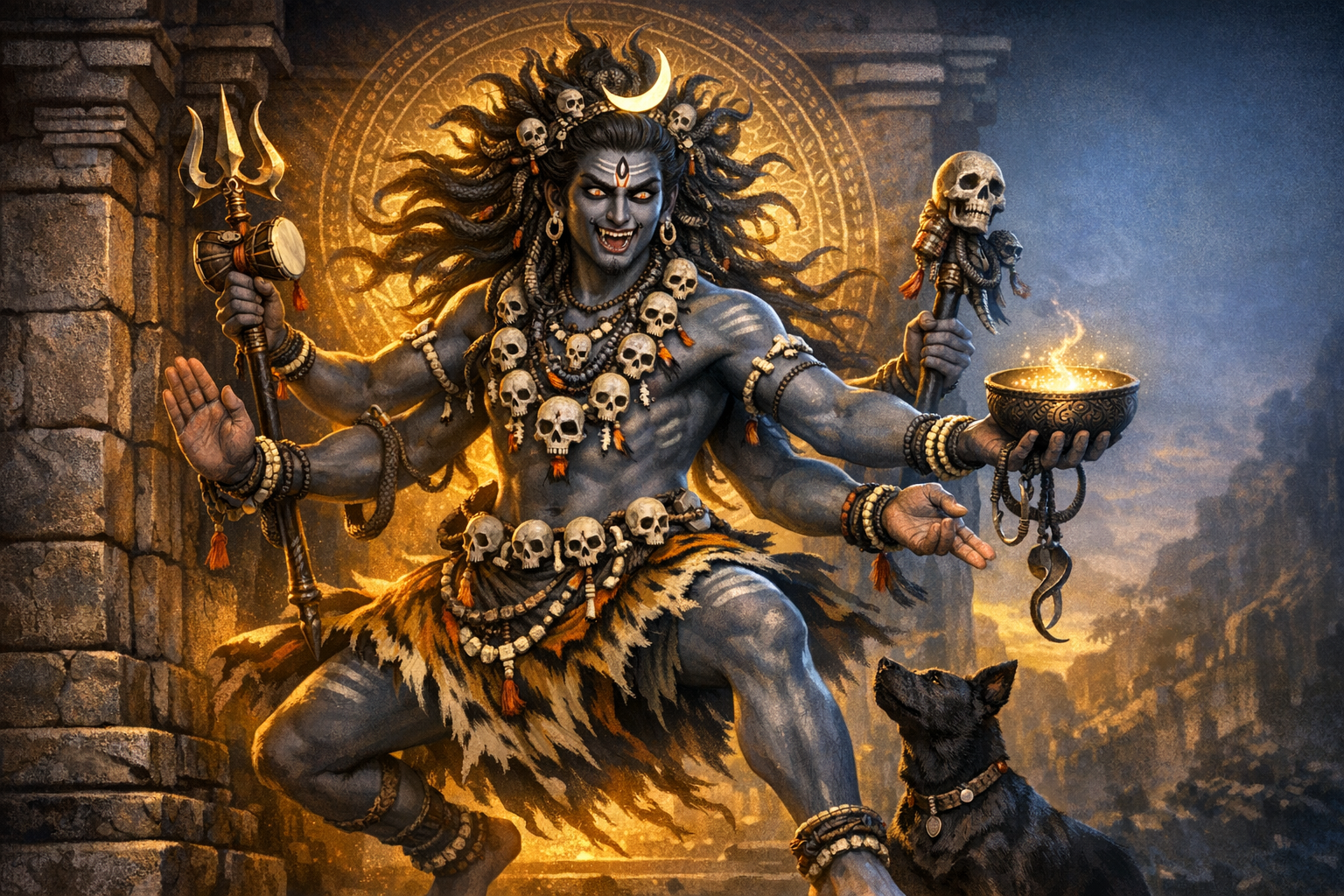
Within the vast ocean of Shaiva worship, Bhairava manifests as one of the most potent and transformative forms of Shiva, embodying the fierce intelligence that severs bondage and protects sacred thresholds. Among the Sixty-Four Bhairavas, Unmatta Bhairava occupies a distinctive place as the exalted guardian who channels divine ecstasy beyond the confines of ordinary reason. This exploration surveys Unmatta Bhairava’s idol form and iconography across texts and living traditions, offering practical cues to identify his images in temples and collections while interpreting their esoteric meanings in a manner that nurtures unity across the dharmic family of Hinduism, Buddhism, Jainism, and Sikhism.
The name Bhairava is traditionally associated with awe and fearlessness. In temple practice and scriptural reflection alike, Bhairava protects by confronting fear and dissolving that which binds the soul to illusion. Etymological and theological interpretations variously link the name to the removal of fear, the terrifying roar of truth, and the total sovereignty over time (kāla). Unmatta, for its part, is a Sanskrit term that literally reads as “ecstatic,” “intoxicated,” or “mad” in the sense of holy rapture; it is cognate with yogic states that transcend the discursive mind (often associated with the unmanī state in nondual Śaiva literature). As a result, Unmatta Bhairava is not a symbol of disorder but of transrational clarityecstasy as supreme lucidity.
In the taxonomies of Ashta Bhairavas (eight principal forms) and the Sixty-Four Bhairavas (multiplicative families of those eight), Unmatta Bhairava is typically described as a fierce guardian whose energy is both protective and liberative. While directionality, complexion, and specific attributes vary by textual lineage and region, Unmatta Bhairava is often assigned a western orientation and paired with a consort (Bhairavī) whose qualities mirror his ecstatic power. These structural patterns help situate a given murti within the broader Shaiva matrix while acknowledging diverse regional canons.
Primary source material for Bhairava worship extends from Purāṇic narrative strata (for example, Kashi Khanda in the Skanda Purana for Kāl Bhairava) to Śaiva Tantras and ritual paddhatis that detail mantras, yantras, and the meditative visualization of forms. These texts inform iconography but do not fully determine it; sculptural schools, patronage patterns, and temple function also shape local depictions. A historically aware reading therefore integrates scripture, art history, and living temple practice.
Facial features and expression are the first diagnostic cues. Unmatta Bhairava is rendered with a fierce visage: three eyes blazing forth omniscience, arched brows, flaring nostrils, and slightly parted lips that often reveal fangs. The expression carries the rasa of raudra (fierce) transmuted into karuṇa (compassion) and ultimately into śānta (peace), indicating that terror is a pedagogical threshold toward freedom rather than an end in itself. The “ecstatic” dimension may be signaled by the intensity of the gaze and the dynamic vitality of the pose.
Hair and cranial adornment commonly feature matted locks (jaṭā) radiating outward like tongues of flame, sometimes crowned with a crescent moon and a small effigy head (kirīṭa or jaṭā-mukuta). In dynamic images, the hair flies to one side, underscoring the unmatta energyecstasy in motion. Skulls (kapāla) and serpents woven through the locks emphasize Bhairava’s mastery over death and cyclical time.
The torso often appears digambara (sky-clad) or lightly draped with a tiger or elephant hide, marking fearlessness and ascetic power. Serpents serve as sacred ornaments; a yajnopavita of snakes or human hair may cross the chest. The waist-cord can be fashioned from bone elements; anklets, armlets, and girdles of bone or ivory reiterate the cremation-ground aesthetic. Together these features encode Bhairava’s intimacy with liminal spaces where transformation is most immediate and complete.
Garlands and emblems intensify the teaching. The iconic skull-garland (muṇḍamālā) may contain fifty heads corresponding to the Sanskrit varṇamālā, signaling sovereignty over sound and meaning. The belt or garland of severed hands represents the stilling of compulsive action (karma) once awareness recognizes its ground. Ash-smeared skin (vibhūti) performs a twofold function: ritual purity and philosophical reminder that all forms resolve into essence.
Arms and attributes vary, but Unmatta Bhairava is frequently shown with four, six, or eight hands. Common implements include the triśūla (trident) to pierce the threefold bonds, a ḍamaru (hourglass drum) whose pulse is creation itself, a khaṭvāṅga (skull-topped staff) indicating mastery over liminal wisdom, a kapāla (skull-bowl) that may contain madhu (nectar) or blood as symbols of transmuted passion, a pāśa (noose) to gather the wandering mind, and an aṅkuśa (goad) to direct energy toward awakening. In some depictions, a sword and shield appear, emphasizing protection and discrimination (viveka). Abhaya (fear-not) and varada (boon-giving) gestures often stabilize the fierce array with grace.
Posture communicates rasa with exceptional clarity. Unmatta Bhairava may stand in pratyālīḍha, stride forward in alīḍha, or dance a vigorous tāṇḍava. Slight asymmetries in hip, shoulder, and neck alignment convey the tension and release of ecstatic suspension beyond thought. As with Nataraja, motion becomes a metaphysics: every gesture teaches the dissolution of contracted awareness into boundless consciousness.
The vāhana of Bhairava is the dog (śvan), a guardian renowned for loyalty, boundary-keeping, and night-vision. Sculptors may carve a single attentive dog at the foot of the deity or a pair flanking the pedestal. In many temple towns, feeding dogs on Bhairava days is understood as direct seva to the guardian himself, aligning devotional ethics with compassionate ecology.
Temple placement follows function. As kṣetrapāla (guardian of the precinct), Bhairava shrines often appear near gateways, at corners of the prākāra (enclosure walls), or in liminal zones such as cremation grounds adjoining certain temples. Unmatta Bhairava, when specifically installed, may be grouped with the Ashta Bhairavas or integrated into processional circuits that ritually secure the sacred geography of the town. Architectural context thus complements iconographic identity.
Ritual calendars across regions honor Bhairava on Kālāshtamī (the Aṣṭamī tithi of Kṛṣṇa Pakṣa) and on specific local anniversaries. Mustard oil lamps, black sesame, curd rice, and seasonal fruits are common offerings; in some Tantric lineages, items symbolizing the transmutation of passion into wisdom appear in highly codified form. Midnight worship is frequent, consistent with Bhairava’s guardianship of thresholds and the pedagogy of fearlessness in the face of darkness.
The esoteric reading of Unmatta Bhairava synthesizes yoga and aesthetics. Ecstasy here is not heedlessness but unbinding. The kapāla teaches that even the most intense emotions can be consecrated as fuel for awakening; the ḍamaru teaches entrainment with the cosmic rhythm; the triśūla teaches that triadic constraints can be pierced in one stroke of insight. Many practitioners describe a paradoxical calm arising from contemplation of the fierce forma lived testimony that raudra, properly received, transforms into śānta.
Cross-dharmic resonances are both historical and living. In Vajrayāna Buddhism, forms such as Vajrabhairava (Yamantaka) mirror the guardian function and transformative ferocity, while Newar communities in Nepal maintain vibrant Bhairava festivals integrated with both Śaiva and Buddhist practices. In Jain communities, regional traditions of Kṣetrapāl and Nakoda Bhairav as protector-deities demonstrate how guardianship motifs travel across ritual ecologies while remaining anchored in ahiṃsā and ethical discipline. The Sikh spirit of chardi kalā and fearlessness in defense of dharma likewise converges with the Bhairava ethos of courage and protection, even as praxis differs. Read in this inclusive frame, Unmatta Bhairava becomes a shared symbol of steadfast guardianship and inner freedom across the dharmic family.
Regional art historical variations sharpen identification skills. South Indian bronzes may emphasize dynamic dance and the tactile detailing of bone-ornaments; Himalayan and Nepalese works may intensify cremation-ground motifs and multiple arms; Central and Western Indian stone sculpture often underscores the dog-vāhana and robust torso modeling. Museum cataloging sometimes confuses Unmatta with other Bhairavas; careful attention to hand attributes, posture, and associated inscriptions or attendants helps correct misattributions.
A practical method for reading an Unmatta Bhairava image proceeds in layers. First, confirm the Bhairava type by dog-vāhana, skull-bowl, trident, cremation-ground ornaments, and fierce visage. Next, look for cues of ecstatic dynamism: disheveled locks, vigorous stance, and the emphatic presence of kapāla and khaṭvāṅga. Then, situate the image within its ritual settinggateway guardian, corner shrine, processional iconas a clue to function. Finally, integrate textual memory (from Purāṇas and Tantra) with local oral knowledge to honor the living lineages that sustain the form.
In sum, Unmatta Bhairava is the ecstatic intelligence of Shiva made visible: fierce to the eye, compassionate in effect, unwavering in guardianship. The iconography instructs as much as it inspires, guiding devotees and researchers alike to recognize how terror, properly understood, is only the mask of boundless grace. Approached with historical care and intertradition respect, the study and darśan of Unmatta Bhairava deepen unity across Hindu, Buddhist, Jain, and Sikh worlds by celebrating a common commitment to courage, ethical protection, and inner liberation.
Inspired by this post on Hindu Blog.
