
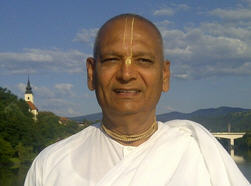
On 03 June 2026, ISKCON Vrindavan hosted a reverential gathering to glorify His Grace Kratu Prabhu, a respected disciple of Srila Prabhupada and a senior figure in the Hare Krishna Movement. The observance affirmed how living exemplars sustain the guru–shishya tradition and safeguard India’s spiritual heritage in Vrindavan, the timeless center of bhakti.
Within the bhakti tradition, glorification (stuti) functions as both pedagogy and practice. It educates the community through lived narratives of seva and sadhana, and it refines the heart through gratitude. By remembering the service of senior Vaishnavas, practitioners internalize standards of humility, compassion, and scriptural fidelityvirtues that anchor the ethos of Sanatana Dharma.
His Grace Kratu Prabhu is widely recognized across ISKCON for steady, community-centered serviceteaching foundational texts such as Bhagavad-gita and Srimad-Bhagavatam, leading congregational kirtan, and guiding seekers toward practical devotional living. Those who have attended his classes frequently describe a balanced synthesis of philosophical clarity and devotional warmth, with an emphasis on accessible application in family, community, and professional life.
The guru–shishya tradition transmits knowledge through realized conduct (sadhu), scriptural authority (shastra), and the living guide (guru). In this framework, senior disciples of Srila Prabhupada serve as luminous links, preserving authenticity while nurturing contextual relevance. The maxim mahajano yena gatah sa panthah reminds that the well-trodden path of realized teachers is a reliable guide for spiritual progress.
Vrindavan, as a sacred geography, magnifies this process. The land itself encodes memory: temples, kirtan mandalis, and daily darshan rhythms create a cultural matrix where remembrance (smaranam) is natural, and service (seva) feels intuitive. ISKCON Vrindavan’s institutional lifeanchored in the Hare Krishna kirtan, scriptural study, and prasadam cultureprovides the stable setting for such commemorations to shape collective conscience.
A glorification assembly typically unfolds through shared kirtan, invocatory prayers, scriptural recitation, and community reflections on the honoree’s service. These elements operate as a ritual ecology: sound (kirtanam) concentrates the mind; narrative (hari-katha) transmits values; and testimony (anubhava) situates ideals within ordinary lives. Together they reinforce the parampara without personality cult, keeping Srila Prabhupada’s mission central.
Participants often recount tangible outcomes: renewed steadiness in japa, a clearer sense of priorities, and a gentler, service-first orientation at home and work. Observers also note how collective chanting and remembrance lower ambient anxiety, increase social trust, and catalyze volunteerismeffects compatible with contemporary research suggesting that rhythmic vocalization and group ritual can support emotional regulation and pro-social behavior.
From a pedagogical vantage, Kratu Prabhu’s public talks model the ninefold bhakti processesespecially sravanam, kirtanam, and smaranamby weaving scriptural exposition with lived illustration. The method is dialogical and mentoring-oriented, aligning with ISKCON’s community development approach where senior devotees guide householders, students, and elders through structured study, congregational participation, and practical seva.
Significantly, the values celebrated in such glorifications resonate across dharmic traditions. Sikh sangat embodies seva and simran through kirtan and langar; Buddhist sangha cultivates compassion (karuna) and mindful remembrance; Jain communities honor teachers through guru vandana while practicing ahimsa; and Vaishnavas advance prema-bhakti through chanting and service. These parallel commitmentsahimsa, seva, satya, shraddhaaffirm a shared civilizational grammar and foster unity in spiritual diversity.
To deepen unity among dharmic paths, inclusive ceremonies emphasize shared principles over institutional boundary-marking. Good practice includes welcoming diverse practitioners, foregrounding scriptural ethics familiar across traditions, and channeling collective inspiration into socially constructive serviceeducation, environmental stewardship, and compassionate community outreach.
Ethically, glorification must avoid uncritical hagiography. The focus remains on replicable virtues rather than personality, ensuring that respect for senior Vaishnavas strengthens rather than supplants allegiance to Srila Prabhupada, shastra, and the broader ideals of Sanatana Dharma. This balance maintains theological integrity while sustaining communal inspiration.
Custodianship of memory is also a technical task. Accurate documentationverbatim teachings, responsibly curated recordings, and contextual annotationshelps future generations distinguish between personal anecdotes and normative teachings. Such archival rigor supports curriculum development and research, benefiting educators within ISKCON and scholars of Indian spiritual traditions.
Community leaders highlight practical steps for continuity: structured study of Bhagavad-gita and Srimad-Bhagavatam, mentorship pairings between seniors and youth, and service projects that translate kirtan-inspired compassion into tangible care. In this way, glorification becomes a living syllabus for the Guru-Shishya Tradition rather than a single-day ceremony.
Accounts of Kratu Prabhu’s interactions often emphasize gentle guidance, an inclusive teaching style, and encouragement to chant the Hare Krishna maha-mantra attentively. The pedagogical aim is transformation by steady practice: small, daily commitments that accumulate into resilience, clarity, and devotion over timehallmarks of the Hare Krishna Movement’s approach to spiritual growth.
Viewed in a wider civilizational frame, honoring Srila Prabhupada’s disciples activates cultural memory, reinforces ethical agency, and nourishes intergenerational belonging. It also advances inter-dharmic harmony by highlighting universally intelligible virtues and shared ritual intelligencefrom kirtan and simran to mindfulness, from seva to systematic self-discipline.
The 03 June 2026 glorification of His Grace Kratu Prabhu thus stands as both remembrance and roadmap: a remembrance of steadfast seva that kept ISKCON Vrindavan’s standards bright, and a roadmap for communities seeking unity in spiritual diversity through compassion, scholarship, and service. Grounded in Srila Prabhupada’s mission, it invites all dharmic communities to deepen mutual respect while walking a common path of truth and love.
Inspired by this post on Dandavats.
