
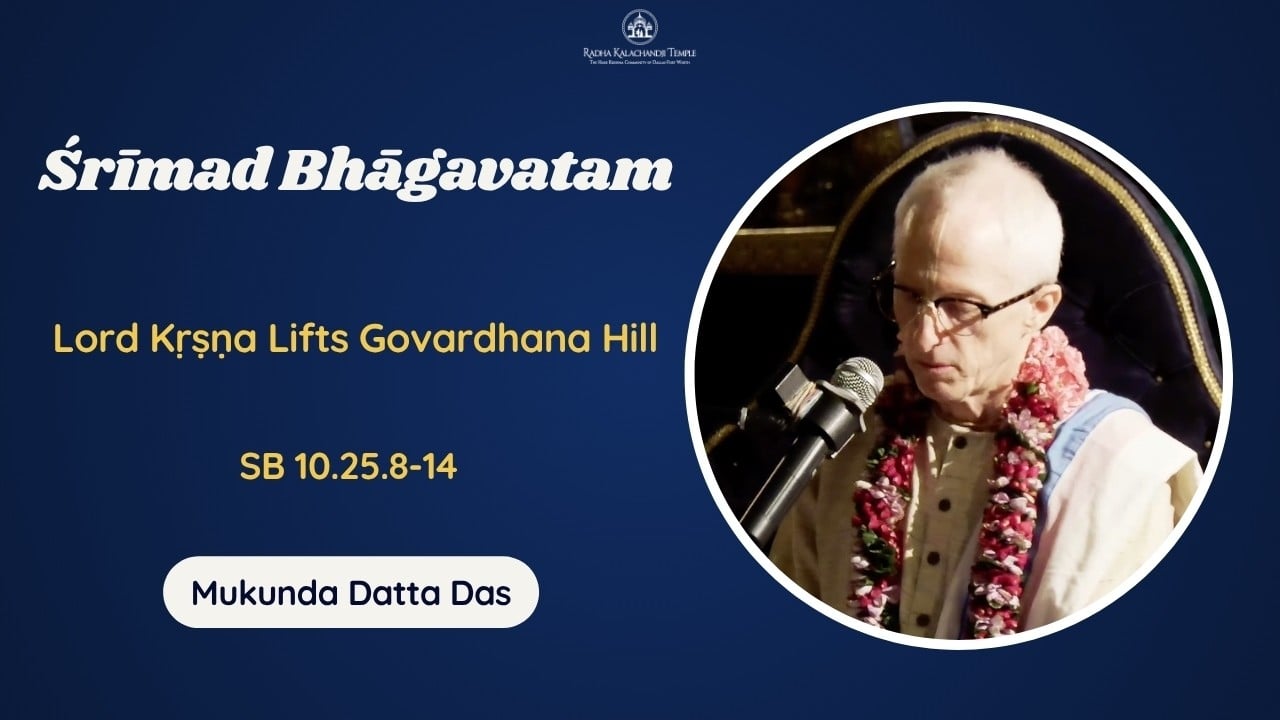
This study offers a focused, academically grounded reading of Srimad Bhagavatam 10.25.8–14, the segment in which the narrative of Govardhana-līlā accelerates from Indra’s ire to Kṛṣṇa’s protective intervention. Presented in the spirit of shared learning across dharmic traditions and informed by a discourse by Mukunda Datta Das on June 1, 2026 at ISKCON Dallas – Sri Radha Kalachandji, the analysis aims to integrate textual context, theological motifs, and contemporary relevance while honoring the Bhagavata Purana’s devotional core.
Textually, these verses sit at a pivotal hinge between the reorientation of ritual practice in 10.24 (from the Indra-yajña to the reverential Govardhana-pūjā) and the dramatic resolution of Indra’s chastening later in Chapter 25. Verses 8–14 condense the moment of escalation: the devas’ sovereign, affronted by Kṛṣṇa’s redirection of Vraja’s worship, summons apocalyptic forces; Vṛndāvana is endangered; and Kṛṣṇa responds with unambiguous, compassionate leadership.
In narrative terms, the passage portrays three tightly linked moves. First, Indra deploys devastating winds and rainoften associated in the text and its commentarial tradition with the fearsome Samvartaka clouds. Second, the Vrajavāsīs (elders, children, gopas, gopīs, and cows) experience a palpable crisis of safety as waters rise and visibility collapses. Third, Kṛṣṇa, reading the moment with serene clarity, raises Govardhana and holds it as a protective canopy, calling all beneath the hill’s shelter. The arc unites cosmic scale with intimate care.
Characterization is deliberate and instructive. Indra exemplifies a deva’s functional power compromised by pride (mada) and misjudgment; the community of Vraja embodies trust and solidarity under duress; Govardhana is at once geographic feature, sacred presence, and emblem of nature’s benevolent reciprocity; and Kṛṣṇa stands as the locus of refuge (śaraṇya), re-centering dharma when ritual form obscures spiritual essence.
Theologically, the sequence reorders the relationship between ritual karma-kāṇḍa and devotional alignment (bhakti). By emphasizing gratitude to cows, land, and mountain (10.24) and then demonstrating unmediated protection (10.25.8–14), Kṛṣṇa affirms that deities of function (like Indra) serve the cosmic moral order only when humility governs power. The passage, therefore, becomes a living pedagogy on dharma: worship is fulfilled not by appeasement of authority but by alignment with compassion, stewardship, and truth.
A brief lexical note clarifies the symbolism at work. “Govardhana” carries layered meanings: “go” signifies cows, earth, and even the senses; “vardhana” indicates nourishment and increase. The hill thus “nourishes cows” and “enriches the earth,” aligning ecology, economy, and devotion. The Samvartaka clouds (evoked here through description rather than formal naming) evoke images of dissolutionhyperbolically transposing eschatological energy into a local catastrophe to make a moral point about hubris and corrective grace.
The storm’s choreographyroaring winds, needle-like rain, rising floodwaterscarries literary force. Whether taken as historical memory, theological drama, or both, the text uses extremity to teach proportion: even cosmic-weather scale cannot overmaster the compassion-centered order Kṛṣṇa embodies. What appears as near-total loss of control is, in Bhagavata idiom, the precise stage upon which protective love discloses its power.
Kṛṣṇa’s response is immediate, measured, and communally oriented. The gesture of raising Govardhana is not a display detached from care; it is care instantiated as shelter. The image functions technically as a theological proof (the Supreme’s effortless potency), ethically as a leadership model (decisive action under uncertainty), and socially as an invitation (the entire village, including animals, finds equal refuge).
Indra’s psychology is instructive in comparative dharmic perspective. In Buddhism, pride (māna) and delusion corrode the clarity needed for wise action; Sikh teachings warn against haumai (ego) and advocate seva; Jain ethics analyze passions (kaṣāyas) as sources of violence against living beings. Read through this shared lens, 10.25.8–14 offers a cross-traditional insight: power untethered from humility imperils community and ecology.
The canopy of Govardhana is also an environmental ethic writ large. Kṛṣṇa’s redirection in the preceding chapter to honor cows, land, and hill was not anti-deva polemic; it was pro-dharma stewardship. The sheltering hill literalizes the principle that nature, when revered and protected, becomes the very medium of collective safety. In a time of climate volatility, the passage models reverence married to practical refuge.
Socially, the scene compresses a template for resilience: one shelter, all beings; one crisis, shared trust; one center, plural relationships. The Vrajavāsīs do not scatter into private fortresses; they gather into a public refuge. Parallels are apparent with the Buddhist sangha ideal of community support, the Jain discipline of non-harm amid hardship, and Sikh langar as levelling fellowship. The Bhagavata’s devotional heart thus resonates with a broader dharmic civilizational ethic of unity in diversity.
Gaudiya Vaiṣṇava commentators (e.g., Śrīdhara Svāmī, Jīva Gosvāmī) traditionally highlight two intertwined claims in this episode: the ontological supremacy of Kṛṣṇa and the intimacy of His care. Even without adducing direct quotations, their interpretive through-lines are clear: supremacy is not domination, but devoted responsibility; omnipotence is legible as protection accessible to all, not as spectacle reserved for a few.
Symbolically, the hill-umbrella reverses the logic of hierarchy. Mountain tops are usually where humans seek the divine; here, the mountain bows to serve all creatures. The inversion is pedagogical: sacredness is measured by service. If one term captures the narrative’s technical thesis, it is śaraṇāgatistructured refuge in the face of overwhelming forcemade visible without excluding anyone.
In terms of rasa, the passage energizes the confidence and intimacy of Vraja. Parental affection (vātsalya), friendship (sakhya), and the village’s uncomplicated trust (viśrambha) all converge beneath Govardhana. The storm tests these bonds but ultimately amplifies them, teaching that love organized as community is itself a theological argument.
Ritually, the episode should not be read as a repudiation of all offerings to devas; rather, it is a recalibration of priorities. Where propitiation crowds out compassion, ritual has lost its telos. Where gratitude to land, cows, and local ecologies is alive, ritual regains coherence. Srimad Bhagavatam 10.25.8–14 crystallizes that correction in a memorable image of shared safety.
From a leadership and governance perspective, three qualities stand out: anticipatory awareness (recognizing that the storm compromises basic needs), rapid mobilization (deploying an available, culturally meaningful assetGovardhanaas shelter), and inclusive communication (calling everyone under a common protection). The passage, therefore, doubles as a template for crisis management grounded in dharmic values.
Philologically, common terms in these verses merit precise reading. “Vṛndāvana” signals a sacralized landscape; “gopa” and “gopī” denote the pastoral community as spiritual protagonists; “Vrajavāsīs” captures the whole settlement; “Samvartaka” encodes the extremity of the meteorological threat. Translations vary on nuance, but the structural thrustpride, peril, protectionremains stable across the tradition.
Comparatively, dharmic literature often uses elemental intensities to disclose moral truth: storms in the Bhagavata, tempests of delusion in Buddhist parables, crises tested by Jain vows of ahiṃsā, and historical challenges met by Sikh seva and fortitude. The unifying thread is clear: humility corrects power; community concentrates courage; and devotion, ethically expressed, becomes practical shelter.
For readers confronting literal or figurative delugesclimate events, social polarization, or personal upheavalthe image of Govardhana-as-canopy invites two practices. First, identify and strengthen “shared shelters” (institutions, relationships, and rituals) that protect without excluding. Second, cultivate the humility that keeps power accountable, because every Indra-moment in public life calls for a Kṛṣṇa-response of care.
Hermeneutically, 10.25.8–14 welcomes layered reading. As devotional history, it narrates the Lord’s grace. As ethical instruction, it encodes a social design of inclusive refuge. As ecological counsel, it affirms a spiritualized stewardship of land and animals. One need not collapse these layers; their harmony is precisely the Bhagavata Purana’s pedagogical strength.
A final note on unity among dharmic traditions: this episode models what all four streamsHinduism, Buddhism, Jainism, and Sikhismcan publicly affirm together without diluting distinctives. Humility over pride, service over status, stewardship over exploitation, and community over isolation are not sectarian positions; they are civilizational commitments that the Govardhana narrative renders vivid and memorable.
Srimad Bhagavatam 10.25.8–14 thus serves as both a classic of Vaiṣṇava devotion and a living charter for shared dharmic ethics. By presenting Kṛṣṇa’s effortless protection, the text re-centers spiritual priorities for seekers and citizens alike: align with compassion, honor the earth that sustains, and build refuges that embrace all beings.
Inspired by this post on Dandavats.
