
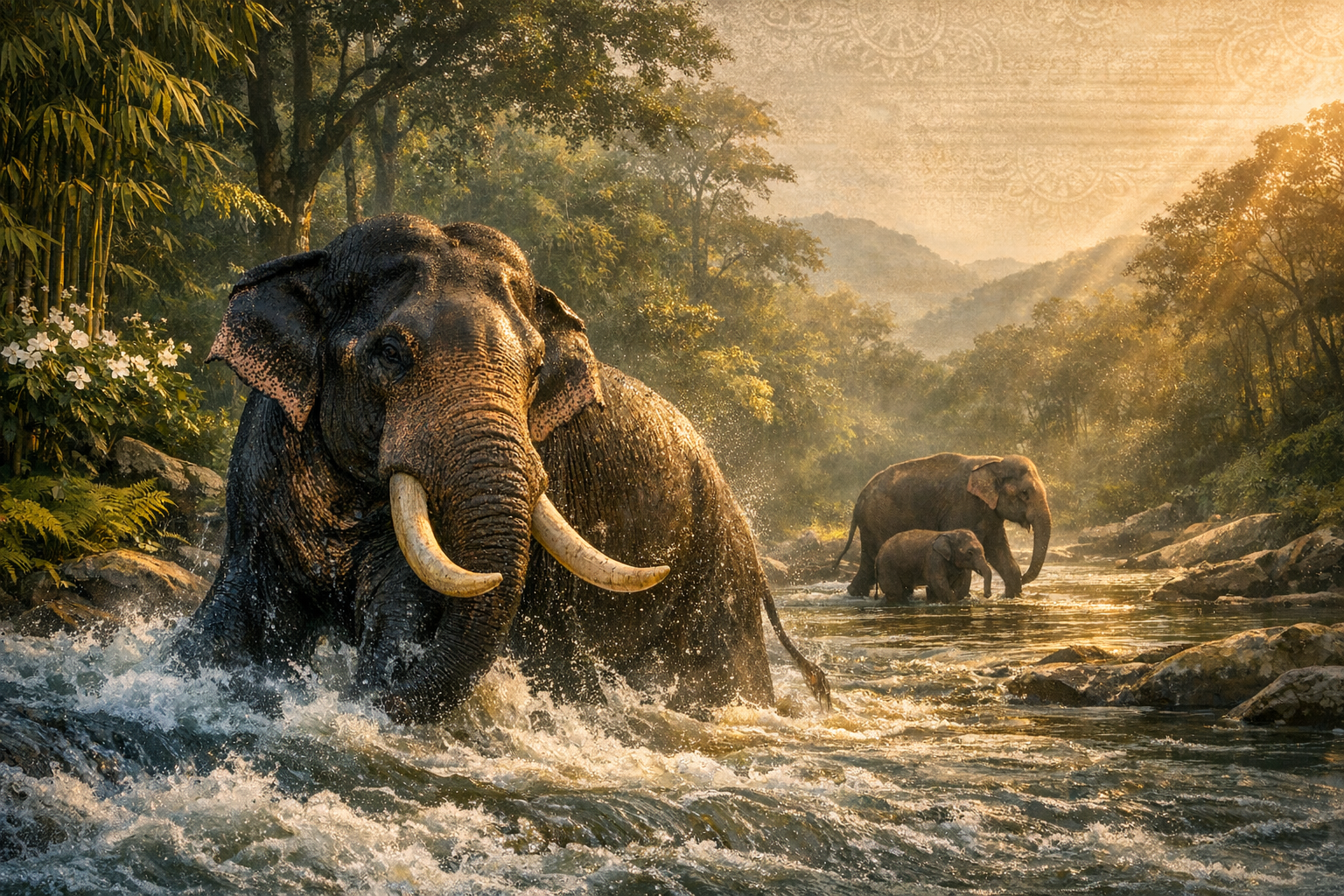
Kalithokai, a core anthology of the Sangam corpus, weaves intimate love poetry with an exacting moral sensibility. Among its most resonant moments is a vignette in which a male elephant shields a female and their calf in the face of danger, silently absorbing risk so the vulnerable may live. Read as ethical philosophy in miniature, this episode offers a lucid teaching on selflessness, duty, and relational carevalues that continue to inform contemporary understandings of dharma across the dharmic traditions of Hinduism, Buddhism, Jainism, and Sikhism.
Situated within the Ettuthokai (Eight Anthologies), Kalithokai belongs to the akam (interior, love) genre and is composed in the kali metre. Scholars generally place the anthology in the later phase of the Sangam period, in the early centuries of the Common Era. While famous for its emotional nuance, Kalithokai also encodes a sophisticated ethical imagination: love appears not as indulgence but as a discipline of mutual responsibility, a practice of care shaped by landscape, community, and season.
The anthology is structured through the five tiṇaikurinji (mountain), mullai (forest/pastoral), marutham (agricultural plains), neithal (littoral), and paalai (arid). Each tiṇai functions as an ecological-emotional matrix in which terrain, livelihood, flora and fauna, time of day, and social roles combine to model states of mind. This environmental grammar makes ethical insight experiential: duty and compassion are shown as embodied responses to place, kinship, and risk, not as abstract imperatives.
Within this framework, the elephant vignette is at home in the sensibilities of mullai, the forest landscape associated with patience, watchfulness, and steady fidelity. The image is spare: sensing perilwhether encroaching hunters, a swollen river, or the disorientation of sudden noisethe tusker repositions itself to intercept harm. The body becomes a living rampart so the mate and calf can move to safety. No proclamation is needed; the act defines its own ethic.
Kalithokai’s narrative economy accomplishes several things at once. First, it models selflessness as preparedness to bear disproportionate risk for those more vulnerablea principle recognizable as dharma in relational form. Second, it portrays strength as service rather than domination: power is measured by what it protects, not by what it can subdue. Third, it suggests that ethical clarity often emerges under constraint; in moments of compressed decision, one’s deepest commitments become visible.
Poetically, the kali metre’s cadence amplifies urgency while enabling fine-grained sensory detailshifts of sound, coursing water, crackle of leaves, and the breath of alarm. Animal imagery functions as ethical mirror: readers see recognizable human bonds refracted through a non-human scene, inviting humility. The poem’s techniqueprecise scene-setting, selective metaphor, and controlled paceenacts the very discipline it praises.
Read philosophically, the episode proposes a relational ethic that complements classical formulations of dharma. Selflessness here is not negation of self but responsibility redistributed according to capacity: those with greater strength assume greater exposure to risk. This is consonant with nishkama karma (selfless action) in Hindu thought, karuṇā (compassion) in Buddhism, aparigraha and ahiṁsā (non-possessiveness and nonviolence) in Jainism, and sevā (selfless service) in Sikh tradition. The unity across these traditions lies in an orientation toward the welfare of others as a measure of the good life.
Because Kalithokai grounds its ethics in lived scenes, it speaks directly to contemporary practice. In families, caregiving often means stepping into difficulty so dependents can thrive. In civic life, first responders, healthcare workers, and community volunteers routinely absorb risk to protect others. In leadership, ethical authority rests less on assertion and more on the quiet redistribution of burdensensuring that the most exposed are shielded and the least heard are attended to.
The elephant vignette also sustains an ecological reading. Sangam literature ties human feeling to the health of land and creatures; compassion toward kin is inseparable from care for habitat. Elephants are keystone beings in South Asian ecologies, shaping forests and water pathways. To preserve them is to preserve the relational worlds they enable. The poem’s ethic thus naturally extends to environmental stewardshipan expression of ahiṁsā in the broadest sense.
From a comparative perspective, the parable aligns with patterns visible across South Asian narrative traditions. Buddhist Jātaka stories frequently render elephants as emblems of disciplined compassion; Jain narrative and monastic ethics emphasize reducing harm even under constraint; Sikh history remembers figures such as Bhai Kanhaiya for radical sevā in the midst of conflict. In each case, the core insight is the same: genuine strength is measured by the protection it affords to others.
Kalithokai’s craft invites careful attention to language. The interlocking of image and ethical inference relies on an economy of simile and alliteration (etukai), the precise matching of landscape cues to emotional states, and the calibration of rhythm to action. Such features reward philological reading while remaining accessible; one does not need specialized training to feel the force of a body taking the blow meant for another.
Historically, the anthology’s survival through palm-leaf manuscript traditions and medieval scholastic attention speaks to its perceived value as both poetry and ethical guide. While dating and authorship across Sangam texts can be complex, consensus about Kalithokai’s place in the akam canon is firm, as is recognition of its distinctive use of the kali metre. The textual record underscores a shared intuition: these poems were kept not only for their beauty but for their wisdom.
Interpreted through moral philosophy, the elephant vignette demonstrates how narrative compresses ethical argument. Instead of abstract rules, the poem offers a structured example. It shows how to weigh valuessafety of the vulnerable, proportional risk, fidelity under pressurewhen time is short. In analytic terms, it provides a model of decision under uncertainty that privileges care over calculation when lives are at stake.
For readers seeking practical application, three habits emerge. First, pre-commitment: decide in calm how to act under stress so values are not negotiated away in crisis. Second, proximity to the vulnerable: let resource allocation and attention flow to those at greatest risk. Third, ecological consciousness: see the protection of people and places as a single task, since harms to habitat rebound upon communities.
As literature, Kalithokai endures because it understands that the heart persuades where doctrines often fail. As philosophy, it endures because it ties virtue to skillful action in concrete circumstances. As a dharmic resource, it endures because it harmonizes the core commitments of Hinduism, Buddhism, Jainism, and Sikhism around a single axis: compassion enacted as responsibility.
In the end, the image persistsquiet, unspectacular, and unforgettable. A tusker turns into the danger so that a mate and calf can pass. Kalithokai leaves the scene unadorned because it does not need adornment. It presents a standard for ethical life that is at once ancient and urgently contemporary: bear more so others may bear less.
Inspired by this post on Hindu Blog.
