
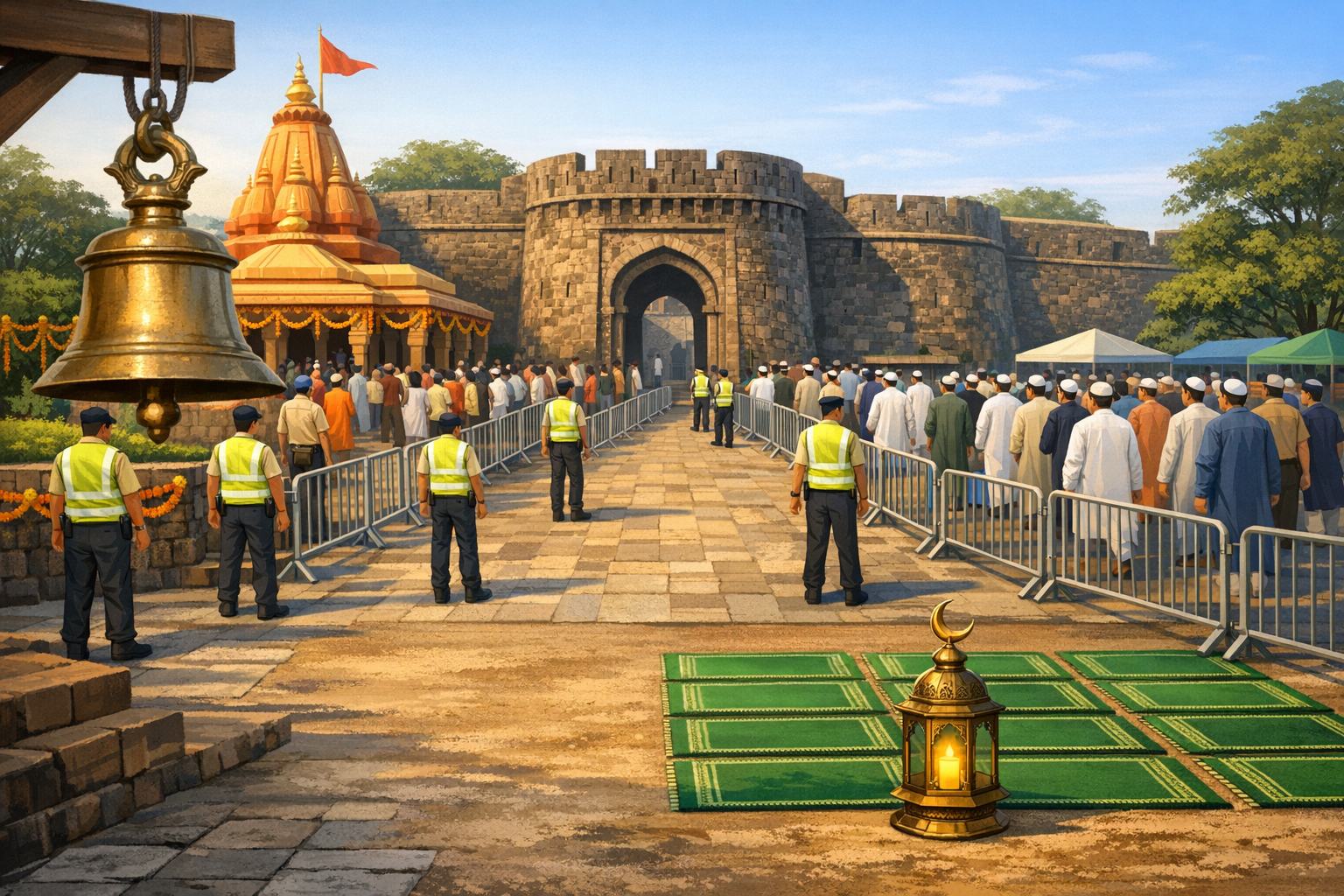
Police in Kalyan, Maharashtra, detained several workers associated with Shiv Sena and allied Hindu organizations during a Ghantanad protest near Durgadi Fort. Demonstrators demanded access to the historic Shri Durgadevi Temple and opposed temporary restrictions reportedly issued by the district administration to accommodate Eid prayers. The episode underscores a recurring governance challenge in India’s plural urban spaces: how to balance constitutionally protected religious freedom with public order when overlapping sacred events converge in shared civic areas.
Durgadi Fort and the Shri Durgadevi Temple occupy a place of deep cultural memory in Kalyan. The very choice of Ghantanadbell-ringingas a mode of demonstration carried symbolic weight, evoking the aural presence of Hindu worship and the longing of devotees for darshan on a significant day. At the same time, Eid prayers represent an equally time-bound religious obligation for local Muslims. When such observances coincide, sentiments across communities naturally intensify. This conjuncture made Kalyan’s situation emotionally charged and required a measured, transparent administrative approach that could be seen as fair by all sides.
India’s constitutional framework offers clear signposts. Article 25 protects the freedom of conscience and the right freely to profess, practice, and propagate religion, subject to public order, morality, and health. Article 26 safeguards the right of religious denominations to manage their own religious affairs. Where concurrent religious gatherings risk congestion or conflict, restrictions may be justifiedbut only to the extent they are proportionate, narrowly tailored in time and space, and non-discriminatory. In practice, this means pre-declared, reasoned orders; least-restrictive alternatives; and credible accommodations for all affected worshippers.
Operationally, simultaneous high-footfall events in compact urban precincts require crowd science, logistics, and empathetic communication to work in tandem. Police often face the immediate burden of de-escalation and flow control; detentions in such contexts are typically framed as preventive measures to avert flashpoints. Yet, durable legitimacy depends on more than enforcement: it requires documented assessment of risk, a clear public rationale for any temporary curbs, and an auditable trail showing that accommodationnot denialwas the first resort.
Beyond law and logistics lies a social truth: Kalyan’s civic fabric is woven through shared marketplaces, overlapping festival calendars, and everyday neighborliness among Hindus, Buddhists, Jains, Sikhs, and Muslims. Families in such towns frequently move between a temple visit, a gurdwara langar, a Jain upashray, or a Buddhist vihara, while also greeting Muslim friends on Eid. The aspiration in every community is similarpeaceful worship without impedimentmaking coordination, not confrontation, the most culturally authentic path forward.
Several policy practices can transform tense overlaps into dignified coexistence. Time-staggered access windows allow both darshan and namaz to proceed with minimal interference. Distinct ingress–egress corridors and unidirectional pedestrian flows reduce crosscurrents that heighten friction. Temporary acoustic managementensuring that amplification near prayer areas is moderated during the overlapping windowpreserves sanctity without silencing devotion. And mixed volunteer marshals drawn from different communities can humanize instructions that might feel impersonal if delivered solely through barricades and megaphones.
Advance planning is decisive. A joint interfaith coordination cell, convened several weeks ahead of peak calendars, can map expected footfalls, mark buffer zones, and publish a consolidated event schedule. Early, multilingual public noticesvia local radio, ward offices, mosques, temples, and digital channelsset shared expectations. Dedicated helplines and on-site grievance desks give devotees and residents a quick, respectful way to flag problems before they become points of agitation.
Transparency and accountability strengthen trust. Orders that temporarily regulate access should be precise about duration, geography, and rationale, alongside parallel mention of accommodations offered. After-action reviewsdocumenting crowd volumes, wait times, detentions, medical incidents, and complaint resolutionhelp refine protocols for the next cycle. Metrics such as the ratio of facilitation interactions to enforcement actions, time-to-reopen of regulated corridors, and mean queueing times (a simple application of queuing theory’s flow principles) keep the focus on service, not just control.
Communication strategy can be as critical as barricading. Rumor control units should proactively counter misinformation on social media and messaging apps, using credible local voices. Live signage and frequent loudspeaker updates reduce anxiety in queues. When devotees hear a clear time at which darshan will resume, or when worshippers know which gate will remain open for namaz, dignity and calm tend to follow.
This incident at Durgadi Fort is best read not as a zero-sum contest but as an opportunity to institutionalize fair, replicable solutions. When the district administration visibly applies the constitutional principle of proportionality, when police consistently prefer dialogue and facilitation, and when community leaders emphasize shared heritage over grievance, the result is safer, quicker restoration of access for everyone. Such a posture aligns with the dharmic ethos across Hinduism, Buddhism, Jainism, and Sikhismanchored in ahimsa, mutual respect, and the recognition that sacred spaces flourish most when all neighbors feel seen and heard.
Ultimately, Kalyan’s experience can offer a model: uphold Freedom of worship while protecting public order; treat every temporary restriction as an exception coupled with meaningful accommodation; and center interfaith coordination as routine civic practice rather than crisis improvisation. If these elements are sustained, the bells of Shri Durgadevi Temple and the prayers of Eid can both resonatedistinct yet harmoniouswithin the shared civic soundscape of Maharashtra.
Inspired by this post on Hindu Jagruti Samiti.
