
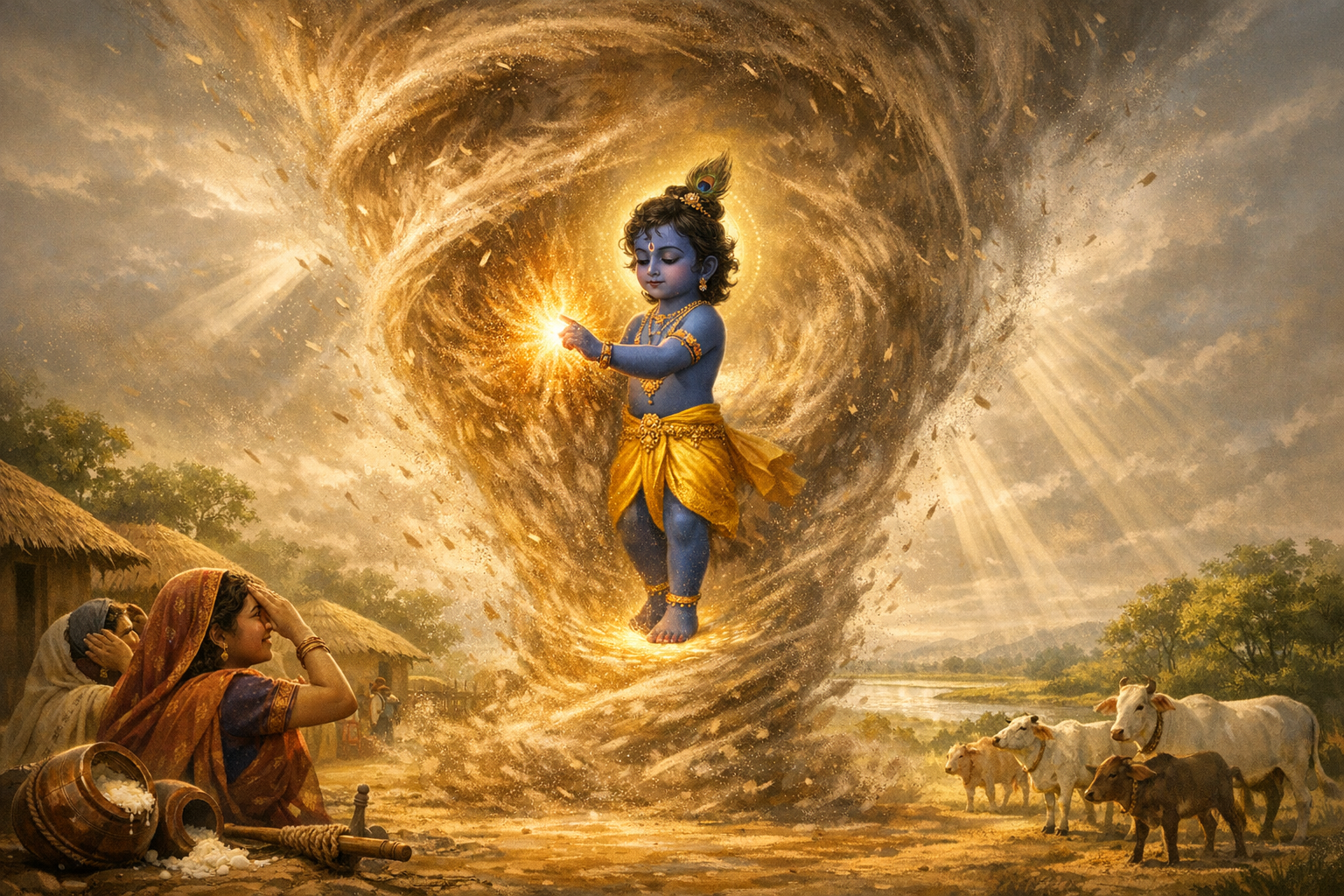
Across the pastoral lanes of Gokul, where the Yamuna’s breeze often carried the scent of fresh butter and wet earth, anxiety from Mathura cast a lengthening shadow. Kamsa’s fear had deepened after the failure of Putana, and the resolve to destroy the child foretold to end his tyranny grew more desperate. This is the setting in which the episode of Trinavartathe wind-demonunfolds, a moment that displays Krishna’s divine supremacy while speaking to universal Dharmic insights about mind, breath, and inner steadiness.
Srimad-Bhagavatam (Canto 10) preserves a clear narrative contour. One day in Gokul, as life resumed its gentle rhythms after earlier perils, Yashoda noticed her infant Krishna becoming unexpectedly heavy, a mysterious shift that devotional commentators often attribute to Yoga-maya’s play. Setting Him down briefly to attend to chores, she was met by a sudden, violent gust. Trinavarta, assuming the form of a towering whirlwind, swept in with a wall of dust and straw, seized the child, and rose to the sky, eclipsing the vision of those below.
As the asura climbed higher and the vortex tightened, the episode inverted: the child’s apparent weight increased beyond measure. The wind-demon’s breath failed, his strength collapsed, and Krishnacalm, unperturbedchoked the attacker with effortless power. The storm ceased as abruptly as it had begun, and Trinavarta’s body crashed upon the outskirts of Vraja. Villagers gathered in disbelief and awe to find the child miraculously safe, returning to Yashoda’s arms as if nothing had transpired.
For caregivers, the panic of a sudden, unseeable danger to a child is universally legible. The people of Vraja responded as any community would: with relief, protective rituals, and redoubled vigilance. In the idiom of village Indiathen and nowsuch moments are often met with apotropaic acts meant to shield from the “evil eye” (drishti), a cultural rhythm that complements the text’s theological center: the omnipresent protection of the Divine in the midst of life’s most uncontrollable forces.
The episode is sequenced in the Purāṇic record soon after Putana (Bhāgavata Purāṇa 10.6) and in proximity to other early childhood pastimes such as the subduing of the cart-demon (Shakata) and, later, Vatsasura. Vishnu Purana (5.5) corroborates the basic contours of the event, underscoring a consistent literary memory across traditions. The narrative logic in these texts is unambiguous: Kamsa’s escalating strategies repeatedly meet the serene, unforced sovereignty of Krishna’s lila.
Philologically, “Trināvarta” invites a literal reading: trina (straw) + āvarta (eddy, whirl). The demon’s chosen form is therefore not incidental; it evokes the sight, familiar on the alluvial plains, of gusting vortices that lift straw, dust, and chaff into spiraling columns. Pre-monsoon afternoons in North India routinely produce such convective “dust devils” when hot ground meets a sudden pressure differencean image that makes the Purāṇic description both vivid and locally grounded.
Within the shared yogic vocabulary of the Dharmic traditions, the motif of wind (vāyu) easily doubles as a symbol of prāṇa and mental restlessness. Texts on yoga speak of the five principal prāṇa-vāyus (prāṇa, apāna, samāna, udāna, vyāna). The upward-moving udāna-vāyu, when unregulated, can metaphorically mirror the destabilizing lift and scatter of a storm. Against this, devotional exegesis reads Krishna’s sudden “heaviness”often connected to the pan-Indic notion of garimā-siddhi (the power of immense weight)as the irresistible gravity of Truth that stills disorder. The storm loses its breath when confronted by wholeness.
This symbolic grammar resonates with the Bhagavad-Gita’s psychological precision: “the mind is restless, turbulent, strong, and obstinatelike the wind” (cf. Gita 6.34). The text’s remedy is abhyāsa (steady practice) and vairāgya (dispassion). Read alongside the Trinavarta episode, the contrast is instructive: the untrained wind scatters, whereas attention restored to its source gains weight, coherence, and clarity. The demon of the whirlwind is not only an external foe but also an inner allegory for an agitated mind uprooting itself from the ground of awareness.
In Bhakti traditions, this moment is therefore not merely martial victory but theological revelation: even in infancy, Krishna manifests viśva-ādhipatyathe effortless lordship over elemental forces. The same child who delights Yashoda as “Gopāla” is also the still center of nature’s cyclical power. Devotees often emphasize how the lila retains tenderness: there is no spectacle of rage, only the cessation of violence and a village’s return to peace. The tone is restorative, not triumphalist.
Across the broader Dharmic spectrum, the interpretive themes align remarkably well. Buddhism frames the path as taming inner tempests through sati (mindfulness) and ānāpānasati (mindfulness of breathing), recognizing that untrained attention can spiral like a storm. Jainism speaks of samyama (self-restraint) and samayik (equanimity practice) to quiet kashāyas (passions), curbing the gusts of anger, pride, deceit, and greed. Sikh teachings highlight the stabilizing power of the Shabad and Naam Simran to calm the “five thieves” that agitate the mind. These are not sectarian divergences but complementary doorways into a shared insight: the winds within must be befriended, not feared, and ultimately anchored in Truth.
From a theological perspective grounded in the Puranas, Kamsa’s policy of external force encounters a metaphysical limit. Dharma is not merely moral convention but cosmic alignment; when the axis of Dharma stands firm, adharma loses breath. The narrative repeatedly demonstrates that divine intervention does not abolish nature; rather, it centers and heals it. The storm disbands; the community regathers; love endures.
Culturally, the Trinavarta episode lives on in katha recitations across Braj and in devotional arts that depict Krishna clasping the demon’s throat amid a halo of dust. During Janmashtami and Gokulashtami observances, this lila is often retold to illustrate both protection and pedagogy: protection, because care for the vulnerable is a sacred duty; pedagogy, because inner steadinesslike a mother’s steady holdmust be cultivated before, during, and after life’s gusts.
The narrative’s emotive architecture is simple yet exacting. The fear of losing what is dearest, the shock of forces beyond control, and the relief that follows a narrowly averted tragedy create an experiential arc anyone can recognize. In this human register, the text locates a universal lesson: when chaos rises, the response is to return to weightof presence, of breath, of remembrance. Even outside explicitly devotional frames, this is practical wisdom for households, communities, and leaders alike.
Intertextually, the story’s placement near other early pastimesPutana’s defeat, the subduing of the cart-demon, and later the Damodara episodebuilds a cumulative theology: reality itself is trustworthy because the center holds. Krishna’s childhood pastimes (bāla-līlā) are not separate from metaphysics; they are metaphysics made intimateon a mother’s lap, among cowherds, along the Yamuna’s banks. Vishnu Purana and Srimad-Bhagavatam converge here, and Gaudiya Vaishnava commentaries expand the interpretive horizon without fracturing the core narrative.
Taken together, these dimensionsphilological, ecological, yogic, devotional, and inter-Dharmicdo not compete for priority. They braid into a single, comprehensible insight: the storm of distraction, pride, and fear cannot endure before the weight of Truth. Whether one approaches through Bhakti (devotion), Dhyana (meditative awareness), or ethical restraint, the path points to grounding the breath, clarifying the mind, and aligning conduct with Dharma.
Thus the defeat of Trinavarta is more than a victory tableau; it is a study in spiritual physics. Unregulated wind rises and scatters; regulated prāṇa enlivens and steadies. Kamsa’s strategy is outward compulsion; Krishna’s response is inward sovereignty. In that contrast lies the perennial promise of Sanatana Dharma and the shared wisdom of Buddhism, Jainism, and Sikhism: cultivate the center, and the storm will pass.
Inspired by this post on Hindu Blog.
