
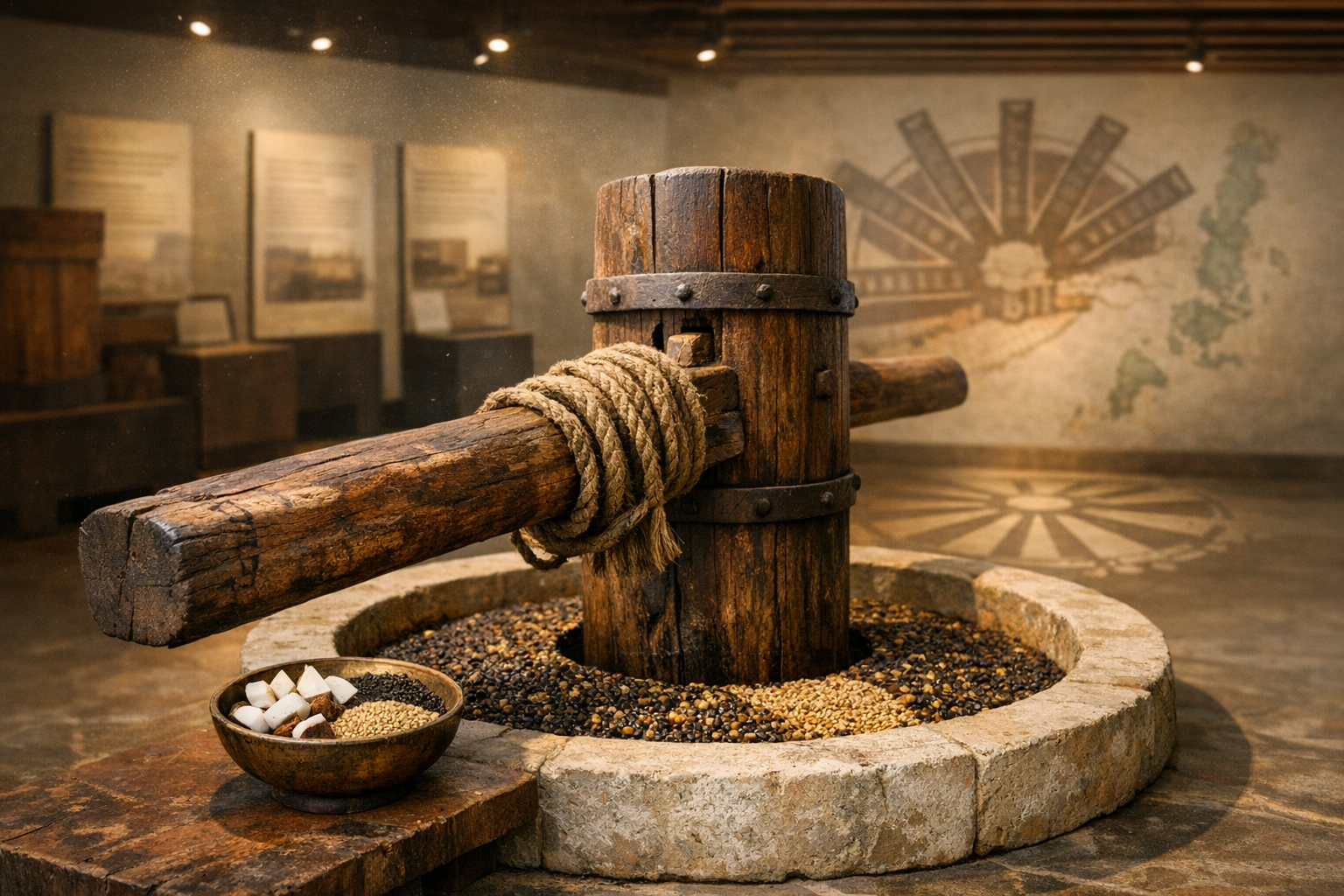
At the Swatantryaveer Savarkar Rashtriya Smarak in Mumbai, a live kolhu demonstration has brought the raw, corporeal memory of the Cellular Jailpopularly known as Kala Paniback into public consciousness. By recreating the oil-press labor imposed on political prisoners in the Andaman penal colony, the exhibit provides a rare, tactile encounter with a chapter of the Indian freedom struggle often relegated to text and testimony. The staging succeeds as public history precisely because it translates archival descriptions of punishment and toil into the palpable language of movement, weight, friction, and endurance, making the immense sacrifices of freedom fighters newly legible to a younger generation.
The kolhu, a traditional oil press, consists of a vertical mortar-and-pestle assembly rotated via a horizontal beam. In agrarian settings, bullocks typically supplied the torque; in the Cellular Jail, human bodies were harnessed to the beam, replacing animal traction with coerced, repetitive locomotion. Seeds such as coconut, mustard, til (sesame), and castor were crushed under sustained pressure and shear, converting human metabolic energy into mechanical work with minimal mechanical advantage for the operatoran arrangement that turned a livelihood tool into an instrument of punishment.
Historically, the Andaman penal settlement was established in 1858, in the aftermath of the 1857 War of Independence, as a site of transportation and penal servitude under British colonial rule. The Cellular Jail in Port Blair, completed between 1896 and 1906, featured seven radiating wings with hundreds of solitary cells designed to isolate inmates and suppress organizing. Its architecture and regulations combined solitude, surveillance, and hard labor to enforce discipline upon a wide spectrum of freedom fighters drawn from across the subcontinent.
Contemporary testimonies and later memoirs by political prisonersamong them V. D. Savarkar’s accounts, Barindra Kumar Ghosh’s reflections in The Tale of My Exile, and writings by Sachindra Nath Sanyal and Ullaskar Duttaconsistently describe kolhu labor as the central axis of coercion. Daily quotas varied by the seed assigned and season, but narratives converge on unremitting expectations enforced under threat of flogging, dietary reduction, or the imposition of fetters. When targets were not met, punishments followed a bureaucratic logic of escalation that left little room for recuperation or appeal.
Instruments of compulsion extended beyond the oil press. Solitary confinement, the silence rule, bar fetters, and standing handcuffs produced cumulative physical and psychological exhaustion. Such methods, codified in colonial carceral practice, were justified administratively as discipline yet functioned as degradationdisconnecting individuals from community, kinship, and even sensory variety. The kolhu stood at the intersection of this regime, translating abstract authority into the concrete momentum of a beam driven by bodies in harness.
The physiological toll of kolhu labor was severe. Continuous circular motion under load created repetitive strain injuries of the hips and shoulders, abrasions from harness friction, and pronounced dehydration in tropical heat. Nutritional deficits compounded the harm, slowing recovery and weakening resistance to disease. Fetters impeded gait and circulation, increasing the risk of neuropathies and musculoskeletal disorders. The result was not merely fatigue but systematic attrition, intended to bend will and body alike.
The psychological effects were equally grave. Isolation in the Cellular Jail’s single-occupancy cells, the monotony and humiliation of forced labor, and the omnipresence of punitive surveillance fractured time into cycles of dread and compulsion. Yet testimonies also record acts of resiliencesilent solidarities, shared songs, coded exchanges, and the cultivation of inner disciplinethat sustained a moral universe in defiance of carceral nihilism.
Seen through the lens of public history and museum practice, the Mumbai kolhu demonstration performs a crucial mediating function. It translates textual memory into embodied cognition: visitors understand with the senses what the archive preserves in prose. Such “living history” methods, when guided by trauma-informed curation, enable empathy without sensationalism and foster critical reflection on British colonialism, penal servitude, and the ethics of remembrance.
Technically, the kolhu embodies a simple but unforgiving mechanics. A long beam increases the turning radius to generate rotational motion around a central pivot, while the pestle exerts compressive and shear forces over a bed of oilseeds. In penal use, the absence of animal traction meant that torque and rotational inertia had to be supplied entirely by human muscle. Because viscous resistance rises as seed mass densifies, effort intensifies over time; the body’s energy systems are thereby taxed in a manner that blends endurance, force output, and pain toleranceprecisely why the device was so effective as a tool of control.
Crucially, the demonstration in Mumbai locates the Cellular Jail within India’s broader freedom struggle, highlighting contributions that cut across regions and communities, including Hindu, Sikh, Jain, and Buddhist lineages. Ghadar movement prisoners from Punjab, revolutionary networks in Bengal, and activists from Maharashtra, Bihar, and the United Provinces all left imprints on Andaman’s carceral landscape. Framing the exhibit within a dharmic ethos of shared dignity and duty underscores that resistance to colonial dehumanization drew strength from a civilizational spectrum of beliefs and practices.
Visitor responses at the Savarkar Smarak suggest that the kolhu reenactment functions as a bridge across generations: elders recall family narratives of sacrifice; students ask practical questions about the device’s mechanics, daily quotas, and discipline; educators connect the experience to curricular units on British colonial rule and the evolution of prisons. The exhibit thus catalyzes intergenerational dialogue while situating individual suffering within collective purpose.
From a methodological standpoint, three curatorial safeguards enhance the ethical integrity of such demonstrations: document-based fidelity to primary sources; explicit context about colonial carceral policy to prevent voyeurism; and space for quiet reflection so that audiences process what they witness. The Mumbai program, by foregrounding testimonies and avoiding theatrical excess, models how public history can transmit difficult knowledge responsibly.
The kolhu’s reappearance in civic space also speaks to a broader decolonial imperative: to recover, preserve, and teach histories that honor agency alongside anguish. Digitizing letters, memoirs, and court records; recording oral histories across dharmic communities; and integrating site visits to the Cellular Jail National Memorial in Port Blair are concrete steps that convert remembrance into civic learning and unity.
Ultimately, the kolhu demonstration at the Swatantryaveer Savarkar Rashtriya Smarak does more than revive memories of brutal torture; it re-centers the ethical grammar of the Indian freedom strugglecourage, discipline, solidaritywithin a living, shared heritage. By aligning rigorous historical accuracy with empathetic pedagogy, it ensures that the sacrifices of freedom fighters are not only remembered, but also understood, across the entwined traditions of Hinduism, Buddhism, Jainism, and Sikhism. In doing so, it affirms a unified civilizational resolve against dehumanization and a commitment to dignity that remains instructive for the present.
Inspired by this post on Hindu Jagruti Samiti.
