
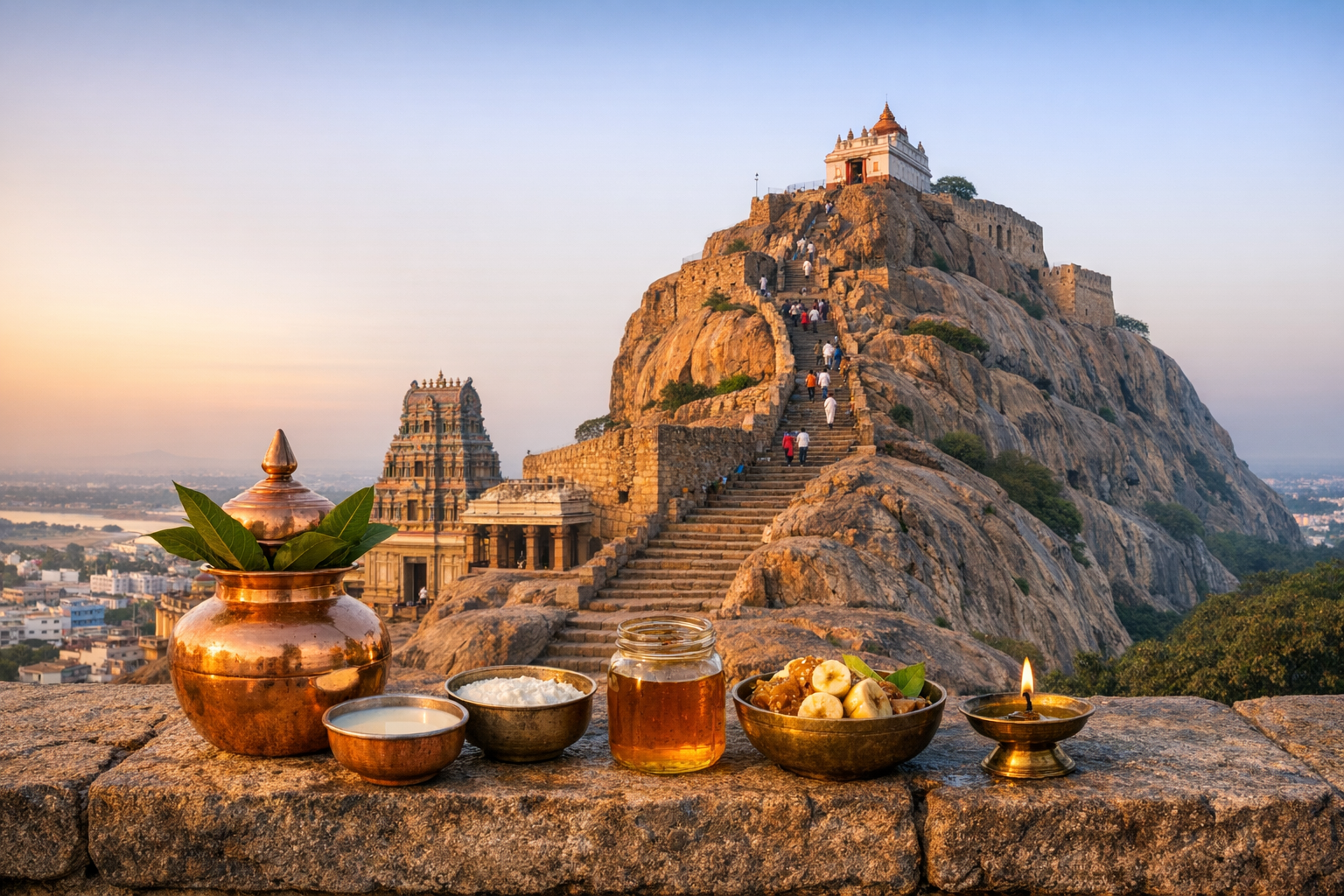
Undertaken on 09.02.2026, this pilgrimage to the Trichy Rockfort Temple complex in Tiruchirappalli unfolds as a contemplative ascent through living history and sacred ritual. Beginning before dawn, the journey proceeded by auto-rickshaw from Kalyanapuram to Kumbakonam and onward to Tiruchirappalli, culminating in participation in multiple Abhishekham riteshoney, milk, curd, and Panchamirthamperformed with care and reverence. What follows is a holistic, research-driven account of the complexits geology, architecture, ritual culture, and the embodied experience of climbing over 400 steps to darshanoffered in a spirit of unity among dharmic traditions.
Set atop an ancient charnockite outcrop that geologists often date to billions of yearsolder than the HimalayasTrichy’s Rockfort rises dramatically over the Kaveri delta. The formation anchors a unique confluence of sacred geography and strategic history: a fortified hill used by the Nayaks of Madurai and, earlier, a site touched by Pallava-era rock-cut artistry. Today it remains one of South India’s most visited living shrines, harmonizing Hindu pilgrimage practice with an enduring cultural landscape.
The Rockfort Temple complex comprises three principal shrines encountered in a traditional sequence: the Manikka Vinayakar Temple at the foothill, the Thayumanaswami (Thayumanavar) Temple dedicated to Shiva approximately midway, and the Ucchi Pillayar Temple to Ganesha at the summit. Ascending more than 400 stone steps, pilgrims encounter distinct ritual rhythms at each level, alongside panoramic views of Tiruchirappalli and the Kaveri riverine plain. This sequence is not only practical for managing the climb; it also reflects a theologically meaningful progression of darshan from the base to the summit.
The itinerary that began in Kalyanapuramwith an early auto-rickshaw ride to Kumbakonamaligns with the pragmatic logic of temple travel in the Tamil region: start early, minimize heat, and arrive in time for morning pujas. The stretch from Kumbakonam to Tiruchirappalli, whether by bus or rail, passes through a temple-rich corridor of the Kaveri delta, where sacred architecture, agrarian life, and river ecology are visibly interwoven. Such a route offers time to settle one’s sankalpa (intention) before entering the Rockfort precincts.
The Abhishekham performed during this visit followed canonical Shaiva and Ganapatya sensibilities articulated across the Agamas and temple manuals: abhiṣeka is both an act of consecration and a metaphor of inner purification. Milk represents sattva and luminosity; curd signifies nourishment and strength; honey invites sweetness in speech and conduct; Panchamirthamregionally formulated as a sanctified blend that may include banana, jaggery, honey, ghee, and aromaticsembodies abundance and harmony. These materials, offered with mantras, are understood to cool, anoint, and refresh the murti while orienting the pilgrim’s mind toward clarity and devotion.
Panchamirtham in Tamil Nadu temples varies by sacred locale. Palani’s Panchamirtham is the most codified and widely referenced, yet analogous offerings at Rockfort observe local practice and seasonality while conforming to hygiene and sanctity norms set by the temple administration. The core principle remains consistent: the fivefold sweetness symbolizes integration of the senses and the cultivation of auspicious qualities within.
Liturgically, Abhishekham sits within a broader daily cycle often structured as Kala-sandhi (morning), Uchikāla (midday), Sāyarakṣā (evening), and Ardha-jāma (night) pujas. While schedules are subject to temple-specific variations and festival calendars, pilgrims typically find that arriving for a morning climb allows calm queues, unhurried darshan, and participation in at least one abhiṣeka or alankara. The Rockfort’s multiple shrines distribute footfall naturally, but patience, quiet attention, and adherence to queue etiquette remain essential to the shared sanctity of the space.
The sthala-purāṇa associated with Ucchi Pillayar is among South India’s most beloved. In the widely retold narrative, Vibhīṣaṇa, brother of Rāvaṇa, obtains a sacred image of Lord Ranganātha to carry toward the north. Ganeshamanifest as a boypromises to hold the image but sets it down at Srirangam, fixing it there. Vibhīṣaṇa chases the boy to the Trichy rock and, realizing the divine play (līlā), submits to the cosmic order. The story situates Rockfort within a larger sacred geography connecting Srirangam, Tiruchirappalli, and the Kaveri’s island-temple ecologies.
Historically, the hill bears inscriptions and architectural cues pointing to Pallava-period rock-cut traditions (circa 6th–7th centuries CE), later embellished and fortified under the Nayaks of Madurai in the 16th–17th centuries. The fortifications figured in the Carnatic Wars and subsequent colonial maneuvers, yet the temples remained remarkably resilient as spaces of worship and community. This palimpsestPallava, Chola-Chalukya exchange zones, Nayak polity, and colonial-era contestationsframes Rockfort as both a strategic acropolis and a spiritual lighthouse.
Architecturally, the complex blends Dravidian superstructures with rock-cut sanctums and pillared mandapas. The ascent reveals carefully hewn stairways, narrow landings carved into the charnockite face, and gopurams guiding movement between sacred thresholds. The mid-level Thayumanaswami Temple showcases classic Shaiva iconography, while the Ucchi Pillayar shrine offers the distilled simplicity characteristic of hilltop Ganapati templesminimalist yet magnetically potent in its elevation above the city.
The geology is more than backdrop. Charnockite’s immense antiquity and density give Rockfort its enduring silhouette. Pilgrims often remark that placing a palm on the warm stone imparts a grounding sensationan encounter with the Earth’s deep-time memory. In a dharmic interpretive lens, the climb becomes a sādhana: an ascent from the gross to the subtle, with the rock symbolizing stability, dharma, and witness-consciousness.
Embodied practice matters on this hill. Over 400 steps invite a mindful cadence: measured breathing, relaxed shoulders, and a steady gaze. Many integrate simple pranayamaequal-length inhalation and exhalationbetween landings. The ascent, then, is not merely locomotion; it is a contemplative passage aligning body, breath, and intention, culminating in darshan that feels earned rather than merely reached.
Conduct within the temples follows time-honored norms that also resonate across Jain, Buddhist, and Sikh sensibilities: quietude, cleanliness, modest attire, and a spirit of seva. Offerings are best kept simple and eco-responsible; photography policies vary and are to be respected without exception. The exchange of prasad, including Panchamirtham, is understood as a sharing of grace and an opportunity to extend kindness to fellow pilgrimsan ethos that underscores unity across dharmic paths.
This unity is not rhetorical. Tamil rock-cut and structural temple architecture developed in conversation with pan-Indic stone-working, monastic, and liturgical traditions. While Rockfort is a Hindu sacred site, its rock-cut lineage and contemplative ascent evoke parallels with Buddhist and Jain cave-temple ecologiesfrom Ajanta and Ellora to smaller southern sitesaffirming a shared civilizational grammar of stone, silence, and sanctity. Such resonances strengthen the contemporary commitment to inter-dharmic harmony and mutual respect.
The day’s Abhishekham experienceshoney, milk, curd, and Panchamirthamhad a cohesive arc. Honey’s viscosity suggested the lingering sweetness of mantra; milk cooled and clarified the senses; curd restored vitality after the climb; and Panchamirtham, with its layered fragrance, evoked abundance without excess. Participating in each rite reinforced a core Agamic principle: external anointment reflects internal refinement, and collective worship refines the social fabric alongside the self.
Practical considerations enhanced the journey’s ease. Beginning early avoided heat buildup on exposed steps. Hydration was managed before and after the climb, leaving hands free for railings. Footwear deposit points at the base streamlined movement between shrines. Simple cotton attire, a small cloth for perspiration, and careful pacing proved more valuable than unnecessary load. Checking the day’s puja timings at the base ensured that Abhishekham participation aligned with the temple’s schedule.
Tiruchirappalli’s urban-temple ecosystem supports the pilgrimage well. Signage is generally clear, and local volunteers or staff courteously guide queues during peak hours. The base Manikka Vinayakar Temple allows a gentle entry into the sacred frame of mind, the Thayumanaswami Temple offers a rich Shaiva ritual experience, and the Ucchi Pillayar shrine at the summit seals the ascent with a vista that is as much inner as outwarda synoptic view of the Kaveri, Srirangam, and the rhythms of a South Indian city.
Safety and accessibility remain paramount. Those with knee or balance concerns may take additional pauses at landings; mornings offer cooler rock surfaces and calmer winds. Families with children often divide the ascent, meeting at designated points. The ethos of shared careoffering a hand, making space in queues, or sharing water at rest pointstransforms the climb into community practice, consistent with the dharmic ideal that personal progress is inseparable from collective well-being.
As daylight advances, the rock’s hue shifts through subtle gradations, and the temple bells mark the day’s temporal anchor points. The mind registers a simple synthesis: the geology’s deep time, the architecture’s crafted time, the ritual’s sacred time, and the pilgrim’s lived time all intersect on this hill. The result is not spectacle but steadinessa felt sense that devotion can be orderly, ethically grounded, and capacious enough to honor all sincere seekers.
This pilgrimage, from Kalyanapuram to Kumbakonam to Tiruchirappalli and finally up the storied steps of Rockfort, illuminates a core promise of Hindu pilgrimage in Tamil Nadu: ritual precision without rigidity, aesthetic refinement without excess, and a quiet, enduring hospitality that welcomes the diversity of India’s dharmic family. In that spirit, the Trichy Rockfort Temple continues to serve as both sanctuary and schoolteaching through stone, silence, and the shared sweetness of Panchamirtham.
Inspired by this post on Hindu Pad.
