
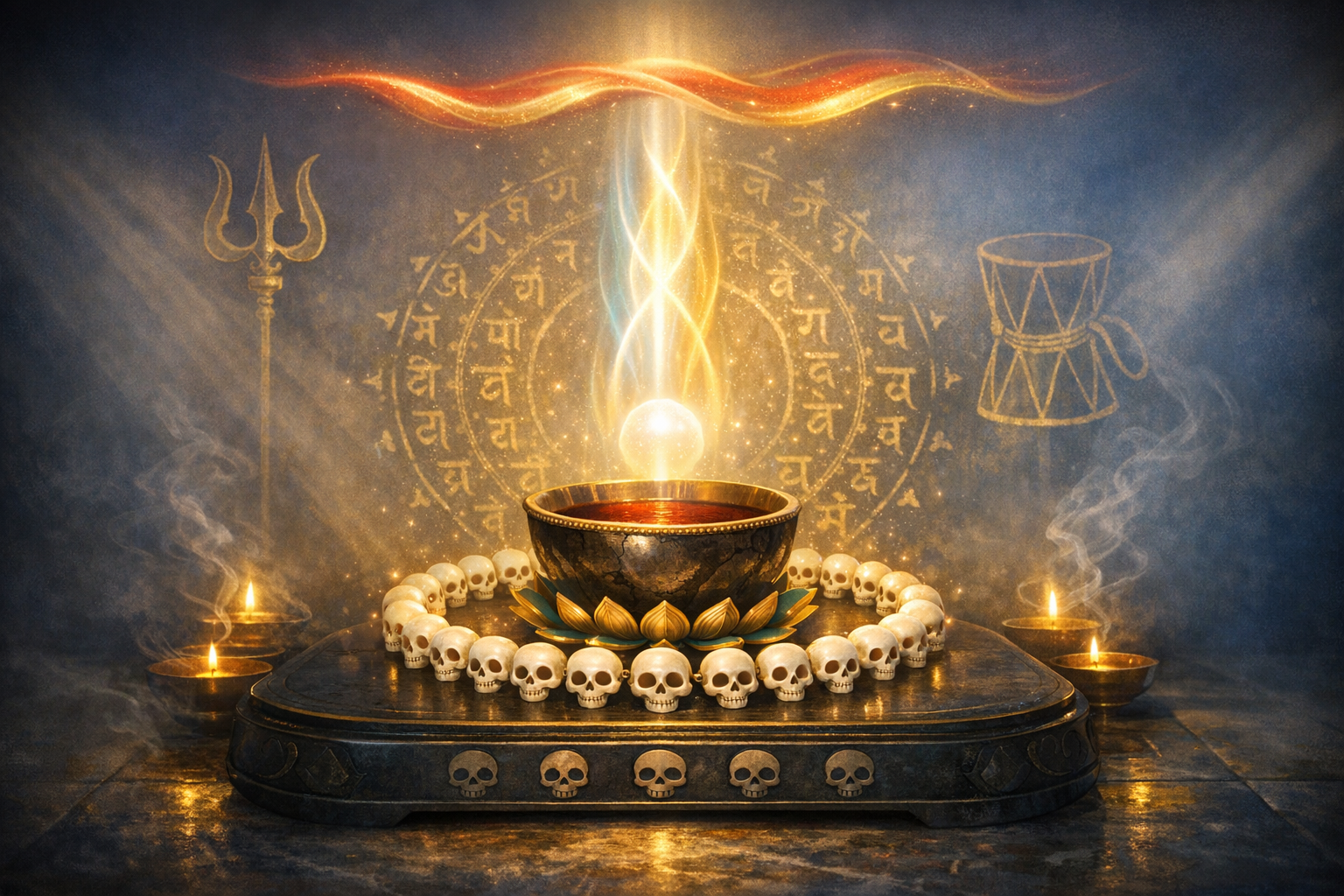
Across the galleries of Tantric iconography, a single image recurs with deliberate insistence: the human skull. Rendered in the hands, crowns, and garlands of deities such as Shiva, Bhairava, Kali, and Chinnamasta, it interrupts ordinary perception. In modern popular culture the skull often signals fear, aversion, or rebellious nihilism; in Tantra it becomes a rigorous teacher that silences the noisy self and directs consciousness beyond fear.
This study decodes skull symbolism in Tantra and allied Dharmic traditions, showing how the image operates as a precise soteriological device designed to cut through ego, pride, and pretension. Properly understood, the skull communicates a disciplined path to fearlessness and humility rather than morbid fascination.
Terminology clarifies function. The kapala is a skull-bowl carried in the hand; the mundamala is a garland or necklace of skulls; and the severed head appears as self-decapitation (notably in Chinnamasta). Each variant corresponds to a phase of inner work: recognition of mortality, offering of identity, and decisive severance of false self-concepts that bind awareness.
Historically, skull motifs crystallized within Shaiva and Shakta Tantra between the sixth and twelfth centuries CE, shaped by Kapalika and Kaula lineages whose contemplations unfolded in the cremation ground (smashana). The imagery traveled widely across Ancient India and Southeast Asia, and resonances appear in Vajrayana Buddhism, where dakinis and mahasiddhas bear the kapala as a wisdom vessel. This diffusion underscores a shared Dharmic vocabulary aimed at liberating insight rather than spectacle.
Kali’s mundamala, often depicted as a row of 50 or 51 heads, is traditionally correlated with the Sanskrit varnamala, the sacred alphabet. The interpretive thrust is counterintuitive: when the letters that construct inner commentary are surrendered to the Goddess, speech resolves into mauna (silence) and attention rests in lucid stillness. Kali stands upon Shiva, indicating that dynamic Shakti reveals changeless awareness; egoic chatter subsides and awareness recognizes itself.
Bhairava, the fearsome form of Shiva, frequently holds the kapala and is associated with the Kapala-vrata, the vow to wander with a skull. Purana-tantric narratives of the severed fifth head of Brahma are read symbolically as the fall of arrogant self-creation. Thus, Bhairava’s skull instructs humility and fearlessness, dissolving mada (pride) and damba (pretension) into steady presence aligned with Dharma.
Chinnamasta, the self-decapitated Shakta deity, dramatizes the return of personal identity to Reality. Her three streams of blood commonly feed the attendants Dakini and Varnini and the Goddess herself; many commentators correlate these streams with ida, pingala, and sushumna, the triadic currents of prana. The focus is not violence but voluntary surrender of ahamkara so that prana flows unobstructed toward bodha (liberating insight).
The Panchamundi Asana, a seat composed of five skulls, adds a further layer of meaning. It is interpreted as mastery over the five sheaths (pancha-kosha), the five elements (pancha-mahabhuta), or the five afflictions (klesha). Seated upon this symbolic foundation, the practitioner places awareness above the changing constituents of embodiment, aligning gross to subtle (sthula to sukshma) and reclaiming sovereignty over reactivity.
Across these images, the skull functions simultaneously as memento mori and method. It relentlessly recalls anitya (impermanence) while training attention to notice the witnessing awareness that is not itself subject to change. When the mind ceases to grip names and forms, the teaching of anatma/anatta becomes experiential rather than conceptual, preparing the ground for moksha.
Psychologically, skull symbolism acts as calibrated exposure to fear. Meeting aversion in contemplative spacerather than suppressing or sensationalizing itreduces limbic overreaction, supports vagal regulation, and cultivates vira-bhava, the courageous stance necessary for deep meditation. The outcome is not numbness but resilient clarity guided by karuna (compassion).
Vajrayana Buddhism preserves closely related technologies. The kapala appears as a vessel of amrita in the hands of dakinis, and charnel-ground sadhanas train recognition of shunyata amid change. The intent converges with Hindu Tantra: egoic clinging is cut so that bodhicitta (compassionate wisdom) can act unimpeded. The imagery therefore supports unity in spiritual diversity rather than sectarian division.
Jainism approaches the same summit through ahimsa, aparigraha, and the pacification of kashaya (anger, pride, deceit, greed). While Jain iconography rarely employs skulls, the Tantric skull can be read in a shared Dharmic idiom as the renunciation of mana (pride) and maya (delusion) that obstruct kevala-jnana. Interpreted inwardly, the symbol harmonizes with Jain ethical philosophy and its emphasis on disciplined self-purification.
Sikh teachings on haumai (ego) and the virtues of nimrata (humility), seva, and simran dovetail with this reading. If the skull in Tantra signifies cutting self-importance, Sikh practice operationalizes the same ideal in community life, ensuring that realization expresses itself as service, equality, and solidarity within the sangat. Such convergences strengthen the ethos of unity in diversity across Dharmic traditions.
Modern culture often flattens the skull into a badge of danger or cynicism, from hazard symbols to heavy metal album covers. Tantric art asks for a subtler literacy: fear is acknowledged, given a seat, and then asked to reveal the truth it guards. Read in context, the skull is not a cult of death but a pedagogy of fearless, ethical life.
Ethically, these images never license harm. Decapitation is a metaphoran inner surgery upon pride and pretension. Teachers emphasize that rites linked to transgressive imagery require maturity, grounding in yama and niyama, and reverence for Dharma across Hinduism, Buddhism, Jainism, and Sikhism. Stripped of this context, the motifs can be misunderstood; held within it, they refine character and compassion.
Contemplative application can be simple and safe. One practice is marana-smriti: briefly contemplating mortality each day to soften grasping and clarify priorities. Another is mantra-led exhalationsilently intoning phat while releasing a surge of prideallowing the nervous system to settle as the mind relinquishes its scripted defenses.
A pragmatic sequence integrates the symbol into ethical action: recognize the rise of mada; name it without judgment; exhale with phat to cut identification; relax the jaw, shoulders, and belly to quiet the body; and respond from karuna rather than impulse. Repeated gently, this “ego-chopping” becomes second nature in work, family, and civic life, advancing both inner steadiness and social harmony.
Kali’s mundamala invites a complementary exercise in silence. Visualize the alphabet of inner talk dissolving, letter by letter, into the necklace of the Goddess, until commentary ceases and only cognizant stillness remains. In that stillness, the presence of Shivaawareness itselfemerges as the luminous ground of experience.
For those who revere Bhairava, the kapala can be contemplated as a bowl that receives, without preference, every experience of the daypleasant and unpleasant alike. This receptive equanimity reframes adversity as instruction, aligning with the Sikh ethos of chardi kala and the Buddhist cultivation of upekkha, thereby translating insight into resilient optimism.
Taken together, the skull in Tantric iconography conveys a single, pan-Dharmic thesis: ego, pride, and pretension are to be chopped offnot by force against others, but by insight within oneself. The symbol belongs to a family of Hindu Symbols that challenge complacency and, when read with cultural sensitivity, strengthens unity in diversity across Dharmic paths.
In museums and temples alike, the skull thus becomes a patient teacher. It poses the same incisive question wherever it appearsWho is the one afraid to let go?and waits until the answer arrives not as a slogan but as lived freedom. When that answer matures, the skull is no longer an emblem of fear but a seal of fearlessness.
Approached with respect for Cultural Heritage and rigorous Philosophy, Tantric skull symbolism enriches contemporary spiritual practice, renews inter-traditional dialogue, and orients seekers toward liberation informed by compassion. In this way, an image often misread as macabre reveals itself as a clear, compassionate map from bondage to fearless clarity.
Inspired by this post on Hindu Blog.
