
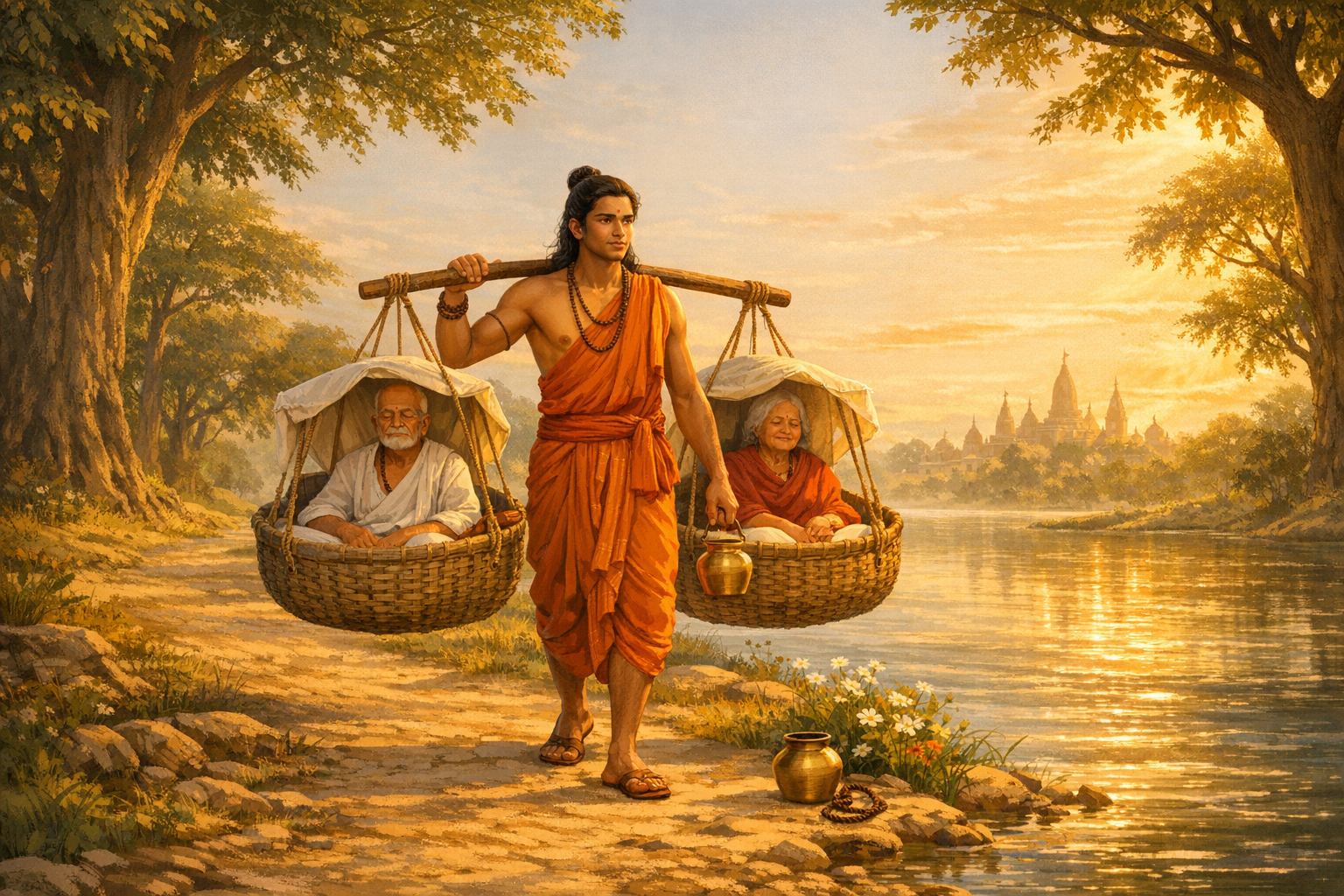
Shravana Kumara, often remembered as Shravan or Shravan Kumar, stands in the Ramayana tradition as a luminous exemplar of Matru-Pitru Bhaktifilial devotion toward one’s parents. His narrative, compact yet profoundly consequential, illuminates central ideas in Hindu Dharma about the sanctity of parental service, the moral vigilance required of rulers, and the subtle workings of karmic causality that shape the epic’s moral arc.
In the Valmiki Ramayana, the account surfaces when King Daśaratha recalls a grave youthful error that would eventually return as a devastating curse. The episode is not an incidental anecdote; it is a carefully positioned ethical mirror in the Ayodhyā Kāṇḍa, where private remorse and public duty intersect. Through Shravana Kumara, the text articulates how personal virtue, family responsibility, and statecraft are braided into a single dharmic weave.
Tradition portrays Shravana Kumara as the only son of elderly, blind parents who lived a saintly life absorbed in devotion. As age and disability limited their mobility, the parents expressed a heartfelt desire to undertake Tirtha-Yatraa sacred pilgrimage to bathe in holy waters and honor deities across the landscape revered by generations. Shravana, moved by reverence and love, pledged to fulfill their wish with sincerity and care.
He fashioned a sturdy shoulder-yoke that balanced two baskets, gently placing a parent in each. Along forest paths and riverbanks, he bore their weight without complaint, pausing to offer water, gather fruits, and ensure their comfort. This image of a son as pilgrim-guardiana living enactment of “Mātṛ Devo Bhava, Pitṛ Devo Bhava”has, for centuries, offered a tangible model of putra-dharma (a child’s duty), inspiring households to view elder care as sacred service rather than burden.
The turning point arrives near Ayodhya, often associated with the Sarayu’s banks. King Daśaratha, out hunting, employs the famed technique of śabdavedhīshooting by sound alone. Mistaking the gurgle of water poured into a pot for the approach of game, he looses an arrow. The strike does not fell an animal; it wounds Shravana Kumara. Realizing the grievous error, Daśaratha rushes to the scene, attempts aid, and is compelled to confront the full human cost of a moment’s misjudgment.
As life ebbs, Shravana Kumara requests the king to carry water to his waiting parents and to tell them what has happened. When Daśaratha, shaken and remorseful, meets the blind couple, he confesses. The parents, devastated, ask to be taken to their son and, upon reaching him, witness the tragic culmination of their pilgrimage. In their anguish, they utter a curse: that Daśaratha, too, shall one day die consumed by putra-śokathe sorrow of separation from his own son. Soon after, overcome by grief, they depart this world.
The curse reverberates through the epic’s later events, granting ethical depth to Daśaratha’s fate. When Rāma departs Ayodhya, the king’s life-force falters under the precise weight of the curse, revealing the Ramayana’s moral architecture: even a sovereign must be anchored in vigilant compassion, for unguarded actions bear exacting consequences. The tragedy is not framed as vengeance but as the unfolding of dharma and karma in a morally structured universe.
From a dharma-śāstra perspective, Shravana Kumara’s life embodies the fulfillment of the “three debts” (ṛṇa-traya) taught in the tradition: deva-ṛṇa (to the gods), ṛṣi-ṛṇa (to the sages), and pitṛ-ṛṇa (to the ancestors). While śrāddha rituals and lineage continuity are customary pathways to discharge pitṛ-ṛṇa, this narrative amplifies day-to-day seva (service) as a direct, living expression of gratitude. Shravana Kumara’s devotion is thus not only affective but also doctrinally aligned with classical Hindu conceptions of duty and ethical reciprocity.
The episode also develops a lesson in rāja-dharma (the duties of a ruler). Daśaratha’s mastery of śabdavedhī archerya formidable skilllacked the prudential guardrails required by duty to subjects. The narrative subtly critiques the aesthetics of martial prowess when uncoupled from ethical restraint. In doing so, it prefigures the Ramayana’s broader concern with just governance: power must be tempered by vigilance, empathy, and accountability.
Across India’s dharmic traditions, the ethical kernel of this story resonates strongly. In Buddhism, the Sigālovāda Sutta (Dīgha Nikāya 31) codifies mutual duties, including the child’s care and respect for parents, embedding filial responsibility within a holistic social ethic. Jainism, through its rigorous emphasis on ahimsa and disciplined household conduct (śrāvaka dharma), nurtures a similar culture of reverence and non-harm that naturally honors elder care. Sikhism extols seva, humility (nimrata), and the dignity of the grihastha (householder) path, affirming that responsibility within the family is a direct expression of righteous living. In this shared ethical space, Shravana Kumara’s Matru Pitru Bhakti becomes a unifying emblem for Hinduism, Buddhism, Jainism, and Sikhism alike.
The story’s cultural memory runs deep. From village retellings and classical theater to children’s primers and calendar art, the image of a son carrying his parents across a sacred geography has shaped family ideals for generations. For many caregivers todaynavigating hospital corridors, balancing work, and tending to elders at homethe narrative offers emotional validation: care is not a private burden but a public virtue and a spiritual discipline.
There is also a practical dimension. Filial devotion does not exclude prudent boundaries or social support; rather, it calls for systemsdomestic and societalthat respect elders’ dignity and caregivers’ wellbeing. In contemporary terms, this might translate to community networks, accessible pilgrimage experiences, equitable workplace policies, and health infrastructures that honor aging as a shared responsibility. The dharmic insight is clear: compassion scales, from the intimacy of a family to the policies of a state.
Read through this ethical lens, Shravana Kumara is not merely a dutiful son but a teacher by example. His steady seva turns movement into meditation, transforming each step of Tirtha-Yatra into an act of worship. Daśaratha’s remorse, likewise, is not mere self-reproach; it is a civic lesson about mastery under conscience. And the parents’ curse, though severe, is framed by the text as a truth about moral causation rather than retribution, preserving the Ramayana’s abiding commitment to justice tempered by empathy.
In sum, the Shravana Kumara episode offers an integrated view of dharma: devotion within the home, restraint and responsibility in public life, and a cosmos in which actions bear meaningful consequences. Its power lies in simplicityone son, two parents, a journeyand in the universality of its values. For readers seeking guidance in the complexities of modern life, the narrative affirms that honoring parents, serving family with tenderness, and acting with vigilant care are not only timeless virtues but also foundations for a compassionate society across all dharmic paths.
Inspired by this post on Hindu Pad.
