
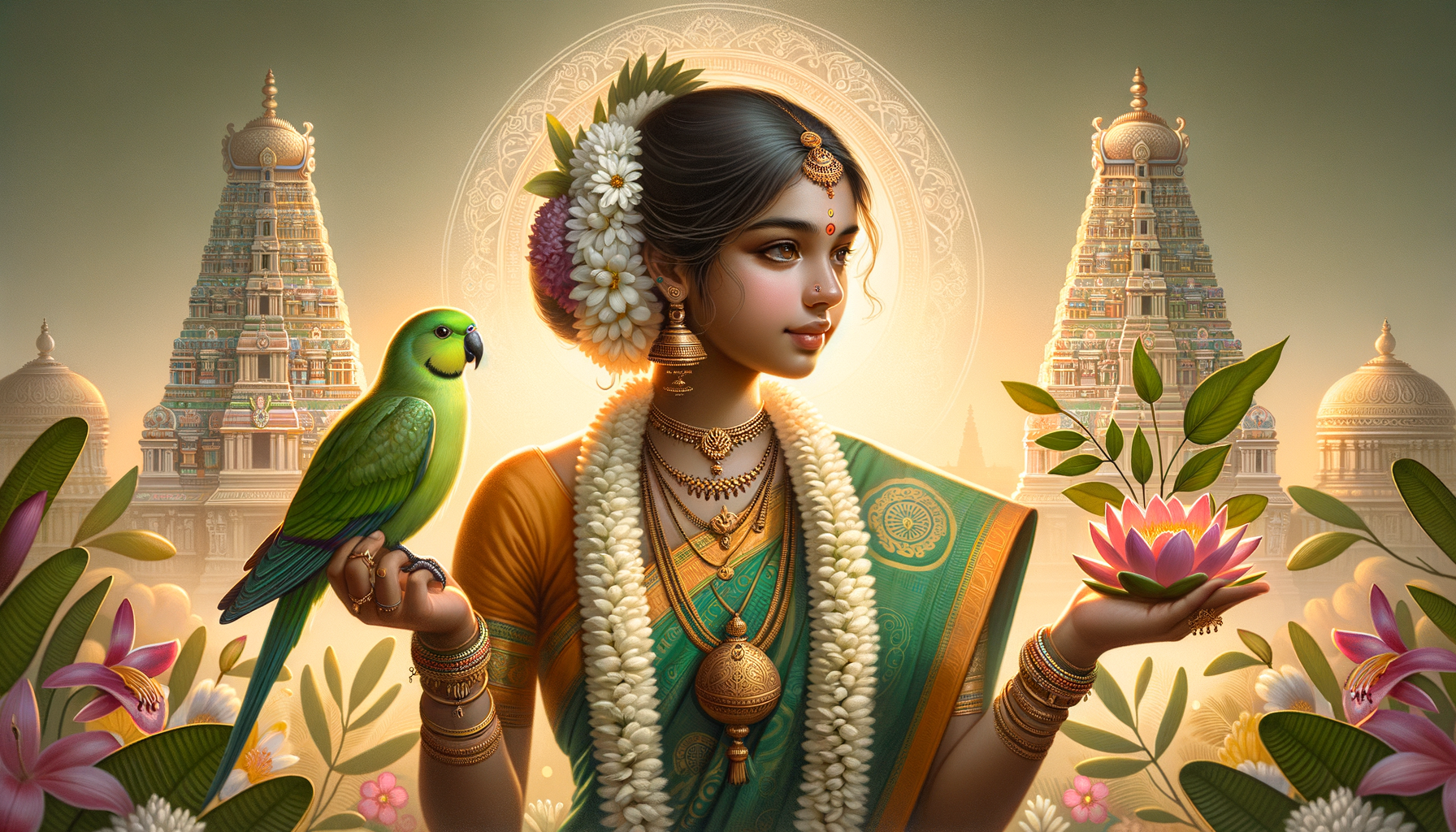
Andal, the cherished Tamil saint and the only female Alvar in the Vaishnava tradition, stands as a luminous icon of love and steadfast devotion. Among the most evocative features of her image is the Shukathe parrotperched lightly in her hand, a sacred symbol that distills the essence of bhakti into color, form, and gesture. Read through the lens of Hindu symbols and Vaishnava iconography, this delicate companion is far more than ornament; it is a profound emblem of message, memory, and mantra.
The iconographic form of Andal typically presents a youthful maiden radiating serenity, adorned with garlands and fine ornaments. The parrot (Shuka) rests near her cheek or on her hand, while the other hand often holds a lotus or a garlandsubtly recalling the Srivilliputhur tradition in which Andal fashioned flower garlands for Vishnu. This poised composition conveys both bridal mysticism and contemplative assurance, placing voice, devotion, and beauty in harmonious balance.
In the Tamil poetic milieu that nourished Andal’s Tiruppavai and Nachiyar Tirumozhi, the parrot frequently functions as a messenger of love. Within Vaishnava devotion, that messenger role acquires an inward turn: the Shuka signifies the devotee’s yearning communication with the Divinelove carried across the apparent distance between soul and Lord. The motif elegantly frames Andal’s longing as a sacred dialogue, where feeling becomes a bridge rather than a boundary.
The parrot also signifies voiceparticularly mantra, nama-sankirtana, and the transformative power of speech. Known for mimicry, the Shuka in Andal’s hand reminds that repeated utterance of the Divine Name can mature from mere echo into embodied wisdom. In this sense, Andal’s own verses become living mantras: poetry as practice, song as remembrance, and speech as sanctified offering.
By resonant association, “Śuka” recalls the sage Śuka, the celebrated narrator of the Bhagavata Purana. Vaishnava iconography does not equate Andal’s parrot with that seer; rather, it invites recollection of scripture transmitted through the human voice. The Shuka thus embodies continuitylinking oral tradition, sacred memory, and devotional literature in a single, graceful sign.
The parrot’s verdant hue evokes fertility, vitality, and auspicious renewal. In the devotional arc of Andalas bridal mystic seeking union with Ranganathathis greenness intimates the ever-fresh life of bhakti. Seasonal rhythms deepen the meaning: the contemplative chill of Margazhi ripens into the promise of spring, and the devotee’s inward vow flowers into realized nearness to the Beloved.
For many devotees, the Shuka becomes an image of the devoted soul itselfresting close to the Divine, sustained by remembrance and song. This insight lives on in temple art, festival processions, and craft traditions across Tamil culture, where parrots appear in textiles, sculpture, and palm-leaf handiwork. The motif remains a living thread that ties household devotion to classical Vaishnava iconography.
The Shuka’s symbolism also harmonizes with wider Dharmic sensibilities. Buddhist Jataka tales depict parrots as emblems of loyalty, compassion, and tireless care; Jain narrative arts often employ birds to teach ahiṁsā, restraint, and ethical clarity; and Sikh reverence for shabad (the Divine Word) and simran (remembrance) affirms the sanctity of truthful, purifying speech. Across these traditions, a shared intuition emerges: voice and virtue, love and discipline, carry the soul toward wisdom.
Seen through this unifying perspective, Andal with the Shuka condenses a complete theology of devotion: love as a message that must be carried, voice as a vessel that must be refined, and memory as a bridge that must be kept alive. Appreciating this icon deepens understanding of Vaishnava devotion and, at the same time, nurtures respect for the broader tapestry of Hinduism, Buddhism, Jainism, and Sikhismtraditions that together sustain India’s civilizational commitment to compassion, truth, and enduring unity.
Inspired by this post on Hindu Blog.
