
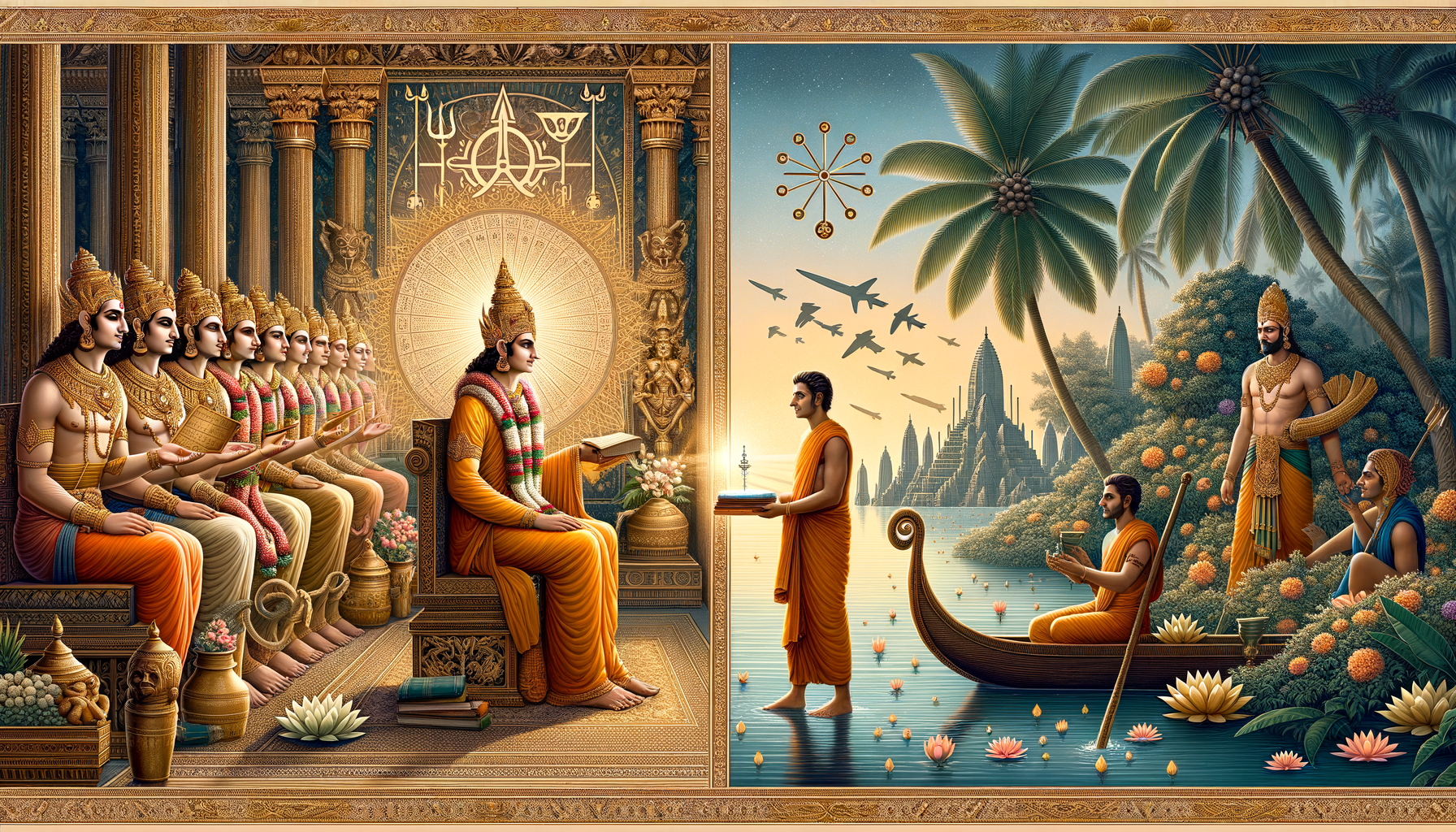
Ravana and Mahabali occupy distinct yet complementary places in Hindu mythology, inviting a careful, empathetic comparison that highlights how dharma, humility, and leadership are understood across India’s shared civilizational heritage. Examining their lineage, conduct, relationships with avatars of Vishnu, and the cultural memory preserved through festivals such as Onam reveals lessons that resonate across Hindu, Buddhist, Jain, and Sikh traditions.
Lineage and identity offer the first point of contrast. Ravana (also known as Ravanasura in some regional traditions) is portrayed in the Ramayana as the rakshasa king of Lanka, born to the sage Vishrava and Kaikesi. He is learned, a master of the Vedas and arts, yet often guided by pride. Mahabali (Bali), by contrast, is the asura king celebrated in the Puranas and Kerala’s living traditions; he is the grandson of Prahlada, a renowned bhakta of Vishnu, and the son of Virochana. Both figures thus emerge from illustrious lineages and carry deep reservoirs of knowledge and power.
Ethical orientation distinguishes them more clearly. Ravana’s intellectual brilliance coexists with adharma when he violates moral boundariesmost notably in the abduction of Sitaplacing personal desire above righteous conduct. Mahabali, while an asura in lineage, is consistently remembered for humility, generosity (dāna), truthfulness (satya), and steadfastness to a promise. This contrast invites a nuanced understanding: deva and asura lineages in the epics are not simplistic moral categories; rather, actions aligned with dharma determine moral standing.
Their encounters with Vishnu’s avatars illustrate the moral arc of each narrative. Ravana’s confrontation with Sri Rama culminates in his downfallan outcome framed as a restoration of cosmic order. Mahabali’s meeting with Vamana unfolds differently: when the dwarf Brahmachari asks for three paces of land, King Bali honors his word even as Vamana expands to cosmic form. In granting his head as the third step, Mahabali exemplifies surrender of ego, after which Vishnu blesses him to reign over Sutala and to visit his people each yearan act remembered joyfully during Onam.
Governance and social memory further deepen the contrast. Ravana’s Lanka is often depicted as prosperous and technologically advanced under a strong central authority, yet fear and personal ambition shadow this prosperity. Mahabali’s reign, by contrast, is preserved in Kerala’s cultural consciousness as a golden age of fairness and equalityevoked in Onam songs that celebrate “Maveli naadu”where social harmony and justice prevailed. These memories function as moral mirrors for communities reflecting on leadership and public good.
Devotion and learning appear in both lives but manifest differently. Ravana is a famed devotee of Shiva; texts and tradition credit him with the powerful Shiva Tandava Stotram and with mastery of music and statecraft. Mahabali, guided by his guru Shukracharya, is renowned for yajnas, generosity, and unswerving fidelity to a promise. Both display tapas (discipline) and vidyā (knowledge), yet their differing prioritiesRavana’s assertion of will versus Bali’s humilityshape their destinies.
Festivals translate these epics into lived experience. Onam, anchored in the memory of Mahabali’s annual return, invites families to celebrate community, equality, and gratitude, values consonant with the dharmic ideals of truthful living (sat), seva, and aparigraha found across Hindu, Sikh, Jain, and Buddhist thought. Narratives of the Ramayanawhether in reading, kirtan, or performanceencourage reflection on ethics, restraint, and compassionate strength. Together, these observances create shared spaces where diverse dharmic paths affirm common values.
Seen through a broader civilizational lens, their stories illuminate core principles. Ravana’s fall warns against unchecked ego, transgression of boundaries, and misuse of knowledgeconcerns that find echoes in the Buddhist critique of craving, the Jain emphasis on self-restraint, and the Sikh stress on humility and service. Mahabali’s ascent through surrender and truthfulness embodies the dharmic insight that inner alignment, generosity, and integrity sustain just leadership and societal harmony.
A compassionate comparison thus avoids reductive binaries. Ravana and Mahabali are not merely opposites; they are narrative anchors that help communities explore how power, devotion, and responsibility ought to be held. Their legacies encourage a collective ethicacross dharmic traditionsof humility over hubris, duty over desire, and unity over division.
In sum, the difference between Ravana and Mahabali can be understood along four axes: lineage (both noble and learned), ethical conduct (adharma versus humility and satya), relationship with Vishnu (confrontation and fall versus surrender and grace), and cultural afterlife (fear-shadowed prosperity versus a remembered age of justice). Engaging these stories with attentiveness strengthens shared values across Hinduism, Buddhism, Jainism, and Sikhism, nurturing unity while honoring the diversity of practice and interpretation.
Inspired by this post on Hindu Pad.
