

If you are trying to decide whether Southeast Asia was once simply Hindu India abroad, the answer is no. The more accurate claim is also more interesting: Bharat generated a family of Dharmic traditions, and societies to its east adopted parts of that inheritance deeply enough to reshape public culture and institutions.
That distinction lets you recognize civilizational kinship without denying Southeast Asian agency. In Bali and Java, the connection extended beyond sacred images and buildings into writing, literature, customs, law, and administration. You do not need a story of permanent political annexation to understand how consequential that was.
Use three maps, not one
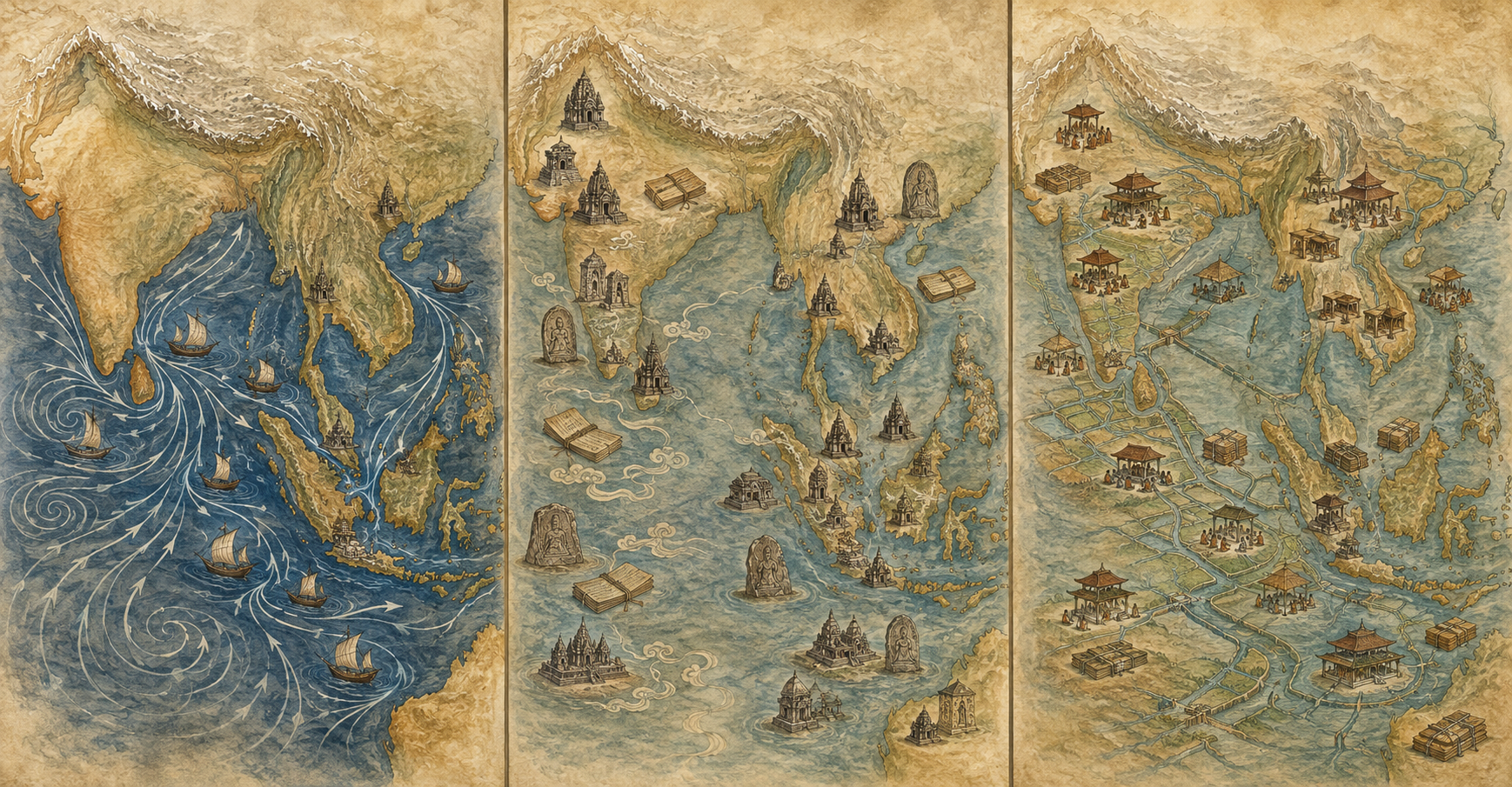
Most confusion begins when sacred geography, civilizational influence, and political sovereignty are placed on the same map. Separate them before you evaluate any claim about Brihad-Bharata, or Greater India.
- The sacred-origin map: Bharat is the birthplace of Hinduism, Buddhism, Jainism, and Sikhism. Varanasi, Bodh Gaya, Amritsar, and Shravanabelagola anchor different sacred geographies within that shared homeland. The Vedas, Upanishads, Puranas, Tripitaka, Agamas, and Guru Granth Sahib preserve distinct bodies of teaching that arose within its civilizational world.
- The civilizational-circulation map: Religious ideas, artistic forms, writing systems, literature, customs, legal thought, and administrative practices moved beyond Bharat. Communities receiving them did not become empty vessels. They selected, interpreted, and adapted what arrived.
- The political map: Kingdoms, frontiers, rulers, and modern states belong to a different category. Cultural affinity does not by itself establish political possession, a single government, or a right to redraw present borders.
Brihad-Bharata is useful when it names a broad field of cultural relationships centred on Bharat. It becomes misleading when it is treated as proof that every society within that field belonged to one state, ethnicity, or uniform legal order. A civilization can cross many political boundaries without abolishing them.
The same discipline applies to the word Sanatani. Used as a civilizational umbrella, it can identify the Bharatiya home and related ethical vocabulary of Hindu, Buddhist, Jain, and Sikh traditions. It must not erase their different scriptures, institutions, doctrines, or self-understandings. Dharma, karma, ahimsa, and moksha belong to a wider philosophical vocabulary, but they do not carry identical meanings in every tradition.
Keep the Southeast Asian claim narrower still. Hindu and Buddhist streams are central to the ancient connection, with Hindu legal-cultural influence especially visible in Bali and Java. Jainism and Sikhism belong to Bharat’s broader Dharmic family, but that fact alone does not establish an equal historical footprint for all four traditions in Southeast Asia. Shared origin is not the same thing as identical geographical expansion.
Look for institutional depth, not merely resemblance

A familiar deity, word, or temple form can establish contact, but it cannot tell you how deeply a civilization entered another society. Use a five-layer test instead. The layers are not a ranking of spiritual value; they measure how much social organization a claim can reasonably support.
- Sacred and philosophical vocabulary: Look for adopted names, concepts, deities, narratives, or teachings. These can travel widely, so resemblance at this level should open an inquiry rather than end it.
- Art and sacred architecture: Buildings, sculpture, and ritual forms show that ideas acquired public expression. Ask whether they were reproduced mechanically or given a recognizable local character.
- Writing and literature: An adopted alphabet or literary tradition matters because it allows knowledge to be copied, taught, debated, and transmitted across generations.
- Customs and social practice: Influence becomes more intimate when it shapes recurring conduct rather than remaining confined to courts, monuments, or elite collections.
- Law and administration: This is the most institutionally demanding layer. A society that incorporates an external legal or administrative grammar is using it to organize authority and public life, not merely displaying it.
Apply the test claim by claim. Do not begin with the conclusion that Southeast Asia was Indianized and then collect anything that looks familiar. Begin with the object, practice, text, rule, or institution in front of you. Establish its location and function. Identify the Bharatiya connection. Then ask what the receiving community changed.
Five questions will expose most weak civilizational claims:
- What exactly is the evidence: a name, building, literary work, customary practice, legal rule, or administrative arrangement?
- Does the comparison demonstrate an origin, or does it merely point to a surface resemblance?
- What did the Southeast Asian community preserve, discard, reinterpret, or combine with its own inheritance?
- What period and place does the evidence actually cover? A finding from Bali or Java should not silently become a claim about every Southeast Asian society.
- Is the language describing cultural influence, or is it smuggling in an unsupported assertion of political sovereignty?
This method does not weaken the connection. It removes inflated claims so that the durable ones become clearer. Local adaptation is evidence of success: an idea has entered a civilization most deeply when people can make it their own without having to remain a replica of its birthplace.
Bali and Java show why law changes the argument
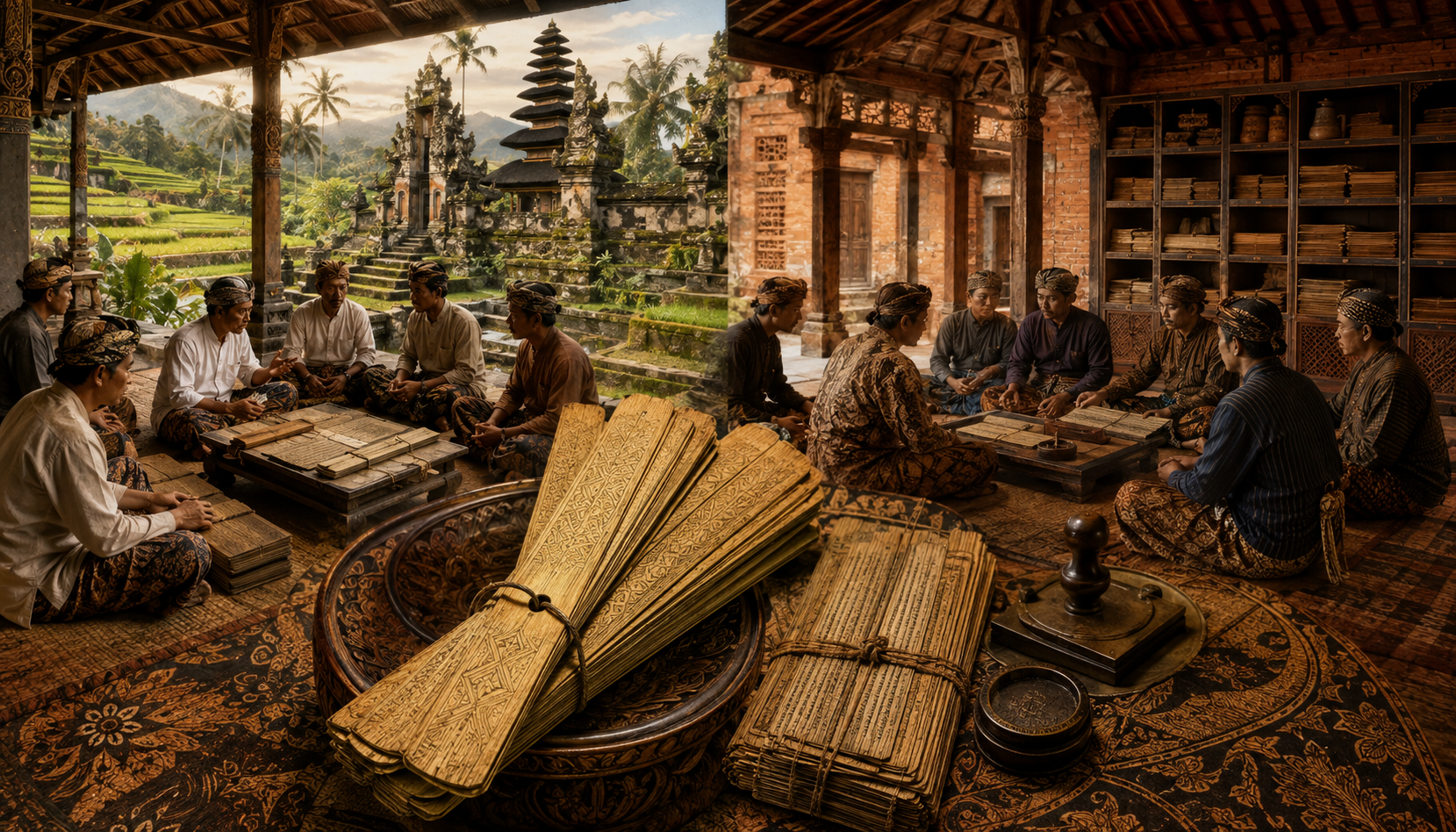
The Hindu legal inheritance in Bali and Java matters because law is harder to dismiss as decoration. Sacred imagery can be admired from a distance. A legal framework must be interpreted, administered, reconciled with local authority, and reproduced through institutions.
Dharmasastra should not be imagined as one centralized statute book enacted everywhere in identical form. It is better understood as a body of normative learning concerned with dharma, conduct, duties, authority, and jurisprudence. Hindu legal influence therefore does not require a page-for-page copy of one Bharatiya code. It can appear through the adoption and local reconstruction of a broader legal grammar.
When assessing that influence, distinguish three processes:
- Adoption: A society receives legal concepts or institutional patterns associated with the Hindu civilizational world.
- Adaptation: Local rulers, jurists, communities, and customs determine how those concepts operate in their own setting.
- Continuity: The resulting framework persists because local institutions continue to use it, not simply because an external power remains present.
This three-part distinction protects you from two opposite errors. The first is denial: treating every Southeast Asian resemblance as accidental because it does not reproduce Bharat exactly. The second is appropriation: treating every adopted element as proof that Bali or Java lacked creativity of its own. Civilizational transmission involves both inheritance and authorship.
Older descriptions sometimes used terms such as cultural conquest, colonies, or cultural empire for Bharat’s reach into Southeast Asia. Read those expressions carefully. They can describe the scale and intensity of influence, but they do not automatically establish a single political empire. Unless separate evidence demonstrates military rule or continuing sovereignty, do not make a metaphor carry a territorial conclusion.
The relevant contrast with British colonial law is one of mechanism, not a claim of moral purity. A colonial administration can enact rules through a coercive bureaucracy even when the governed population does not regard those rules as its own. A borrowed civilizational framework becomes durable when local society absorbs and adapts it. That distinction does not prove that every historical encounter was free of hierarchy or conflict. It identifies the mechanism that could make Dharmasastra-derived ideas part of Balinese and Javanese institutional life rather than a temporary foreign overlay.
Turn civilizational memory into responsible action
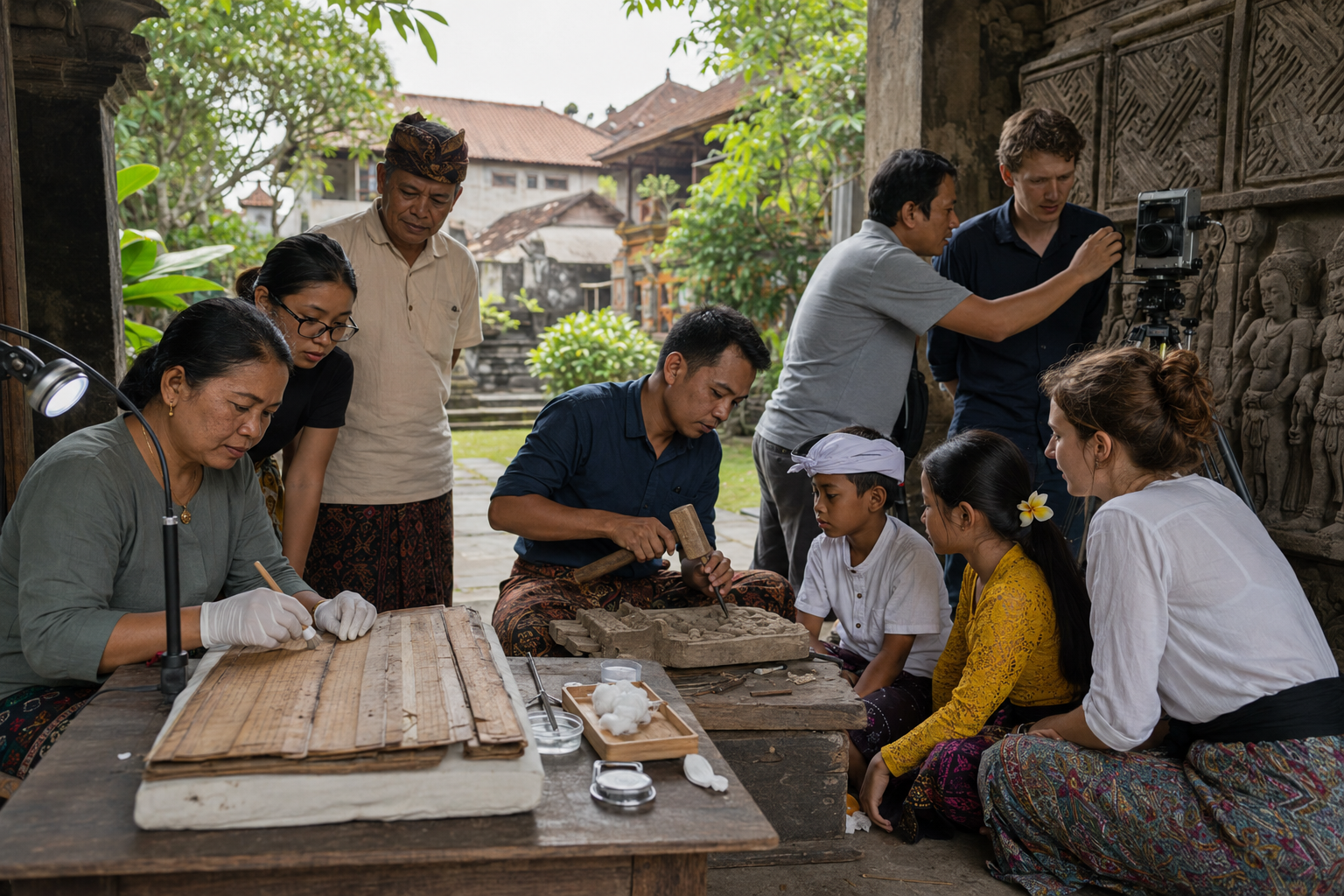
Bharat’s role is not confined to remote origins. Its sacred places, knowledge traditions, festivals, and living communities preserve continuity across major changes in politics and society. Diwali, Vesak, Mahavir Jayanti, and Vaisakhi do not express one theology, but together they make visible a civilizational home capacious enough to sustain different paths.
That continuity creates a responsibility. Southeast Asia should not be used merely as evidence in a boast about Bharat’s former greatness. The stronger task is to understand how a Bharatiya inheritance became Southeast Asian, and then to build present relationships on reciprocal respect.
For any example you intend to teach, publish, or share, make a four-part record:
- Bharat root: Name the particular idea, text, tradition, legal framework, artistic form, or institution. Do not substitute the vague label Indian influence for identification.
- Mode of transmission: Record what actually moved: religious teaching, literature, writing, artistic practice, custom, legal thought, or administrative organization. If the route is uncertain, label it uncertain.
- Local transformation: Show what Bali, Java, or another specific community did with the inheritance. If you cannot identify local adaptation, your account is incomplete.
- Continuity: Separate historical presence from living practice. A surviving building, remembered tradition, operative custom, and functioning institution support different kinds of conclusions.
Use exact verbs when you write the result. Originated means something arose in Bharat. Travelled means it moved beyond Bharat. Adopted means another community chose or received it. Adapted means that community changed it. Persisted means it continued over time. Influenced means it affected something without necessarily replacing it. Owned, ruled, and conquered make political claims that require a different class of evidence.
For teachers and cultural organizations, this framework points to paired learning: place a Bharatiya text, concept, or institution beside its Balinese or Javanese development, and give equal attention to origin and localization. For public policy, it supports translation projects, joint scholarship, heritage conservation, student exchanges, and relationships among living religious and educational institutions. Those activities turn civilizational memory into shared capacity.
Bharat’s eastward engagement should also outlast the political mood of any one government. An Act East outlook grounded in civilizational kinship can deepen trust, but only if Southeast Asian societies are treated as partners rather than geopolitical property. Cultural diplomacy is strongest when each side can recognize itself in the relationship.
Key takeaways
- Bharat is the birthplace of Hindu, Buddhist, Jain, and Sikh traditions; Southeast Asian adoption is a related but distinct historical question.
- The ancient Southeast Asian connection should be stated most confidently in relation to Hindu and Buddhist streams, not projected equally onto every Dharmic tradition.
- Writing, literature, customs, law, and administration demonstrate a deeper civilizational relationship than visual resemblance alone.
- Dharmasastra’s influence in Bali and Java is best understood through adoption, local adaptation, and continuity rather than mechanical copying.
- Brihad-Bharata describes cultural geography usefully only when it is not mistaken for a modern territorial claim.
- A reliable account identifies the Bharatiya root, mode of transmission, Southeast Asian transformation, and evidence of continuity.
Your next step can be small and concrete. Choose one legal-cultural example from Bali or Java and build the four-part record before you repeat a sweeping claim about Greater India. Begin with evidence of adoption, then look for the local act of transformation. That is where the Sanatani connection becomes both credible and alive.
References
- DharmaRenaissance Blog – The Sprawling Heritage of the Hindu Legal System in Bali and Java
- DharmaRenaissance Blog – Bharat: The Natural Home for Sanatanis (Hindus, Buddhists, Jains, and Sikhs)
