
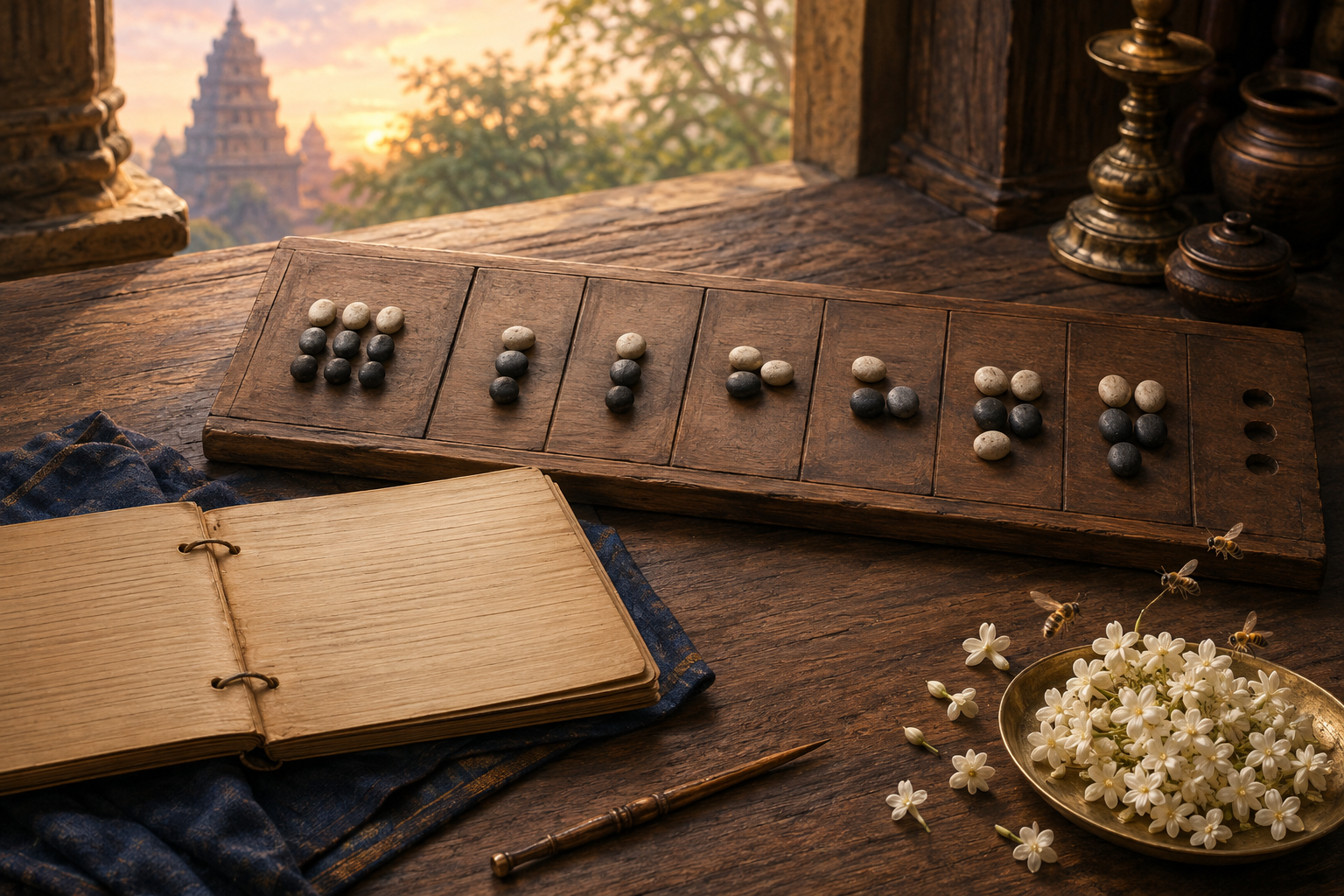
You may have arrived with a simple question: what exactly did Indian mathematicians contribute to algebra, beyond the familiar list of celebrated names? The clearest answer comes from doing the mathematics. Once you can distinguish a determined equation from an indeterminate one, Bharat’s contribution appears as a tradition of disciplined procedures rather than a vague civilisational boast.
We will begin with a classical riddle about bees, translate its poetry into an equation, and then change one condition to reveal what makes a problem indeterminate. You can use the same method to solve elementary integer equations and to assess historical claims about algebra more carefully.
Start by asking how many answers the conditions permit
An unknown quantity does not make an equation indeterminate. A problem becomes indeterminate when its conditions do not isolate a single answer in the chosen number system. The answer may then be a family of values rather than one value.
That last qualification matters. Every equation has a domain, whether or not the problem states it clearly. Are negative numbers allowed? Fractions? All real numbers? Only integers? Only positive counts? A relation that has infinitely many real solutions may have a short list of non-negative integer solutions, or no integer solution at all.
Suppose you have one linear equation involving two unknowns. Over the real numbers, you will ordinarily have a line of possible pairs. If the quantities count bees, baskets, coins, or journeys, however, fractional answers may be inadmissible. The integer requirement does not automatically produce a unique answer; it changes which members of the family are allowed.
This gives you a reliable first test:
- List the unknown quantities.
- Count the independent equations or conditions.
- State the permitted number system.
- Ask whether the task is to find one value or describe every allowed value.
Do not treat indeterminate as a synonym for meaningless, impossible, or unsolved. An indeterminate equation can be completely solved when you give a rule that generates all its solutions and then apply the problem’s boundaries.
The bee riddle shows how poetry becomes algebra

Consider the celebrated swarm. One-fifth of the bees settles on a Kadamba blossom, one-third on a Silindhra flower, and three times the difference between those groups flies to a Kutaja bloom. One bee remains in the air. The question is the total size of the swarm.
Let N be the total number of bees. The first group is N/5 and the second is N/3. Because one-third is larger than one-fifth, their difference is:
N/3 – N/5 = 2N/15.
Three times that difference is 6N/15, which is 2N/5. The verbal riddle can therefore be written as one balance:
N = N/5 + N/3 + 2N/5 + 1.
The three groups that landed account for 14N/15. That leaves:
N = 14N/15 + 1.
Subtracting 14N/15 from both sides gives N/15 = 1, so N = 15. The check is as important as the derivation: three bees are on the Kadamba, five are on the Silindhra, six are on the Kutaja, and one remains in the air. The counts add to 15, and six is three times the difference between five and three.
This is a determined equation. Its literary form may make it look mysterious, but every quantity except N is fixed. The final bee is not decorative scenery; it supplies the condition that sets the scale of the entire swarm.
That is the practical lesson to carry into any word problem. Mark every noun that represents a quantity, translate each relationship separately, and inspect apparently small details such as a remainder. A fixed remainder can be the condition that turns a family of proportional answers into one answer.
Free one condition and the equation becomes indeterminate

Now replace the fixed final bee with an unknown remainder R. The landing proportions remain unchanged, but the balance becomes:
N = 14N/15 + R.
Rearranging gives N = 15R. We now have two unknown quantities and only one independent relation. If both must be positive integers, every positive integer choice of R produces a corresponding swarm whose size is 15R. The correct answer is no longer one total. It is the complete family described by that formula.
Notice precisely what changed. The arithmetic did not become less rigorous. We removed a condition, so the form of the answer changed from a single number to a parameterised family. This is the central habit required for indeterminate analysis: do not stop after finding one pair that works.
A common linear form is aX + bY = c, with integer coefficients and integer unknowns. Let d be the greatest common divisor of a and b. An integer solution exists only when d divides c. This divisibility test lets you reject an impossible problem before searching through candidate values.
When a and b are nonzero, d divides c, and one solution (X0, Y0) is known, every integer solution can be written as:
X = X0 + (b/d)T, and Y = Y0 – (a/d)T, where T is any integer.
The parameter T is not an admission of failure. It is what makes the answer complete. Conditions such as X being non-negative, Y being positive, or both quantities lying below a practical limit then determine which parameter values survive.
Reuse the numbers from the bee calculation in a separate counting model: 3X + 5Y = 15. The greatest common divisor of three and five is one, and one divides 15, so integer solutions exist. Starting from (5, 0), the full family is X = 5 + 5T and Y = -3T. If zero is allowed but negative counts are not, only (5, 0) and (0, 3) remain. If both quantities must be strictly positive, neither pair qualifies, so the same equation has no solution in that narrower domain.
Use this sequence whenever you face a linear indeterminate equation:
- Define every unknown and its domain.
- Move the equation into the form aX + bY = c.
- Compute the greatest common divisor of a and b.
- Check whether that divisor also divides c.
- Find one integer solution and generate the whole parameterised family.
- Apply positivity, size, or other real conditions only after the family is visible.
- Substitute the surviving values into the original wording, not merely the rearranged equation.
The last step catches a common error. Algebraic rearrangement can preserve the equality while your interpretation violates the problem. A negative integer may satisfy the symbols perfectly and still fail as a count of physical objects.
The Indian achievement was procedural, not merely symbolic
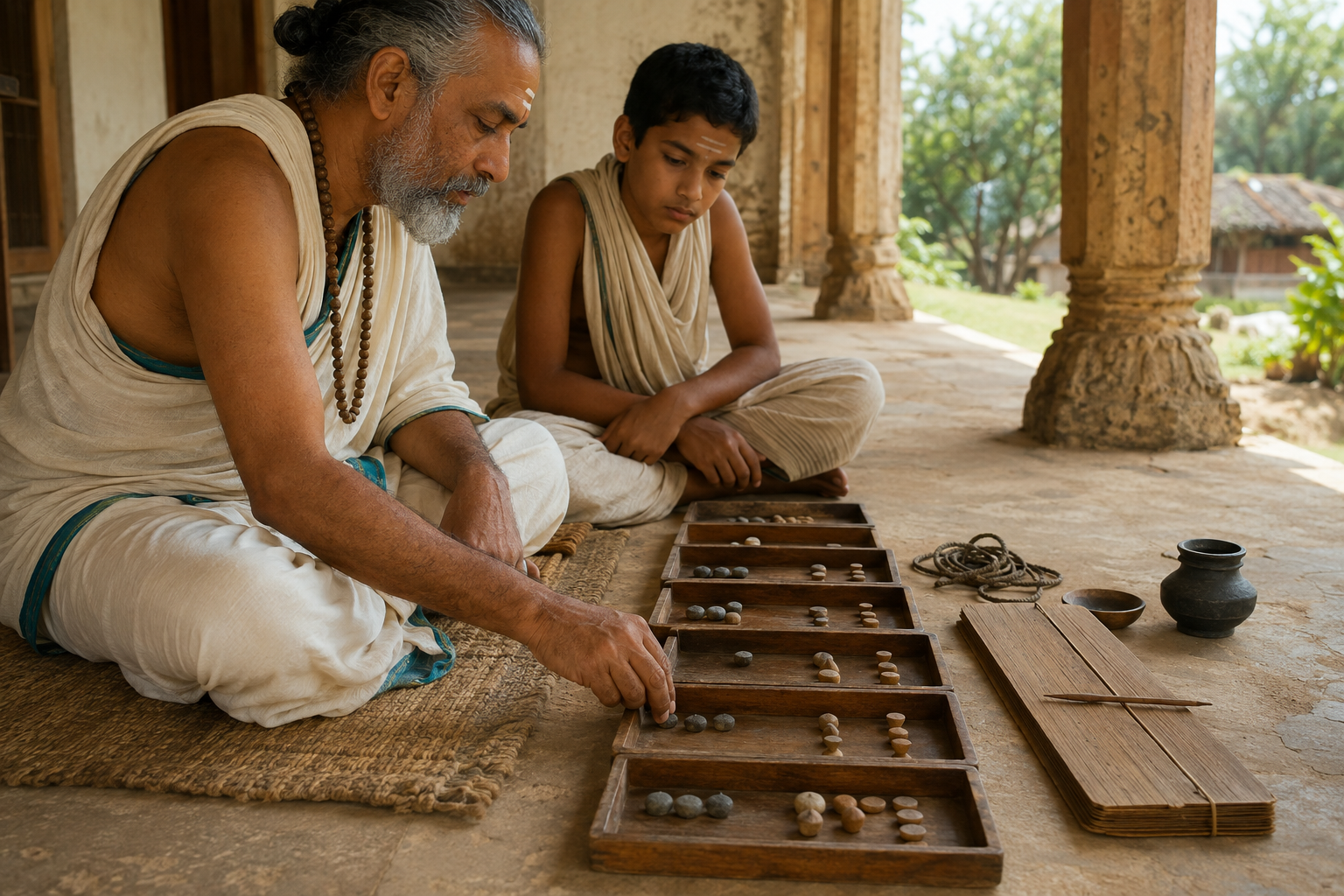
Once you understand the mechanism, the historical importance becomes easier to state accurately. The achievement was not simply that Indian thinkers encountered unknown numbers. They developed systematic ways to transform conditions, operate with unfamiliar quantities, and search for valid solutions under numerical constraints.
- Aryabhata advanced methods for linear and quadratic equations within a larger mathematical program that also served trigonometry and astronomy.
- Brahmagupta’s Brahmasphutasiddhanta set out arithmetic rules involving zero and developed work on quadratic and indeterminate equations.
- Bhaskara extended techniques for quadratic equations and the investigation of number properties, and his name is associated with the development of radical notation.
These contributions should be kept distinct. Saying that one person simply invented algebra conceals the more instructive history: mathematical capabilities accumulated through rules for zero, treatments of unknowns, quadratic methods, notation, and procedures for equations whose acceptable answers had to be found rather than assumed.
The poetic form of the bee problem also tells you something important about mathematical expression. The verse is not a substitute for logic. It compresses a network of exact relations into memorable language. Solving it requires the reader to move in the opposite direction: unpack the images, assign quantities, preserve every condition, and prove that the final count fits them all.
This is also the defensible connection between classical algebra and computing. A computer does not inherit the poem; it inherits the procedure. Once a problem can be expressed as a finite sequence of transformations, divisibility checks, parameter generation, boundary tests, and verification, those operations can be carried out mechanically. The continuity lies in algorithmic reasoning, not in pretending that an ancient equation was literally a modern program.
Modern textbooks often call integer equations of this kind Diophantine equations. That useful label does not exhaust their history. If you want to understand Bharat’s place in algebra, look past the label and ask what mathematical work was actually performed: Was the problem translated into an equation? Was a valid starting solution found? Was the whole family generated? Were integer and positivity conditions enforced? Those questions expose substantive accomplishment more reliably than a sweeping slogan.
Key takeaways for solving and judging these problems
- Count unknowns and independent conditions before you begin calculating. The balance between them tells you whether to expect one value or a family.
- State the domain explicitly. Real, rational, integer, non-negative integer, and positive integer solutions are different answers to different questions.
- Translate every verbal condition. In the bee riddle, the single bee left in the air fixes the scale and makes the total determinate.
- For aX + bY = c, test whether the greatest common divisor of a and b divides c before searching for integer pairs.
- After finding one solution, parameterise all solutions. Then use the problem’s boundaries to filter the family.
- Verify candidates against the original situation. Symbolic validity alone does not make a negative value a valid count.
- Assess historical claims by naming the mathematical operation and the text or thinker connected with it. Specific contributions reveal more than claims that a civilisation invented an entire subject at once.
Take the next numerical verse or word problem you encounter and write just four lines before trying to solve it: the unknowns, the domain, the independent conditions, and the expected form of the answer. That small discipline will show you why Indian algebra matters: it turns an evocative question into a reproducible path from uncertainty to knowledge.
References
- DharmaRenaissance Blog — The Poetry of Algebra: How India Contributed to the Logic of Indeterminate Equations
