
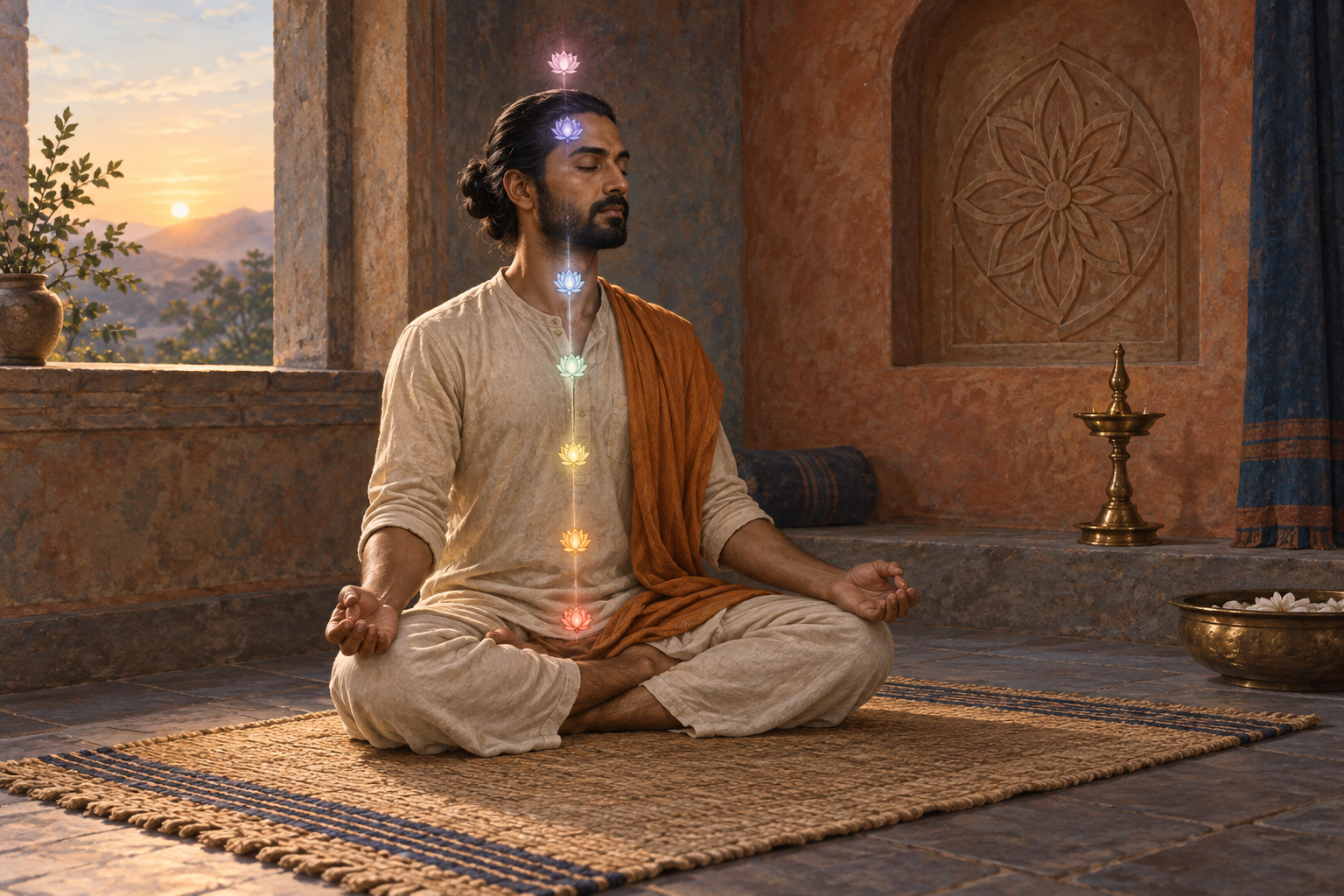
If you have encountered a brightly coloured chakra chart, you may have been left with more claims than clarity. One chart links each chakra to an emotion, another promises physical healing, and a third tells you that an uncomfortable feeling proves an energy centre is blocked.
You do not need to accept all of those claims to work meaningfully with the seven chakras. The more useful approach is to treat them as a traditional map for directing attention, breath and contemplation. That preserves the spiritual purpose of the practice without mistaking a subtle-body teaching for an anatomical diagram or a medical diagnosis.
Read the chakra system as a map, not a scan of the body

The Sanskrit word chakra means wheel or disk. In traditional Indian frameworks associated with yoga, tantra and Ayurveda, chakras are focal centres through which prana, or vital energy, is understood and worked with.
The word energy needs careful handling here. In chakra practice, it belongs to a traditional spiritual vocabulary. It should not automatically be equated with electricity, metabolism or another quantity measured by modern instruments. A chakra is therefore not a physical organ that a practitioner can locate through dissection, imaging or a blood test.
That distinction does not empty the practice of meaning. A map can guide attention without being identical to the territory. A practitioner may use the chakra sequence to notice posture, breathing, emotion, mental activity and the quality of awareness. The mistake begins when observations made through that practice are turned into unsupported claims about disease, personality or spiritual rank.
You should also resist treating one modern chart as the universal Indian position. Indian spiritual traditions contain different schools, methods and subtle-body schemes. Even where chakra language is used, the number of centres, their functions and the practices connected with them may differ. The familiar seven-centre sequence is a useful framework, but it is not a licence to flatten every Hindu, Buddhist, Jain or Sikh teaching into one system.
Key takeaways
- A chakra is a contemplative and energetic focal point within traditional practice, not a medically established organ.
- The seven-centre model should be used as a practice map rather than a personality test.
- Colours, seed syllables, deities, elements and visualisations may belong to particular teaching systems; they are not interchangeable decorations.
- No sensation does not prove that a chakra is blocked, and a strong sensation does not prove that it has opened.
- Physical or psychological symptoms require appropriate professional care, not a chakra diagnosis.
The seven chakras from the base to the crown
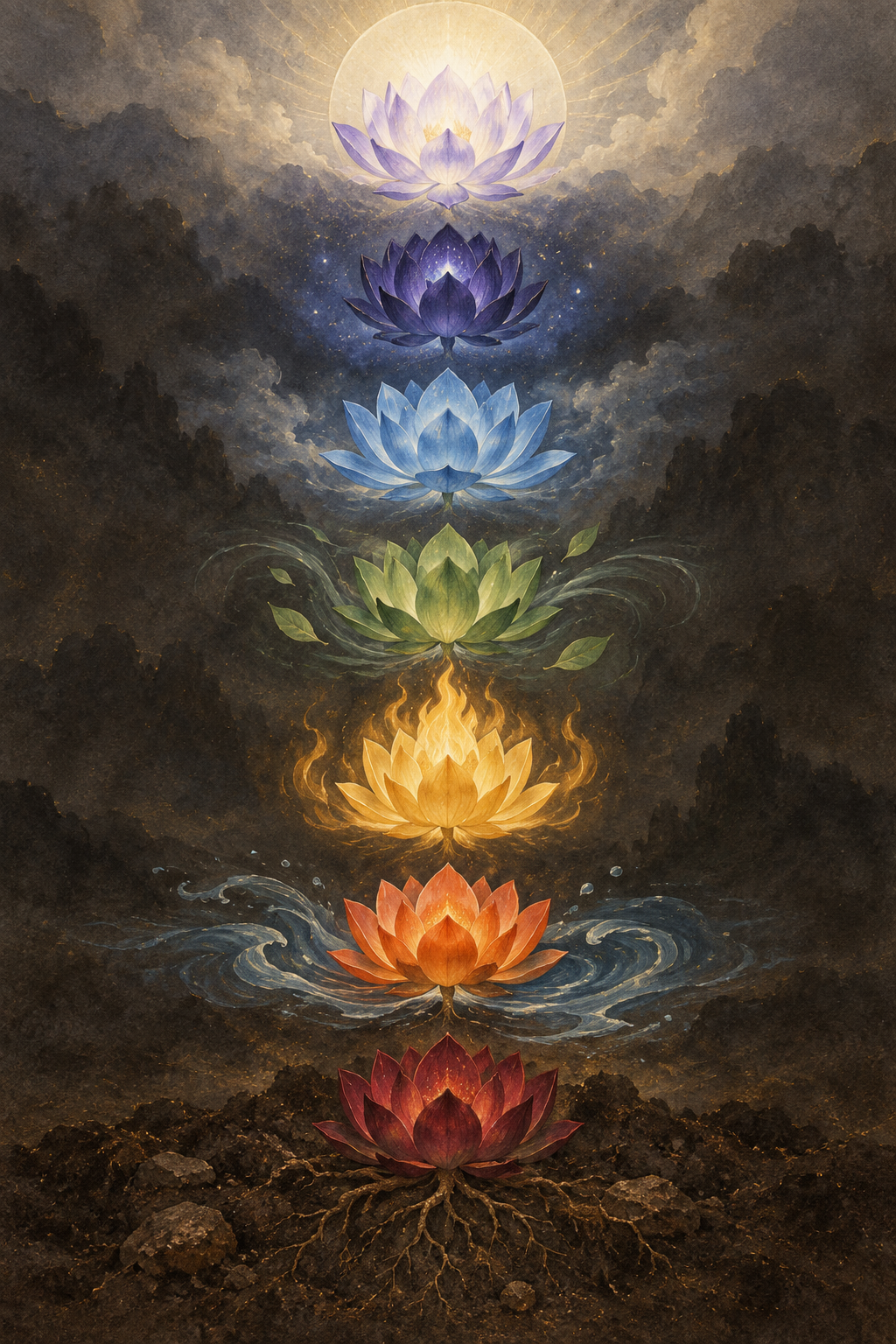
The commonly taught sequence moves upward from the base of the body to the crown of the head. The locations below are practical focal areas, not hard anatomical boundaries. The observation cues are deliberately neutral: they help you pay attention without telling you in advance what you are supposed to feel.
| Chakra | Common focal area | Neutral observation cue |
|---|---|---|
| Muladhara | Base of the spine and pelvic floor | Notice the body’s contact with the floor or seat and whether you can remain present without bracing. |
| Svadhisthana | Lower abdomen and sacral region | Notice movement in the lower belly without tightening it or trying to manufacture a sensation. |
| Manipura | Navel and upper-abdominal region | Follow the natural expansion and release of the abdomen as you breathe. |
| Anahata | Centre of the chest | Feel the movement of breathing around the chest without forcing an emotional state. |
| Vishuddha | Throat | Notice the throat, jaw, swallowing reflex and any unnecessary effort around the voice. |
| Ajna | Brow centre | Observe mental activity and the direction of attention without straining the eyes. |
| Sahasrara | Crown of the head | Let attention become spacious rather than trying to produce an image or dramatic experience. |
These cues are not complete definitions of the chakras. They are a restrained way to begin observing the associated regions. A formal lineage may add mantra, yantra, deity, breath regulation, mudra or philosophical contemplation. Those elements should be learned in their proper context rather than assembled at random from unrelated charts.
It is particularly easy to mistake a memorable correspondence for an eternal rule. If a teacher assigns a colour, emotion or element to each chakra, ask where that correspondence comes from and how it functions within the actual practice. The answer matters more than whether the resulting diagram looks complete.
A grounded way to practise chakra awareness
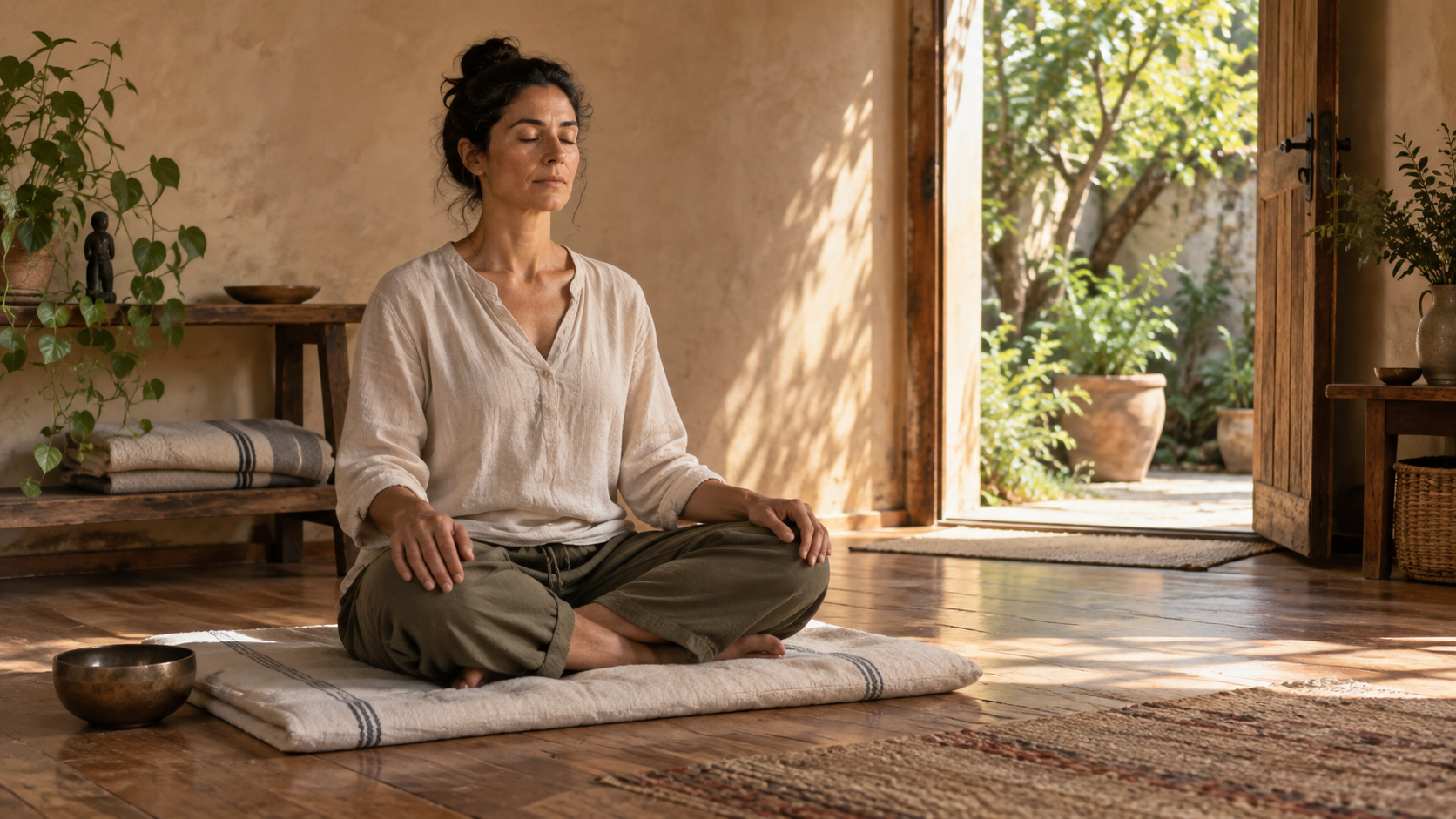
Begin with attention rather than ambition. You are not trying to force energy upward, prove that a centre is active or reproduce somebody else’s vision. You are learning to notice what is present while keeping the breath and body at ease.
- Sit in a stable position that allows you to breathe comfortably. A chair is acceptable; an elaborate posture is not required for this basic observation.
- Let the breath settle into its natural rhythm. Do not hold it, deepen it aggressively or tighten the abdomen.
- Place your attention at Muladhara, then move upward through Svadhisthana, Manipura, Anahata, Vishuddha, Ajna and Sahasrara. Pause at each area for several unforced breaths.
- At every centre, notice bodily sensation, the movement of breathing and the tone of the mind. Name what is actually present: pressure, warmth, ease, restlessness, dullness or no distinct sensation.
- If you notice nothing unusual, continue without judgement. Neutrality is a valid observation, not evidence of spiritual failure.
- After reaching the crown, return attention to the whole body. Feel the seat or floor beneath you, allow your eyes to open, and notice the room before standing.
- Briefly record where attention felt clear, where effort entered and how you felt after the practice. Compare patterns across repeated sittings instead of drawing a conclusion from one striking moment.
Keep this introductory practice simple. Combining it with forceful breathing, prolonged breath retention, muscular locks or attempts to drive kundalini should not be treated as casual experimentation. If you want to undertake intensive pranayama or subtle-body practice, learn it from a qualified teacher who can observe your response and explain the method’s limits.
Stop the session if you become dizzy, panicked, disoriented or overwhelmed. Open your eyes, return to ordinary breathing and orient yourself to the physical room. If distress persists or repeatedly returns, seek appropriate medical or mental-health support rather than assuming that discomfort is a necessary sign of spiritual progress.
What chakra sensations can and cannot tell you
Focused attention can make subtle sensations more noticeable. Posture, breathing, muscle tension, expectation and emotion can all affect what you perceive. Tingling at the brow, warmth in the chest or pressure near the spine may be meaningful within a practice, but the sensation alone does not establish its cause.
- No sensation is not a blockage. Attention varies from day to day, and some parts of the body are easier to perceive than others.
- A vivid sensation is not proof of attainment. Intensity does not by itself demonstrate purification, awakening or superior spiritual status.
- An emotion is not a diagnosis. Sadness noticed at the chest or fear noticed in the abdomen does not prove that the corresponding chakra caused it.
- A chakra label does not explain persistent symptoms. Pain, fainting, breathing difficulty, severe anxiety, depression or other concerning symptoms warrant assessment by an appropriately qualified professional.
- A spiritual practice is not a guaranteed cure. Be wary of anyone who promises that chakra balancing can replace medical or psychological treatment.
A useful chakra interpretation remains modest. It might tell you, for example, that your attention becomes strained around the throat or that your breathing grows shallow when you focus on the chest. That observation can guide further contemplation. It cannot, by itself, tell you that an organ is diseased, a trauma has been resolved or a supernatural power has appeared.
Use chakra language to form questions, not verdicts. What happens to your breath here? Are you observing, suppressing or exaggerating? Does the practice leave you clearer and steadier, or more agitated and preoccupied? Those questions keep attention connected to discernment.
Go deeper through lineage, discipline and conduct
If you want more than a basic attention practice, choose a coherent path. A devotional method, a tantric visualisation, an Ayurvedic consultation and a general yoga class do not use identical assumptions merely because each may mention prana or chakras. Mixing fragments can produce an impressive ritual without a clear purpose.
Before accepting instruction, ask practical questions:
- Which tradition, lineage or body of teaching gives this method its structure?
- What is the practice intended to cultivate?
- Which parts are suitable for beginners, and which require direct supervision?
- How should a practitioner respond to fear, agitation, pain or other adverse effects?
- Does the teacher distinguish spiritual interpretation from medical fact?
- Are questions welcomed, or is every doubt dismissed as evidence of blockage or impurity?
Good instruction should make the practice more intelligible, not make you dependent on increasingly dramatic interpretations. Claims of guaranteed healing, instant awakening or exclusive access to your hidden condition are reasons to step back.
Finally, judge the practice by what it does to your conduct as well as what you feel during meditation. Heightened sensation is easy to pursue for its own sake. Greater steadiness, truthful speech, restraint from harm and responsible action are harder tests. A chakra practice that produces fascination but weakens discernment has not served you well.
For your next sitting, put the elaborate chart aside and make one gentle ascent from the base to the crown. Observe without forcing, return to the whole body, and carry one clear act of attention into the rest of your day. That is a sounder beginning than trying to declare all seven centres open.
References

Leave a Reply
You must be logged in to post a comment.