

You may have encountered Guhya Kali beside serpents, a coiled kundalini, or a yantra and wondered what you are meant to do with the image. The first answer is surprisingly restrained: do not assume that it promises dramatic sensations or instructs you to force an energy up your spine. The coiled serpent represents latent capacity within a subtle map, not a physical creature waiting inside the body.
Read with care, the symbolism gives you a practical standard for sadhana. Power must be guarded before it is expressed, instinct must be integrated rather than hated, and inner change must become visible as clearer conduct. That standard helps you distinguish a serious approach to Guhya Kali from spiritual spectacle.
Guhya means the power is protected before it is displayed
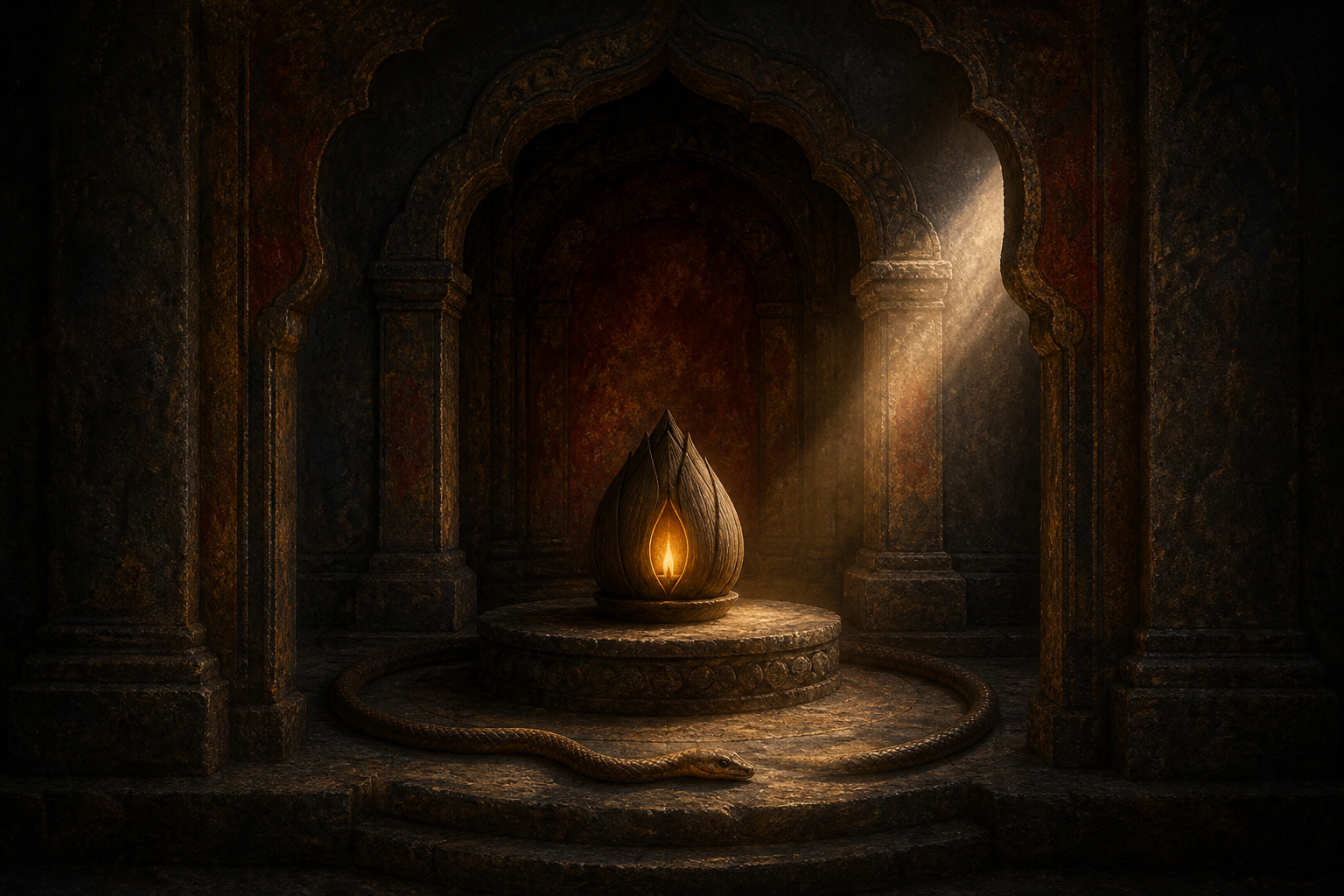
The name does more than place the word “secret” before Kali. Guhya comes from the Sanskrit root guh, meaning to conceal. Its semantic field includes secrecy, sanctity and guardianship. Kali, understood in many lineages as the first of the Mahavidyas, embodies time and the movement through which forms appear and disappear. Guhya Kali therefore points toward an inward, protected and initiatory mode of Shakti.
Protection is the important word. Tantric secrecy is not merely the withholding of unusual information. It is a method of teaching in stages, so that understanding, discipline and responsibility can mature together. A practice involving body, breath, mantra and emotion can be distorted when it is detached from its ethical setting. Keeping an instruction confidential may preserve its purpose, not elevate the social status of the person who possesses it.
This gives you a useful three-part distinction. An image may be contemplated symbolically. A deity may be approached through ordinary devotion. An operative mantra, breath discipline or ritual procedure may require personal transmission. Those are related modes of engagement, but they are not interchangeable. Seeing a serpent in an icon does not by itself authorize a technique, just as reading a bija syllable does not supply the preparation that traditionally surrounds its use.
When you meet a teaching labelled secret, ask what the secrecy protects. Does it preserve a progression of practice, a teacher-practitioner relationship, an ethical commitment or the integrity of a mantra? If the only answer is prestige, fear or a promise of instant power, the label is not doing the pedagogical work implied by guhya.
The serpent marks latent force and a guarded threshold
The serpent carries several meanings at once in the sacred grammar of Bharat. Nagas guard waters, treasures, groves and thresholds. Ananta-Shesha expresses sustaining infinitude, while Vasuki becomes the rope that churns the cosmic ocean. These are not random appearances of the same animal. They associate the serpent with hidden potency, cyclical renewal and vigilant guardianship.
Kundalini makes the connection more technical. It is conventionally pictured at the muladhara as a serpent coiled three and a half times around the subtle axis. The coil matters because it conveys concentration: vitality folded into itself rather than scattered. Its resting position conveys potential, not failure. Its ability to rise conveys transformation, but the guardian symbolism warns that a threshold should be crossed with preparation.
The other movements of a serpent refine the reading. Shedding skin offers an image of relinquishing an identity that has become restrictive. Stillness followed by sudden movement resembles attention becoming concentrated before insight. The serpent’s place at thresholds tells you that transition needs discernment. None of these symbols requires you to imitate a snake physically or manufacture an extraordinary bodily event.
In some regional forms of Guhya Kali, serpents appear as anklets, armlets or a girdle. Their position as ornaments signifies sovereignty over instinctive force. Kali does not deny the energies that frighten polite consciousness; she places them in a larger order. The cremation ground, the garland associated with letters and time, and her fearless bearing deliver a related instruction: whatever arises can be faced, transformed and directed toward awakening.
Yantric symbolism makes the same movement geometrically. Spirals and triangles draw attention toward a bindu, the concentrated point of manifestation. The downward-pointing triangle signifies Shakti as origin, while the movement toward the centre mirrors attention returning to its ground. Geometry here is not decoration. It trains you to find stillness without rejecting movement.
The seven-centre ascent is an integration map, not a score

Yogic subtle anatomy describes ida, pingala and sushumna as three principal currents associated with the subtle spine. As breath and attention are refined, prana is said to become balanced and enter sushumna. The resulting ascent through the chakras is best read as a map of integration. It is not a leaderboard on which unusual sensations prove spiritual superiority.
The traditional fields named in this map can become practical questions about your conduct. The final column below is a reflection aid, not a fixed scriptural definition.
| Centre | Symbolic field | A question for practice |
|---|---|---|
| Muladhara | Survival | Can you remain present when fear is activated? |
| Svadhisthana | Vitality | Can desire move without ruling every choice? |
| Manipura | Agency | Can power serve responsibility rather than display? |
| Anahata | Relational coherence | Can strength and compassion operate together? |
| Vishuddha | Discernment | Can you speak clearly without using truth as a weapon? |
| Ajna | Clarity | Can you notice a pattern before automatically obeying it? |
| Sahasrara | Nondual awareness | Can experience be held without turning it into a personal trophy? |
This reading changes what counts as progress. A compelling inner sensation at anahata is not automatically evidence of relational coherence. A vision associated with ajna does not excuse confused judgement. If a practice is genuinely integrating the symbolic field, some effect should become visible in how you respond to fear, use agency, relate to others, speak and perceive your habits.
The granthis, or knots, sharpen the point. They represent the binding of experience into fear, clinging and confusion. Kali’s cutting is therefore not an attack on your body or personality. It is uncompromising clarity directed at the attachments that obstruct freedom. The fierceness belongs to the precision of the removal; compassion belongs to its liberating purpose.
The Kali bija is often given as Kreem. Within those traditions, it concentrates this action of severing what conceals luminosity. That meaning does not make the syllable a universal self-help formula. A bija is a practice within a transmitted discipline, not merely a word with a dictionary definition. If you have not received guidance for its operative use, you can still understand what the symbol teaches without improvising a mantra sadhana.
Approach the symbolism without forcing an experience
Mantra japa, pranayama and meditation can have cumulative effects on attention, emotion and the nervous system. That is one reason potent practices are traditionally introduced in stages. If you are new to kundalini language, start by strengthening the conditions for practice rather than trying to produce ascent.
- Begin with conduct. Choose one recurring form of harm, clinging or confused reaction that you can honestly observe. Work on reducing it before treating intense experience as spiritual advancement.
- Identify the mode of engagement. Ask whether you are studying an image, offering ordinary devotion or undertaking an initiatory technique. Do not slide from the first mode into the third simply because instructions are easy to find.
- Establish ordinary steadiness. Use a stable posture, natural breathing and unforced attention. Do not hold the breath to the point of distress or try to drive a sensation through the spine.
- Measure integration in daily life. Look for less automatic fear, more responsible use of agency, clearer speech and greater capacity for compassionate action. Heat, tingling, visions or emotional intensity do not answer those questions by themselves.
- Do not stack potent methods. Combining forceful pranayama, visualisation, bija repetition and unfamiliar ritual makes it difficult to know what is affecting you. Initiatory practices belong with a qualified teacher who can explain progression and limits.
- Respond to destabilisation plainly. If a practice causes distress or disrupts ordinary functioning, stop the technique. Consult a responsible teacher and seek medical or mental-health support when appropriate. A spiritual interpretation is not a substitute for professional care.
You can apply the same care when evaluating instruction. Ask what ethical commitments accompany the method, which elements require initiation, how readiness is assessed, what signs call for slowing down, and how the practice should change your conduct. Clear answers matter more than claims of secret status.
The panchamundi asana illustrates why inner meaning cannot be separated from preparation. In Kali traditions it represents a seat established over five limiting energies. Its essential claim is that the practitioner can sit at the centre of fear without bargaining with it. Treating such an emblem as an exotic object to reproduce misses the discipline it signifies.
Key takeaways
- Guhya points to protected transmission and inward ripening, not secrecy used as social status.
- The kundalini serpent depicts concentrated and guarded potential; it is not literal physical anatomy.
- Chakra ascent is useful when it produces integration in conduct, not when it becomes a contest for sensations.
- Kali’s fierceness is directed toward fear, clinging and confusion, while her purpose remains liberation.
- Forceful breathwork, initiatory mantra and advanced ritual call for qualified guidance; distress is a reason to stop, not proof that a method is working.
The wider Dharmic serpent prevents a narrow occult reading

Guhya Kali’s serpents belong to a civilizational vocabulary broader than one Tantric stream. In Buddhist memory, the naga king Mucalinda shelters the Buddha in meditation. In Jain tradition, Dharanendra protects Parshvanatha beneath a canopy of hoods. Sikh hagiography remembers a cobra shading the young Guru Nanak. Across these distinct paths, the serpent becomes a guardian of steadfast awareness.
This resemblance should not be used to erase doctrinal differences among Hinduism, Buddhism, Jainism and Sikhism. It reveals a shared cultural intuition instead: primal power need not be destroyed when consciousness becomes steady. It can shelter meditation, acknowledge virtue and serve awakening. That is a stronger reading than reducing every sacred serpent to kundalini or treating every tradition as if it teaches the same subtle anatomy.
The symbol also returns you to the living world. Serpents help regulate rodent populations, support ecological balance and indicate the condition of habitats. Nag Panchami joins reverence to this ecological relationship. A spiritual reading that encourages contempt for actual creatures has therefore failed one of the symbol’s most grounded tests: sacred regard should reduce careless harm.
Shakta landscapes make embodiment equally difficult to ignore. At Kamakhya in Assam, subterranean springs and living earth shape the sacred setting. The name Guhyeshwari in Kathmandu preserves the language of the hidden and sanctified. In both cases, secrecy is not flight from the world. It is intimacy with realities approached through humility rather than display.
The next time you encounter Guhya Kali and the serpent, ask three questions before seeking an experience: What capacity is being guarded? What fear or attachment must be faced honestly? What change in conduct would show that the symbol has been understood? Begin there. Let steadiness, ethical clarity and responsible guidance determine whether any further practice is appropriate.