
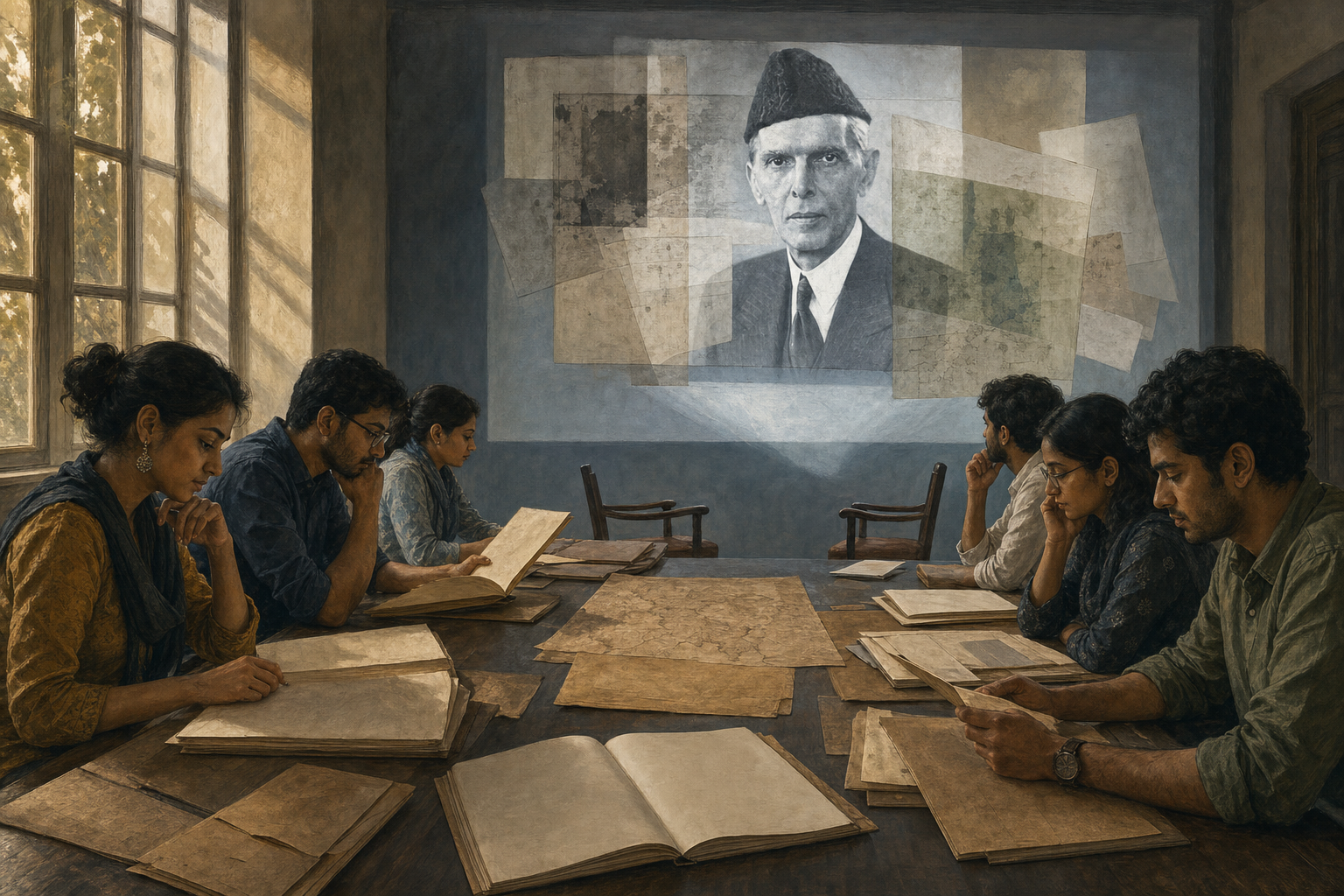
If you have seen Jinnah’s name in a university syllabus and are wondering whether the institution is legitimising the two-nation theory, do not decide from the chapter title alone. Inclusion can mean rigorous scrutiny, uncritical praise, or superficial tokenism. The readings, learning outcomes, classroom method, and examination questions reveal which one it is.
That distinction does not ask you to become indifferent to Partition. It gives you a more demanding standard. A university should neither erase the political ideas that divided Bharat nor detach those ideas from their arguments, opponents, historical conditions, and human consequences.
A name in the syllabus is not a certificate of honour
The protests at the University of Jammu, including reported student mobilisation by ABVP, have exposed a common but misleading first question: should Jinnah be taught at all? The better question is: what exactly are students being taught to understand, test, and judge?
It is difficult to explain the last phase of British rule, the development of the All India Muslim League’s programme, or the movement toward Partition without examining Jinnah’s political arguments. For many Indians, he represents the two-nation theory and the rupture that accompanied Partition. That makes critical examination more necessary, not less.
Teaching about a political figure is not the same as teaching in support of that figure. Universities routinely examine destructive doctrines because citizens cannot recognise an ideology’s assumptions, methods, and consequences if they encounter only its name. But inclusion does not become defensible merely because a department invokes academic freedom. Academic freedom carries a corresponding duty to use evidence, disclose interpretive choices, and permit reasoned criticism.
You can make an initial diagnosis by looking at the verbs used in the course. Does it ask students to analyse, compare, contextualise, and evaluate? Or does it ask them to appreciate, celebrate, or accept? Does it place Jinnah’s claims beside competing proposals, or give him an isolated personality chapter? Does it examine the human consequences of Partition, or end when elite negotiations end? Those choices matter more than whether his name appears in a unit heading.
Five tests for a defensible university module

A serious curriculum should pass all five of the following tests. Passing only one or two can produce the appearance of balance while leaving the central distortion untouched.
- Historical context: The module should trace the movement from constitutional bargaining to the Lahore Resolution of 1940, the changing programme of the Muslim League, and the negotiations preceding independence. A biography detached from institutions and political conditions makes one leader appear to control history single-handedly.
- Primary-source scrutiny: Students should encounter selected arguments such as the Fourteen Points and major speeches from the 1930s and 1940s, together with relevant correspondence and competing political proposals. Excerpts are never neutral merely because they are primary documents. Ask who selected them, what surrounding passages were omitted, and whether students can challenge the author’s claims.
- Comparative political analysis: Congress and Muslim League positions should be examined side by side. Federal arrangements, central authority, minority safeguards, mass mobilisation, and competing conceptions of nationhood belong in the same analytical field. Without comparison, a course can quietly adopt one organisation’s description of the conflict as the conflict itself.
- Consequences beyond high politics: Partition must not appear as a tidy constitutional outcome. Survivor testimony, demographic evidence, displacement, and material loss should remain visible. The lived histories of Hindus, Sikhs, Jains, Buddhists, and Muslims across affected regions prevent elite speeches from becoming a substitute for social history.
- Assessment without an ideological answer key: Marks should reward accurate use of evidence, engagement with counterarguments, and clarity about method. A student should not have to admire or condemn a figure in prescribed language to succeed. Annotated document analyses, source-based oral examinations, and structured debates are more revealing than prompts that reward slogans from either side.
If one of these elements is missing, identify the omission precisely. Saying that a syllabus is anti-national or politically captured may express a genuine concern, but it gives an academic body little that it can test. Pointing to an unbalanced reading list, a leading examination question, excluded Partition testimony, or an unsupported learning outcome creates a reviewable case.
Compare competing nationalisms instead of building a personality portrait
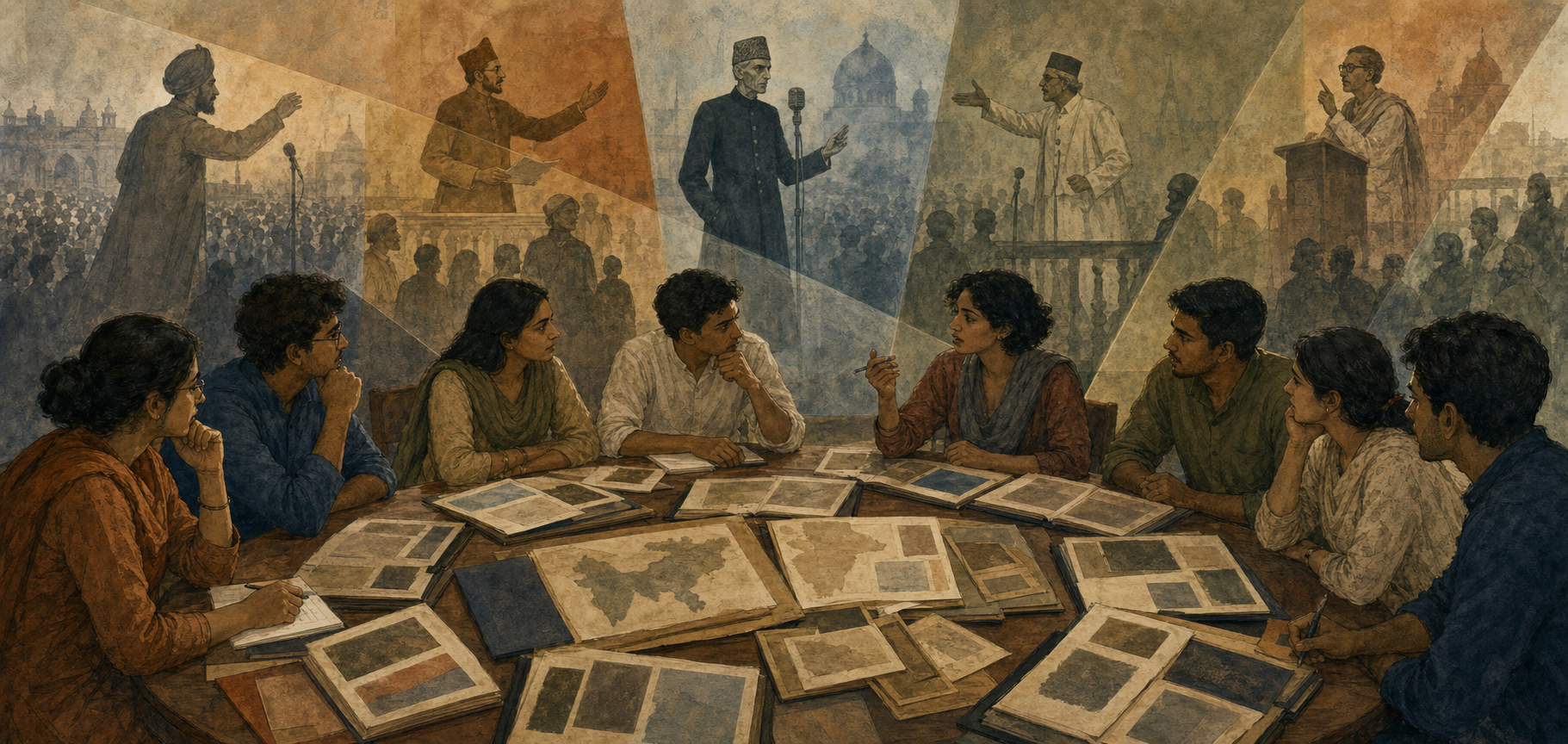
The strongest design would not be a stand-alone celebration or denunciation of Jinnah. A unit such as Contesting Nationalisms, 1930-1947: Congress, Muslim League, and Other Currents would make comparison unavoidable. It would also keep students from mistaking one personality’s career for a complete explanation of Partition.
Within that frame, students should be able to do five concrete things by the end of the unit: analyse political arguments in primary texts; compare Congress and Muslim League constitutional proposals; explain the conditions under which the two-nation theory gained momentum; assess Partition’s social and ethical consequences; and connect those consequences with the constitutional and plural traditions intended to prevent another such rupture.
This structure also guards against hindsight. Partition should not be taught as though it were inevitable from the beginning, nor as though one speech alone produced it. Students need to see decisions, failed negotiations, competing fears, institutional incentives, and the changing political environment. Context does not absolve responsibility. It allows responsibility to be argued with evidence rather than assigned by a prewritten conclusion.
Jammu and Kashmir’s position makes local context especially important. A university in a border region with connections extending toward Ladakh and the wider Himalayas should not use regional history as decorative background. It should ask how national political programmes were experienced locally and how displacement, borders, and contested identities affected different communities.
A Dharmic approach strengthens this method. Satya requires us to examine arguments as they were made, not as we wish they had been made. Ahimsa requires us to keep human suffering in view. Respect for plural paths does not mean pretending that every political doctrine had the same aims or consequences. It means judging claims carefully without turning present-day classmates into proxies for historical actors.
How to challenge a weak syllabus with evidence

If you are a student, parent, alumnus, teacher, or concerned citizen, begin with the official material rather than a cropped screenshot. A chapter title cannot tell you whether the problem is inclusion, framing, source selection, or assessment. Use this sequence:
- Obtain the complete syllabus. Read the unit title, description, learning outcomes, required readings, suggested readings, and assessment pattern together. Confirm the programme, semester, and course for which it was approved.
- Request a curricular rationale. Ask the department to explain why the material is included, which analytical skill it develops, and how examinations test that skill. A short public rationale can settle misunderstandings or reveal that the design was never adequately defended.
- Record exact deficiencies. Identify the page, reading, omitted perspective, or wording at issue. Separate factual errors from interpretive disagreement. A contested interpretation needs counterevidence; a factual error needs correction.
- Use the university’s academic process. Submit the case to the relevant Board of Studies and Faculty or School Board, with review by the Academic Council where required. The Executive Council may also have a role under the institution’s rules. NCERT’s role in school education should not be confused with a public university’s own statutory curriculum process.
- Ask for a transparent, time-bound review. The university should publish the review’s terms, invite written submissions, appoint qualified reviewers of the sources and historiography, and release its recommendation. The result might retain, reframe, revise, or remove material; the remedy should follow the documented defect.
- Propose replacement language. If the personality-centred design is the problem, offer a comparative unit on nationalisms, constitutional proposals, and Partition. If the readings are one-sided, name the missing kinds of evidence. If an examination prompt prescribes a political judgment, rewrite it so that evidence and counterargument determine the marks.
Peaceful protest has a legitimate place in campus democracy, especially when ordinary channels have failed or remained opaque. It becomes more effective when organisers publish their evidence, protect academic schedules and safety, and state the correction they want. A demand tied to identifiable curricular defects is harder to dismiss than anger directed at a name alone.
The National Education Policy 2020 emphasises critical thinking, constitutional values, and multidisciplinary learning. The UGC Learning Outcomes-based Curriculum Framework likewise expects departments to connect content, outcomes, and assessment. These principles give critics a practical language: ask whether the unit actually develops analysis and civic understanding, then show where its design falls short.
After the immediate dispute is resolved, the university should schedule another review after two or three academic cycles. Faculty can then examine student work, classroom difficulties, new teaching material, and whether assessments produced inquiry or merely shifted sloganising into examination answers.
Key takeaways for students, parents, and citizens
- Jinnah’s presence in a syllabus does not by itself prove endorsement; the framing, readings, outcomes, and assessments determine the educational purpose.
- A credible module must examine the Muslim League’s programme, Congress responses, constitutional negotiations, the rise of the two-nation theory, and Partition’s human consequences together.
- Primary documents should be compared and interrogated, not treated as self-validating statements.
- The most defensible unit compares competing nationalisms between 1930 and 1947 instead of isolating one leader in a personality portrait.
- A strong curricular objection identifies an exact imbalance or error and seeks review through the university’s statutory academic bodies.
- A pro-Bharat and Dharmic curriculum should preserve civilisational memory through truth, evidence, restraint, and attention to those who suffered.
Before you support either automatic removal or automatic retention, place four things side by side: the full syllabus, its rationale, the reading list, and the assessment rubric. Then ask for the smallest change that corrects the actual defect without concealing the political ideas and consequences students need to understand. That is how you defend historical memory without surrendering intellectual confidence.