

You may know your zodiac sign and still be unsure which Rashi matters for Jyotirlinga worship. The familiar sign from a newspaper horoscope may not be the sign used in this devotional practice, and choosing a shrine from an unverified chart can leave you more confused than focused.
Begin with your Janma Rashi, confirm the Jyotirlinga association through a trusted Jyotish or temple tradition, and then use that association to shape a clear sadhana. The purpose is not to restrict where you may worship. It is to give your devotion a steady centre.
Start with Janma Rashi, not the sign you casually use
The usual starting point for a Rashi-linked Jyotirlinga practice is the Moon sign in your Janam Kundali. This is commonly called Janma Rashi. Do not assume that the sun sign you know from a date-based horoscope is automatically the same.
Use this sequence before choosing a temple:
- Find your Janam Kundali and identify the Rashi occupied by Chandra, the Moon.
- If you do not have a reliable chart, consult a knowledgeable Jyotish practitioner, a local priest, or an appropriate Panchang reference.
- Ask for the Rashi name and its associated Jyotirlinga to be written together. This prevents a correct temple pairing from being attached to the wrong personal sign.
- Record which family, priestly, or devotional convention you are following so that you can use one coherent framework.
If you receive conflicting temple names, do not let the disagreement become a new source of fear. Ask each adviser which convention is being used, choose the guidance you trust, and stay consistent with it. The association is meant to concentrate bhakti, not produce endless recalculation.
You also do not need astrological certainty before you may worship Shiva. If your birth details are unavailable, visit the Jyotirlinga that is accessible to you or begin a home practice. Technical precision can support the journey, but it is not the source of devotion.
Treat the temple association as an anchor, not a restriction
A Rashi-Jyotirlinga pairing works best as a personal sadhana rather than a rigid rule. It does not prohibit you from taking darshan at another Jyotirlinga, joining a family pilgrimage, or worshipping at your local Shiva temple. Nor should it be treated as a guarantee that one visit will remove every difficulty.
The practical value of the association is focus. Instead of arriving with a vague wish for everything to improve, you choose one concern that requires clarity and one quality you are prepared to cultivate. A concern about study, for example, may lead to a sankalpa for steadiness and disciplined effort. A strained relationship may lead to a sankalpa for patience, truthful speech, and restraint.
A simple personal sankalpa can follow this form: “With reverence to Shiva, I undertake this worship for clarity in [the concern] and steadiness in [the conduct I will practise].” This is a working template, not a mandatory ritual formula. If your family or temple gives you a customary wording, follow that instruction.
Keep the intention narrow enough to remember after darshan. “Help me solve every problem” gives you no way to notice what must change in your conduct. “May I act without anger in this family dispute” gives you a daily discipline. The second sankalpa connects prayer to dharma.
If your concern involves illness, livelihood, debt, or a legal dispute, let worship support courage and mental steadiness while you also obtain the appropriate medical, financial, or legal help. A Jyotirlinga practice can shape how you face a serious problem; it should not replace the professional assistance that problem requires.
Turn the association into a concrete Shiva sadhana
Once your Rashi and temple association are settled, decide what you will actually do. A modest practice performed attentively is more useful than an elaborate plan abandoned after a few days.
For a temple pilgrimage, use this sequence:
- Write your sankalpa in one sentence before leaving home.
- Learn the temple’s current customs and timings before fixing the journey. Local rules determine which offerings and forms of worship are appropriate.
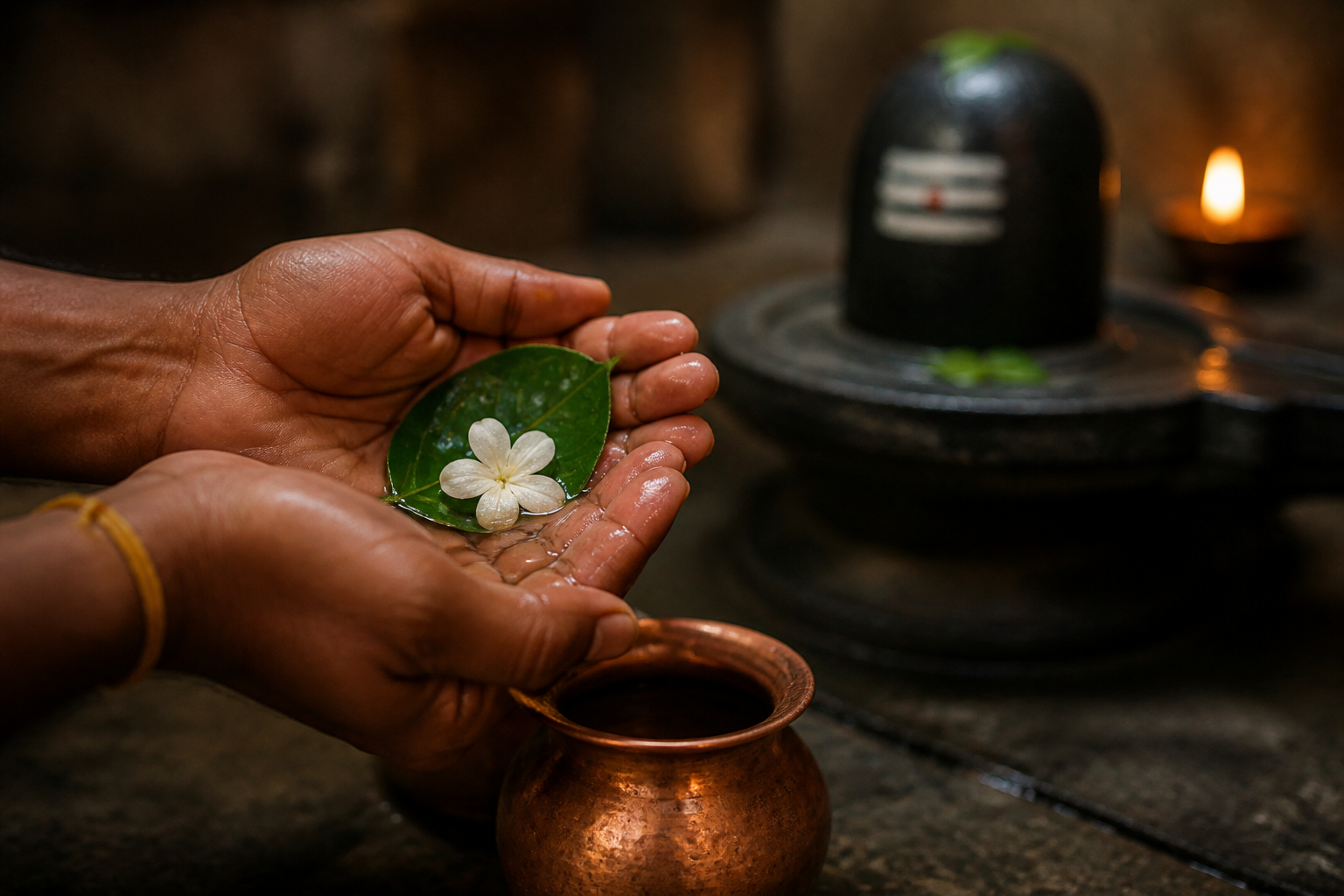
- Carry only permitted offerings. Bilva Patra may be offered where local practice allows it; do not assume that every item can be taken into every sacred area.
- Keep the darshan queue quiet. Use the waiting time for slow breathing or mental japa instead of treating it as dead time.
- Recite “Om Namah Shivaya” with attention. A manageable number of sincere repetitions is preferable to rushing through a private target.
- Take darshan without trying to force a particular emotion or sign. Offer the sankalpa, remain present, and allow the moment to be simple.
- Perform pradakshina only in the manner permitted at that temple, keeping attention on the breath and mantra.
- Receive prasad with gratitude and leave the inner precinct without obstructing the movement of other devotees.
After the visit, translate the sankalpa into one observable commitment. If you sought clarity in study, establish a regular period of undistracted learning. If you prayed for harmony, choose one recurring situation in which you will pause before speaking. The pilgrimage then continues through conduct instead of ending at the temple gate.
Keep a short journal for the period after darshan. Record the intention, the conduct you chose, moments when you remembered it, and moments when you did not. Look for changes in attention, patience, resolve, and decision-making rather than waiting for a dramatic event that proves the pilgrimage “worked.”
Keep the pilgrimage dharmic before, during, and after darshan
Sacred geography is not a backdrop for private wishes. A Jyotirlinga pilgrimage also places you in a living temple community. Your behaviour toward that community belongs to the sadhana.
- Respect temple instructions even when they differ from the customs you follow at home.
- Avoid wasteful packaging and dispose of permitted offerings in the designated manner.
- Do not leave plastic, food, or ritual material near a river, path, or shrine.
- Buy and consume mindfully in the temple town so that your visit supports, rather than burdens, the local community.
- Protect the stillness of other devotees. Darshan is not improved by crowding, loud conversation, or competing for a longer view.
- Carry the ethics of the journey home through truthfulness, non-harm, generosity, and seva.
If you cannot travel
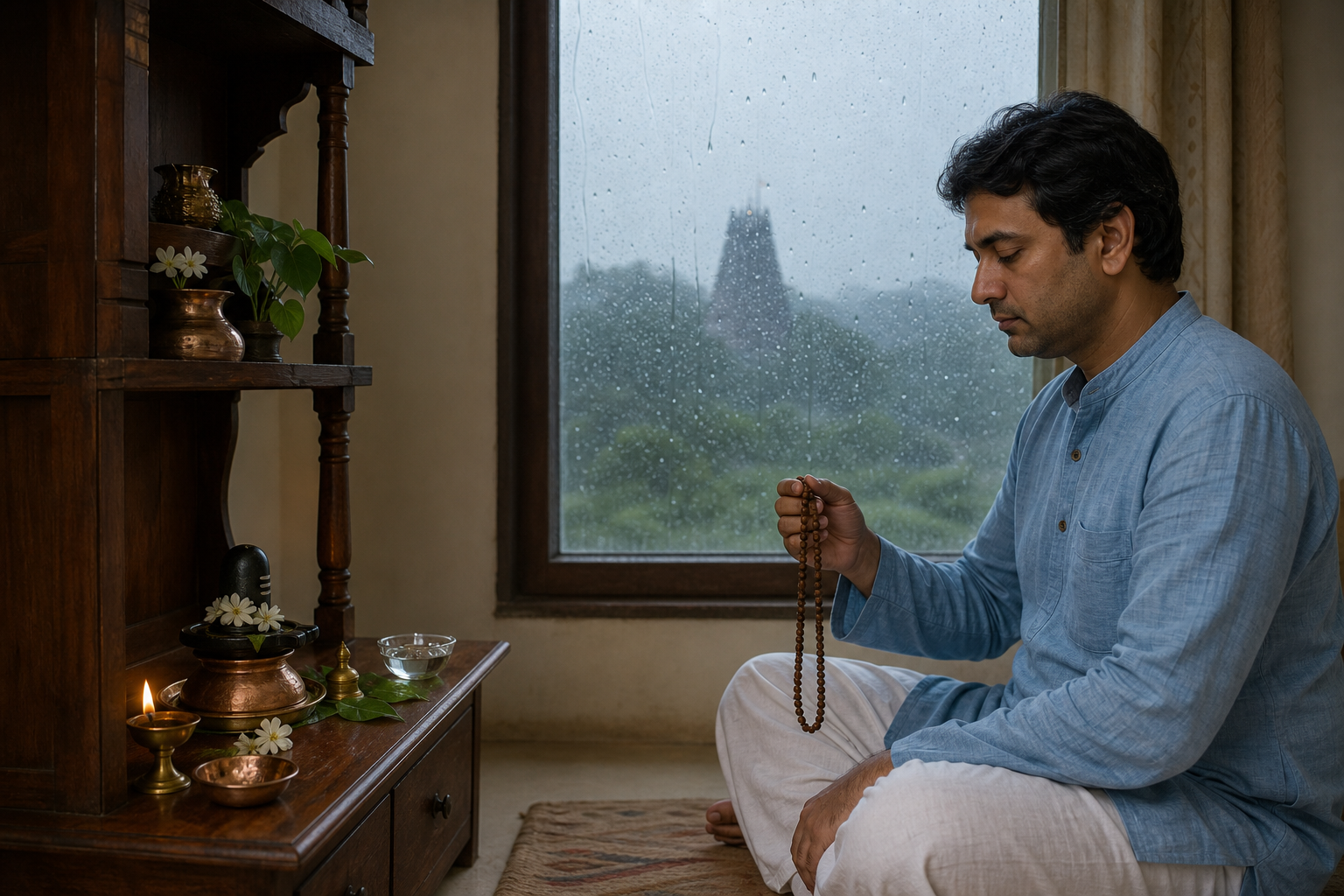
Distance does not make the association unusable. Set aside a clean place for Shiva worship, state the same sankalpa, light a lamp where it is safe to do so, and practise “Om Namah Shivaya” japa. You may also listen to Shiva bhajans, read Purana narratives about Shiva, or meditate on jyoti as inner light. Choose a rhythm you can sustain rather than imitating the intensity of a journey from home.
If you are planning as a family
A family can record each member’s Janma Rashi and associated Jyotirlinga, then choose one shrine for the first journey. Let the person connected with that shrine explain their sankalpa, while everyone else participates without treating the visit as spiritually irrelevant to them. Over time, a family circuit can become a way to transmit temple customs, mantra practice, seva, and the geography of Bharat across generations.
Do not turn the circuit into a race to complete twelve destinations. One pilgrimage that changes how the family speaks, serves, or keeps discipline has more spiritual substance than a checklist completed without attention.
Key takeaways
- Use Janma Rashi, normally the Moon sign in the Janam Kundali, rather than assuming your familiar sun sign applies.
- Confirm both the Rashi and its Jyotirlinga association through a trusted Jyotish, priestly, family, or devotional convention.
- Treat the associated shrine as a focus for bhakti, not as the only Jyotirlinga you may worship.
- Carry one clear sankalpa into darshan and connect it to one change in your own conduct.
- Use simple practices such as “Om Namah Shivaya” japa, permitted Bilva Patra offerings, attentive pradakshina, and grateful reception of prasad.
- If travel is not possible, preserve the same intention through home puja, bhajans, Purana reading, meditation, and ethical action.
Your next step is small: locate your Janam Kundali, write down the Moon sign, and have the associated Jyotirlinga confirmed by a person or tradition you trust. Then choose one sankalpa you are willing to practise, not merely request.


References
