
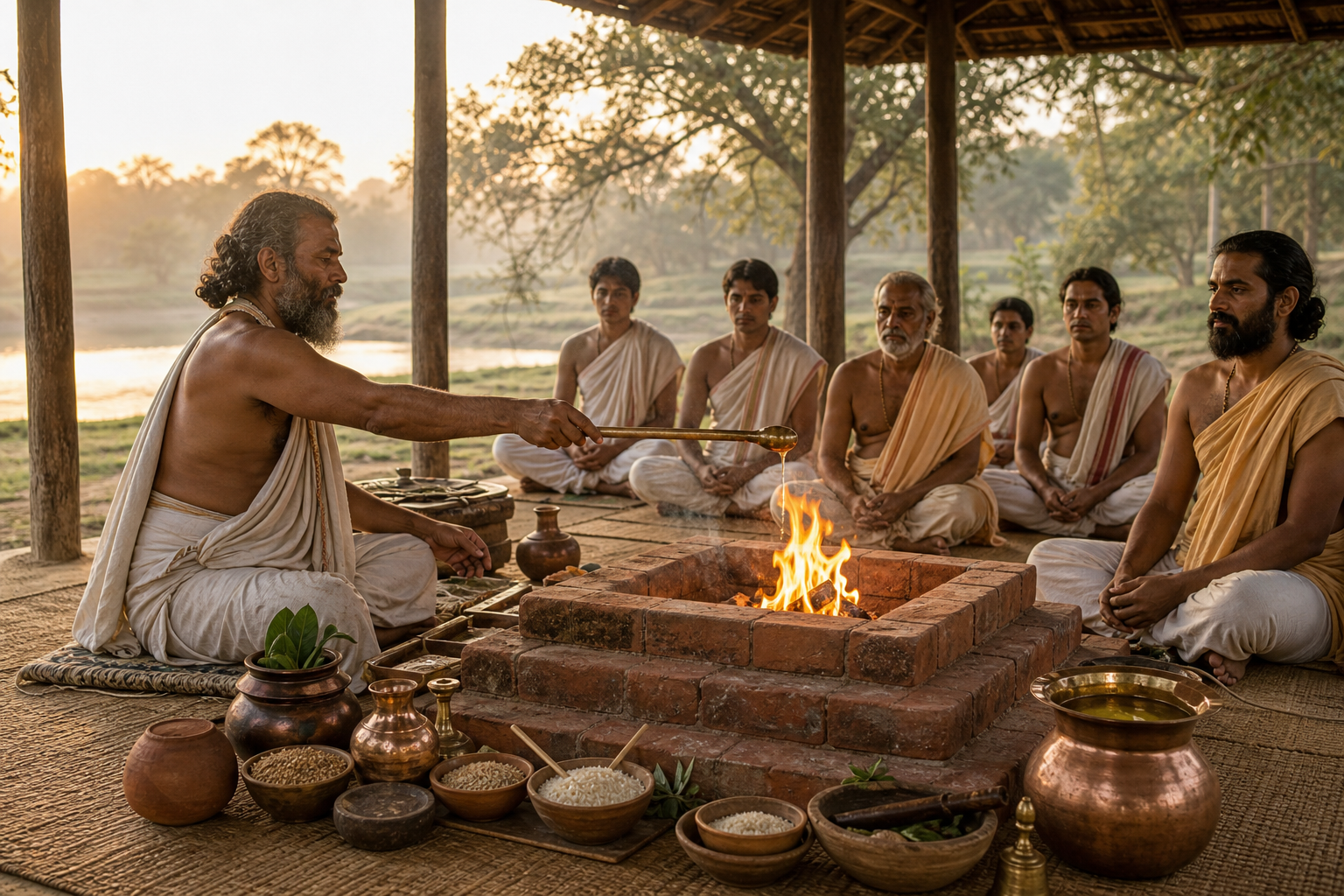
If you have been invited to a yajna, asked to prepare its offerings, or encountered the word havis while studying Vedic ritual, an ingredient list is not enough. You need to know what the offering is doing, which rite governs it, and why changing the material can change the meaning.
Havis is a sanctified oblation placed into a consecrated fire. It may consist of ghee, grain, a prepared food, or another prescribed substance. Yet the material alone is not the sacrifice. Agni, mantra, procedure, intention, and conduct turn an ordinary item of nourishment into a disciplined act of yajna.
Key takeaways
- Havis is a ritual category, not the name of one universal mixture. The prescribed offering changes with the rite and tradition.
- The offering works as a whole: the material is dedicated, Agni conveys it, mantra directs it, and the participant offers with disciplined intention.
- Ghee, grain preparations, milk preparations, sesame, barley, seasonal produce, and herbs are common instructional examples, not a shopping list for every yajna.
- Haviryajnas are rites centred on havis and are distinguished from Soma-centred sacrifices. Agnihotra is one specific haviryajna, not a synonym for every homa.
- A responsible contemporary approach combines fidelity to the rite with ahimsa, careful sourcing, fire safety, mindful disposal, and an inward commitment that continues after the flame is extinguished.
Havis joins substance, Agni, mantra, and intention
The simplest mistake is to think that havis means whatever happens to be put into a fire. Burning a substance is a physical event. Offering havis is a ritual act with an intelligible structure.
- A fitting substance is selected. The oblation represents something of value: nourishment, abundance, disciplined effort, or the produce of a particular season.
- The fire is consecrated and invoked as Agni. Agni is the carrier of the offering within the rite, joining the visible human action to its divine address.
- Mantra gives the action direction. Recitation identifies and shapes the act of dedication. The words and the offering should therefore be coordinated rather than treated as two unrelated parts of a ceremony.
- The participant relinquishes the offering. The gesture is not merely the transfer of an object. It trains gratitude, attention, restraint, and the willingness to place something valued beyond personal possession.
This structure explains why havis is associated with ṛta, the ordering principle that sustains a coherent cosmos. Yajna places human life within a pattern of receiving, giving, and accepting responsibility. Food comes through relationships among land, season, labour, community, and forces beyond individual control. Returning a portion through Agni makes gratitude concrete.
That reciprocity should not be reduced to a bargain with a deity. The participant is also being disciplined. Measured movement restrains haste. Mantra gathers a scattered mind. Relinquishment challenges possessiveness. The outward offering and the inward correction belong to the same act.
When you observe a yajna, follow four questions: What is being offered? To whom is it dedicated? Which mantra accompanies it? What disposition is the participant expected to cultivate? Those questions reveal more than watching the flame alone.
What can be offered as havis
A commonly taught five-part grouping helps a learner understand the range of havis. It is a map of recurring forms and meanings, not a claim that every rite uses all five or that every lineage prepares them identically.
| Form of havis | Ritual association | What you should notice |
|---|---|---|
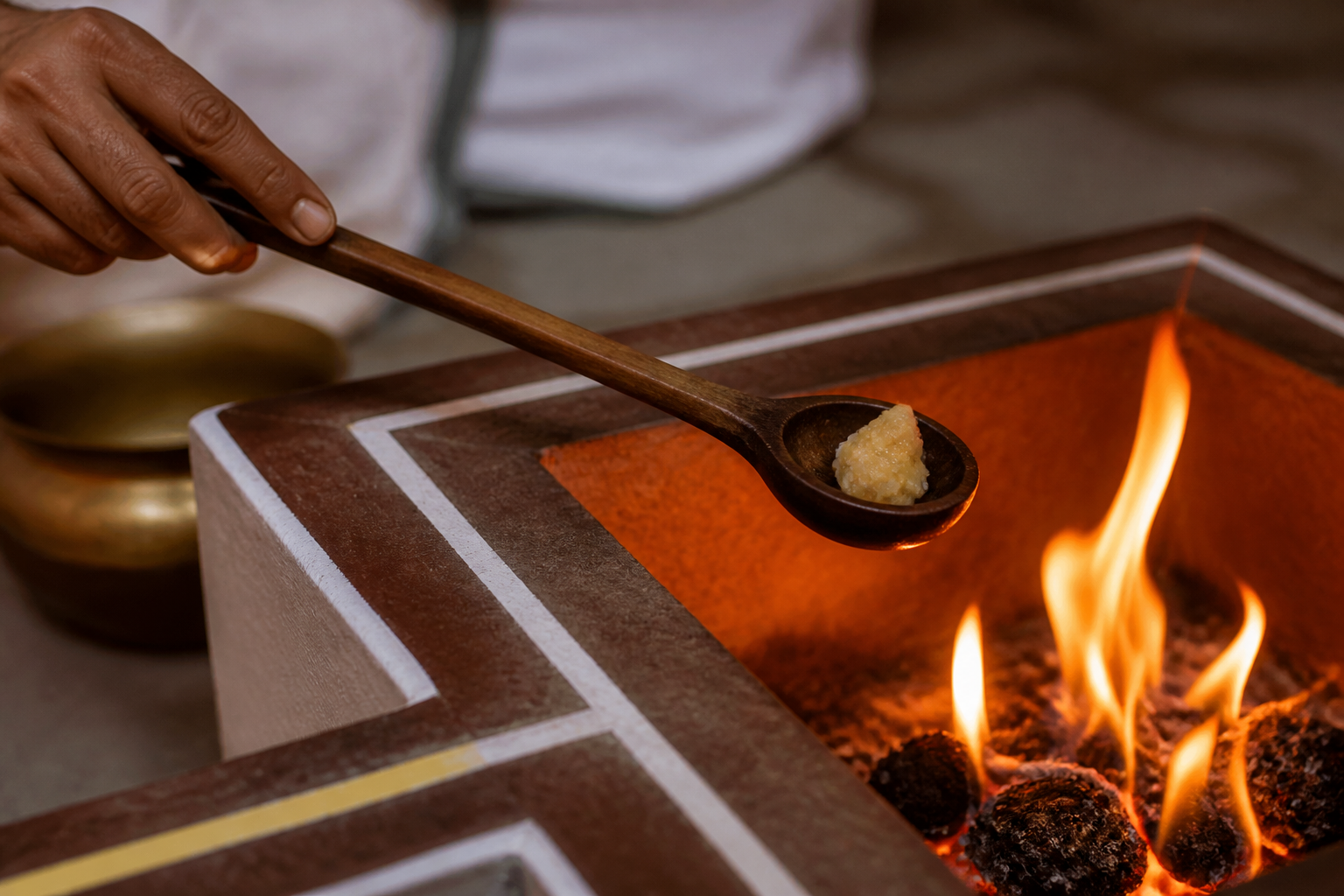
| Ghee or ghṛta | Consecration and the carrying of the offering’s essence | As ghee brightens the flame, it can direct attention toward clarity and refinement. |
| Grain and puroḍāśa, including prepared rice cakes | Nourishment and the fruits of cultivated life | The offering represents sustenance shaped by land, labour, discipline, and community. |
| Milk-based preparations such as payas | Abundance and nourishment | The prepared form matters; it should not be treated as an interchangeable generic liquid. |
| Sesame and barley | Austerity, steadiness, and simplicity | Modest substances can express disciplined constancy rather than display. |
| Seasonal produce or herbs | Time, place, harvest, and communal life | The offering connects ritual to the actual season and sources of sustenance. |
Two corrections follow from this range. First, havis does not mean ghee alone, even though ghee is a prominent oblation. Second, it is not necessarily identical to a loose mixture of fragrant materials. The decisive question is not, “What burns well?” but, “What oblation does this rite prescribe?”
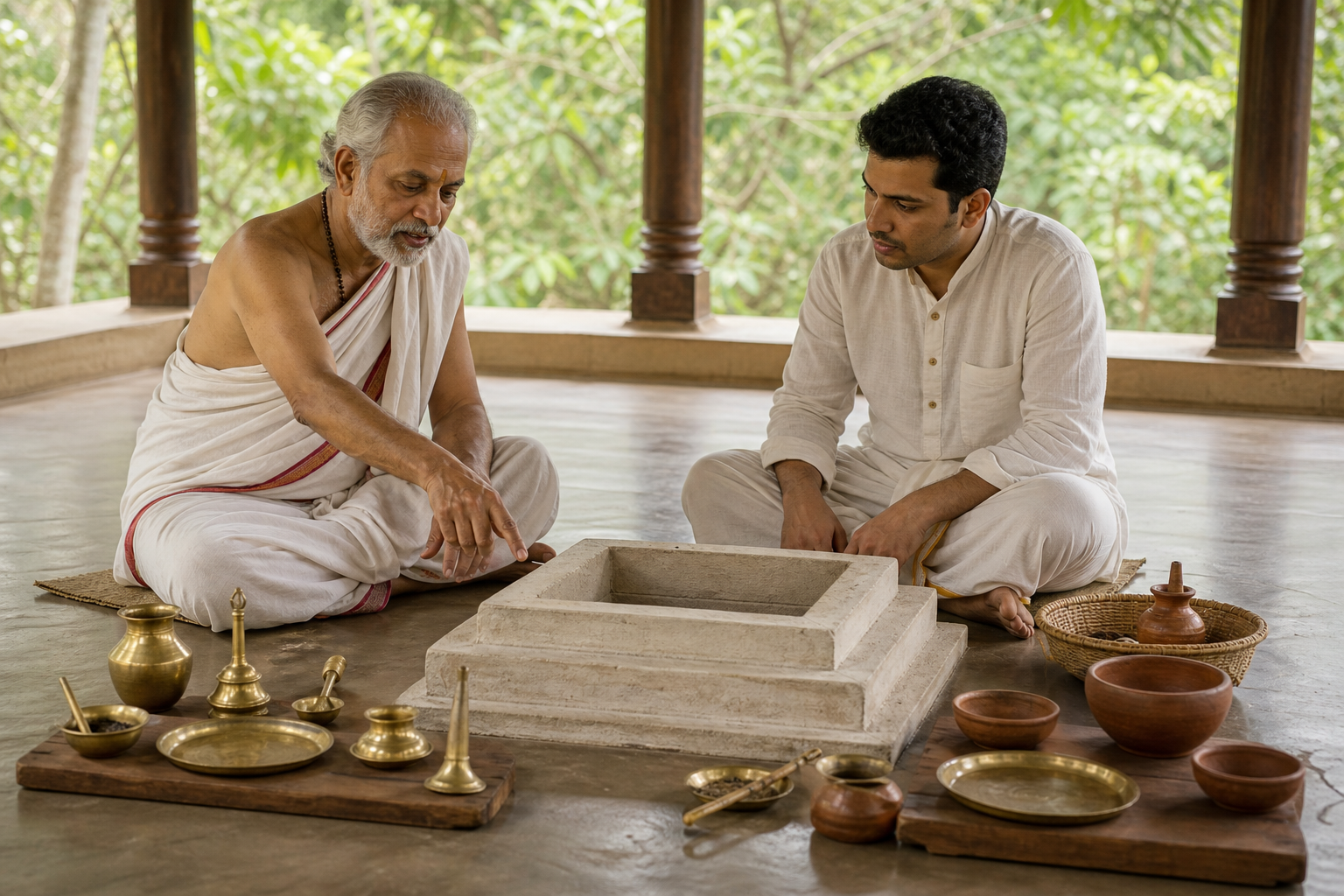
Exact selections and preparations vary across śrauta and gṛhya settings. If you are helping with a real ceremony, ask the officiant or competent teacher for the rite-specific list before buying or combining anything. Confirm whether an item must be whole, ground, cooked, mixed, portioned, or offered separately. A general five-part classification cannot replace those instructions.
This is also where humility matters. A familiar family custom may be entirely appropriate within its setting without becoming a universal rule. Preserve the name and method of the tradition you are following instead of presenting one household’s practice as the sole Vedic form.
Where havis belongs in the Vedic sacrificial system
Not every Vedic sacrifice is organised around the same central oblation. Haviryajnas are the sacrificial cycle centred on offerings of havis, while Soma-centred rites form a distinct ritual category. Keeping that distinction clear prevents “Vedic sacrifice” from becoming a vague label for every ceremony involving fire.
- Agnihotra is a daily fire-offering. Because it names a particular haviryajna, you should not use “Agnihotra” as a casual synonym for every household homa.
- Darśa-Pūrṇamāsa orders observance around the new and full moon. Its timing joins sacrificial discipline to the lunar cycle.
- Cāturmāsya marks seasonal transitions. Here ritual time follows changes in the larger natural order rather than personal convenience alone.
- Āgrayaṇa is a first-fruits rite. Its logic is especially clear: the new produce is acknowledged through offering before it is treated merely as private possession.
These examples show why a rite’s name matters. “We are doing a fire ceremony” does not yet tell you which materials, sequence, mantras, or ritual responsibilities apply. Before participating, obtain four pieces of information: the exact name of the rite, the tradition or procedure being followed, the required oblations, and the person authorised to direct the sequence.
You do not need to master the entire Vedic ritual system before attending a homa. You do need to resist renaming a ceremony from surface resemblance. Two rites may both include flame, ghee, and recitation while differing in occasion, preparation, sequence, and purpose.
How to approach havis responsibly now
A living practice has to preserve meaning without turning carelessness into tradition. The following sequence is useful whether you are hosting a family havan, assisting at a community rite, or teaching children what they are seeing.
- Name the rite before assembling materials. Ask which procedure is being followed and obtain its exact requirements. Do not improvise substitutions merely because two ingredients carry similar symbolic associations.
- Prepare only suitable, responsibly sourced materials. Use clean fuel and the specified samagri. Avoid excess: the purpose is disciplined offering, not producing the largest flame or the most smoke.
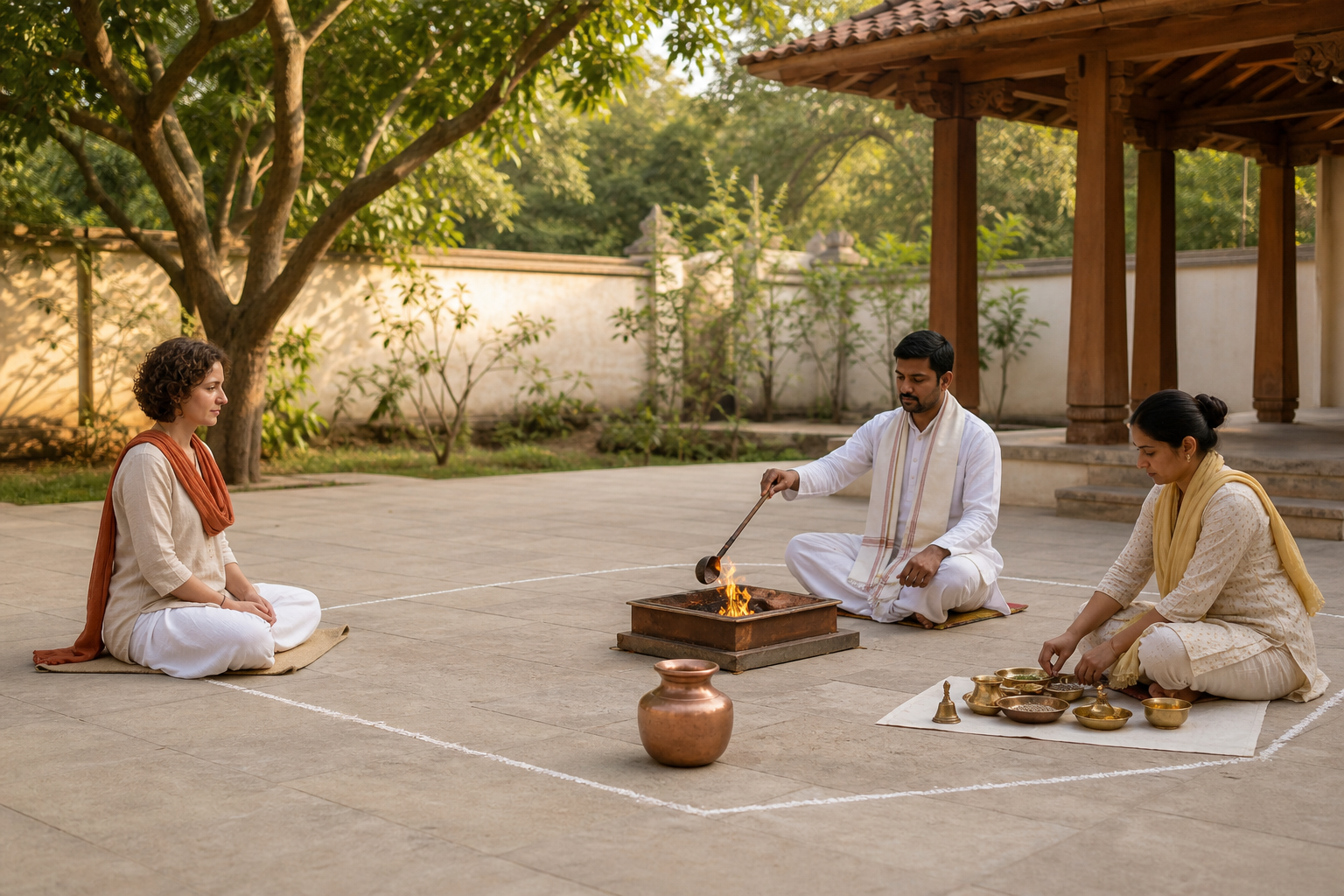
- Make the physical setting safe. A consecrated fire remains a real fire. Use an appropriate, stable havan kund, keep combustible objects away, maintain competent adult supervision, and follow the rules of the venue. If flame or smoke creates a safety problem, do not force the rite into that setting.
- Keep offering and mantra coordinated. Know who places each oblation and when. If you do not know the sequence, follow the officiant rather than anticipating the next action.
- Give observers an intelligible role. A child can be told, in one sentence, what a particular offering represents and then asked to watch for its accompanying mantra. This turns attendance into transmission rather than passive spectacle.
- Plan the completion as carefully as the lighting. Follow the tradition’s guidance for concluding the rite and disposing of the remains. Mindful disposal is part of respecting both the ritual and the surrounding environment.
Many contemporary practices address historically complex sacrificial elements through substitution or interpretation aligned with ahimsa. That approach should be handled openly. Do not assume that one modern formulation governs every lineage, but do ask how non-harm is being upheld and who has authorised any change to the prescribed oblation.
The internal discipline must remain visible as well. The heat of the fire can recall tapas, the effort required to refine conduct. Ghee can call you back to clarity. Grain can remind you that ethical life requires steady nourishment. The measured cadence of mantra can train sustained attention. These correspondences matter only when they affect what you do after the ceremony.
Rhythmic chanting, warmth, fragrance, and shared attention may foster calm and communal cohesion. Calm, however, is not a reliable substitute for understanding the rite. A pleasant atmosphere can accompany yajna, but ritual integrity rests on right preparation, disciplined offering, and the conduct that follows.
The wider Dharmic family offers useful parallels without erasing differences. Buddhist lamp offerings and dāna cultivate clarity and generosity. Jain devotion stresses purity, restraint, and non-harm. Sikh ardas and langar join intention to service. These are not versions of Vedic havis. Their family resemblance lies in training the person to relinquish self-centred possession and contribute to a larger good.
Before your next yajna, write down three things: the exact rite-name, the authorised materials, and one quality you intend to carry from the offering into daily conduct. That small preparation will help you see havis not as something consumed by a flame, but as a disciplined relationship among sustenance, gratitude, cosmic order, and responsibility.

References
