
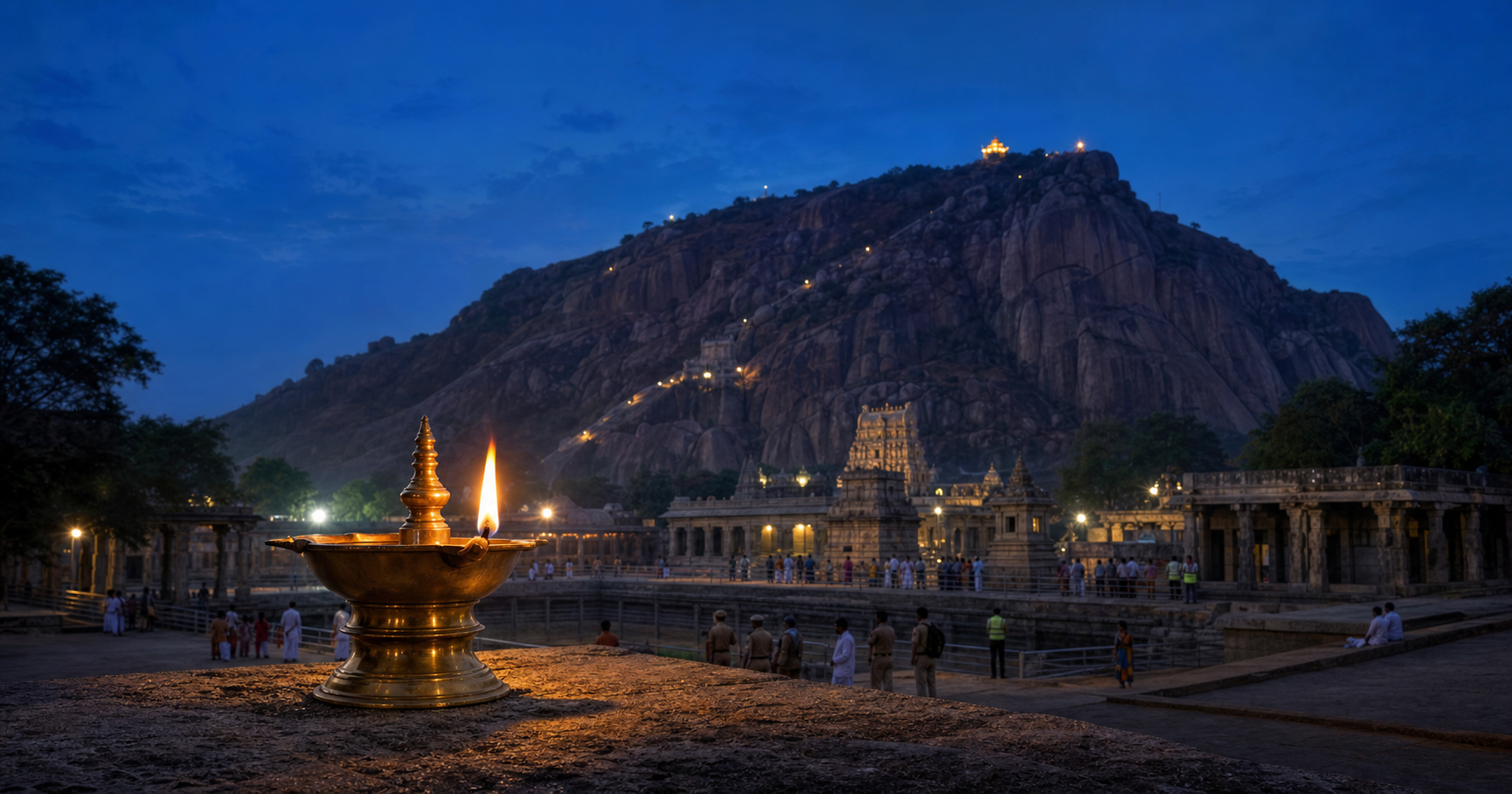
If you want to know whether ritual rights at Thirupparankundram are being honoured, the visible question – whether the Deepam was lit – is only the beginning. You also need to know where the observance occurred, whether its established form was preserved, who imposed any restriction, and whether that restriction was published and justified.
That gives you a practical standard for judging state action: continuity for the long-standing Karthigai Deepam, precise controls where safety or heritage genuinely requires them, and equal administration without turning every part of the hill into an unrestricted ritual space.
The dispute turns on ritual, place and administration
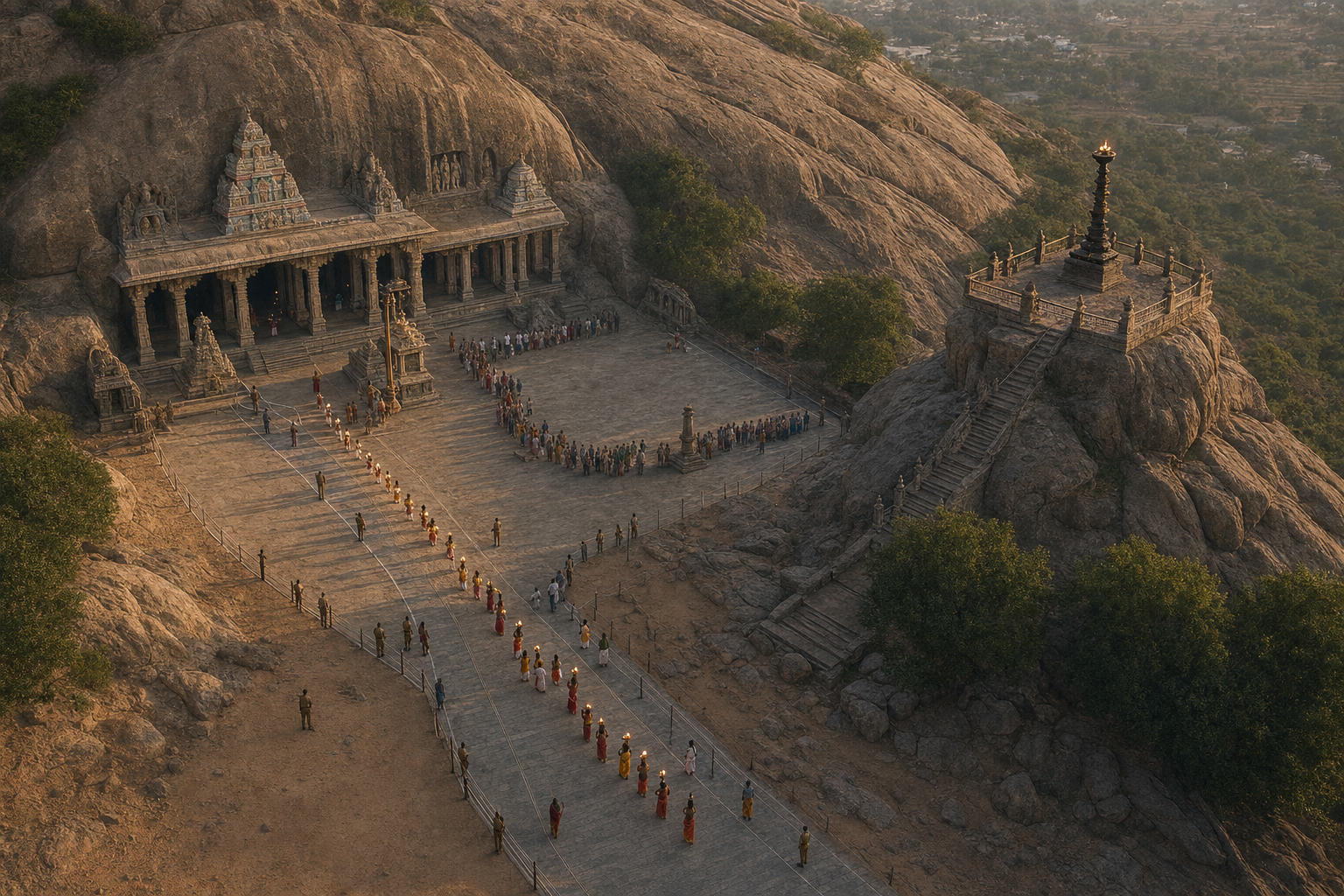
Thirupparankundram is both a sacred hill and the home of the revered Subramanya Swamy Temple. Its Karthigai Deepam observance, associated with the stone pillar on the hill, is living Tamil Hindu heritage rather than a newly asserted use of an ordinary public site.
The Supreme Court intervention has been widely understood to protect the long-standing Deepam while permitting restrictions on new or expanded practices at specified sensitive points. Peaceful and non-discriminatory access remains subject to public-order, safety and heritage requirements.
That understanding contains three separate questions. Keeping them separate is essential:
- Ritual continuity: Can the established Karthigai Deepam observance continue in its traditional setting and recognisable form?
- Control of place: Can the administration prevent the introduction or expansion of practices at a particular sensitive location when crowd, conservation or public-order concerns justify doing so?
- Fair administration: Are access rules, safety measures and restrictions explained in advance and applied without discrimination?
Confusing these questions produces the loudest but least useful claims. Protection of a traditional observance does not create unlimited permission to use every part of the hill. Administrative power to manage a sensitive site does not authorise officials to erase the protected observance. Equal treatment does not require every practice to be allowed at every location; it requires the state to use consistent criteria, provide reasons and avoid selective enforcement.
Articles 25 and 26 provide the constitutional setting: religious freedom and denominational autonomy are protected, while secular matters such as crowd movement, emergency access and heritage conservation may be regulated. The central issue is therefore not whether regulation exists, but whether it is properly connected to a legitimate need and leaves the protected religious observance intact.
A legal caution matters here. A widely circulated interpretation is not a substitute for the exact operative directions of the Court. If you are preparing a petition, alleging non-compliance or considering contempt proceedings, obtain an authenticated copy of the relevant order and ask a qualified lawyer to apply its wording to the facts. A headline, speech or forwarded message is not a safe basis for litigation.
Key takeaways for judging compliance
- The protected interest is continuity of the long-standing Karthigai Deepam, not an unlimited claim over every activity on the hill.
- A restriction concerning a specified point does not automatically establish a rule for the entire hill or for every community activity.
- Safety, conservation and crowd-control measures should identify the affected place, time, conduct and administrative authority.
- Compliance is visible in the written festival plan, consistent enforcement, accessible facilities and a working process for correcting mistakes.
- A dignified alternative may accommodate a practice restricted at a sensitive point, but it should not become a device for displacing the established Deepam itself.
- Any formal legal challenge should rely on the authenticated judicial directions, official notices and verifiable events on the ground.
A written festival plan is the first test of governance

A sound legal principle can still fail during implementation. Last-minute barricades, contradictory oral instructions and unexplained route changes can impair an observance even when officials publicly promise compliance. The administration should therefore publish a time-bound Standard Operating Procedure early enough for temple authorities, residents and devotees to understand it and raise specific objections.
A usable plan should contain at least the following:
- Ritual schedule: The recognised stages of the Karthigai Deepam observance, the locations involved and the officials responsible for facilitating them.
- Zone map: Clearly marked ritual areas, heritage-sensitive points, public-access areas and temporarily restricted zones. Each restriction should have a stated reason rather than an ambiguous boundary described only at the site.
- Crowd rules: Entry and exit routes, emergency egress, holding areas and the trigger for pausing or reopening access. If officials intend to use a capacity threshold, the plan should state it rather than announcing an undefined limit after people arrive.
- Accessibility arrangements: Practical routes for elders and persons with disabilities, along with any assistance point needed where the terrain prevents ordinary access.
- Emergency support: Medical posts, evacuation procedures and a clear chain of command among temple personnel, police, fire and health services.
- Transport coordination: Arrival and departure arrangements that prevent a traffic bottleneck from becoming a crowd emergency near the hill.
- Heritage and environmental safeguards: Rules governing flame safety, waste, barriers and access to vulnerable areas, stated in terms that volunteers and devotees can actually follow.
- Public communication: One official page carrying the current timings, routes, closures, contact points and corrections. Every update should display when it was issued so that an outdated screenshot cannot compete with the current instruction.
Consultation should occur before the plan is finalised, not after barriers have been installed. Temple authorities, local residents, law-enforcement personnel, heritage specialists, transport and medical teams, and representatives of communities directly affected by an access rule should receive an agenda, a map and a record of unresolved objections.
Consultation has limits. It can clarify routes, reduce conflict and identify a workable accommodation. It should not turn the continuity of an established temple observance into a popularity contest or give any stakeholder a veto over a judicial direction.
Transparency need not depend on an elaborate digital system. A single public page, downloadable route map, dated advisory and named control-room contact would answer most operational questions. During the festival window, the same page can carry crowd advisories and temporary changes. Afterward, a short compliance report can record closures, incidents and corrective action.
Apply six tests to every restriction
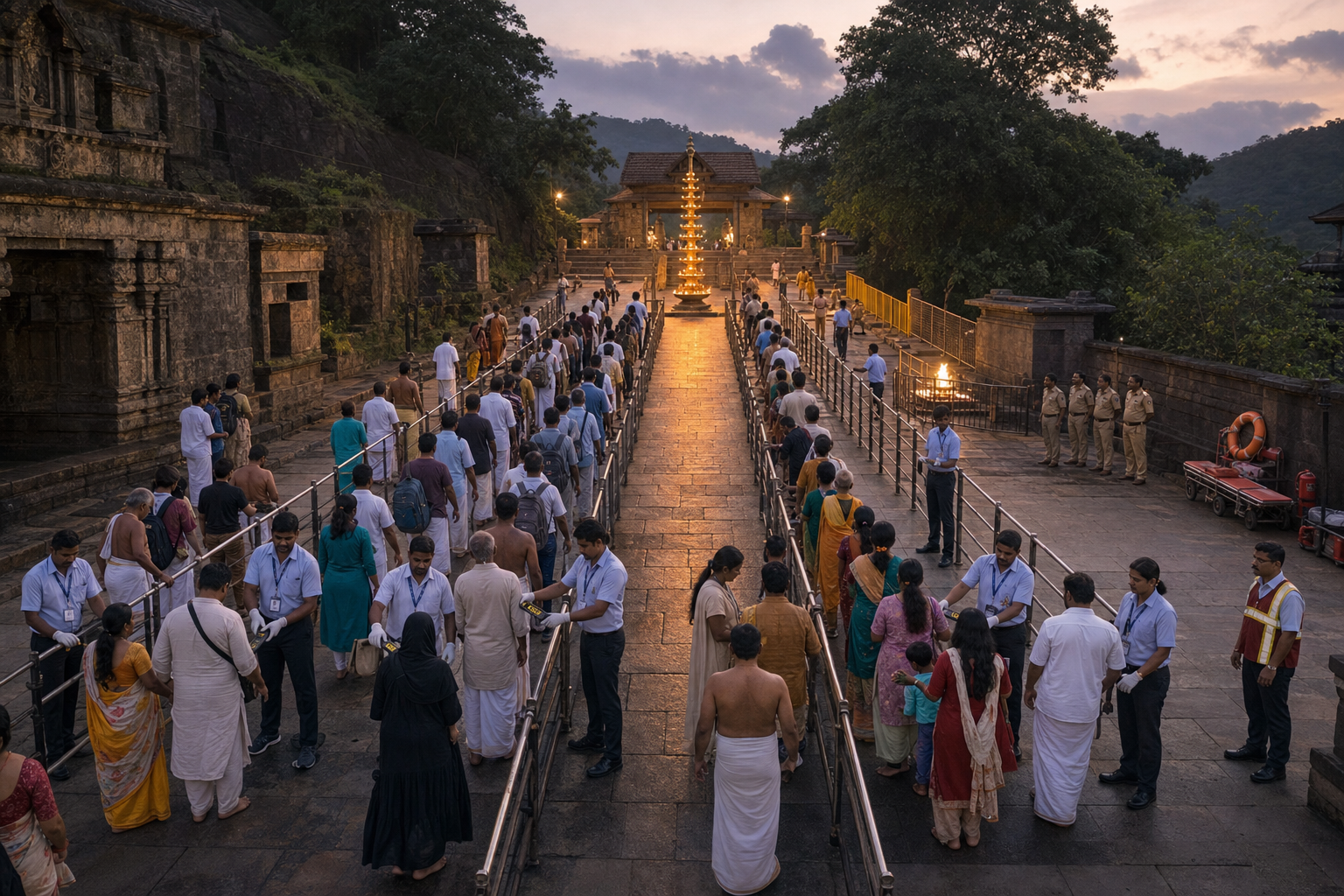
When an official restriction is announced, do not judge it only by whether you agree with its political effect. Apply the same six tests regardless of which group or practice is affected.
- Specificity: Does the instruction identify the exact place, period and conduct being regulated? A rule for one sensitive point should not silently become a prohibition across the entire hill.
- Connection to a real need: Is the restriction tied to crowd flow, emergency access, conservation or a defined public-order concern? The closer the connection, the easier the decision is to evaluate. A generic reference to tension leaves too much room for arbitrary enforcement.
- Protection of ritual continuity: What happens to the long-standing Deepam if the rule is enforced? A change in location, timing or access can alter the substance of an observance even when officials describe it as a minor logistical adjustment.
- Consistent criteria: Are comparable crowd, safety and heritage risks being handled by the same published standards? Non-discrimination means using the same governing criteria for like situations. It does not mean pretending that every activity has the same history, physical requirements or effect on a particular site.
- Practical accommodation: If a new or expanded practice cannot occur at a sensitive point, has the administration considered a dignified and reasonably nearby alternative? The alternative must be workable for the people affected. It must also remain an accommodation for the restricted practice, not a pretext for relocating the protected Deepam.
- Reviewability: Is the authority for the decision identified? Are the reason, duration and route for seeking correction available in writing? A restriction that exists only as an oral command is difficult to audit and easy to apply inconsistently.
These tests also expose three common misreadings. Religious freedom does not eliminate all crowd and conservation controls. Public order does not give the administration unbounded discretion. Equality does not require every community to perform every activity at the same point on the hill. The workable position protects inherited worship, regulates secular logistics and demands reasons for differential treatment.
Timing matters as much as wording. A temporary closure during a documented crowd surge may satisfy these tests when access resumes under a stated rule. The same closure imposed through the entire ritual window, without a disclosed trigger or reopening process, can have a fundamentally different effect. Record the duration and consequence, not merely the label officials place on the measure.
Build a factual record before escalating a complaint
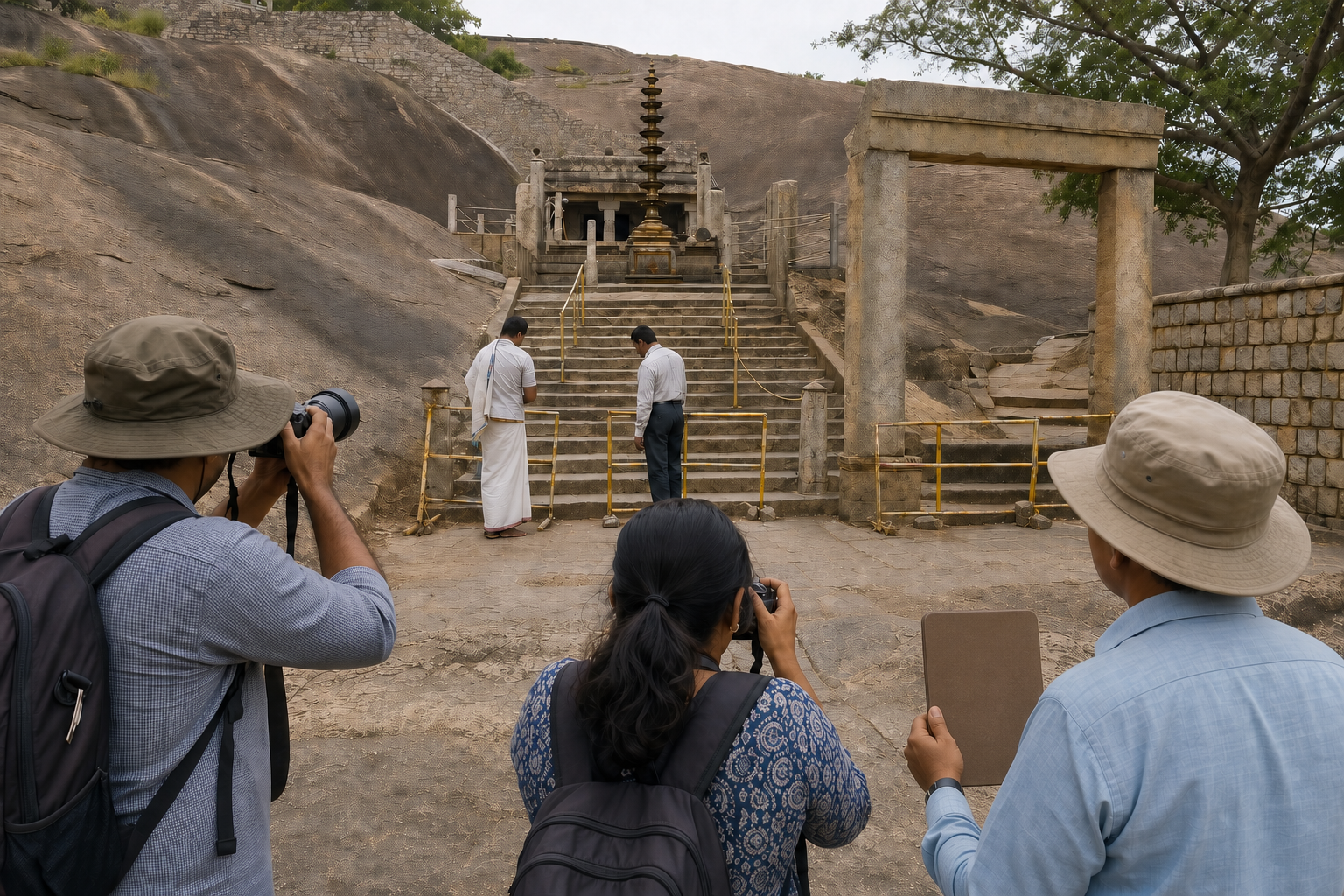
The quickest way to weaken a legitimate grievance is to call everything illegal before identifying the exact departure from the governing directions. If you are a devotee, resident, volunteer or cultural organisation, build a record that separates verified facts from rumours.
Before the festival
- Save the current official SOP, route map, access notice and emergency contacts. Keep the publication date and web address with each copy.
- Create a one-page matrix with six fields: expected arrangement, actual instruction, affected ritual or access, exact location, time, and stated official reason.
- Ask unanswered questions in writing. A precise request for the zone map or capacity rule is more useful than a general demand to protect tradition.
- Identify one person authorised to communicate for your temple body or civic group. Multiple contradictory public statements can obscure a straightforward implementation failure.
- If litigation is realistically possible, have counsel identify the exact judicial directions that need to be monitored before the event begins.
During the observance
- Do not physically test a barricade or confront personnel at a crowded site. Defiance can create a safety incident, expose you to legal consequences and make the underlying rights issue harder to resolve.
- Record the exact words of an instruction as soon as safely possible, along with the time, location and agency involved. If an official gives a name or designation, note it accurately; do not guess.
- Photograph public notices, barriers and route signs only from a lawful position and without obstructing worshippers or emergency personnel. Preserve the original files.
- Distinguish an individual officer’s on-site instruction from a published policy. The discrepancy may be the problem, but it needs to be documented as a discrepancy.
- Track when a restriction begins, whether comparable access is treated by the same rule, and when normal access resumes. Duration often reveals more than the initial announcement.
If violence, a dangerous crowd surge or a medical emergency develops, move to safety and follow emergency instructions. Documentation is never worth obstructing responders or remaining in a hazardous area.
After the event
- Submit a concise written representation identifying the instruction, the claimed inconsistency, the practical consequence and the remedy sought. Attach the strongest records rather than a large collection of unrelated social-media material.
- Ask the authority to identify the legal or administrative basis, the officer responsible, the reason for the measure and whether it remains in force.
- Where a formal challenge is likely, ask a lawyer how to seek preservation of relevant official logs, notices or recordings. Do not assume that a general complaint automatically preserves evidence.
- Support a post-event review involving temple representatives, residents, heritage professionals and civil authorities. Its task should be to compare the published plan with what happened and assign corrective action before the next festival.
- Reserve allegations of deliberate discrimination or judicial defiance for cases supported by the operative order and verified facts. Serious language without a sound record makes accountability easier to dismiss.
Court oversight becomes effective when public administration is legible. Before the next festival window, ask for the published SOP and zone map. If they exist, test them against ritual continuity, safety, equality and what occurs on the ground. If they do not exist, request them in writing. That single step turns a vague controversy into a question the administration must answer.
References
