
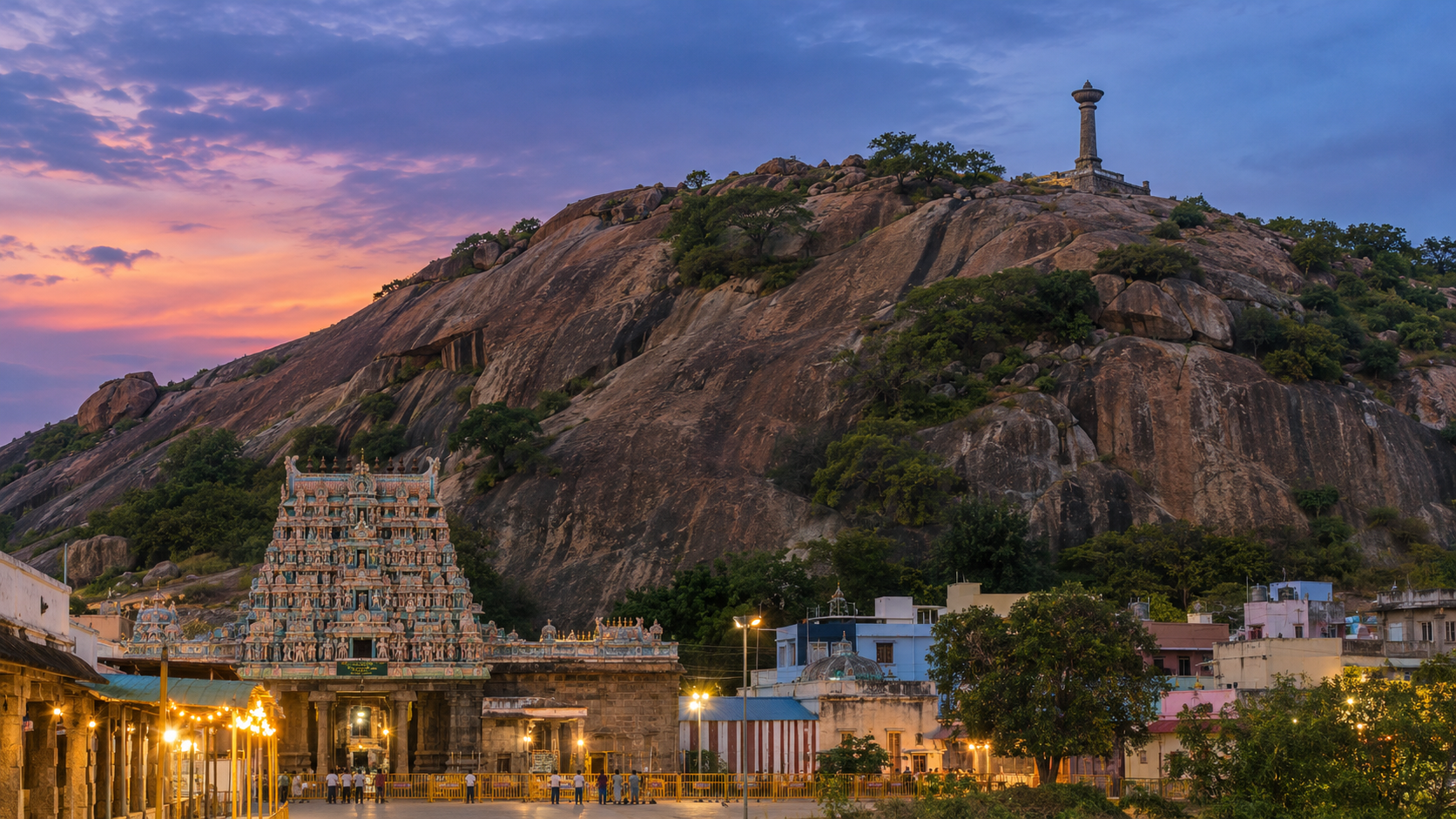
If you are trying to decide whether the Thiruparankundram controversy is about a denied Hindu observance, a disputed monument, the naming of a sacred hill, or police action against devotees, the honest answer is that all four issues are present. They should not be collapsed into one claim.
The clearest starting point is narrow: the Supreme Court allowed a controlled, one-time Karthigai Deepam lighting at the Deepathoon on November 24, 2026. The lamp was not lit there. You can support accountability for that failure without claiming that every historical or legal question has already been settled.
Key takeaways
- The Supreme Court permitted an authorised temple team to light the Deepam at the Deepathoon under official supervision, but only as a one-time arrangement.
- The order did not give the general public permission to climb the hill, assemble at the site, hold a procession, or demonstrate during the ceremony.
- The Deepam was lit near the customary Uchi Pillaiyar Temple location on November 24, while the Deepathoon remained unlit.
- A government historical position identifies the structure as a British-era survey pillar; the opposing side contests that conclusion and maintains its religious significance.
- The use of Sikandarmalai in government documentation is politically and culturally consequential, but it does not by itself prove that the hill has been formally renamed.
- The most important unanswered question is who decided that the court-permitted lighting would not occur, and on what written ground.
What happened on November 24
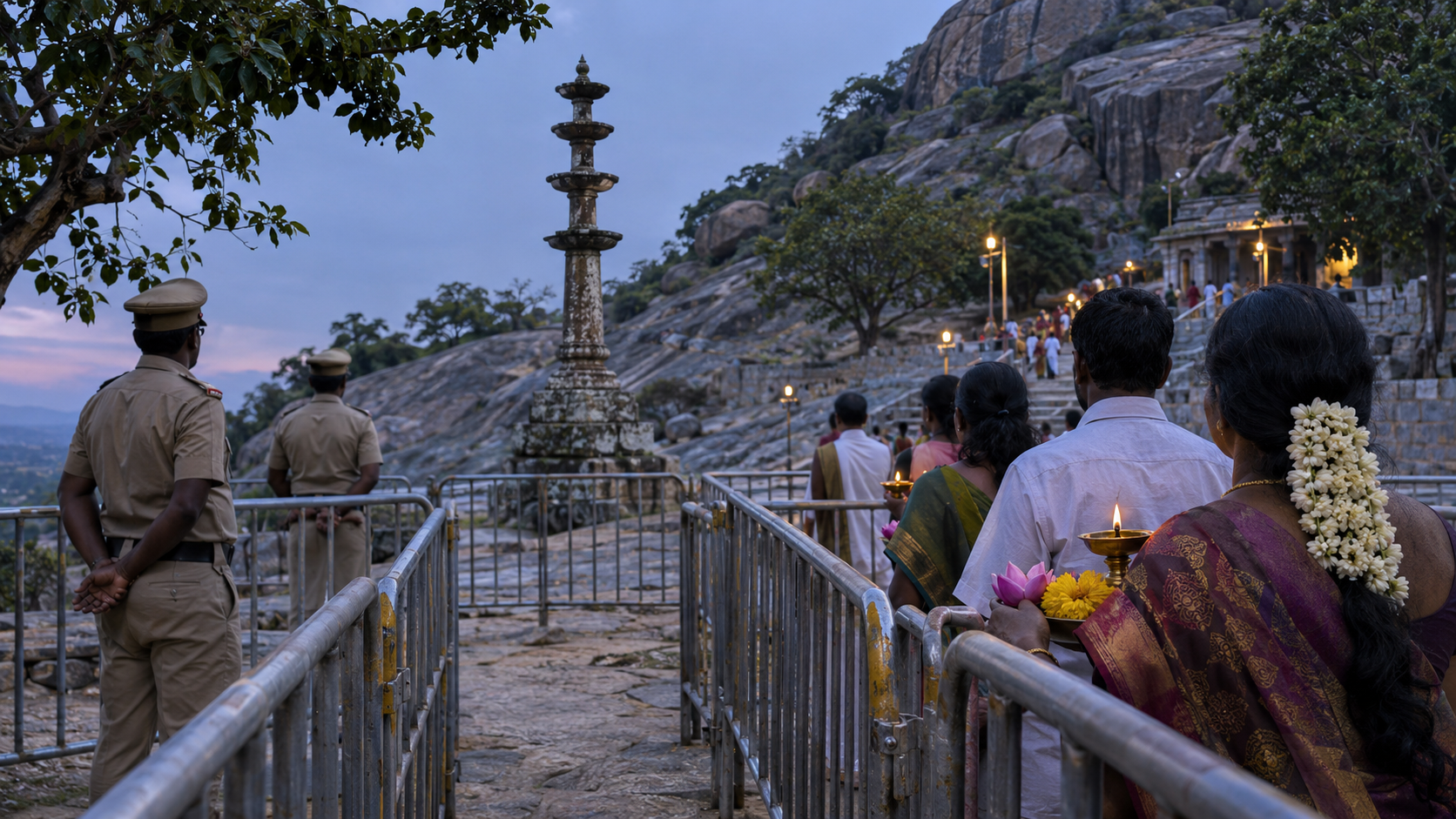
On November 20, 2026, the Supreme Court permitted a restricted team authorised by the temple administration to light the Karthigai Deepam at the Deepathoon on November 24. The Madurai District Collector was made the nodal officer, and the police and other authorities were expected to coordinate the safeguards.
The permission was deliberately limited. It applied to the authorised team and accompanying officials, not to a public ascent. Gatherings, processions, and demonstrations at the site during the ceremony were prohibited. The Court also made clear that this exceptional arrangement would not create a permanent customary, religious, or proprietary right.
On November 24, the ceremonial lamp was lit at the customary location near the Uchi Pillaiyar Temple, but the Deepathoon remained unlit. That omission produced an immediate and understandable question: if the Court had opened a lawful route for the ritual, why was that route not used?
Devotees and members of Hindu organisations protested. Around 300 protesters were reportedly detained amid a deployment of about 5,600 police personnel. Police also displayed a prepared Tamil warning that classified the gathering as unlawful, ordered people to disperse, and warned that batons could be used to remove them.
Two facts can therefore be true at once. The public had not been granted unrestricted access to the summit, and the police could enforce the Court’s crowd restrictions. At the same time, those restrictions do not explain why the small authorised team apparently did not complete the separately permitted lighting. A prohibited public gathering and an unperformed official arrangement are different matters.
One controversy contains three separate disputes
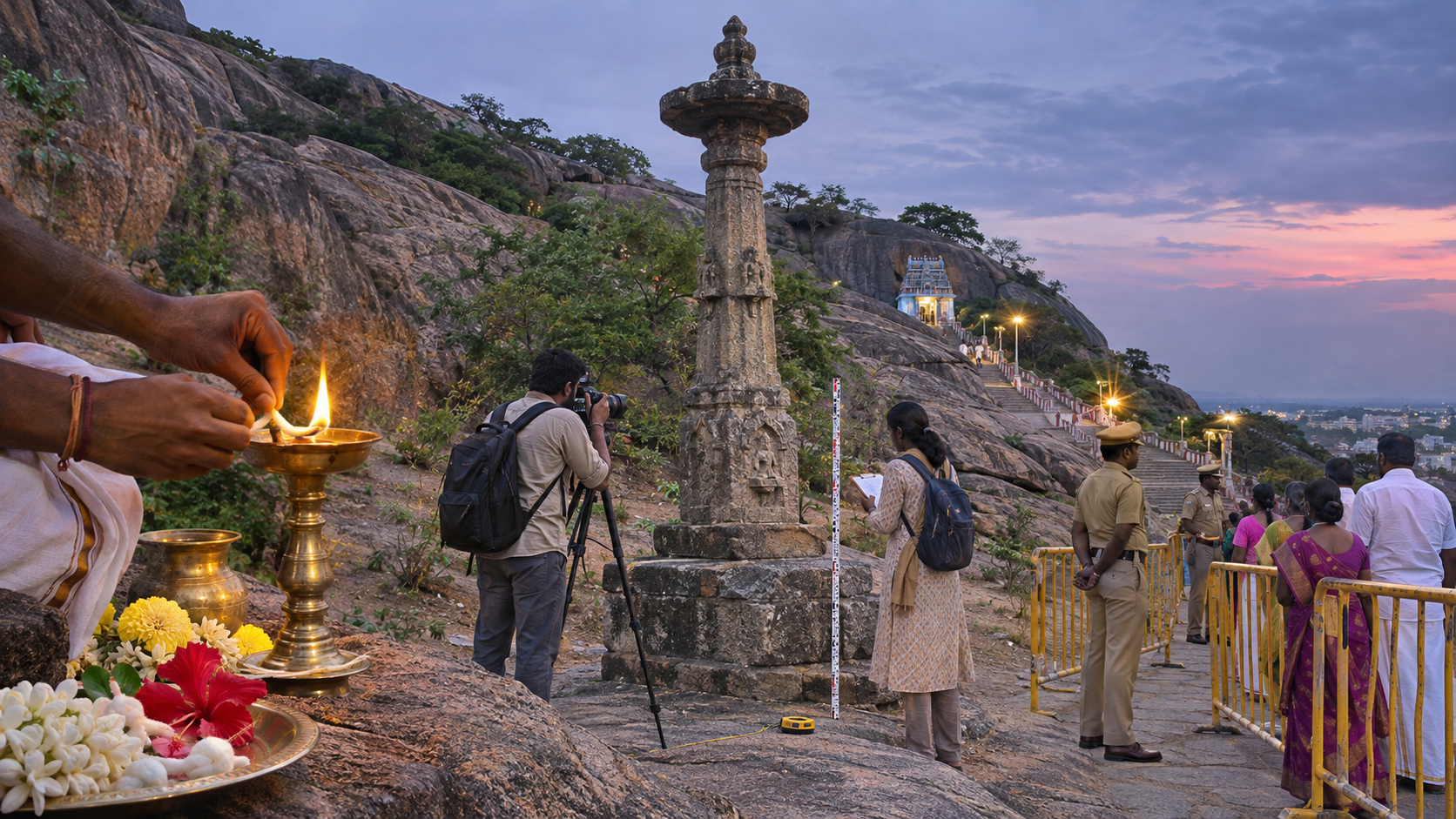
You will understand the issue more clearly if you separate the legal-administrative question, the historical question, and the public-order question. Evidence answering one of them does not automatically answer the other two.
- The legal-administrative dispute asks what the Supreme Court authorised, which officials had responsibilities under the arrangement, and why the lighting did not occur.
- The historical and cultural dispute asks what the stone structure originally was, whether it has a religious history or significance, and what evidence supports each position.
- The public-order dispute asks whether the restrictions, detentions, warnings, and scale of the police response were legally grounded and proportionate.
On the first question, wording matters. Permission is not identical to a declaration of permanent right, and the November 20 arrangement explicitly avoided deciding permanent rights. It nevertheless created a lawful and supervised way for the authorised team to perform the lighting. The responsible authorities should therefore disclose whether a team was nominated, whether it reached the access point, whether access was refused, and whether safety, weather, administrative, or legal reasons were recorded for abandoning the arrangement.
The word contempt should be used carefully. The fact that the Deepathoon remained unlit justifies scrutiny of compliance, but contempt is a legal conclusion for a court to reach after examining the operative language, the duties imposed, the explanation offered, and the conduct of the responsible parties. Devotees do not weaken their case by demanding those facts before applying the label.
On the historical question, Tamil Nadu’s Survey and Settlement and Archaeology departments reportedly rely on a five-volume compilation of more than 1,800 pages. The state position identifies the structure as a British-era Great Trigonometrical Survey pillar, classifies Thiruparankundram as a secondary survey station, and records triangulation links with several surrounding locations.
That is a historical claim supported by a government reconstruction, not an uncontested final verdict. The opposing side disputes the identification. The responsible way to test the competing positions is to examine the underlying station descriptions, survey maps, dates, coordinates, archival images, later temple records, and physical characteristics of the pillar. A large page count is not a substitute for showing the particular pages and primary records that prove the conclusion.
Origin and religious significance also need separate treatment. Evidence that a structure served as a survey station may be relevant to its origin, but it does not automatically resolve every claim about later ritual association. Conversely, calling the structure a Deepathoon does not by itself establish its construction date or original purpose. Both propositions require evidence.
The naming issue deserves the same discipline. The government documentation reportedly uses Sikandarmalai repeatedly in connection with Thiruparankundram. Because the hill is a prominent sacred landscape associated with the Arulmigu Subramaniya Swamy Temple, repeated official terminology can influence how the place is represented in administration and public memory. That warrants an explanation. It does not, without a separate legal or administrative act, prove that a formal renaming has occurred.
On public order, the prepared warning banner shows that police anticipated the possibility of dispersing a gathering. It does not, standing alone, prove that officers had made a prior decision to conduct a lathi charge regardless of events. The heavy deployment, detentions, barricades, notices, video records, and any orders authorising restrictions must be examined together. The merits of the Deepam demand do not automatically legalise every assembly, just as detention of protesters does not disprove the underlying grievance.
Which claims are established, and which still need proof
The dispute has generated forceful slogans on every side. Before you repeat one, compare it with what the available facts actually establish.
| Claim | What is established | What is still needed |
|---|---|---|
| The government committed contempt of the Supreme Court. | The Court permitted a one-time supervised lighting, and the Deepathoon remained unlit. | The full operative order, allocation of duties, official explanation, evidence of wilful non-compliance, and any judicial finding on contempt. |
| The pillar’s religious identity is conclusively settled. | Hindu devotees and organisations assert that the structure is the Deepathoon and sought the ritual there. | Dated records, material evidence, documented ritual history, and a fair examination of the competing historical case. |
| The British survey identification ends the dispute. | The state position reportedly classifies the structure as a survey pillar connected with the Great Trigonometrical Survey. | Publication of the relevant underlying records, scrutiny of the identification, and separate consideration of any later religious significance. |
| The warning banner proves that a lathi charge was pre-planned. | Police had prepared a warning about forcible dispersal, deployed heavily, and detained protesters. | Operational orders, command logs, timing, video evidence, and proof that a decision to use force had been made in advance. |
| Use of Sikandarmalai formally renames the sacred hill. | The term was reportedly repeated in government historical documentation. | A formal renaming notification or other competent administrative act, if one exists, and an explanation of the terminology’s official status. |
This distinction is not an exercise in neutrality for its own sake. It protects the Hindu case from being tied to claims that can be knocked down because they outrun the evidence. The strongest public argument is the one that remains accurate even when read by a sceptical judge, historian, or administrator.
What devotees should demand next
If you want a durable outcome rather than another cycle of outrage and detention, direct the next effort toward records that officials can be required to defend. These are the most useful requests:
- Obtain the certified November 20 Supreme Court order and work from its operative paragraphs, not screenshots, headlines, or paraphrases.
- Ask the District Collector and temple administration for a written chronology of November 24: the authorised team’s names or official designations, assembly time, route, access arrangements, instructions received, and the recorded reason the Deepathoon was not lit.
- Request any execution, compliance, incident, or after-action report prepared by the Collector, police, temple administration, or other participating department.
- Seek the exact pages of the five-volume government compilation concerning Thiruparankundram, together with reproductions or citations for the archival survey records on which the pillar identification rests.
- Ask whether Sikandarmalai is being treated as a historical survey label, an alternate place-name, an official administrative name, or a formal replacement for Thiruparankundram. Demand the order or notification if officials claim a formal change.
- For each detention, document the legal ground, place and duration of custody, release terms, and whether a case or first information report was registered. People directly affected should have a Tamil Nadu lawyer assess those records.
- Preserve original videos, photographs, police notices, and witness notes with their dates and times. Edited clips may attract attention, but complete files are more useful in court and formal representations.
- Do not attempt an unauthorised ascent or recreate the ceremony in defiance of restrictions. That can expose devotees to arrest, endanger people on the hill, and shift attention away from the administration’s failure to explain the unperformed arrangement.
Formal representations and Right to Information requests should be narrow. Instead of asking an office to explain its entire policy, ask who made a particular decision, when it was recorded, under which authority, and where the corresponding file can be inspected. Narrow questions are harder to evade and easier to use in later proceedings.
The immediate test of accountability can be stated in one sentence: who decided that the authorised team would not light the Deepam at the Deepathoon on November 24, and what written reason supported that decision? Put that question to the Collector, the temple administration, and any court examining compliance. A precise demand, pursued lawfully and without provocation, gives devotees the best chance of protecting both the observance and the credibility of their case.
References

Leave a Reply
You must be logged in to post a comment.