

If death has stopped feeling theoretical, you may be wondering whether spiritual life offers more than consolation. Can you actually become free of death and rebirth, or is that only a phrase repeated in scripture?
The Dharmic answer is demanding but practical. You do not defeat mortality by pretending that the body will last. You learn to stop feeding the ignorance, attachment and harmful action that keep samsara in motion. The call to avoid death and rebirth by cultivating spiritual life is therefore an instruction about how to live now, not a promise of physical immortality.
What escaping death and rebirth means – and does not mean

Physical death and samsaric bondage are related, but they are not the same problem. The body is impermanent. Liberation concerns the deeper pattern through which ignorance, craving, ego and karma continue to condition existence. Trying to preserve the present personality forever would preserve the very attachments that spiritual practice is meant to loosen.
This distinction protects you from two serious mistakes. The first is materialism dressed in religious language: treating prayer, austerity or ritual as a technique for making the body invulnerable. The second is life-rejection: imagining that hatred of the body, neglect of duty or a wish to die is spiritual detachment. Vairagya is freedom from possessiveness, not hostility toward life. A detached person can care responsibly for health, family and society without mistaking any of them for an eternal possession.
The Dharmic traditions agree that ordinary conditioned existence is not the final human possibility, but they do not offer an interchangeable metaphysics:
- Hindu traditions speak of moksha from samsara, yet explain it in different ways. Advaita Vedanta emphasizes knowledge of the Self and freedom from misidentification. Bhakti lineages emphasize loving devotion, surrender and the grace of Bhagavan. Other Hindu paths give distinctive roles to disciplined action, meditation, discrimination and divine worship.
- Buddhist traditions characteristically teach anatta, or the absence of a permanent independent self. Nirvana is not the survival of an eternal ego; it is freedom from the ignorance and craving that condition suffering and rebirth.
- Jain traditions affirm the jiva and understand liberation as its release from karmic bondage. Ahimsa, restraint, right understanding and purification of conduct are therefore central, while anekantavada warns against confusing a partial viewpoint with the whole truth.
- Sikh tradition speaks of mukti through the Guru’s wisdom, Naam, devotion, seva and the overcoming of haumai, or ego-centredness. Liberation is pursued amid responsible household life rather than through indifference to the world.
These differences matter. If you say atman during one practice and anatta during another without understanding either, you may only be collecting vocabulary. Choose a coherent spiritual home and ask four practical questions: What does this path say is bound? What keeps the bondage going? What is liberation? Which discipline directly addresses the cause?
Build your practice around the mechanism of bondage

A spiritual routine becomes decorative when it is detached from diagnosis. You can perform elaborate worship and still remain governed by resentment. You can discuss non-duality while defending every injury to your status. You can meditate regularly while arranging the rest of life around unchecked appetite. Practice begins to liberate when it meets the habit that actually controls you.
Match the discipline to the form of bondage you can already observe:
- Forgetfulness: use mantra, Naam simran, mindfulness, remembrance or self-inquiry as taught in your path. The function is to interrupt automatic identification, not merely to produce a pleasant mood.
- Craving: adopt a clear restraint concerning the pleasure, possession or approval you habitually chase. A vrata, precept or practice of aparigraha becomes useful at the moment desire argues that its demand is exceptional.
- Harm: make ahimsa concrete in speech, consumption, work and family conduct. Notice where anger recruits religious language to justify cruelty.
- Ego and entitlement: practise seva or dana where recognition is unlikely. Service reveals whether you love the good itself or the identity of being a good person.
- Confusion: study a primary text with a qualified teacher and test your understanding in conduct. Information that never changes a decision has not yet become wisdom.
These practices perform related ethical functions, but they are not metaphysically identical. Your primary discipline should come from the tradition whose account of bondage you are seriously following. Supplement it with moral restraint and service instead of assembling a private religion from whichever techniques feel easiest.
Scriptural hearing should also end in a decision. Use Srimad Bhagavatam 7.5.7, or a passage recognized by your own lineage, as more than material for quotation. Hear the explanation, restate the governing instruction in your own words, identify the habit it challenges, and decide where that instruction will govern your next choice.
A teacher can help you see the evasions that private practice protects. Look for someone rooted in a recognizable lineage, willing to explain how an interpretation arises from the text, open to sincere questions and visibly accountable in conduct. Demands for secrecy, sexual access, reckless financial surrender, contempt for medical care or isolation from trustworthy family are not signs of transcendence. They are reasons to step back and seek sound counsel.
A daily rule that turns belief into spiritual life
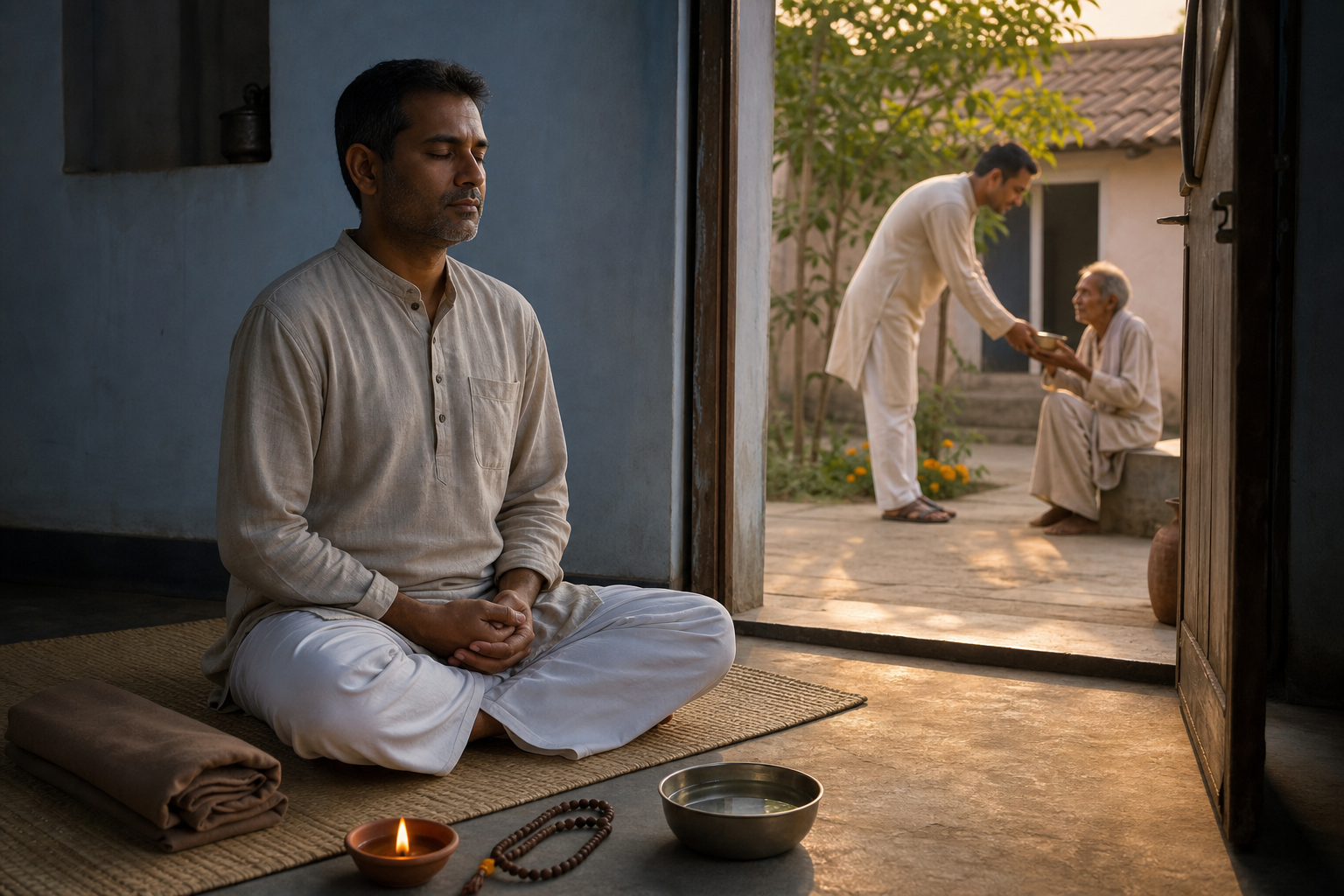
You do not need to imitate a monastic schedule in order to begin. You need a repeatable order that reaches the mind before distraction does and then follows you into ordinary duties. Adapt the following rule to the discipline authorized by your tradition:
- Recollect the aim before taking in the world’s demands. On waking, use your mantra, prayer, refuge, Naam or contemplative formula before opening messages or news. Remember that the day is for liberation, not merely acquisition and defence.
- Perform the primary practice while the mind is still relatively unclaimed. Chant, meditate, pray, conduct self-inquiry or undertake the discipline given by your teacher. Protect this period from multitasking.
- Read a small, workable portion of scripture. Stop when you can answer: What must change in my conduct because of this? More pages are not necessarily more assimilation.
- Carry a restraint into the day’s predictable point of friction. Decide beforehand how you will respond when provoked, tempted to lie, pulled toward excess or hungry for praise. A vow made only after desire arrives will be negotiated by desire.
- Complete an act of duty or service without advertising it. Caregiving, honest work, hospitality, dana and community responsibility can weaken self-centredness when they are offered without a demand for applause.
- Review the day before sleep. Recall where awareness held and where attachment took command. Admit the failure without theatrical guilt, make any needed repair, and prepare a more truthful response for the next encounter.
Your work, family obligations and civic responsibilities are not interruptions to this rule. They are where its truth becomes visible. The person who appears peaceful only when undisturbed has discovered a favourable setting, not necessarily freedom. Household life gives you repeated opportunities to practise patience, truthful speech, non-appropriation, gratitude and service under real pressure.
Remembrance of death can sharpen this practice, but keep it ordered toward dharma. Let mortality expose delay, vanity and unfinished repair; then return to the duty in front of you. Do not use death contemplation to cultivate despair. If thoughts of death become panic, inability to function or an urge to harm yourself, seek immediate local professional help and tell a trustworthy person. Do not reinterpret a mental-health emergency as vairagya, karma or spiritual advancement.
Measure progress where attachment meets resistance

Unusual sensations, intense emotion and mystical language are unreliable measures on their own. A more demanding test is your conduct when something you want is blocked. Liberation should become visible as less compulsion, less harm and less need to protect an imagined importance.
Use these questions for a regular self-audit:
- When desire is frustrated, how quickly do you move toward blame, manipulation or self-pity?
- When criticized, can you examine the truth of the criticism before defending your image?
- When nobody will know about a good action, does the action still seem worth doing?
- When you cause harm, do you repair it, or do you hide behind intention, doctrine or status?
- When mortality comes to mind, does it make you more honest and attentive to dharma, or merely more frightened and avoidant?
- Is your practice increasing respect for people on other sincere paths, or feeding spiritual superiority?
Look for movement rather than a performance of perfection. Anger may still arise, but you recognize it sooner and obey it less. Desire still speaks, but it no longer receives automatic authority. Praise feels pleasant, but its absence does not cancel service. Loss still hurts, yet pain does not have to become cruelty or nihilism.
Watch for false detachment as carefully as attachment. Neglecting dependants, refusing ordinary care, becoming contemptuous of the world, repeating that everything is illusion to avoid an apology, or using karma to blame someone who suffers are not convincing signs of freedom. A genuine spiritual life makes responsibility clearer. It does not erase responsibility with metaphysics.
Key takeaways and your next step
- Escaping death means freedom from samsaric bondage, not indefinite preservation of the present body and personality.
- Hindu, Buddhist, Jain and Sikh paths share a liberating purpose but do not teach identical accounts of self, bondage or release.
- Choose a coherent path, then connect its primary practice to the attachment, ignorance or harmful habit that actually governs you.
- Make scripture actionable by naming the conduct a passage requires before moving on to more reading.
- Judge progress under frustration, criticism, temptation and anonymity, where ego cannot easily maintain a spiritual appearance.
- Keep mortality remembrance directed toward honest living, repair, service and dharma rather than fear or life-rejection.
At your next quiet period, write this sentence and complete it plainly: Bondage grows in me when… Choose the practice from your tradition that directly interrupts your answer, and carry it into the next situation where that habit normally wins. You do not need to feel liberated before beginning. You need to stop giving the cause of bondage unquestioned control of another day.
References
- Dandavats – Everyone Should Try to Avoid Death and Rebirth by Cultivating Spiritual Life
- Dandavats – Srimad Bhagavatam Class .7.5.7 | By H.G Gkulchandra Prabhu | 19July 2026